
Showing posts with label soviet bloc. Show all posts
Showing posts with label soviet bloc. Show all posts
Friday, February 26, 2021
"BRIDGE OF SPIES" (2015) Photo Gallery


Tuesday, December 18, 2018
"All Aboard the Orient Express"

Below is a look at three major movies and a television movie that featured journeys aboard the famed Orient Express:
“ALL ABOARD THE ORIENT EXPRESS”
I will be the first to admit that I am not one of those who demand that a novel, a movie or a television production to be historically accurate. Not if history gets in the way of the story. But there is an anal streak within me that rears its ugly head, sometimes. And that streak would usually lead me to judge just how accurate a particular production or novel is.
Recently, I watched four movies that featured a journey aboard the legendary train, the Orient Express. Perhaps I should be a little more accurate. All four movies, “MURDER ON THE ORIENT EXPRESS” (1974), “MURDER ON THE ORIENT EXPRESS” (2010), “MURDER ON THE ORIENT EXPRESS” (2017) and “FROM RUSSIA WITH LOVE” (1963) featured a famous route that came into existence nearly a year following World War I called the Simplon Orient Express. The original route for the Orient Express stretched from Paris to Istanbul via Strasbourg, Munich, Vienna, Budapest and Bucharest. Then in 1919, Compagnie Internationale des Wagons-Lits introduced a more southerly route, due to the opening of the Simplon Tunnel. This route stretched between Paris and Istanbul, via Lausanne, Milan, Venice, Belgrade and Sofia. Writers Agatha Christie and Ian Fleming made the Simplon Orient Express route famous thanks to their novels, “Murder on the Orient Express” (1934) and “From Russia With Love” (1957). And the movie adaptations of these novels increased the route’s fame.
Both Christie and Fleming’s novels featured the Simplon Orient Express’ route from Istanbul to France via Yugoslavia and Italy. There are reasons why their stories do not stretch further west to as far as at least France. In “Murder on the Orient Express”, the train became stuck in a snowdrift in Yugoslavia and detective Hercule Poirot spent the rest of the novel trying to solve the murder of an American passenger. And in “From Russia With Love”, British agent James Bond and his companion, Tatiana Romanova, made it as far as either Italy or France. The 1974, 2010 and 2017 adaptations of Christie’s novel, more or less remained faithful to the latter as far as setting is concerned. However, EON Production’s 1963 adaptation of Fleming’s novel allowed Bond and Tatiana to escape from the train before it could cross the Yugoslavia-Italy border.
While watching the four movies, I discovered that their portrayals of the Simplon Orient Express route were not completely accurate. I can imagine the thoughts running through the minds of many, declaring “Who cares?”. And I believe they would be right to feel this way. But I thought it would be fun to look into the matter. Before I do, I think I should cover a few basics about this famous train route from Istanbul to Paris-Calais.
During its heyday, the Orient Express usually departed from Istanbul around 11:00 p.m. Following the rise of the Iron Curtain after World War II, the Orient Express extended it route to stops in Greece in order to avoid the Soviet-controlled countries. The only Communist country it passed through was Yugoslavia. When the train became the slower Direct Orient Express in 1962, it usually departed Istanbul around 4:15 p.m. I do not know whether a restaurant car and/or a salon “Pullman” car was attached to the Direct Orient Express when it departed Istanbul between 1962 and 1977. One last matter. In the three adaptations of the two novels, the Orient Express usually made a significant stop at Belgrade. It took the Orient Express, during its heyday, at least 23 to 24 hours to travel from Istanbul to Belgrade.
Let us now see how accurately the three “MURDER ON THE ORIENT EXPRESS” movies and the 1963 “FROM RUSSIA WITH LOVE” flick accurately portray traveling aboard the Simplon Orient Express (or Direct Orient Express) on film. I will begin with the “MURDER ON THE ORIENT EXPRESS”, the 1974 adaptation of Agatha Christie’s novel.
“ALL ABOARD THE ORIENT EXPRESS”
I will be the first to admit that I am not one of those who demand that a novel, a movie or a television production to be historically accurate. Not if history gets in the way of the story. But there is an anal streak within me that rears its ugly head, sometimes. And that streak would usually lead me to judge just how accurate a particular production or novel is.
Recently, I watched four movies that featured a journey aboard the legendary train, the Orient Express. Perhaps I should be a little more accurate. All four movies, “MURDER ON THE ORIENT EXPRESS” (1974), “MURDER ON THE ORIENT EXPRESS” (2010), “MURDER ON THE ORIENT EXPRESS” (2017) and “FROM RUSSIA WITH LOVE” (1963) featured a famous route that came into existence nearly a year following World War I called the Simplon Orient Express. The original route for the Orient Express stretched from Paris to Istanbul via Strasbourg, Munich, Vienna, Budapest and Bucharest. Then in 1919, Compagnie Internationale des Wagons-Lits introduced a more southerly route, due to the opening of the Simplon Tunnel. This route stretched between Paris and Istanbul, via Lausanne, Milan, Venice, Belgrade and Sofia. Writers Agatha Christie and Ian Fleming made the Simplon Orient Express route famous thanks to their novels, “Murder on the Orient Express” (1934) and “From Russia With Love” (1957). And the movie adaptations of these novels increased the route’s fame.
Both Christie and Fleming’s novels featured the Simplon Orient Express’ route from Istanbul to France via Yugoslavia and Italy. There are reasons why their stories do not stretch further west to as far as at least France. In “Murder on the Orient Express”, the train became stuck in a snowdrift in Yugoslavia and detective Hercule Poirot spent the rest of the novel trying to solve the murder of an American passenger. And in “From Russia With Love”, British agent James Bond and his companion, Tatiana Romanova, made it as far as either Italy or France. The 1974, 2010 and 2017 adaptations of Christie’s novel, more or less remained faithful to the latter as far as setting is concerned. However, EON Production’s 1963 adaptation of Fleming’s novel allowed Bond and Tatiana to escape from the train before it could cross the Yugoslavia-Italy border.
While watching the four movies, I discovered that their portrayals of the Simplon Orient Express route were not completely accurate. I can imagine the thoughts running through the minds of many, declaring “Who cares?”. And I believe they would be right to feel this way. But I thought it would be fun to look into the matter. Before I do, I think I should cover a few basics about this famous train route from Istanbul to Paris-Calais.
During its heyday, the Orient Express usually departed from Istanbul around 11:00 p.m. Following the rise of the Iron Curtain after World War II, the Orient Express extended it route to stops in Greece in order to avoid the Soviet-controlled countries. The only Communist country it passed through was Yugoslavia. When the train became the slower Direct Orient Express in 1962, it usually departed Istanbul around 4:15 p.m. I do not know whether a restaurant car and/or a salon “Pullman” car was attached to the Direct Orient Express when it departed Istanbul between 1962 and 1977. One last matter. In the three adaptations of the two novels, the Orient Express usually made a significant stop at Belgrade. It took the Orient Express, during its heyday, at least 23 to 24 hours to travel from Istanbul to Belgrade.
Let us now see how accurately the three “MURDER ON THE ORIENT EXPRESS” movies and the 1963 “FROM RUSSIA WITH LOVE” flick accurately portray traveling aboard the Simplon Orient Express (or Direct Orient Express) on film. I will begin with the “MURDER ON THE ORIENT EXPRESS”, the 1974 adaptation of Agatha Christie’s novel.
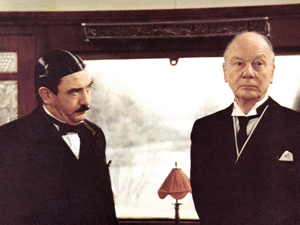
“MURDER ON THE ORIENT EXPRESS” (1974)
Following the conclusion of a successful case for the British Army somewhere in the Middle East, Belgian-born detective is on his way home to London, via a train journey aboard the famed Orient Express. When an American businessman named Samuel Rachett is murdered during the second night aboard the train, Poirot is asked by his friend and director of the Compagnie Internationale des Wagons-Lits, Senor Bianchi, to investigate the crime.
In this adaptation directed by Sidney Lumet, the Simplon Orient Express that left Istanbul at 9:00 at night. The movie also included a dining car attached to the train. One scene featured a chef examining food being loaded onto the train. This scene is erroneous. According to the The Man in Seat 61 website, there was no dining car attached to the train when it left Istanbul. A dining car was usually attached at Kapikule on the Turkish/Bulgarian border, before it was time to serve breakfast. The movie also featured a salon car or a “Pullman”, where Hercule Poirot interrogated most of the passengers of the Istanbul-Calais car.
Following the conclusion of a successful case for the British Army somewhere in the Middle East, Belgian-born detective is on his way home to London, via a train journey aboard the famed Orient Express. When an American businessman named Samuel Rachett is murdered during the second night aboard the train, Poirot is asked by his friend and director of the Compagnie Internationale des Wagons-Lits, Senor Bianchi, to investigate the crime.
In this adaptation directed by Sidney Lumet, the Simplon Orient Express that left Istanbul at 9:00 at night. The movie also included a dining car attached to the train. One scene featured a chef examining food being loaded onto the train. This scene is erroneous. According to the The Man in Seat 61 website, there was no dining car attached to the train when it left Istanbul. A dining car was usually attached at Kapikule on the Turkish/Bulgarian border, before it was time to serve breakfast. The movie also featured a salon car or a “Pullman”, where Hercule Poirot interrogated most of the passengers of the Istanbul-Calais car.


According to the “Seat 61” site, there was no salon “Pullman” car attached to the train east of Trieste, Italy. Christie needed the presence of the car for dramatic purposes and added one into her novel. The producers of the 1974 movie did the same. At least the producers of the 1974 used the right dark blue and cream-colored car for the Pullman. More importantly, they used the right dark blue cars for the train’s sleeping coaches, as shown in the image below:

In the movie, the Simplon Orient Express reached Belgrade 24 hours after its departure from Istanbul. For once, the movie was accurate. Somewhere between Vinkovci and Brod, the Orient Express ended up snowbound and remained there until the end of the story.

“MURDER ON THE ORIENT EXPRESS” (2010)
This adaptation of Agatha Christie’s novel first aired on Britain’s ITV network in 2010. The television movie started with Hercule Poirot berating a British Army officer caught in a devastating lie. After the officer commits suicide, Poirot ends up in Istanbul, where he and a British couple witness the stoning of an adulterous Turkish woman. Eventually, the couple and Poirot board the Orient Express, where the latter finds himself investigating the murder of an American passenger.
I do not know what time the Simplon Orient Express departed Istanbul in this adaptation. The movie never indicated a particular time. This version also featured a brief scene with a chef examining food being loaded aboard a dining car. As I previously mentioned, a dining car was not attached until Kapikule. The movie did feature Poirot and some of the Istanbul-Calais car passengers eating breakfast the following morning. In this scene, I noticed a major blooper. Car attendant Pierre Michel was shown serving a dish to Poirot in the dining car. Note the images below:
This adaptation of Agatha Christie’s novel first aired on Britain’s ITV network in 2010. The television movie started with Hercule Poirot berating a British Army officer caught in a devastating lie. After the officer commits suicide, Poirot ends up in Istanbul, where he and a British couple witness the stoning of an adulterous Turkish woman. Eventually, the couple and Poirot board the Orient Express, where the latter finds himself investigating the murder of an American passenger.
I do not know what time the Simplon Orient Express departed Istanbul in this adaptation. The movie never indicated a particular time. This version also featured a brief scene with a chef examining food being loaded aboard a dining car. As I previously mentioned, a dining car was not attached until Kapikule. The movie did feature Poirot and some of the Istanbul-Calais car passengers eating breakfast the following morning. In this scene, I noticed a major blooper. Car attendant Pierre Michel was shown serving a dish to Poirot in the dining car. Note the images below:

Pierre Michel greets Poirot and M. Bouc before they board the train

Pierre serves breakfast to Poirot
Why on earth would a car attendant (or train conductor, as he was in the 1934 novel) act as a waiter in the dining car? Like the 1974 movie, the ITV adaptation also featured a salon “Pullman” attached to the train, east of Italy. In fact, they did more than use one salon “Pullman”. As I had stated earlier, the westbound Simplon Orient Express usually acquired a salon “Pullman” after its arrival in Trieste. But in this adaptation, the producers decided to use the dark blue and cream-colored “Pullman” cars for the entire train as shown in these images:


This is completely in error. As I had stated earlier, the Orient Express usually featured a dark-blue and cream-colored salon “Pullman” between Italy and Paris. But it also featured the dark-blue and cream-colored seating “Pullmans” between Calais and Paris. There is no way that the Orient Express leaving Istanbul would entirely consist of the blue and cream “Pullman” cars.
However, the train did arrive at Belgarde at least 24 hours after its departure from Istanbul. Like the other movie, the train ended up snowbound between Vinkovci and Brod and remained there until the last scene. However, I am confused by the presence of the police standing outside of the train in the last scene. Poirot and the other passengers should have encountered the police, following the train’s arrival in Brod, not somewhere in the middle of the Yugoslavian countryside.
However, the train did arrive at Belgarde at least 24 hours after its departure from Istanbul. Like the other movie, the train ended up snowbound between Vinkovci and Brod and remained there until the last scene. However, I am confused by the presence of the police standing outside of the train in the last scene. Poirot and the other passengers should have encountered the police, following the train’s arrival in Brod, not somewhere in the middle of the Yugoslavian countryside.
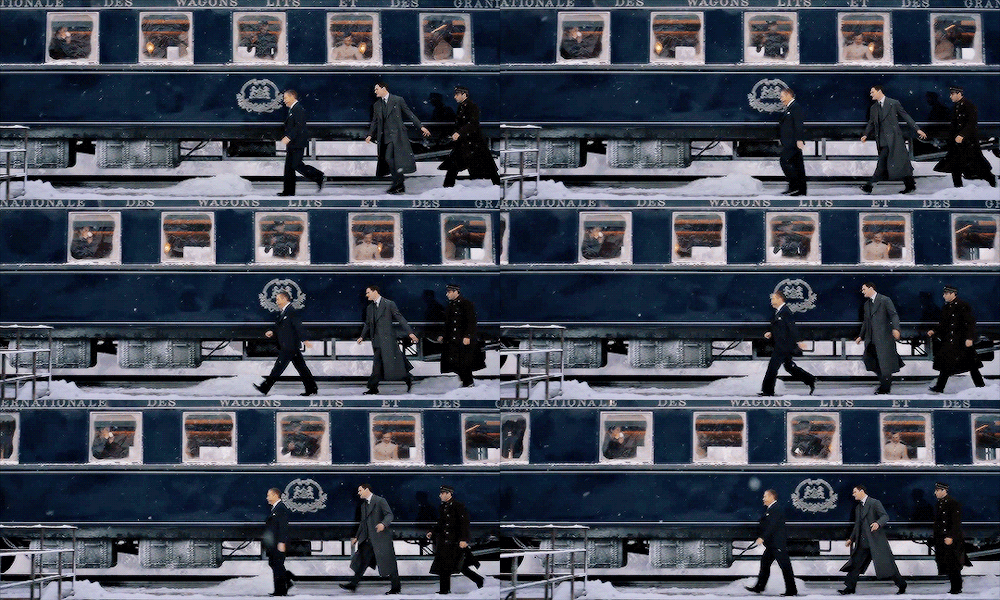
“MURDER ON THE ORIENT EXPRESS” (2017)
In this adaptation of Christie’s 1934 novel, in which Kenneth Branaugh directed and starred, Poirot solves a theft at the Church of the Holy Sepulchre in Jerusalem. The detective hopes to rest in Istanbul after traveling there via the Mediterranean and Agean Seas, but a telegram summons him to London for a case and he boards the Orient Simplon Orient Express with the help of young Monsieur Bouc, a director of the Compagnie Internationale des Wagons-Lits. When an American passenger named Samuel Rachett is found stabbed to death following his second night aboard the Orient Express, Poirot is asked to solve his murder.
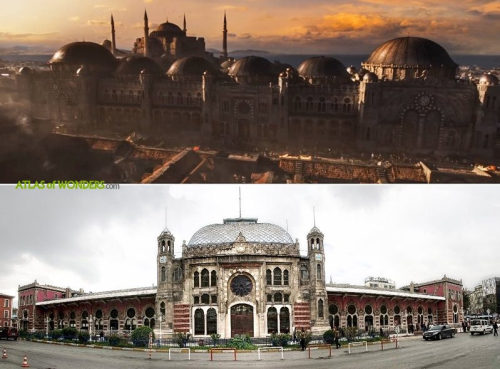
This movie featured the departure of the Simplon Orient Express around 7:00 p.m., instead of eleven o'clock. However, this is probably the only adaptation of Christie’s novel that featured the strongest similarity to the real Sirkeci Terminal in Istanbul, the train’s eastern terminus.
However, I also noticed that passengers boarded via the dining car, at the tail end of the train. That is correct. This adaptation also has a dining car attached to the Orient Express in Istanbul, instead of having it attached at Kapikule, the Turkish-Bulgarian border crossing. And unlike the previous adaptations, the dining car and the lounge car are dark blue like the sleeping compartments, instead of a color mixture of dark-blue and cream-colored. Which was an error.
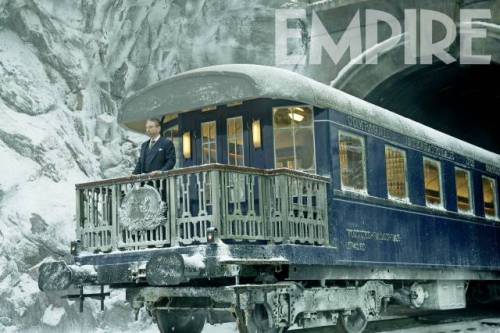
The movie did not feature a stop in Belgrade, Yugoslavia. It did, however, featured a brief stop at Vinkovci, before it encountered a snow drift, later in the night. Since it was definitely at night when the train stopped at Vinkovci, no error had been committed. Especially since it was not quite dark when the train departed from Istanbul. And the journey between Istanbul and Belgrade lasted roughly 24 hours. At the end of the film, Poirot departed from the Orient Express at Brod. This is also appropriate, since the train had been snowbound somewhere between Vinkovci and Brod in the novel. More importantly, unlike the 2010 adaptation, Poirot gave his false resolution to Rachett’s murder to the police … in Brod and not in the spot where the train had been trapped.
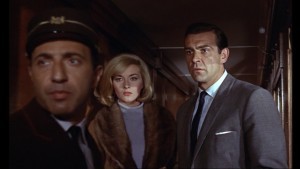
“FROM RUSSIA WITH LOVE” (1963)
Ian Fleming’s tale begins with the terrorist organization, SPECTRE, plotting the theft of the KGB’s a cryptographic device from the Soviets called the Lektor, in order to sell it back to them, while exacting revenge on British agent James Bond for killing their agent, Dr. No. After Bond successfully steals the Lektor from the Soviet consulate in Istanbul, he, defector Tatiana Romanova and MI-6 agent Kerim Bey board the Orient Express for a journey to France and later, Great Britain.
While I found this adaptation of Ian Fleming’s 1957 novel extremely enjoyable, I found myself puzzled by the movie’s portrayal of Bond’s journey aboard the Orient Express. It seemed so . . . off. In the movie; the Orient Express conveying Bond, his traveling companions and SPECTRE assassin “Red” Grant; departed Istanbul somewhere between 3:00 and 4:00 o'clock in the afternoon. The train departed Istanbul around nine o'clock at night, in Fleming’s novel. Mind you, the novel was set in the 1950s and the movie, set in the early 1960s, which meant that its departure in the movie was pretty close to the 4:15 pm departure of the Direct Orient Express train that operated between 1962 and 1977. I do not recall seeing a dining car attached to the train, during its departure in the movie, so I cannot comment on that. But after the train’s departure, the movie’s portrayal of Bond’s Orient Express journey proved to be mind boggling.
The main problem with “FROM RUSSIA WITH LOVE” is that Bond’s journey proved to be the fastest I have ever witnessed, either on film or in a novel. It took the train at least three-to-four hours to reach Belgrade, following its departure from Istanbul. One, it usually took the Orient Express nearly 24 hours to reach Belgrade during its heyday. During the first ten-to-fifteen years of the Cold War, it took the Orient Express a little longer to reach Belgrade, due to it being re-routed through Northern Greece in an effort to avoid countries under Soviet rule. This was made clear in Fleming’s novel. But the 1963 movie followed the famous train’s original eastbound route . . . but at a faster speed. After killing Grant, Bond and Tatiana left the train before it reached the Yugoslavian-Italian border. Bond’s journey from Istanbul to that point took at least 15 hours. During the Orient Express’ heyday, it took at less than 48 hours. And during the 15 years of the Direct Orient Express, it took longer.
Ian Fleming’s tale begins with the terrorist organization, SPECTRE, plotting the theft of the KGB’s a cryptographic device from the Soviets called the Lektor, in order to sell it back to them, while exacting revenge on British agent James Bond for killing their agent, Dr. No. After Bond successfully steals the Lektor from the Soviet consulate in Istanbul, he, defector Tatiana Romanova and MI-6 agent Kerim Bey board the Orient Express for a journey to France and later, Great Britain.
While I found this adaptation of Ian Fleming’s 1957 novel extremely enjoyable, I found myself puzzled by the movie’s portrayal of Bond’s journey aboard the Orient Express. It seemed so . . . off. In the movie; the Orient Express conveying Bond, his traveling companions and SPECTRE assassin “Red” Grant; departed Istanbul somewhere between 3:00 and 4:00 o'clock in the afternoon. The train departed Istanbul around nine o'clock at night, in Fleming’s novel. Mind you, the novel was set in the 1950s and the movie, set in the early 1960s, which meant that its departure in the movie was pretty close to the 4:15 pm departure of the Direct Orient Express train that operated between 1962 and 1977. I do not recall seeing a dining car attached to the train, during its departure in the movie, so I cannot comment on that. But after the train’s departure, the movie’s portrayal of Bond’s Orient Express journey proved to be mind boggling.
The main problem with “FROM RUSSIA WITH LOVE” is that Bond’s journey proved to be the fastest I have ever witnessed, either on film or in a novel. It took the train at least three-to-four hours to reach Belgrade, following its departure from Istanbul. One, it usually took the Orient Express nearly 24 hours to reach Belgrade during its heyday. During the first ten-to-fifteen years of the Cold War, it took the Orient Express a little longer to reach Belgrade, due to it being re-routed through Northern Greece in an effort to avoid countries under Soviet rule. This was made clear in Fleming’s novel. But the 1963 movie followed the famous train’s original eastbound route . . . but at a faster speed. After killing Grant, Bond and Tatiana left the train before it reached the Yugoslavian-Italian border. Bond’s journey from Istanbul to that point took at least 15 hours. During the Orient Express’ heyday, it took at less than 48 hours. And during the 15 years of the Direct Orient Express, it took longer.
Unlike many recent film goers and television viewers, historical accuracy or lack of it in a movie/television production has never bothered me. I am a major fan of “MURDER ON THE ORIENT EXPRESS” (both the 1974 and 2017 versions) and “FROM RUSSIA WITH LOVE”. And although I have other problems with the 2010 “MURDER ON THE ORIENT EXPRESS” movie, there are still aspects of it that I continue to find very enjoyable. Historical inaccuracy has never impeded my enjoyment of a film, unless I found it particularly offensive. But since I can be occasionally anal and was bored, I could not resist a brief exploration of the Hollywood and British film industries’ portrayals of the Orient Express.
Friday, October 7, 2016
"TINKER, TAILOR, SOLDIER, SPY" (1979) Review

"TINKER, TAILOR, SOLDIER, SPY" (1979) Review
I would have never thought about watching the BBC's television adaptation of John le Carré's 1974 novel if I had not seen the 2011 version. Never. For some reason, I have never been that inclined to read his novels or watch any movie or television adaptations of his work. But after seeing Tomas Alfredson's movie, I had to see this version that starred Alec Guinness.
Unlike the 2011 movie, this "TINKER, TAILOR, SOLDIER, SPY" was set around the time the miniseries aired, since the Cold War was still in full swing. You know the story. The head of SIS (MI-6 in real life), Control, sends agent Jim Prideaux to Czechoslovakia to meet a Czech general who claims to have information identifying a deep-cover Soviet spy planted in the highest echelons of "Circus" (the nickname for the SIS headquarters). "Operation Testify" proves to be a trap when Prideaux is shot and captured by the Soviets. Due to the mission's failure, both Control and his right-hand man, George Smiley, are forced to retire.
But when Ricky Tarr, a British agent gone missing in Portugal, turns up in England with new evidence backing up Control's mole theory, Smiley is recalled to find the mole. He learns from Oliver Lacon, who oversees the country's intelligence services, that Control had four suspects occupying high positions in SIS - Percy Alleline (who assumed the position as the Circus' new head), Toby Esterhase, Bill Haydon and Roy Bland. Smiley, with the help of Peter Twiliam (who happens to be Tarr's immediate supervisor), instigates a secret investigation of Operation Testify to learn the name of the mole, nicknamed "Gerald".
To compare a seven-part television miniseries with a motion picture with a running time just barely over two hours seems just a bit too ridiculous to me. Instead, I will merely talk about the former. And what can I say about "TINKER, TAILOR, SOLDIER, SPY"? It was a first-rate production that deserved all of the accolades it had received three-three to thirty-four years ago. Instead of the usual action-dominated spy stories that have spilled out of Hollywood and the British film industries since the first James Bond movies, "TINKER, TAILOR, SOLDIER, SPY" felt like an well-paced Cold War mystery that featured a good deal of excellent acting, dramatic moments and perhaps the occasional action scene or two on the side.
Too many flashbacks can be deadly to a story or a production. But when said production is basically a mystery, flashbacks can be effectively used. Director John Irvin and screenwriter Arthur Hopcraft certainly used the miniseries' flashbacks with great dramatic effect - aside from one particular flashback. The most effective flashback - at least for me - proved to be the back story regarding of Ricky Tarr's affair with Irina, the wife of a Moscow Center intelligence official, in Portugal. This affair leads to Tarr's discovery of new evidence supporting Control's theory of a high-ranking Soviet mole in the Circus. Another flashback that I found interesting proved to be Sam Collins' recollection of the night when news of Jim Prideaux's capture reached the Circus.
The single flashback that failed to resonate with me proved to be Smiley's recollection of his brief meeting with his nemesis, KGB operative-turned-official Karla, during the 1950s. Although the scene featured an excellent performance from Alec Guinness as Smiley and a strong screen presence in the form of a smoldering Patrick Stewart as Karla, the brief scene nearly put me to sleep. I would have been satisfied with a verbal recollection from Smiley. And there were two sequences that I found either unnecessary or disappointing. I found the sequence featuring Prideaux's trip to Czechoslovakia. I realize that both Irvin and Hopcraft's script tried to convey this entire sequence as intriguing action scene. It did not work for me. Considering that most of the sequence was shot at night, I found it rather dull. And it came as a relief when the miniseries moved on to Smiley's recruitment into Operation Testify. Smiley's capture of "Gerald" in the last episode struck me as unsatisfying and anti-climatic. And while watching the miniseries, I realized that one needs a great deal of patience to watch it. I had no problem with its length, but I did find Irvin's pacing rather slow at times.
The performances featured in "TINKER, TAILOR, SOLIDER, SPY" struck me as outstanding. I have already commented on Patrick Stewart's brief, yet strong silent presence as Karla in one scene. Siân Phillips' portrayal of Smiley's unfaithful wife, Ann, proved to be equally brief. Although the character was discussed in numerous scenes, Phillips did not appear long enough for me to be impressed by her performance. Terence Rigby's portrayal of one of the "Gerald" suspects - Roy Bland - seemed like a waste of time to me. Although Rigby gave a first-rate performance in one scene in which his character is interviewed by Smiley, he spent most of the production as a background character. I found this rather odd, considering his role as one of the major suspects. I also enjoyed the performances of John Standing, Joss Ackland, Alexander Knox and Michael Aldridge, who proved to be effectively smug as the new head of the Circus, Percy Alleline.
Ian Richardson was the last person I could imagine portraying the charming, yet acid-tongue womanizer, Bill Haydon. Yet, he really did a fabulous job in the role and it seemed a pity that he never portrayed similar characters, later in his career. I really enjoyed Ian Bannen's performance as disgraced agent, Jim Prideaux. But I must admit there were times when I found it a bit hammy . . . especially in those scenes in his new profession as a schoolmaster. Beryl Reid struck me as perfect in the role of former Circus intelligence analyst, Connie Sachs. She not only conveyed the character's intelligence, but also the latter's joie de vivre that had sadly dampened with time and a surprising job termination. Bernard Hepton's portrayal of mole suspect, Toby Esterhase, struck me as the most unusual role I have ever seen him portray. He was marvelous and slightly eccentric as the Hungarian immigrant who rose to the top echelon of the Circus by toadying to others. Hywel Bennett did a great job in his performance as field agent, Ricki Tarr, projecting both the character's emotions and trapped situation. Michael Jayston's portrayal of Smiley's protégé, Peter Guilliam, struck me as equally emotional. In fact, I found his performance so effective that there were times I found myself wondering if the character was suited for intelligence work. The top prize for best performance definitely belonged to Alec Guinness, for his portrayal of intelligence officer, George Smiley. With delicious subtlety, he did a superb job of conveying every aspect of Smiley's personality. To my knowledge, only five actors have portrayed Smiley either in the movies or on television. I believe that Guinness' portrayal is probably one of the two best interpretations I have come across.
"TINKER, TAILOR, SOLDIER, SPY" is not perfect. I believe it has a few flaws that included an unnecessary flashback, an unnecessary action sequence and some very slow pacing. But its virtues - an excellent story, first-rate use of flashbacks and some superb characters portrayed by a cast led by the legendary Alec Guinness - outweighed the flaws considerably. In my opinion, the 1979 miniseries might be one of the best television productions from the 1970s and 80s.
Wednesday, May 4, 2016
"TINKER, TAILOR, SOLDIER, SPY" (1979) Photo Gallery


Subscribe to:
Posts (Atom)