LOVE AND WAR (1984) Book ReviewI have stumbled across my share of "Best Civil War Novels" lists on the Internet. I have yet to come across a list that includes John Jakes' 1984 novel, "LOVE AND WAR".Back in the 1980s, Jakes created his second major literary series, a trilogy about two wealthy American families during a period of thirty years during the 19th century. The first novel, "NORTH AND SOUTH" (1982) focused on the experiences of the Hazards of Pennsylvania and the Mains of South Carolina between the years 1842 and 1861. "HEAVEN AND HELL" (1987), the third novel, is set between 1865 and 1877. But the second novel, "LOVE AND WAR" focused on the two families' experiences during the Civil War.The trilogy began when George Hazard, the son of a wealthy iron industrialist; and Orry Main, the son of a South Carolina rice planter; first met on their way to West Point in the late spring of 1842. The pair quickly became life-long friends, as they survived four years at the military academy, the Mexican-American War, and nearly a decade-and-a-half of political strife over the issue of slavery. Due to George and Orry's friendship, their two families became very close over the years. By the end of "NORTH AND SOUTH", George's younger brother Billy had married Orry's younger sister, Brett. Orry and the love his life, Madeline Fabray LaMotte, finally reconciled after years of clandestine meetings, when Madeline left her venal husband Justin Lamotte, after seventeen years of marriage.However, following the outbreak of the Civil War, the friendship and familial connection between the Hazards and the Mains became tested when the Civil War begins. "LOVE AND WAR" began two weeks after "NORTH AND SOUTH" ended - in late April 1861. By the beginning of "LOVE AND WAR", the two families consist of:The Hazards*George Hazard - one of the protagonists, who is a former Army officer and like his father, an iron industrialist*Constance Flynn Hazard - George's Irish-born wife and an abolitionist*Stanley Hazard - George's older brother, who left the iron trade to become a politician*Isobel Truscott Hazard - Stanley's shrewish and social-climbing wife*Virgilia Hazard - George's only sister and die-hard abolitionist*Billy Hazard - George's younger brother and Army officer*Brett Main Hazard - Orry's youngest sister and Bily's new brideThe Mains*Orry Main - one of the protagonists, who is a former Army officer and like his father, a rice planter*Madeline Fabray LaMotte Main - Orry's wife and widow of Justin LaMotte*Cooper Main - Orry's older brother and owner of a shipping company*Ashton Main Huntoon - Orry's younger sister and die-hard secessionist*Charles Main - Orry's young cousin, who had resigned from the U.S. Army to join the Confederacy Army*Judith Stafford Main - Cooper's wife, who also happens to be an abolitionist*James Huntoon - Ashton's husband, who is also a secessionist and attorney*Clarissa Brett Main - Orry's ailing motherThe novel not only featured the viewpoints of the Hazards and Mains, but also their friends, lovers, slaves and one Elkhannah Bent, an Ohio-born Army officer who had become an enemy of George and Orry during their years at West Point. Bent even became an enemy of Charles Main, when the two had served together on the Texas frontier in the late 1850s. the outbreak and chaos of war, along with Bent's determination to survive, failed to put a damper on his desire to strike back at George, Orry, Charles and the other members of the two families.I noticed that most of "LOVE AND WAR" focused on the Civil War's Eastern Theater. Aside from taking readers to the political offices, salons and the military hospitals of Washington D.C. and Union Army camps; the novel also explored the Union and Confederate home fronts in Lehigh Station, Pennsylvania - the Hazards' hometown; and the Mains' plantation, Mont Royal, in the South Carolina low country. Jakesk also explored various historical and violent incidents on the homefront through his characters - especially the Southern bread riot that broke out in 1862 Richmond, and the 1863 New York City draft riots. Although both George and Orry become military officers again after thirteen-to-fourteen years as civilians, their wartime experiences as military bureaucrats prove to be sources of great frustration for both of them. Stanley Hazard's role as a political aide with the War Department gave readers a look into the politics of wartime Washington D.C. Readers learn about politics in wartime Richmond via the eyes of Ashton Main Huntoon, who also happened to be a politician's wife. Through Virgilia Hazard, readers not only discover what countless number of women - including a future famous author - experienced as a wartime nurse. Cooper Main joined the Confederate's Navy Department at the beginning of the war and through him, readers learned about the Confederates' efforts to construct new warships in Great Britain's shipyards. Through characters like Charles Main and Billy Hazard, readers explored the horrors of Civil War combat and prison camps in Maryland, Pennsylvania and especially Northern Virginia. Only through the Elkhannah Bent character were readers able to experience the war's Western theater via the Battle of Shiloh and Union occupied New Orleans.If I must be honest, I am rather surprised that Jakes' trilogy, especially "LOVE AND WAR", became major bestsellers. From the recent comments and reviews I have read on the Internet, I came away with the feeling that many found "LOVE AND WAR" difficult to read. In fact, many readers have complained that the novel featured too many characters. I found this complaint rather odd, considering that novels with several major characters have been the norm during the 20th century. And when did the number of characters suddenly became a detriment to a good novel? Following my recent reading of "LOVE AND WAR", I must admit that I find this opinion hard to accept. And then there is the matter of the novel's content. I have discovered that a good number of critics seem unwilling to accept Jakes' mixture of historical drama and melodrama. And so, I found myself scratching my head at another criticism. Melodrama and history in a novel? These two elements have been the norm in many historical dramas - including the still highly rated "GONE WITH THE WIND" and the "POLDARK" series. When did the mixture of history and melodrama become unacceptable?When it comes to the mixture of history and melodrama, I believe John Jakes has proven to be one of the few novelists who did it best. In "LOVE AND WAR", I thought he did an excellent job in conveying both the personal and historic experiences of his major characters - especially during a highly charged period in American history like the Civil War. Not only did the author explore his characters' desires, loves, fears, personal tragedy and ambition; he did so while exploring the historical background of the novel's setting. I just realized that aside from a handful of history books and documentaries, I managed to learn a great deal about the United States' Antebellum period, the Civil War and the post-war era from the NORTH AND SOUTH Trilogy, due to Jakes' meticulous research and skillful writing. And about human nature.Four of the most interesting aspects of "LOVE AND WAR" proved to be the wartime experiences of Billy Hazard, Brett Main Hazard, a former slave named Jane and Charles Main. Being an Army engineer, Billy Hazard did not participate in any battles, although he did witness a good deal of danger. Billy started out the novel as an Army officer loyal to the Union cause, but lacking any sympathy toward abolition or African-Americans - unlike Virgilia, Constance or George. Despite spending the first half of the war maintaining this attitude, it took capture by Confederate forces and a harrowing period as a prisoner of war inside Libby Prison for Billy to even understand what it means to be treated cruelly, let alone be under the complete control of another. And it took his experiences with black troops during the war's last year to make him view them more than just subhuman, children or victims.Ironically, his wife, Brett Main Hazard, went through a similar metamorphosis on the home front. Being the daughter and later, the sister of a South Carolina planter, Brett had difficulty adjusting to life in the North and the resentment of the Hazards' neighbors. Throughout the novel, Brett's encounter with several people during the war forced her to question her own priviledged Southern upbring through a series of stages. First, she helped her impoverished sister-in-law, the hardcore abolitionist Virgilia Hazard, regain some kind of physical attraction. George and Constance Hazard's sponsorship of a local orphanage for Southern black children displaced by the war led Brett to develop compassion for them - something she had failed to do with her family's slaves back at Mont Royal. The orphanage also led to a surprising friendship with the orphanage's founder, a New England-born black man named Arthur Scipio Brown.Another interesting character proved to be a young African-American woman named Jane, who found herself living at Mont Royal during the war. Jane was never owned by the Mains. She was introduced as a recently emancipated slave, who was accompanying her aunt, an elderly free black woman named Aunt Belle Nin, to the Union lines. Due to Aunt Belle's illness, the pair sought brief refuge at Mont Royal, due to the elderly woman's friendship with Madeline Main. Following Aunt Belle's death, Madeline asked Jane to remain at Mont Royal and educate the plantation's slaves in preparation for the end of the war. Madeline, who was biracial, foresaw the end of slavery and wanted the slaves to be prepared for the chaos of a post-war South. Through Jane's eyes, readers saw how the institution of slavery affected her fellow African-Americans throughout generations. What made Jane's role in the novel so interesting is that readers were given a closer and more personal look at the slaves as human beings than he ever did in the trilogy's first novel, "NORTH AND SOUTH".Charles Main's wartime experiences did not bring about a social and political metamorphisis as it did his cousin and best friend, Brett and Billy Hazard. Even as a child, he never really shared his family's racism or dismiss the ugliness of slavery. On the other hand, readers were granted an exploration of life within the ranks of the Confederate Army through his eyes. Looking back, I realized that Charles' experiences pretty much served as a metaphor for the novel's title. Charles had began the story as a man who had already gained experience as a military officer during his four years at West Point and another four years as a U.S. Army officer on the Texas frontier. He spent his early months of the war not only trying (and sometimes failing) to instill a sense of professionalism to the Confederate soldiers who served under him. Charles' sense of professionalism also included a belief that soldiers had no business getting involved in a serious romance. As far as Charles was concerned, serious romance prevented a soldier from being distracted and doing his job. This belief was immediately challenged after meeting a young and witty Virginia widow named Augusta Barclay, who owned a farm in Northern Virginia. Despite his efforts to maintain an emotional distance from Augusta, Charles' feelings for her deepened. And as the war began to take an emotional toll upon him, Charles began to question the logic of continuing his romance with Augusta. If anything, Charles' professional and personal experiences during the war proved to be a prime example of Jakes' ability to skillfully weave both history and melodrama together.I do have a few complaints about "LOVE AND WAR". One, most of the novel's setting seemed to be focused solely on the war's Eastern Theater - with scenes and chapters set along the Eastern Seabord. Villain Elkhanah Bent's participation in the Battle of Shiloh and his assignment in New Orleans gaves readers a view of the war's Western theater. Also, at least three characters ended up in the New Mexico Territory by the end of the war. But a part of me wished that Jakes had allowed more scenes away from the East - as he had done in "NORTH AND SOUTH".But my complaint about setting is minor in compare to another issue - namely the novel's villains. I will give Jakes kudos for managing to portray them with the same kind of complexity as he did his protagonists. I suspect that he may have somewhat succeed with Elkhannah Bent, Ashton Huntoon and Stanley Hazard. The author went further in revealing their desires, fears and ways of dealing with their personal demons and crisis. However, both Bent and Ashton still seemed less rounded than in compare to the protagonists. James Huntoon had been portrayed as a minor villain in the 1982 novel. But once his marriage fell apart, thanks to Ashton's love affair with a smuggler and political conspirator named Lamar Powell and his career within the Confederate government stalled, Huntoon ceased to be a villain and Jakes portrayed him with a lot more sympathy.Jakes' portrayal of the Mont Royal slave named Cuffey began with some level of complexity, as the character expressed his anger over being considered the Mains' property. But not much time had passed before Jakes had reduced Cuffey to a one-note thug and bully. I look back at Forest Whitaker's portrayal of the character in the 1986 miniseries, "NORTH AND SOUTH: BOOK II" and found myself wishing that the literary version of the character had been portrayed in a similar manner. Jakes' portrayal of Isabel Truscott Hazard remained as static as ever. Although Jakes seemed willing to portray Stanley with more complexity, he kept Isabel as the one-note vindictive shrew throughout the novel - with the exception of one poignant scene in which she had discovered Stanley's affair with a tawdry actress. As for the Lamar Powell character, he struck me as a one-dimensional rogue with a cruel and controlling streak. Granted, Jakes did allow one sequence featuring Powell's point-of-view. But that could not save the character for me.I cannot say the same about George's older brother, Stanley Hazard. Jakes seemed a lot more sympathetic toward Stanley in "LOVE AND WAR" than he was in the preceeding novel. Stanley did not become a better person. His views of his brother George remained as resentful as ever, despite his own success in politics. And his support of the Radical Republicans and their pro-abolitionist views was at best, a hoax on his part in order to further his career. And yet, Jakes seemed more than willing to portray Stanley with a bit more sympathy and more complexity.On the other hand, I found it odd that Jakes was willing to be more flexible with Stanley's character, but he could not do the same for the character's only sister, Virgilia Hazard. Unlike other fans of Jakes' saga, I have never regarded Virgilia as a villain and I never will. I do not regard her as perfect. And she is guilty of killing a wounded Confederate officer who had the bad luck to share the same name as her former lover, a fugitive slave named Grady who had been killed during John Brown's raid on Harper's Ferry. But I can never regard Virgilia as a villain. One, I share her political views . . . very strongly. Two, I find her family's unwillingness to allow Virgilia to be herself rather frustrating. I suspect that their dismissal of her politics - due to their own conservatism and her gender - had a negative effect on her character. And three, I have noticed that Jakes' negative portrayal of Virgilia seemed to have spread toward those historic figures that share her politics - namely the Radical Republicans.I realize that the Radical Republicans were not perfect. But not all of them were not as bad as Jakes had portrayed them. Not once have I ever sensed the author's willingness to portray them with any kind of sympathy or understanding. He seemed willing to criticize their behavior and policies, yet he avoids criticizing moderates such as President Lincoln like the plague. In once scene, Brett Hazrard had learned from her brother-in-law Stanley about the Republican Party's plans to exploit the freed slaves' gratitude over being emancipated after the war. I can only wonder if Jakes was accusing all of the Radical Republicans (including men like Thaddeus Stevens) for this willingness to exploit former slaves or fake abolitionists like Stanley and Isabel Hazard. Were all Radical Republicans - save for Virgilia - fake abolitionists? And was he trying to convey to readers that Virgilia was blind to the machinations of the Radical Republicans? Or was Virgilia simply a victim of Jakes' overall negative attitude toward the Radical Republicans? Judging from what I have read, I can only conclude the latter.In regard to historical accuracy, I can only account for one major example in the novel. It features an assassination plot hatched by Lamar Powell, along with the Huntoons and a few others against Confederacy president Jefferson Davis. Needless to say, this never happened. However, dislike and/or hatred of Davis did exist within the Confederacy. But aside from this story arc, Jakes painted a realistic portrait of the Civil War."LOVE AND WAR" is probably one of the finest Civil War novels I have ever read. The novel really gives readers a wide range view of war through the eyes of the Hazard and Main families and those with close connections to them. More importantly, Jakes managed to provide readers with a realistic portrait of the Civil War filled with a good deal of personal drama, humor, brutality, euphoria and tragedy. It is a shame that this novel is so underrated by book readers and critics today, because I thought it was simply superb, despite the few flaws it might possess. Who knows? Perhaps one day it will be universally appreciated again.

"INDIANA JONES AND THE LAST CRUSADE" (1989) ReviewAfter a mixed reaction to the darker tones of 1984's "INDIANA JONES AND THE TEMPLE OF DOOM", George Lucas and Steven Spielberg decided to compensate by ending what was then planned their Indiana Jones trilogy with a movie lighter in tone. The result of this decision is the 1989 movie, "INDIANA JONES AND THE LAST CRUSADE".The movie began with a prologue set in 1912 with a 13 year-old Indiana Jones riding with his Boy Scout troop in Utah. He stumbles across some robbers in a cave finding an ornamental cross that once belonged to Spanish explorer Coronado. Indy manages to steal the cross from the robbers and make it back to town to report the crime. His father, Henry Jones Sr. is oblivious to what his happening, due to his obsessive research on the Holy Grail. And Indy is forced to give up the cross to a mysterious man for whom the robbers worked for. Twenty-six years later, Indy finally gets his hands on the cross from the mysterious man, off the coast of Portugal."INDIANA JONES AND THE LAST CRUSADE" proved to be the only film in the franchise in which its prologue had little to do with the movie's main narrative, aside from a brief peek into Henry Sr.'s obsession with the Holy Grail. Still in 1938, Indiana is contacted by an American businessman named Walter Donovan, who also happens to be a collector of antiquities. He informs Indy that Henry Sr. had vanished in Venice, Italy while searching for the Holy Grail on his behalf. Indy also receives a package in the mail that contains his father's "Grail Diary" - a notebook featuring the latter's research on the artifact. Realizing that Henry Sr. is in trouble, Indy and his mentor, Marcus Brody, travel to Venice and with the assistance of Dr. Elsa Schneider, Henry's Austrian-born assistance, search for the missing archaeologist. During their adventures, the trio discover that Henry's disappearance is either tied to a Christian secret society called the Brotherhood of the Cruciform Sword or the Nazis.From the time I first saw "INDIANA JONES AND THE LAST CRUSADE", I enjoyed it very much. Actually, I can say the same for just about every INDIANA JONES movie I have seen, save one. It really is a fun movie and I suspect this is a result of Lucas and Spielberg's decision to make its tone lighter than either "TEMPLE OF DOOM" and 1981's "RAIDERS OF THE LOST ARK". Just like in the previous movies, "THE LAST CRUSADE" saw Indiana Jones on a globe-trekking adventure to acquire a famous artifact on behalf of someone. In this case, he seemed to be working on behalf of both Walter Donovan and especially his father, Henry Jones Sr. But there was one aspect of this movie that made this movie particularly enjoyable was the casting. Lucas and Spielberg, along with screenwriters Jeffrey Boam and Tom Stoppard (uncredited), decided to make this movie a family affair by including Indy's dad into the story. They also broadened the role of Indy's mentor (and Henry Sr.'s college chum), Marcus Brody, who was featured in probably the movie's funniest scene. And this is the only INDIANA JONES film and the second one for Lucas that featured a villainous leading lady. In fact, I suspect that Lucas was inspired by the Princess Sorsha character in 1988's "WILLOW", who started out as a villain and ended up as a sympathetic character. With Dr. Elsa Schneider, Lucas and Spielberg had a leading lady who started out as a heroine, slipped into villainess mode and ended up as a very ambiguous anti-heroine. I am not claiming that Elsa was the best of the movie franchise's leading ladies, but she was certainly interesting.The movie also featured some first-rate action sequences. My favorite included Indiana and Elsa's conflict with the Brotherhood of the Cruciform Sword in Venice, Indy and Henry Sr.'s hasty departure from a Zeppelin that was returning to Germany and especially their escape from the German Army controlled Brunwald Castle on the Austrian-German border. The extended action sequence featuring Indiana's clash with Colonel Ernst Vogel aboard a tank in the fictional Hatay desert ended with one of the movie's best scenes - namely the tank falling over a cliff along with Indy and Vogel. This particular sequence must have been so successful that I suspect producer-director Peter Jackson more or less used it in one important scene in 2003's "LORD OF THE RINGS: RETURN OF THE KING". But the movie was not sustained by interesting characterizations and action sequences alone. The main narrative for "INDIANA JONES AND THE LAST CRUSADE" - the search for the Holy Grail and belief in its existence and power - not only set in motion a series of adventures for the main characters, but also served as a backdrop for Indiana's complicated relationships with both Elsa Schneider and especially, Henry Sr. In fact, one of my favorite scenes in the entire movie featured a brief conversation between Indy and Henry Sr. aboard the Zeppelin in which the former pointed out that the latter's obsession with the Holy Grail and inability to communicate led to a twenty-two year estrangement between father and son.But as much as I enjoyed "INDIANA JONES AND THE LAST CRUSADE", it is probably my least favorite in the franchise. Aside from the leading lady's characterization, the movie strikes me as the least original of the four movies. The other three movies offered something truly original to the franhcise - especially in regard to narratives. I cannot say the same about "THE LAST CRUSADE". Despite its unusual addition of the Elsa Schneider and Henry Jones Sr. characters, it was more or less a rehash of "RAIDERS OF THE LOST ARK", which included a search for a Judeo-Christian artifact, Nazis, a Middle Eastern setting, the return of both Marcus Brody and Sallah Mohammed Faisel el-Kahir (Sallah), and a non-German collaborator of the Nazis who seemed more interested in the artifact than ideology.Also, I was not that impressed by the 1912 Utah prologue for the movie. I did not find it particularly interesting, even though I am thankful that it served as a forerunner to "THE YOUNG INDIANA JONES CHRONICLES" television series from the early 1990s. And as much as I enjoyed the relationship between Indy and Elsa, there was one scene between them that I found unappealing. It concerned Indy's efforts to retrieve his father's "Grail Diary" from the Austrian art historian in Berlin. The retrieval led to an angst-filled quarrel that struck me as rather false. I got the impression that Lucas and Spielberg were trying to capitalize on the emotional relationship between the James Bond and Kara Milovy characters in the 1987 Bond movie "THE LIVING DAYLIGHTS". The problems were that I never got the feeling that Indy and Elsa were that emotionally involved for such angsty fight, and Harrison Ford and Alison Doody never really sold it for me . . . at least in that particular scene. Like the other three movies in the franchise, "THE LAST CRUSADE" suffered from some heavy-handed action sequences. This was especially apparent in the Hatay desert sequence featuring the Nazi tank. And could someone please explain how that Zeppelin traveled from Berlin to Southeastern Europe so fast? It was in the latter region where Indy and Henry Sr. encountered the German fighter planes sent to kill them. Also, "THE LAST CRUSADE" suffered from a fault that also marred both "RAIDERS OF THE LOST ARK" and 2008's "INDIANA JONES AND THE KINGDOM OF THE CRYSTAL SKULLS". In the film's final confrontation scenes, Indy played no role in the main villain's downfall. Like in the 1981 and 2008 films, he mainly stood around with this thumb up his ass while someone else . . . or a supernatural entity dealt with the main villain. And like in the other two movies, I found this anti-climatic and rather disappointing.But I was certainly not disappointed with the cast. They proved to be first-rate . . . not surprisingly. Harrison Ford returned as the intrepid archaeologist Indiana Jones and was superb and more relaxed in the role. Okay, I did criticize his acting in that Berlin scene with Alison Doody, but it was only one blot in an otherwise excellent performance. Dr. Henry Jones Sr. has to be my favorite Sean Connery role of all time. I adored him as Indy's priggish and high-minded father who finds working in the field a new experience. And he also got to speak one of my favorite lines in the entire film, while repelling a German fighter plane in Eastern Europe. In fact, it is my favorite Connery quote of all time. Alison Doody was at least 21 or 22 years old when "THE LAST CRUSADE" went into production. She only had at least 2 to 3 years of acting experience. And yet, I was more than impressed by her portrayal of the amoral Austrian art historian Dr. Elsa Schneider. Doody had once complained that dealing with the Austrian accent was difficult for her. I would think dealing with Elsa's complex nature would be more difficult. And I believe that despite her limited experience at the time, she did a pretty damn good job in portraying the very ambiguous Elsa - aside from that Berlin scene with Ford.Julian Glover gave a smooth performance as Walter Donovan, the American businessman for whom the Jones family sought out the Holy Grail. His Donovan also proved to be just as complex, thanks to his skillful performance. Both John Rhys-Davies and Denholm Elliot reprised their roles as Sallah and Dr. Marcus Brody. And both were not only entertaining, but also gave first-rate performances. I especially enjoyed Elliot's display of humor in a scene featuring Marcus' arrival in Turkey. Michael Byrne's portrayal of S.S. Colonel Ernst Vogel struck me as both subtle and intimidating. Back in 1980, Kevork Malikyan first tried out for the role of Sallah for "RAIDERS OF THE LOST ARK", but the role went to Rhys-Davies. But Spielberg remembered him and hired the actor to portray Kazim, a member of the Brotherhood of the Cruciform Sword, whom Indy and Elsa encountered in Venice. Malikyan's skllful portrayal of Kazim proved to be a complex mixture of intensity, religious fevor and a deep-seated calm. And River Phoenix did a marvelous job in portraying the 13 year-old Indiana. He proved to be quite adept in capturing Ford's mannerisms and speech pattern, while maintaining the persona of a boy in his early teens.As I had stated earlier, I found "INDIANA JONES AND THE LAST CRUSADE" to be the least original of the four movies in the franchise. Because of this, it is also my least favorite. But despite being my least favorite "INDIANA JONES" film, it is still very entertaining and I never get tired of watching it, thanks to a solid story penned by Jeffrey Boam and Tom Stoppard, first-rate direction by Steven Spielberg and an outstanding cast led by Harrison Ford and Sean Connery.
 R.I.P. Sir Sean Connery (1930-2020)

Below is an article I had written about a famous comfort food dish known as Macaroni and Cheese:MACARONI AND CHEESEMacaroni and Cheese is a famous dish known throughout Europe and other Western countries, especially the United States. My own memories of the dish date back to my childhood when my parents and grandmother used to serve it to me and my siblings . . . especially from the pre-packaged box form created by the company, Kraft. But I have eaten traditional homemade Macaroni and Cheese every now and then.Although known today as an American comfort dish, Macaroni and Cheese was a dish made from Parmesan cheese and past that originated in Italy. Pasta and cheese casseroles have been recorded in cookbooks as early as the 14th century's "Liber de Coquina", one of the oldest medieval cookbooks. The dish also made its first appearance in England during the same century, in the famous English medieval cookbook titled "Forme of Cury".The first modern recipe for Macaroni and Cheese appeared in Elizabeth Raffald's 1769 book "The Experienced English Housekeeper". Her recipe called for a Béchamel sauce with Cheddar cheese, which is mixed with macaroni pasta, sprinkled with Parmesan cheese and baked. The dish also appeared in the famous Victorian cookbook, "Mrs. Beeton's Book of Household Management" and included two recipes for the dish.Many would be surprised to learn that the future third President of the United States, Thomas Jefferson may have been responsible for the introduction of Macaroni and Cheese to Americans. He first sampled the dish in both in Paris and in northern Italy, and later incorporated the dish at his Virginia home, Monticello. As the country's third president, Jefferson served Macaroni and Cheese at a State dinner in 1802. Mary Randolph, sister to Jefferon's son-in-law Thomas Mann Randolph Jr., included a recipe for the dish in her 1824 cookbook, "The Virginia Housewife".Below is a recipe for "Macaroni and Cheese" from the MyRecipe website:Macaroni and CheeseIngredients2 cups milk2 tablespoons butter2 tablespoons all-purpose flour1/2 teaspoon salt1/4 teaspoon freshly ground black pepper1 (10-oz.) block extra sharp Cheddar cheese, shredded1/4 teaspoon ground red pepper (optional)1/2 (16-oz.) package elbow macaroni, cookedPreparation1. Whisk flour into butterPreheat oven to 400°. Microwave milk at HIGH for 1 1/2 minutes. Melt butter in a large skillet or Dutch oven over medium-low heat; whisk in flour until smooth. Cook, whisking constantly, 1 minute.2. Whisk in warm milkGradually whisk in warm milk, and cook, whisking constantly, 5 minutes or until thickened.3. Whisk in cheeseWhisk in salt, black pepper, 1 cup shredded cheese, and, if desired, red pepper until smooth; stir in pasta. Spoon pasta mixture into a lightly greased 2-qt. baking dish; top with remaining cheese. Bake at 400° for 20 minutes or until golden and bubbly.

"JOHN WICK: CHAPTER 3 - PARABELLUM" (2019) Review
I have seen all three films in the "JOHN WICK" franchise so far. All three of them. However, "JOHN WICK: CHAPTER 3 - PARABELLUM" is the first film I saw in the movie theaters. And it is the first I have reviewed for my blog.
"JOHN WICK: CHAPTER 3 - PARABELLUM" picked up a few minutes later after the franchise's last film, "JOHN WICK: CHAPTER 2" left off. In the latter, former assassin John Wick had been approached by Italian crime lord Santino D'Antonio to assassinate his sister Gianna, so he can claim her seat at the "High Table", a council of 12 high-level crime lords. Although reluctant to complete the task, John is forced to accept D'Antonio's request since the latter had helped him with a task that allowed him to retire as an assassin and marry his late wife. However, Gianna committed suicide before John could kill her and D'Antonio put a contract on the former under the guise of "avenging his sister's death". Determined to get revenge for this betrayal, John pursued D'Antonio to the Continental Hotel, a refuge for the underworld's assassins where no "business" is allowed, and kills the Italian gangster. Because he had broken the hotel's "no killing" rule, John is declared "excommunicado" by his handlers at the High Table and placed under a $14 million bounty.
In this third film, John struggles to evade nearly every assassin, while he tries to retrieve a crucifix necklace and a "marker" medallion from a secret cache in a book at the New York City Public Library. He needs both items to present to the Director, a woman from his past, and use as a "ticket" for safe passage to Casablanca, Morocco. With the help of an old friend and fellow assassin named Sofia, John hopes to fend off other assassins long enough to reach the Elder of the "High Table" and find a way to call off the bounty. However, John eventually learns that he will have to pay a few steep prices to achieve his goal.
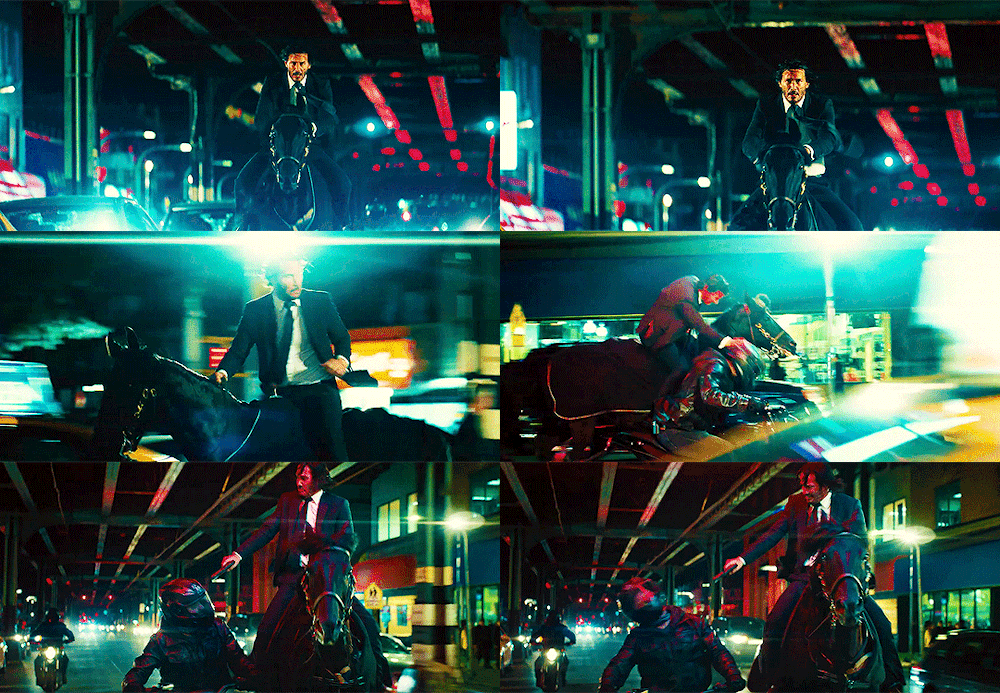
I wish I could say that I loved "JOHN WICK: CHAPTER 3 - PARABELLUM". Hell, I wish I could say that I loved all of the John Wick movies. But I did not. I merely liked them. What kept me from loving these three films? The level of action featured in them. "JOHN WICK 3" opened with the main protagonist leaving the Continental Hotel and making his way to the main New York Public Library in order to retrieve two objects that would help him leave the country. I do not know how long this sequence lasted, but it almost seemed like forever. Wick seemed to encounter one assassin after the other, city block after city block. Even when he reached the library, he had to fight off another assassin. Then he was forced to defend himself against more assassins as he struggled to reach the Director, a Russian-born who had raised him. There was such an overwhelming slew of action in this film that I was to appreciate the more dramatic moments with great relief. When I had asked one of my relatives on how she felt about the movie, her response was . . . "action porn". She liked the movie, but like me, found the amount of action in it rather overwhelming.
I honestly cannot think of anything else that turned me off about "JOHN WICK: CHAPTER 3 - PARABELLUM". Ironically, as much as I found the onslaught of action a bit off putting, there were a handful of scenes that I genuinely enjoyed, thanks to Chad Stahelski's direction. There were three sequences that stood out for me. One involved Wick's unexpected encounter with a rather large assassin inside the New York Library. His final fight against a New York City assassin named Zero and the latter's men at the New York Continental Hotel almost struck me as surreal. But if I had to select my favorite action sequence, it has to be his battle against a group of assassins in Casablanca, with the aide of his old friend, Sofia. Watching Keanu Reeves and Halle Barry fight side by side against a slew of killers proved to be more than satisfying for me. And exciting.
I also suspect that this deluge of action had allowed the film's five screenwriters to create a more streamlined narrative. Five screenwriters? This movie required five screenwriters? Anyway, one of the aspects of the John Wick films that I found refreshing is that the narratives for the three films were not repetitive. "JOHN WICK 3" marked the first time that the hero is forced to face the consequences of his actions. There is a reason why once or twice, a self-reflective Wick had to admit that he had brought his current crisis upon himself. More importantly, he also realized that his decision to become a professional assassin and criminal in the first place had brought him to this point in his life. In age in which the questionable decisions and actions of many protagonists in movies and television are either swept under the table or whitewashed, John Wick's self-reflection struck me as a breath of fresh air.
"JOHN WICK: CHAPTER 3 - PARABELLUM" featured some solid performances from its supporting cast. The likes of Lance Reddick, Anjelica Huston, Jerome Flynn, Randall Duk Kim and Yayan Ruhian did not exactly blow my mind, but I found their performances impressive. Saïd Taghmaoui gave a brief, yet impressive performance as the Elder, leader of the High Table; whom John Wick struggles to reach to overturn the contract against him. Asia Kate Dillon was memorable as the Adjudicator, a member of the High Table who castigated both Winston and the Bowery King for helping Wick in the previous film. However, I thought her character seemed like a remake of the character she portrays on Showtime's "BILLIONS". Ian McShane was elegant and charismatic as ever as Winston, the manager of the Continental Hotel, who found himself in trouble for giving Wick a head start on the contract in the second film. Laurence Fishburne was equally charismatic as the New York crime lord known as the Bowery King. But unlike McShane, I also found his performance rather theatrical in an entertaining way. Halle Berry radiated charismatic, style and gravitas as an old friend of Wick named Sofia, who helps him reach the Elder. I really enjoyed both her dramatic and action scenes with the leading man. Speaking of the latter, Keanu Reeves was perfect, as usual as the ex-assassin John Wick. I think I enjoyed his performance in this film a bit more, due to the pathos he infused in scenes that featured Wick's self reflections about his profession and past.
In a nutshell, I would never regard "JOHN WICK: CHAPER 3 - PARABELLUM" as among the best action movies I have seen. Like the other movies in the JOHN WICK franchise, I thought it was over saturated with too many action sequences. But . . . the movie did feature a solid and well-written narrative that picked up from where the second movie in the franchise left off. More importantly, I was impressed that for once, the main protagonist was paying the consequences of his past actions. In the end, I thought director Chad Stahelski had delivered a solid and entertaining film with a talented cast led by Keanu Reeves.