Showing posts with label albert finney. Show all posts

Wednesday, January 2, 2019

"TOM JONES" (1963) Review

520419_300


"TOM JONES" (1963) Review

Recently, I searched my memories for any movies produced outside of the United States that not only won the Academy Award for Best Picture, but I would also consider a personal favorite of mine. Only one came to mind - the 1963 movie, "TOM JONES"

"TOM JONES" turned out to be the second non-Hollywood film that won the coveted Oscar prize. Directed by Tony Richardson, the movie is an adaptation of Henry Fielding's 1749 novel, "The History of Tom Jones, a Foundling", about the coming-of-age and misadventures of an illegitimate young man, raised by a landowner in mid-18th century England. I might as well start from the beginning. Sometime during the 1720s, one Squire Allworthy returned home to his Somerset estate and found an abandoned infant in his bedroom. Demanding to learn the identity of the infant's parents, the Squire learned from his housekeeper and other servants that the child's parents were a local schoolmaster named Partridge and a servant girl named Jenny Jones. Squire Allworthy banished both from the immediate neighborhood and became the baby's new guardian.

Named Tom Jones, the infant grew up to become a charming, handsome and slightly roguish young. He also became friendly with most of the locals, especially his guardian's neighbor, Squire Western. Tom's good looks and charm not only captured the eyes of Squire Western's only child, Sophie, but also Molly Seagrim, the promiscuous daughter of a local poacher named Black George Seagrim. But malignant forces in the form of Squire Allworthy's venomous nephew, Mr. Blifil, the tutors for both young men - Mr. Thwackum and Mr. Square, and Tom's own personal vices; eventually lead Squire Allworthy to order the young hero's departure from the Allworthy estate. Tom sets out for London, where more acquaintances and adventures await.

I first saw the Best Picture Oscar winner, "TOM JONES", on television, when I was in my early teens. And I immediately fell in love. Mind you, my love for the movie has not blinded me from its flaws that are featured in the last ten minutes. It felt so rushed. And it seemed as if director Tony Richardson had retold Henry Fielding's tale with a great deal of detail and atmosphere, before he lost his impatience and rushed the last few minutes of the movie's narrative. Richardson and screenwriter John Osbourne never allowed the audiences to witness Lawyer Dowling's revelation to Squire Allworthy of the details in the letter written by the Squire's late sister, Mrs. Bridget Allworthy Blifil. Instead, they allowed the Mrs. Waters character to break the fourth wall and inform the audiences of the letter's contents. I found this very frustrating, especially since the audience was denied the Squire's immediate reaction. I also found the appearance of Lieutenant Norton, the Army officer whom Tom prevented from harming Mrs. Waters on the journey to London. By some bad coincidence, Norton managed to rejoin the Army and ended up leading the detail that escorted Tom to a public execution. For me, this is coincidence of the cheap kind. But as I had stated earlier, my complaints are few.

Overall, "TOM JONES" strikes me as a beautiful and lively film to watch. I have the feeling that it ushered in a new style for period movies on both sides of the Atlantic. One, the movie lacked the gloss that marred the realism of most costume dramas before 1963. Richardson approached the story's earthiness, sexuality and violence with a great deal of realism without any overindulgence. Prime examples of the director's approach could be found in famous scenes like Tom and Mrs. Waters' lusty supper at the Upton Inn, Tom and Mr. Partridge's colorful entry into mid-18th century London, and the fox hunt sequence that still delivers quite a cinematic punch after fifty years. Richardson also utilized a filming style used in comedies from the silent era with great effect in scenes that included Squire Allworthy's discovery of the infant Tom and the romantic chaos that ensued following Mr. Fitzgerald's erroneous interruption of Tom and Mrs. Waters' nocturnal activities at Upton.

I have to express my admiration for John McCorry's costumes. I believe they perfectly reflected the fashions for all classes in Britain of the 1740s, without any pesky 20th century influences. Both Ralph W. Brinton's production designs and Josie MacAvin's set decorations conveyed Richardson's earthy and realistic view of mid-18th century Britain. Brinton and MacAvin earned Oscar nominations, along with Ted Marshall for his art direction. "TOM JONES" was filmed mainly in the rural areas of Somerset and Dorset. And Walter Lassally's photography captured the beauty of the English countryside with a natural elegance and zest that I found very appealing. It seemed a pity that he was not recognized with an Oscar nomination. I feel he deserved it . . . especially for his work on the fox hunt and London arrival sequences. On the other hand, John Addison won the Best Score Oscar for his work on the film. I cannot deny that I found his music for the film truly outstanding. It beautifully captured the spirit and atmosphere of the movie's setting. Despite my pure satisfaction of Addison's score, a part of me still wishes that Elmer Bernstein had won that Oscar for the "HOW THE WEST WAS WON" score.

I read somewhere that Albert Finney found the character of Tom Jones something of a bore. If he did find the character boring, it is a credit to his acting skills and perseverance that his boredom never appeared in his performance. In fact, I believe he gave a sparkling, charismatic and star-making portrayal of one of the most charming and roguish characters in English literature . . . and earned a Best Picture Oscar nomination for his work. I have no idea how Susannah York felt about the character of Sophie Western. For me, it does not matter. She was a delight, as far as I am concerned. More importantly, she infused a great deal of fire into her performance, reminding viewers that despite the well-mannered and elegant appearance, she is her father's daughter. Speaking of Squire Western, Hugh Griffith seemed to be having a ball, portraying the lively and somewhat coarse landowner, Squire Western. It was not surprising to learn that he had earned a Best Supporting Actor nomination for his performance. Three other cast members earned Oscar nominations - Edith Evans, who gave an energetic performance as Squire Western's caustic and snobbish sister; Diane Cilento, whose portrayal of Molly Seagrim seemed to be an interesting mixture of sexiness and desperation; and Joyce Readman, who radiated a more mature sexiness in her portrayal of Mrs. Waters, Tom's famous companion at the Upton Inn. 

I do wish the Academy had considered Joan Greenwood for a nomination. I was very impressed by her subtle, yet malevolent portrayal of the lustful, yet insidious Lady Bellaston. The movie also featured some solid performances from the likes of George Devine, who gave a solid and heart-warming performance as Squire Allworthy; David Tomlinson as the sexually aggresive Lord Fellamar; Jack MacGowran as Tom's faithful companion, Partridge; and George A. Cooper as Sophie's hot-headed cousin-in-law, Mr. Fitzpatrick. Four other performances struck me as noteworthy. One came from Rachel Kempson, who not only gave a brief, yet solid performance as Bridget Allworthy Blifil, but also happened to be Richardson's mother-in-law. The second one belonged to well-known character actor David Warner. "TOM JONES" not only featured his film debut, but also featured the first of many villainous roles he would portray over the years. Also in the movie was Julian Glover, who also made an impressive film debut in "TOM JONES" as a villain, namely Lieutenant Northerton. And Richardson's sister-in-law, Lynn Redgrave, made her film debut in a brief scene as a maid at Upton Inn.

I read somewhere that Tony Richardson was never satisfied with his work on "TOM JONES". According to cinematographer Walter Lassally, an unsatisfied Richardson tinkered a bit too much with the movie's editing during the post-production period. Perhaps that is why the movie is not particularly perfect. But neither Richardson's unsatisfied tinkering or Albert Finney's boredom with the main character could mar what became one of my favorite Oscar winning movies of all time . . . or cause Richardson to lose his Best Director Oscar. After half a century, "TOM JONES" has lost none of its magic.

Tuesday, December 18, 2018

"All Aboard the Orient Express"


Below is a look at three major movies and a television movie that featured journeys aboard the famed Orient Express:


“ALL ABOARD THE ORIENT EXPRESS”

I will be the first to admit that I am not one of those who demand that a novel, a movie or a television production to be historically accurate. Not if history gets in the way of the story. But there is an anal streak within me that rears its ugly head, sometimes. And that streak would usually lead me to judge just how accurate a particular production or novel is.

Recently, I watched four movies that featured a journey aboard the legendary train, the Orient Express. Perhaps I should be a little more accurate. All four movies, “MURDER ON THE ORIENT EXPRESS” (1974)“MURDER ON THE ORIENT EXPRESS” (2010)“MURDER ON THE ORIENT EXPRESS” (2017) and “FROM RUSSIA WITH LOVE” (1963) featured a famous route that came into existence nearly a year following World War I called the Simplon Orient Express. The original route for the Orient Express stretched from Paris to Istanbul via Strasbourg, Munich, Vienna, Budapest and Bucharest. Then in 1919, Compagnie Internationale des Wagons-Lits introduced a more southerly route, due to the opening of the Simplon Tunnel. This route stretched between Paris and Istanbul, via Lausanne, Milan, Venice, Belgrade and Sofia. Writers Agatha Christie and Ian Fleming made the Simplon Orient Express route famous thanks to their novels, “Murder on the Orient Express” (1934) and “From Russia With Love” (1957). And the movie adaptations of these novels increased the route’s fame.

Both Christie and Fleming’s novels featured the Simplon Orient Express’ route from Istanbul to France via Yugoslavia and Italy. There are reasons why their stories do not stretch further west to as far as at least France. In “Murder on the Orient Express”, the train became stuck in a snowdrift in Yugoslavia and detective Hercule Poirot spent the rest of the novel trying to solve the murder of an American passenger. And in “From Russia With Love”, British agent James Bond and his companion, Tatiana Romanova, made it as far as either Italy or France. The 1974, 2010 and 2017 adaptations of Christie’s novel, more or less remained faithful to the latter as far as setting is concerned. However, EON Production’s 1963 adaptation of Fleming’s novel allowed Bond and Tatiana to escape from the train before it could cross the Yugoslavia-Italy border.

While watching the four movies, I discovered that their portrayals of the Simplon Orient Express route were not completely accurate. I can imagine the thoughts running through the minds of many, declaring “Who cares?”. And I believe they would be right to feel this way. But I thought it would be fun to look into the matter. Before I do, I think I should cover a few basics about this famous train route from Istanbul to Paris-Calais.

During its heyday, the Orient Express usually departed from Istanbul around 11:00 p.m. Following the rise of the Iron Curtain after World War II, the Orient Express extended it route to stops in Greece in order to avoid the Soviet-controlled countries. The only Communist country it passed through was Yugoslavia. When the train became the slower Direct Orient Express in 1962, it usually departed Istanbul around 4:15 p.m. I do not know whether a restaurant car and/or a salon “Pullman” car was attached to the Direct Orient Express when it departed Istanbul between 1962 and 1977. One last matter. In the three adaptations of the two novels, the Orient Express usually made a significant stop at Belgrade. It took the Orient Express, during its heyday, at least 23 to 24 hours to travel from Istanbul to Belgrade.

Let us now see how accurately the three “MURDER ON THE ORIENT EXPRESS” movies and the 1963 “FROM RUSSIA WITH LOVE” flick accurately portray traveling aboard the Simplon Orient Express (or Direct Orient Express) on film. I will begin with the “MURDER ON THE ORIENT EXPRESS”, the 1974 adaptation of Agatha Christie’s novel.

image
“MURDER ON THE ORIENT EXPRESS” (1974)

Following the conclusion of a successful case for the British Army somewhere in the Middle East, Belgian-born detective is on his way home to London, via a train journey aboard the famed Orient Express. When an American businessman named Samuel Rachett is murdered during the second night aboard the train, Poirot is asked by his friend and director of the Compagnie Internationale des Wagons-Lits, Senor Bianchi, to investigate the crime.

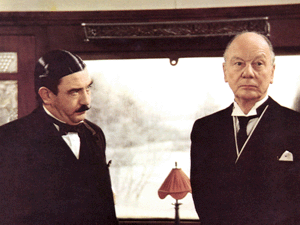
In this adaptation directed by Sidney Lumet, the Simplon Orient Express that left Istanbul at 9:00 at night. The movie also included a dining car attached to the train. One scene featured a chef examining food being loaded onto the train. This scene is erroneous. According to the The Man in Seat 61 website, there was no dining car attached to the train when it left Istanbul. A dining car was usually attached at Kapikule on the Turkish/Bulgarian border, before it was time to serve breakfast. The movie also featured a salon car or a “Pullman”, where Hercule Poirot interrogated most of the passengers of the Istanbul-Calais car.

oe2
LE-CRIME-DE-L-ORIENT-EXPRESS-MURDER-ON-THE-ORIENT-EXPRESS-1974_portrait_w858

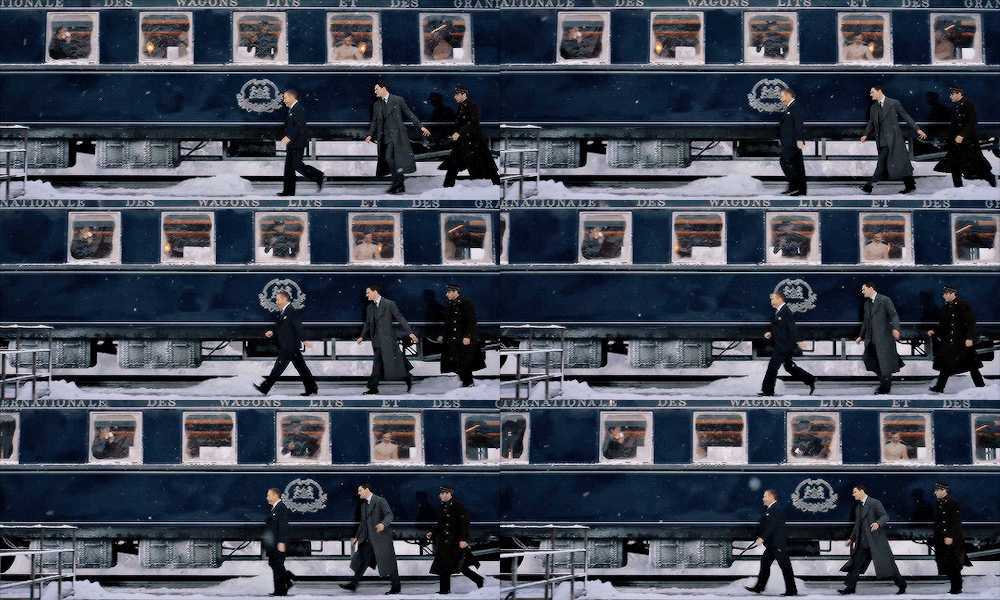
According to the “Seat 61” site, there was no salon “Pullman” car attached to the train east of Trieste, Italy. Christie needed the presence of the car for dramatic purposes and added one into her novel. The producers of the 1974 movie did the same. At least the producers of the 1974 used the right dark blue and cream-colored car for the Pullman. More importantly, they used the right dark blue cars for the train’s sleeping coaches, as shown in the image below: 
oe3

In the movie, the Simplon Orient Express reached Belgrade 24 hours after its departure from Istanbul. For once, the movie was accurate. Somewhere between Vinkovci and Brod, the Orient Express ended up snowbound and remained there until the end of the story. 


6a00e5500c8a2a88330133f413d531970b-800wi

“MURDER ON THE ORIENT EXPRESS” (2010)

This adaptation of Agatha Christie’s novel first aired on Britain’s ITV network in 2010. The television movie started with Hercule Poirot berating a British Army officer caught in a devastating lie. After the officer commits suicide, Poirot ends up in Istanbul, where he and a British couple witness the stoning of an adulterous Turkish woman. Eventually, the couple and Poirot board the Orient Express, where the latter finds himself investigating the murder of an American passenger.

I do not know what time the Simplon Orient Express departed Istanbul in this adaptation. The movie never indicated a particular time. This version also featured a brief scene with a chef examining food being loaded aboard a dining car. As I previously mentioned, a dining car was not attached until Kapikule. The movie did feature Poirot and some of the Istanbul-Calais car passengers eating breakfast the following morning. In this scene, I noticed a major blooper. Car attendant Pierre Michel was shown serving a dish to Poirot in the dining car. Note the images below: 

pierre michel1
Pierre Michel greets Poirot and M. Bouc before they board the train

pierre michel2
Pierre serves breakfast to Poirot

Why on earth would a car attendant (or train conductor, as he was in the 1934 novel) act as a waiter in the dining car? Like the 1974 movie, the ITV adaptation also featured a salon “Pullman” attached to the train, east of Italy. In fact, they did more than use one salon “Pullman”. As I had stated earlier, the westbound Simplon Orient Express usually acquired a salon “Pullman” after its arrival in Trieste. But in this adaptation, the producers decided to use the dark blue and cream-colored “Pullman” cars for the entire train as shown in these images: 

oe1
IMG_7341

This is completely in error. As I had stated earlier, the Orient Express usually featured a dark-blue and cream-colored salon “Pullman” between Italy and Paris. But it also featured the dark-blue and cream-colored seating “Pullmans” between Calais and Paris. There is no way that the Orient Express leaving Istanbul would entirely consist of the blue and cream “Pullman” cars.

However, the train did arrive at Belgarde at least 24 hours after its departure from Istanbul. Like the other movie, the train ended up snowbound between Vinkovci and Brod and remained there until the last scene. However, I am confused by the presence of the police standing outside of the train in the last scene. Poirot and the other passengers should have encountered the police, following the train’s arrival in Brod, not somewhere in the middle of the Yugoslavian countryside.


image

“MURDER ON THE ORIENT EXPRESS” (2017)
In this adaptation of Christie’s 1934 novel, in which Kenneth Branaugh directed and starred, Poirot solves a theft at the Church of the Holy Sepulchre in Jerusalem. The detective hopes to rest in Istanbul after traveling there via the Mediterranean and Agean Seas, but a telegram summons him to London for a case and he boards the Orient Simplon Orient Express with the help of young Monsieur Bouc, a director of the Compagnie Internationale des Wagons-Lits. When an American passenger named Samuel Rachett is found stabbed to death following his second night aboard the Orient Express, Poirot is asked to solve his murder.

image

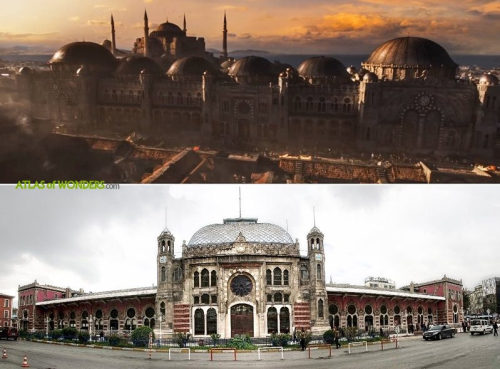
This movie featured the departure of the Simplon Orient Express around 7:00 p.m., instead of eleven o'clock. However, this is probably the only adaptation of Christie’s novel that featured the strongest similarity to the real Sirkeci Terminal in Istanbul, the train’s eastern terminus.

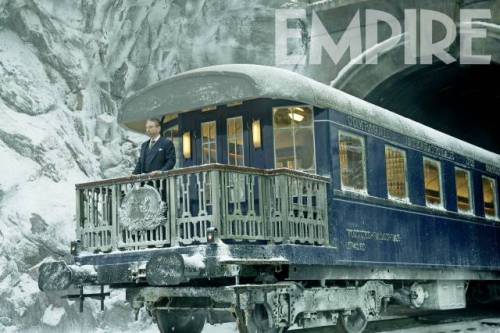
However, I also noticed that passengers boarded via the dining car, at the tail end of the train. That is correct. This adaptation also has a dining car attached to the Orient Express in Istanbul, instead of having it attached at Kapikule, the Turkish-Bulgarian border crossing. And unlike the previous adaptations, the dining car and the lounge car are dark blue like the sleeping compartments, instead of a color mixture of dark-blue and cream-colored. Which was an error.
image

The movie did not feature a stop in Belgrade, Yugoslavia. It did, however, featured a brief stop at Vinkovci, before it encountered a snow drift, later in the night. Since it was definitely at night when the train stopped at Vinkovci, no error had been committed. Especially since it was not quite dark when the train departed from Istanbul. And the journey between Istanbul and Belgrade lasted roughly 24 hours. At the end of the film, Poirot departed from the Orient Express at Brod. This is also appropriate, since the train had been snowbound somewhere between Vinkovci and Brod in the novel. More importantly, unlike the 2010 adaptation, Poirot gave his false resolution to Rachett’s murder to the police … in Brod and not in the spot where the train had been trapped. 


image

“FROM RUSSIA WITH LOVE” (1963)

Ian Fleming’s tale begins with the terrorist organization, SPECTRE, plotting the theft of the KGB’s a cryptographic device from the Soviets called the Lektor, in order to sell it back to them, while exacting revenge on British agent James Bond for killing their agent, Dr. No. After Bond successfully steals the Lektor from the Soviet consulate in Istanbul, he, defector Tatiana Romanova and MI-6 agent Kerim Bey board the Orient Express for a journey to France and later, Great Britain.

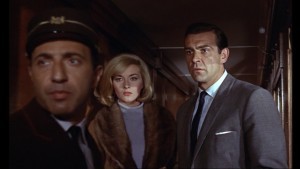
While I found this adaptation of Ian Fleming’s 1957 novel extremely enjoyable, I found myself puzzled by the movie’s portrayal of Bond’s journey aboard the Orient Express. It seemed so . . . off. In the movie; the Orient Express conveying Bond, his traveling companions and SPECTRE assassin “Red” Grant; departed Istanbul somewhere between 3:00 and 4:00 o'clock in the afternoon. The train departed Istanbul around nine o'clock at night, in Fleming’s novel. Mind you, the novel was set in the 1950s and the movie, set in the early 1960s, which meant that its departure in the movie was pretty close to the 4:15 pm departure of the Direct Orient Express train that operated between 1962 and 1977. I do not recall seeing a dining car attached to the train, during its departure in the movie, so I cannot comment on that. But after the train’s departure, the movie’s portrayal of Bond’s Orient Express journey proved to be mind boggling.

The main problem with “FROM RUSSIA WITH LOVE” is that Bond’s journey proved to be the fastest I have ever witnessed, either on film or in a novel. It took the train at least three-to-four hours to reach Belgrade, following its departure from Istanbul. One, it usually took the Orient Express nearly 24 hours to reach Belgrade during its heyday. During the first ten-to-fifteen years of the Cold War, it took the Orient Express a little longer to reach Belgrade, due to it being re-routed through Northern Greece in an effort to avoid countries under Soviet rule. This was made clear in Fleming’s novel. But the 1963 movie followed the famous train’s original eastbound route . . . but at a faster speed. After killing Grant, Bond and Tatiana left the train before it reached the Yugoslavian-Italian border. Bond’s journey from Istanbul to that point took at least 15 hours. During the Orient Express’ heyday, it took at less than 48 hours. And during the 15 years of the Direct Orient Express, it took longer.


Unlike many recent film goers and television viewers, historical accuracy or lack of it in a movie/television production has never bothered me. I am a major fan of  “MURDER ON THE ORIENT EXPRESS” (both the 1974 and 2017 versions) and “FROM RUSSIA WITH LOVE”. And although I have other problems with the 2010 “MURDER ON THE ORIENT EXPRESS” movie, there are still aspects of it that I continue to find very enjoyable.  Historical inaccuracy has never impeded my enjoyment of a film, unless I found it particularly offensive. But since I can be occasionally anal and was bored, I could not resist a brief exploration of the Hollywood and British film industries’ portrayals of the Orient Express. 


Tuesday, May 22, 2018

"TOM JONES" (1963) Photo Gallery


Below are photos and other images from the 1963 Academy Award winning movie, "TOM JONES". Directed by Tony Richardson, the movie starred Albert Finney and was based upon Henry Fielding's 1749 novel, "The History of Tom Jones, a Foundling"


"TOM JONES" (1963) Photo Gallery


0548377_13165_MC_Tx360


0548377_26682_MC_Tx360


1328999512_15_tom_jones


david-warner-tomjones


Film-and-Television-010


tomjones40


susannah-york-tomjones-7


tomjones41


Tom-Jones-1963

Tuesday, August 9, 2016

"AMAZING GRACE" (2006-07) Review

22amazing600


"AMAZING GRACE" (2006-07) Review

Ever since the release of the 2012 Oscar winning film, "12 YEARS A SLAVE", there seemed to be this idea - especially with the British media - that Hollywood has remained silent regarding the topic of American slavery. I find this opinion ironic, considering my failure to find many U.K. films on British slavery. 

When I first read McQueen's criticism of Hollywood's failure to produce a good number of films about American slavery, I decided to check the Internet to see how many slavery movies that the British film industry had produced. So far, I have only come across three - and one of them is "AMAZING GRACE", the 2006 movie about abolitionist William Wilberforce's efforts to end Britain's participation in the Atlantic Slave Trade.

Looking back upon "AMAZING GRACE", I could not help but feel that it would have made an appropriate companion piece to Steven Spielberg's 2012 movie, "LINCOLN". Although one focused upon the slave trade throughout Britain's Empire around the Georgian Era and the other focused upon the United States' efforts to officially end slavery during the last year of the Civil War, both explored the political impacts on the institution of slavery in their respective countries. But there were differences. "AMAZING GRACE" focused upon the end of Britain's official participation in the Atlantic slave trade and received only a few accolades. "LINCOLN", on the other hand, focused upon the end of slavery altogether (the country's participation in the slave trade ended around the same time as Great Britain) and received a great deal of accolades.

"AMAZING GRACE" begins in the middle of its story with a very ill William Wilberforce traveling to Bath with his cousin Henry Thornton and cousin-in-law Marianne to Bath for a recuperative holiday in 1797. The Thorntons decide to play matchmaker and introduce him to their friend, Barbara Spooner. Although the pair initially goes out of their way to resist any romantic overtures, Barbara ends up convincing Wilberforce to relate the story of his career. 

The movie flashes back some fifteen years into the past, when Wilberforce was a young and ambitious Member of Parliament (MP). After he experiences a religious enlightenment and aligns himself with the evangelical wing of the Church of England, Wilberforce contemplates leaving politics to study theology. But friends such as William PittThomas ClarksonHannah More, and Olaudah Equiano convinces him that he could be more effective doing God's work by fighting for the issue of Britain's slave trade. Wilberforce's convictions are deepened by a meeting with his former mentor, John Newton, a former slave ship captain turned Christian, whose regrets of his past participation in the slave trade led him to become an evangelist minister and writer of the poem that led to the song,"Amazing Grace". Despite great effort and assistance from his fellow abolitionists, Wilberforce's efforts fail, thanks to the pro-slavery cabal in Parliament after fifteen years. Following his marriage to Barbara Spooner, Wilberforce takes up the cause again with different results.

I am going to be brutally frank. "AMAZING GRACE" did not strike me as superior or at the same level of quality as "LINCOLN". I am not stating that the 2006 movie was terrible or even mediocre. I simply feel that it is not as good as the 2012 Oscar winning film. There is something about the style of "AMAZING GRACE" that lacked the more complex nature and characterizations of "LINCOLN". I found it . . . well, ideal and very preachy at times. I realize this movie is about the institution of slavery throughout the British Empire. But I believe that just because a story ( in any form) centers around an unpleasant topic like slavery does not have to be told with such a lack of moral complexity. I suspect that screenwriter Steven Knight tried to inject some kind of complexity in Wilberforce's original reluctance to take up the cause of the abolition of the slave trade and in his despair over the failure of the abolition cause by 1797. But the movie simply lacked that murky ambiguity that made movies like "LINCOLN" and "DJANGO UNCHAINED" more complex to me. Even worse, there were times when the movie fell into the danger of transforming Wilberforce into some idealized character - what is known by those familiar with fan fiction as a Mary Sue. The movie seemed to hint that the success of Britain's abolitionist movement centered around Wilberforce. And I found that annoying. 

I have one last problem with "AMAZING GRACE". The use of flashbacks struck me as a bit . . . well, confusing. This especially seemed to be the case in the first two-thirds of the movie, which alternated between the present setting (1797) and the past (between 1782 and 1797). I hate to say this, but director Michael Apted and editor Rick Shaine did not handle these shifts in time with any real clarity. After my third viewing of the film, I finally got a handling on the shifts between the narrative's past and present. Many film critics have pointed out the movie's historical inaccuracies, which include the time period in which Wilberforce became interested in animal rights and the Duke of Clarence's erroneous service in the House of Commons. Honestly? They are simply bloopers and nothing for me to get excited over. 

Despite its flaws, I must admit that "AMAZING GRACE" is a first-rate and stirring film. It touched upon a subject that I knew very little of . . . namely Britain's abolition movement. In fact, when I first saw the film, it reminded me that countries like the United States, Cuba, and Brazil were not the only ones with strong ties to slavery and the Atlantic slave trade. These ties were especially made apparent in scenes which Wilberforce and his allies battled with the pro-slavery forces like Banastre Tarleton and the Duke of Clarence and St. Andrews (the future King William IV). Although "AMAZING GRACE" mainly focused on the political aspect of abolition in Great Britain, there are two memorable scenes that reflect the horrors of slavery - Wilberforce and Olaudah_Equiano's tour of a slave ship and Newton's verbal recollections of his time as a slave ship captain. However, "AMAZING GRACE" also touches upon Wilberforce's personal life - especially his courtship of and marriage to fellow abolitionist Barbara Spooner. And it is to Ioan Gruffudd and Romola Garai's credit that they had created a strong and very believable screen chemistry.

"AMAZING GRACE" is also a very beautiful movie to look at. And that is an odd thing to say about a movie about slavery. As always, I tend to look at the production designer as the one responsible for the movie's overall visual style. In the case of "AMAZING GRACE", the man responsible was Charles Wood, who did an amazing job in recapturing Great Britain during the late 18th century. His work was ably assisted by the art direction team led by David Allday and Eliza Solesbury's set decorations. And since "AMAZING GRACE" is a period drama, I cannot ignore the costumes designed by film icon Jenny Beavan. Needless to say, her costumes were beautiful and perfectly adhered to the movie's time period and the characters. I especially enjoyed her costumes for actresses Romola Garai and Sylvestra Le Touzel.

All of the beautiful costumes, magnificent photography and impressive production designs in the world cannot save a movie. Aside from a first-rate narrative, a movie needs a talented cast. Thankfully for "AMAZING GRACE", it had one. Ioan Gruffudd, whom I tend to associate more with television, gave an excellent and passionate performance as the dedicated William Wilberforce. Also, Gruffudd more than held his own with the array of more experienced performers that were cast in this film. I do not know when Benedict Cumberbatch first made a name for himself. But I cannot deny that he gave a superb performance as William Pitt, the politician who eventually became the country's youngest Prime Minister. Cumberbatch did a first-rate job in portraying how Pitt's idealism, political savy and professional ambiguity sometimes clashed. Romola Garai gave a beautiful performance as Barbara Spooner Wilberforce, the politician's wife of thirty-odd years. By expressing her character's own passionate beliefs in the abolitionist movement, Garai portrayed her more than just Wilberforce's love interest. 

Albert Finney made several appearances in the film as former slave ship captain-turned-evangelist John Newton, who became Wilberforce's mentor. Despite his limited appearances, Finney brilliantly portrayed Newton's pragmatic nature about his past and the guilt he continued to feel for his role in Britain's slave trade. I also have to comment on Rufus Sewell's very entertaining performance as abolitionist Thomas Clarkson. I do not think I have ever come across a performance so colorful, and at the same time, very subtle. The movie also benefited excellent support from the likes of Michael Gambon, Ciarán Hinds, Toby Jones, Jeremy Swift, Stephen Campbell Moore, and Bill Paterson. Senegalese singer-activist Youssou N'Dour gave a solid performance in his acting debut as former slave-turned-abolitionist Olaudah Equiano. And Nicholas Farrell and Sylvestra Le Touzel, who co-starred in 1983's "MANSFIELD PARK"together, reunited to give entertaining performances as the Wilberforces' close friends, Henry and Marianne Thornton.

Without a doubt, I regard "AMAZING GRACE" as an entertaining, yet very interesting look into the life of William Wilberforce and his role in Britain's abolition of the slave trade. Granted, the movie came off a touch pretentious and there were times when the Wilberforce character came off as too idealized. But the movie's visual style, intelligent script, excellent performances from a cast led by Ioan Gruffudd, and solid direction from Michael Apted made this film worthwhile for me.