I will be the first to admit that I have never been an ardent reader of Tom Clancy's novels. Many who know me would find this strange, considering my penchant for the movie adaptations of his stories. The first I ever saw was "THE HUNT FOR RED OCTOBER", the 1990 adaptation of Clancy's 1984 novel of the same title.
The last remnants of the Cold War - at least the one between the United States and the Soviet Union - were being played out when "THE HUNT FOR RED OCTOBER" hit the screen. Realizing this, director John McTiernan, screenwriter Larry Ferguson (who also had a role in the film) and producer Mace Neufeld decided to treat Clancy's story as a flashback by setting the movie in the year Clancy's novel was published. The movie begins with the departure of the new Soviet submarine, the Red October, which possesses a new caterpillar drive that renders it silent. In command of the Red October is Captain Marko Ramius. Somewhere in the Atlantic Ocean, the U.S. Navy submarine called the U.S.S. Dallas has a brief encounter with the Red October before it loses contact due to the Soviet sub's caterpillar drive. This encounter catches the attention of C.I.A. analyst Jack Ryan, who embarks upon studying the Red October's schematics.
Unbeknownst to the C.I.A., Captain Ramius has put in motion a plan for the defection of his senior officers and himself. They also intend to commit treason by handing over the Red October to the Americans. Unfortunately, Ramius has left a letter stating his intentions to his brother-in-law, a Soviet government official. This leads the Soviet ambassador in Washington D.C. to inform the Secretary of Defense that the Red October has been lost at sea and requires the U.S. Navy's help for a "rescue mission". However, Ryan manages to ascertain that Ramius plans to defect. When the Soviets change tactics and claim that Captain Ramius has become a renegade with plans to fire a missile at the U.S. coast, Ryan realizes that he needs to figure out "how" Ramius plans to defect before the Soviet or U.S. Navies can sink the Red October.
I might as well put my cards on the table. After twenty-three years, "THE HUNT FOR RED OCTOBER" holds up very well as a Cold War thriller. What prevented it from becoming a dated film were the filmmakers' decision to treat Clancy's tale as a flashback to the last decade of the Cold War. I have never read Clancy's novel. In fact, I have only read two of his novels - "Patriot Games" and "Clear and Present Danger". Because of this, I could not judge the movie's adaptation of the 1984 novel. But there is no doubt that "THE HUNT FOR RED OCTOBER" is a first-rate - probably superb thriller. Screenwriters Larry Ferguson and Donald E. Stewart made another first-rate contribution to the script by not rushing the narrative aspect of the story. The movie is not some fast-paced tale stuffed with over-the-top action. Yes, there is action in the film - mainly combat encounters, a murder, hazardous flying in a rain storm and a shoot-out inside the Red October's engine room. And it is all exciting stuff. However, Ferguson and Stewart wisely detailed the conversations held between Ramius and his fellow defectors, Ryan's attempts to figure out Ramius' defection plans and his efforts to convince various high-ranking U.S. Naval officers not to accept the Soviets' lies about the Red October's captain.
"THE HUNT FOR RED OCTOBER" also features some excellent performances. Sean Connery gave one of his best performances as the Red October's enigmatic and wily captain, Markus Ramius. Alec Baldwin was equally impressive as the slightly bookish, yet very intelligent C.I.A. analyst, Jack Ryan. A part of me believes it is a pity that he never portrayed the role again. The movie also boasted fine performances from James Earl Jones as Ryan's boss, C.I.A. Deputy Director James Greer; Scott Glenn as the intimidating captain of the U.S.S. Dallas, Bart Mancuso; Sam Neill as Ramius' very loyal First Officer, Vasily Borodin; Fred Dalton Thompson as Rear Admiral Joshua Painter; Courtney B. Vance as the Dallas' talented Sonar Technician, Ronald "Jonesy" Jones; Tim Curry as the Red October's somewhat anxious Chief Medical Officer (and the only one not part of the defection) Dr. Yevgeniy Petrov; and Joss Ackland as Ambassador Andrei Lysenko. Stellan Skarsgård made a dynamic first impression for me as Viktor Tupolev, the Soviet sub commander ordered to hunt and kill Ramius. And Richard Jordan was downright entertaining as the intelligent and somewhat manipulative National Security Advisor Dr. Jeffrey Pelt. The movie also featured brief appearances from the likes of Tomas Arana, Gates McFadden (of "STAR TREK: NEXT GENERATION") and Peter Firth (of "SPOOKS").
Before one starts believing that I view "THE HUNT FOR RED OCTOBER" as perfect, I must admit there were a few aspects of it that I found a bit troublesome for me. The movie has a running time of 134 minutes. Mind you, I do not consider this as a problem. However, the pacing seemed in danger of slowing down to a crawl two-thirds into the movie. It took the Dallas' encounter with the Red October to put some spark back into the movie again. And could someone explain why Gates McFadden portrayed Ryan's wife, Dr. Cathy Ryan, with a slight British accent? Especially since she was an American-born character?
Despite these minor quibbles, "THE HUNT FOR RED OCTOBER" is a first-rate spy thriller that has withstood the test of time for the past 23 years. And I believe the movie's sterling qualities own a lot to John McTiernan's excellent direction, a well-written script by Larry Ferguson and Donald E. Stewart, and superb performances from a cast led by Sean Connery and Alec Baldwin.
Below are images from "THE HUNT FOR RED OCTOBER", the 1990 adaptation of Tom Clancy's 1984 novel. Directed by John McTiernan, the movie starred Sean Connery and Alec Baldwin:
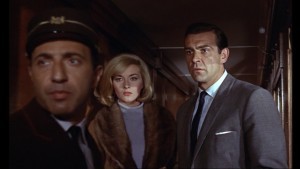
Below is a look at three major movies and a television movie that featured journeys aboard the famed Orient Express:
“ALL ABOARD THE ORIENT EXPRESS”
I will be the first to admit that I am not one of those who demand that a novel, a movie or a television production to be historically accurate. Not if history gets in the way of the story. But there is an anal streak within me that rears its ugly head, sometimes. And that streak would usually lead me to judge just how accurate a particular production or novel is.
Recently, I watched four movies that featured a journey aboard the legendary train, the Orient Express. Perhaps I should be a little more accurate. All four movies, “MURDER ON THE ORIENT EXPRESS” (1974), “MURDER ON THE ORIENT EXPRESS” (2010), “MURDER ON THE ORIENT EXPRESS” (2017) and “FROM RUSSIA WITH LOVE” (1963) featured a famous route that came into existence nearly a year following World War I called the Simplon Orient Express. The original route for the Orient Express stretched from Paris to Istanbul via Strasbourg, Munich, Vienna, Budapest and Bucharest. Then in 1919, Compagnie Internationale des Wagons-Lits introduced a more southerly route, due to the opening of the Simplon Tunnel. This route stretched between Paris and Istanbul, via Lausanne, Milan, Venice, Belgrade and Sofia. Writers Agatha Christie and Ian Fleming made the Simplon Orient Express route famous thanks to their novels, “Murder on the Orient Express” (1934) and “From Russia With Love” (1957). And the movie adaptations of these novels increased the route’s fame.
Both Christie and Fleming’s novels featured the Simplon Orient Express’ route from Istanbul to France via Yugoslavia and Italy. There are reasons why their stories do not stretch further west to as far as at least France. In “Murder on the Orient Express”, the train became stuck in a snowdrift in Yugoslavia and detective Hercule Poirot spent the rest of the novel trying to solve the murder of an American passenger. And in “From Russia With Love”, British agent James Bond and his companion, Tatiana Romanova, made it as far as either Italy or France. The 1974, 2010 and 2017 adaptations of Christie’s novel, more or less remained faithful to the latter as far as setting is concerned. However, EON Production’s 1963 adaptation of Fleming’s novel allowed Bond and Tatiana to escape from the train before it could cross the Yugoslavia-Italy border.
While watching the four movies, I discovered that their portrayals of the Simplon Orient Express route were not completely accurate. I can imagine the thoughts running through the minds of many, declaring “Who cares?”. And I believe they would be right to feel this way. But I thought it would be fun to look into the matter. Before I do, I think I should cover a few basics about this famous train route from Istanbul to Paris-Calais.
During its heyday, the Orient Express usually departed from Istanbul around 11:00 p.m. Following the rise of the Iron Curtain after World War II, the Orient Express extended it route to stops in Greece in order to avoid the Soviet-controlled countries. The only Communist country it passed through was Yugoslavia. When the train became the slower Direct Orient Express in 1962, it usually departed Istanbul around 4:15 p.m. I do not know whether a restaurant car and/or a salon “Pullman” car was attached to the Direct Orient Express when it departed Istanbul between 1962 and 1977. One last matter. In the three adaptations of the two novels, the Orient Express usually made a significant stop at Belgrade. It took the Orient Express, during its heyday, at least 23 to 24 hours to travel from Istanbul to Belgrade.
Let us now see how accurately the three “MURDER ON THE ORIENT EXPRESS” movies and the 1963 “FROM RUSSIA WITH LOVE” flick accurately portray traveling aboard the Simplon Orient Express (or Direct Orient Express) on film. I will begin with the “MURDER ON THE ORIENT EXPRESS”, the 1974 adaptation of Agatha Christie’s novel.
“MURDER ON THE ORIENT EXPRESS” (1974)
Following the conclusion of a successful case for the British Army somewhere in the Middle East, Belgian-born detective is on his way home to London, via a train journey aboard the famed Orient Express. When an American businessman named Samuel Rachett is murdered during the second night aboard the train, Poirot is asked by his friend and director of the Compagnie Internationale des Wagons-Lits, Senor Bianchi, to investigate the crime.
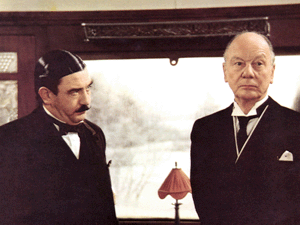
In this adaptation directed by Sidney Lumet, the Simplon Orient Express that left Istanbul at 9:00 at night. The movie also included a dining car attached to the train. One scene featured a chef examining food being loaded onto the train. This scene is erroneous. According to the The Man in Seat 61 website, there was no dining car attached to the train when it left Istanbul. A dining car was usually attached at Kapikule on the Turkish/Bulgarian border, before it was time to serve breakfast. The movie also featured a salon car or a “Pullman”, where Hercule Poirot interrogated most of the passengers of the Istanbul-Calais car.
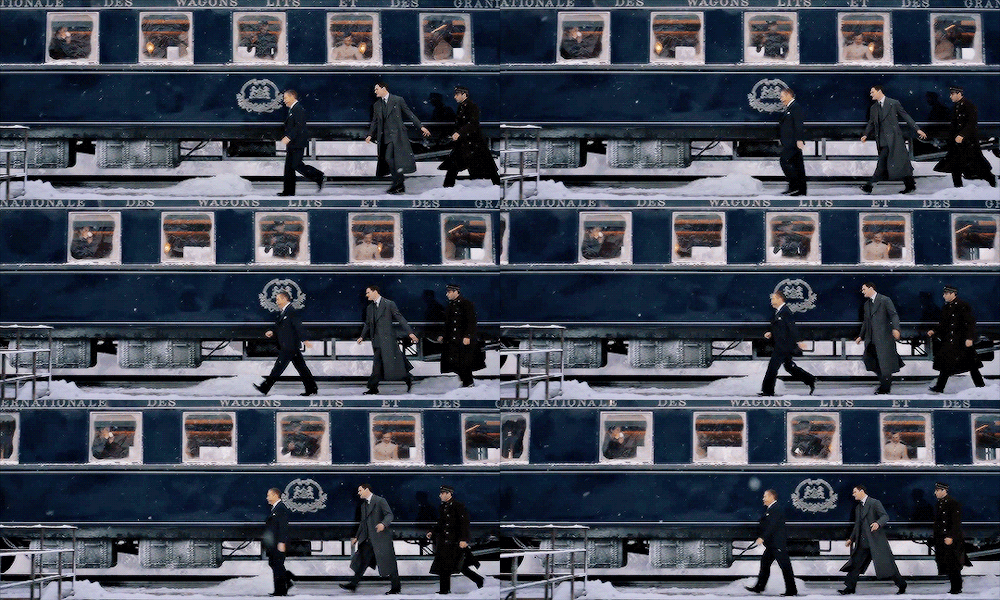
According to the “Seat 61” site, there was no salon “Pullman” car attached to the train east of Trieste, Italy. Christie needed the presence of the car for dramatic purposes and added one into her novel. The producers of the 1974 movie did the same. At least the producers of the 1974 used the right dark blue and cream-colored car for the Pullman. More importantly, they used the right dark blue cars for the train’s sleeping coaches, as shown in the image below:
In the movie, the Simplon Orient Express reached Belgrade 24 hours after its departure from Istanbul. For once, the movie was accurate. Somewhere between Vinkovci and Brod, the Orient Express ended up snowbound and remained there until the end of the story.
“MURDER ON THE ORIENT EXPRESS” (2010)
This adaptation of Agatha Christie’s novel first aired on Britain’s ITV network in 2010. The television movie started with Hercule Poirot berating a British Army officer caught in a devastating lie. After the officer commits suicide, Poirot ends up in Istanbul, where he and a British couple witness the stoning of an adulterous Turkish woman. Eventually, the couple and Poirot board the Orient Express, where the latter finds himself investigating the murder of an American passenger.
I do not know what time the Simplon Orient Express departed Istanbul in this adaptation. The movie never indicated a particular time. This version also featured a brief scene with a chef examining food being loaded aboard a dining car. As I previously mentioned, a dining car was not attached until Kapikule. The movie did feature Poirot and some of the Istanbul-Calais car passengers eating breakfast the following morning. In this scene, I noticed a major blooper. Car attendant Pierre Michel was shown serving a dish to Poirot in the dining car. Note the images below:
Pierre Michel greets Poirot and M. Bouc before they board the train
Pierre serves breakfast to Poirot
Why on earth would a car attendant (or train conductor, as he was in the 1934 novel) act as a waiter in the dining car? Like the 1974 movie, the ITV adaptation also featured a salon “Pullman” attached to the train, east of Italy. In fact, they did more than use one salon “Pullman”. As I had stated earlier, the westbound Simplon Orient Express usually acquired a salon “Pullman” after its arrival in Trieste. But in this adaptation, the producers decided to use the dark blue and cream-colored “Pullman” cars for the entire train as shown in these images:
This is completely in error. As I had stated earlier, the Orient Express usually featured a dark-blue and cream-colored salon “Pullman” between Italy and Paris. But it also featured the dark-blue and cream-colored seating “Pullmans” between Calais and Paris. There is no way that the Orient Express leaving Istanbul would entirely consist of the blue and cream “Pullman” cars.
However, the train did arrive at Belgarde at least 24 hours after its departure from Istanbul. Like the other movie, the train ended up snowbound between Vinkovci and Brod and remained there until the last scene. However, I am confused by the presence of the police standing outside of the train in the last scene. Poirot and the other passengers should have encountered the police, following the train’s arrival in Brod, not somewhere in the middle of the Yugoslavian countryside.
“MURDER ON THE ORIENT EXPRESS” (2017)
In this adaptation of Christie’s 1934 novel, in which Kenneth Branaugh directed and starred, Poirot solves a theft at the Church of the Holy Sepulchre in Jerusalem. The detective hopes to rest in Istanbul after traveling there via the Mediterranean and Agean Seas, but a telegram summons him to London for a case and he boards the Orient Simplon Orient Express with the help of young Monsieur Bouc, a director of the Compagnie Internationale des Wagons-Lits. When an American passenger named Samuel Rachett is found stabbed to death following his second night aboard the Orient Express, Poirot is asked to solve his murder.
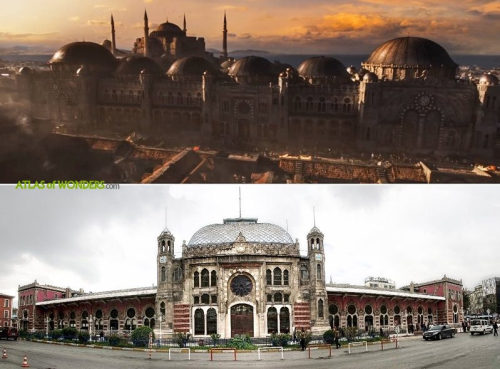
This movie featured the departure of the Simplon Orient Express around 7:00 p.m., instead of eleven o'clock. However, this is probably the only adaptation of Christie’s novel that featured the strongest similarity to the real Sirkeci Terminal in Istanbul, the train’s eastern terminus.
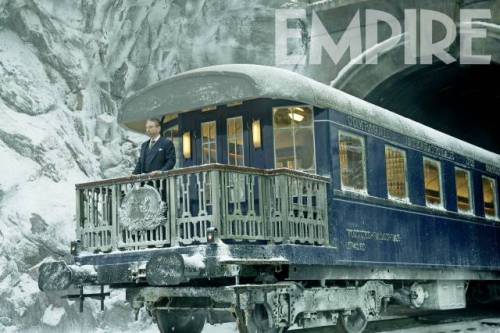
However, I also noticed that passengers boarded via the dining car, at the tail end of the train. That is correct. This adaptation also has a dining car attached to the Orient Express in Istanbul, instead of having it attached at Kapikule, the Turkish-Bulgarian border crossing. And unlike the previous adaptations, the dining car and the lounge car are dark blue like the sleeping compartments, instead of a color mixture of dark-blue and cream-colored. Which was an error.
The movie did not feature a stop in Belgrade, Yugoslavia. It did, however, featured a brief stop at Vinkovci, before it encountered a snow drift, later in the night. Since it was definitely at night when the train stopped at Vinkovci, no error had been committed. Especially since it was not quite dark when the train departed from Istanbul. And the journey between Istanbul and Belgrade lasted roughly 24 hours. At the end of the film, Poirot departed from the Orient Express at Brod. This is also appropriate, since the train had been snowbound somewhere between Vinkovci and Brod in the novel. More importantly, unlike the 2010 adaptation, Poirot gave his false resolution to Rachett’s murder to the police … in Brod and not in the spot where the train had been trapped.
“FROM RUSSIA WITH LOVE” (1963)
Ian Fleming’s tale begins with the terrorist organization, SPECTRE, plotting the theft of the KGB’s a cryptographic device from the Soviets called the Lektor, in order to sell it back to them, while exacting revenge on British agent James Bond for killing their agent, Dr. No. After Bond successfully steals the Lektor from the Soviet consulate in Istanbul, he, defector Tatiana Romanova and MI-6 agent Kerim Bey board the Orient Express for a journey to France and later, Great Britain.
While I found this adaptation of Ian Fleming’s 1957 novel extremely enjoyable, I found myself puzzled by the movie’s portrayal of Bond’s journey aboard the Orient Express. It seemed so . . . off. In the movie; the Orient Express conveying Bond, his traveling companions and SPECTRE assassin “Red” Grant; departed Istanbul somewhere between 3:00 and 4:00 o'clock in the afternoon. The train departed Istanbul around nine o'clock at night, in Fleming’s novel. Mind you, the novel was set in the 1950s and the movie, set in the early 1960s, which meant that its departure in the movie was pretty close to the 4:15 pm departure of the Direct Orient Express train that operated between 1962 and 1977. I do not recall seeing a dining car attached to the train, during its departure in the movie, so I cannot comment on that. But after the train’s departure, the movie’s portrayal of Bond’s Orient Express journey proved to be mind boggling.
The main problem with “FROM RUSSIA WITH LOVE” is that Bond’s journey proved to be the fastest I have ever witnessed, either on film or in a novel. It took the train at least three-to-four hours to reach Belgrade, following its departure from Istanbul. One, it usually took the Orient Express nearly 24 hours to reach Belgrade during its heyday. During the first ten-to-fifteen years of the Cold War, it took the Orient Express a little longer to reach Belgrade, due to it being re-routed through Northern Greece in an effort to avoid countries under Soviet rule. This was made clear in Fleming’s novel. But the 1963 movie followed the famous train’s original eastbound route . . . but at a faster speed. After killing Grant, Bond and Tatiana left the train before it reached the Yugoslavian-Italian border. Bond’s journey from Istanbul to that point took at least 15 hours. During the Orient Express’ heyday, it took at less than 48 hours. And during the 15 years of the Direct Orient Express, it took longer.
Unlike many recent film goers and television viewers, historical accuracy or lack of it in a movie/television production has never bothered me. I am a major fan of “MURDER ON THE ORIENT EXPRESS” (both the 1974 and 2017 versions) and “FROM RUSSIA WITH LOVE”. And although I have other problems with the 2010 “MURDER ON THE ORIENT EXPRESS” movie, there are still aspects of it that I continue to find very enjoyable. Historical inaccuracy has never impeded my enjoyment of a film, unless I found it particularly offensive. But since I can be occasionally anal and was bored, I could not resist a brief exploration of the Hollywood and British film industries’ portrayals of the Orient Express.
In recent years, EON Production’s 1967 movie, “YOU ONLY LIVE TWICE” has not been highly regarded by many Bond fans. In a way, I can understand why, judging by Sean Connery’s performance in his fifth consecutive turn as James Bond and the movie’s plot.
The plot begins with the abduction of an American space capsule in space by a mysterious craft. The U.S. government blames the Soviet government, but the British government, who has tracked the mysterious craft to Japan, where James Bond is sent to investigate. With the help of Tiger Tanaka and Japan’s SIS agency, Bond eventually links the mysterious craft to SPECTRE, who is being paid by the People’s Republic of China to start a war between the U.S. and the Soviet Union. As one can see, the movie’s plot, written by Roald Dahl, bears very little resemblance to the novel under the same name. Characters like Kissy Suzuki, Tiger Tanaka, Ernst Blofeld and Dikko Henderson are in both the movie and the novel. But the latter dealt with a Bond (depressed over the death of his wife, Tracy) given one last chance by MI6 to get direct access from the Japanese to Magic 44, the project revealing all Soviet radio transmissions. The mission, which eventually involves Blofeld and a place called “Castle of Death”, seems like a far cry from the movie’s plot.
Not only is the movie’s plot bears very little or no resemblance to the novel (a first in the Bond franchise), there are some moments in the story that seem to defy logic. I never understood why Aki (Akiko Wakabayashi) failed to mention that she worked for Tiger Tanaka (Tetsuro Tamba) and the Japanese SIS when she first met Bond. Why would Helga Brandt (Karin Dor) go through all of that trouble in allowing Bond to “convince her” to betray Osato (Teru Shimada) before finally attempting to kill him? If she did it for sex with the British agent, then she had deserved to be consumed by the piranha fish. I never could figure out on which side was the wheel placed on Aki’s white Toyota sports car – the left or the right. What exactly did Bond plan to do once he joined the escaped American astronauts impersonating SPECTRE astronauts? Especially since he had sent Kissy Suzuki (Mie Hama) to summon Tiger and his Ninja warriors? And why in the hell did Blofeld (Donald Pleasance) shoot Osato and then force Bond to another spot before attempting to kill him? Why was it necessary for him to force Bond to move to a different spot, in the first place?
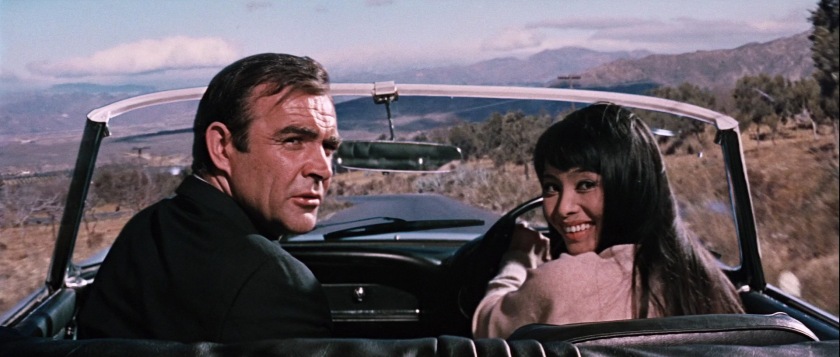
Most of the performances in the movie were satisfying. especially Akiko Wakabayashi, who memorably played the charming and very competent Aki. In fact, I would say that she practically gave one of two gem performances in the movie. It seemed a shame that she had failed to survive the movie. The other gem turned out to be the performance of Tetsuro Tambo, who played the charismatic head of Japan’s SIS, Tiger Tanaka. Teru Shimada was properly menacing as SPECTRE middleman, Mr. Osato. Charles Gray made a nice appearance as MI6 agent, Dikko Henderson, four years before his stint as Ernst Blofeld.
Speaking of Blofeld, Pleasance was not bad, but his Middle European accent seemed a little unconvincing and the scar on his cheek seemed a little over-the-top. Karin Dor seemed like an obvious attempt on EON Production’s part to cash in on Luciana Paluzzi’s popular performance in “THUNDERBALL” . . . and it failed. Her appearance seemed like a waste of time. Mie Hama, although charming and beautiful, turned out to be one of the most boring Bond leading ladies of all time. I could not detect anything interesting about her character, Japanese SIS agent and diving girl, Kissy Suzuki. Many have commented on Sean Connery’s less than spectacular performance in this movie. And I must agree with their opinion. Granted, he had some good moments with Wakabayashi and Tambo, but overall, he seemed to be walking through the performance. And this is not surprising, since it had been reported that Connery was pretty much weary of the Bond role, by this time. But at least he did not seemed to be spoofing his role, as he did in “DIAMONDS ARE FOREVER”.
“YOU ONLY LIVE TWICE” did have high water marks, other than Wakabayashi and Tambo’s performances. The movie can boast beautiful shots of Japan, thanks to cinematographer, Freddie Young; and a lovely John Barry score, topped by a beautiful and lilting theme song, performed by Nancy Sinatra. “YOU ONLY LIVE TWICE” might not be considered the best of Bond films or those made during the Connery era, but it still turned out to be very entertaining.
Below are images from "YOU ONLY LIVE TWICE", the 1967 adaptation of Ian Fleming's 1964 novel. Directed by Lewis Gilbert, the movie starred Sean Connery as James Bond aka 007: