Showing posts with label patrick stewart. Show all posts

Monday, February 18, 2019

"X-MEN" (2000) Review

3603_09577


"X-MEN" (2000) Review

If anyone had asked me what was the first genuine superhero film, based upon Marvel Comics characters, my choice would be the 2000 flick, "X-MEN". In fact, I suspect that it was the first Marvel film ever shown in the movie theaters. Its success spawned a series of superhero films that continue to this day. 

Based upon the Marvel Comics series, the plot for "X-MEN" began first in 1944, at a concentration camp in German-occupied Poland. Thirteen year-old Erik Lehnsherr is separated from his parents, upon entry to the camp. And in an attempt to reach them, he causes a set of gates to bend with a magnetic force and is knocked unconscious by the guards. The story jumps several decades later when a 17 year-old girl from Meridan, Mississippi named Marie aka Rogue is flirting with her boyfriend. They kiss and her boyfriend goes into a coma, thanks to Marie's ability to suck an individual's life force. Instead of immediately killing a mutant, Marie's ability manages to suck his or her ability before dying. Upset over the harm she had inadvertently caused, Marie runs away from home and ends up in Laughlin City, Alaska. She meets Logan, an amateur fighter known as "The Wolverine" at a local bar. He also possesses superhuman healing abilities, heightened senses, and metal claws that extend outwards from between his knuckles. Marie hitches a ride with Logan. While on the road together, they are both attacked by Sabretooth, a fellow mutant and an associate of the adult Erik Lehnsherr, who has become known as Magneto. Two mutants - Scott Summers aka Cyclops and Ororo Munroe aka Storm arrive on time to save Wolverine and Rogue, and bring them to Charles Xavier's mansion in Westchester County, New York. Xavier is an old friend of Magneto's.

Xavier's mansion serves as headquarters for Cyclops and Storm, the two mutants who had rescued Rogue and Logan. They are part of a group called the X-Men, who try to seek peace with non-mutant humans, educate young mutants in the responsible use of their powers, and stop Magneto from starting a war with humanity. While Xavier, Cyclops, Storm and a fourth member of the X-Men named Jean Grey try to figure out the reason by Magneto's attempt to kidnap Logan and Marie; Magneto sets his plan in motion with the kidnapping of an anti-mutant politician named Senator Robert Kelly by Sabretooth and another minion, a shapeshifter named Mystique. Kelly is behind a Federal legislation called the "Mutant Registration Act", which would force mutants to publicly reveal their identities and abilities. Magneto uses Kelly as a subject for a machine that artificially induces mutation. He plans to use it on the entire non-mutant population. But a mutant has to generate the machine's power. When it weakens Magneto during his experimentation on Senator Kelly, it becomes clear to the X-Men that Magneto wants to use Rogue's transferring ability and the Statue of Liberty to power the machine.

I never saw "X-MEN" at the movie theater. In fact, I had never heard of Marvel's "X-MEN" comic series, until I saw the movie after its video release in late 2000. Needless to say, I became an immediate fan. I found the idea of a group of people with psychic abilities divided by moral compass and political beliefs, and who are regarded by others as freaks, rather fascinating. I realize that the movie is not particularly faithful to the comic book series that it is based upon. However, director Bryan Singer and screenwriter David Hayter did a pretty solid job of using the comic source to create their own cinematic version of the series. The movie also featured some first-rate acting and excellent production values.

After seeing the film, I saw how the original costumes for the X-Men looked in the comics. And all I have to say is thank goodness Louise Mingenbach designed a more uniformed look for the superheroes . . . even if it involved black leather. Newton Thomas Sigel's photography struck me as solid. His best work seemed to be featured in the Liberty Island sequence. Ann Brodie and her team did excellent work on the makeup for some of the characters - especially Logan, Sabretooth, Toad and Mystique. Mike Fink and his team received an Oscar nomination for the film's visual effects. Fink later expressed dissatisfaction with his work and I can see why. They struck me as . . . okay, but nothing more or less. I found the visual affects used during Logan's fight against Sabertooth atop the Statue of Liberty as somewhat clumsy. And considering that most of the movie was either set indoors or at night, I cannot honestly say that "X-MEN" was a visually stunning film.

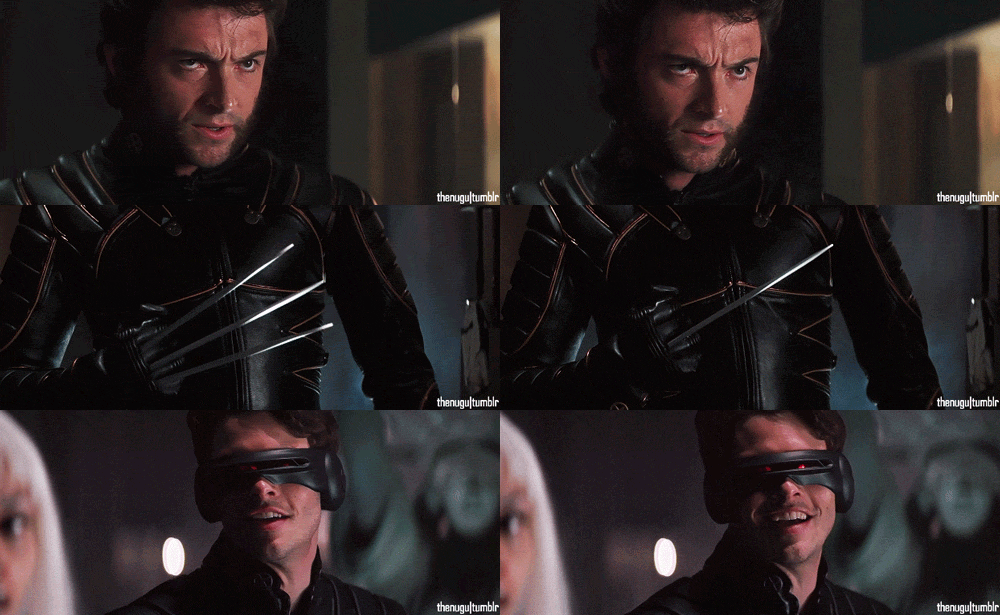
Most of the performances featured in "X-MEN" struck me as solid. There were a few exceptional ones. The movie made a star out of Hugh Jackman and it is easy to see why. Jackman is obviously a talented actor and he had the good luck to be cast in one of the comic franchise's most memorable characters. I could also say the same about Ian McKellen's performance as Erik Lensherr aka Magneto. What I found fascinating about McKellen's take on the character is that he managed to convey Magneto's willingness to pretend that his heinous actions were for the benefit of his fellow mutants, whom he believe should rule the earth. Patrick Stewart gave a fine performance as the more tolerant Charles Xavier, who would rather mutants and non-mutants to live side-by-side, instead of engaging in eternal conflict. I was also impressed by Anna Paquin's poignant performance as the young Marie aka Rogue, who seemed desperate to make some kind of connection to others, despite her ability. Bruce Davidson gave an excellent and complex performance as Senator Robert Kelly, whose fervent anti-mutant stance eventually softens from a traumatic experience and a conversation with Ororo Munroe aka Storm.

Among the movie's solid performances came from James Marsden's Scott Summers aka Cyclops, Famke Jenssen's Jean Grey and Rebecca Romijn as Magneto's hench woman, Mystique. I suspect some might be astonished by my description of Romijn's performance as "solid". I stand by my word. Mind you, I found the Mystique character rather striking - especially physically - but Romijn's performance merely struck me as solid. I wish I could say the same about Ray Park's portrayal of another of Magneto's minions, Toad. Honestly? I found the character cartoonish and one-dimension. Unfortunately, Park failed to rise above the material. I hate to say this, but I have to say the same about Halle Berry's performance as X-Men Storm aka Ororo Munroe. Most fans tend to blame Berry for the poor portrayal of Storm in this film. I cannot, considering her more positive portrayals of the character in subsequent films. Frankly, I blame Bryan Singer and screenwriter David Hayter. Poor Storm was merely used as a background character, except in a few crucial scenes. And Hayter wrote one of the worst pieces of dialogue in Hollywood history for the character. However, there was one scene in which Berry gave an excellent performance; and it featured Storm's poignant conversation with Senator Kelly.

image

As much as I liked "X-MEN", I feel that it is very overrated by many critics and the franchise's fans. I can honestly say that it is probably my least favorite X-MEN film. The main problem I have with this film is the number of plot holes or lack of logic in the story. I could say that it is indicative of the franchise's growing reputation for plot inconsistency. I never understood how Magneto learned about Rogue's ability to absorb a mutant's ability. I realize he must have learned about what she had done to her boyfriend David. But how did he learn about her ability's impact upon mutants? How did he or Sabretooth discover that she had traveled all the way from Mississippi to Alaska? I was also unimpressed by Logan's first scene at Xavier's school in which he woke up, heard voices in his head and ended up roaming all over the place in confusion. I am confused. Did Professor Xavier used telepathy to awaken him? Or did Logan simply hear voices, thanks to his enhanced hearing? 

The one sequence that really puzzles me was Mystique's activities at Xavier's School. The scene began with Mystique shape shifting into Rogue's new boyfriend, Bobby Drake aka Iceman in order to convince the adolescent that Xavier was angry at her for using her ability on Logan to heal herself and that she should leave the school. Why? So that Magneto could have an opportunity to snatch her. Later, Mystique transformed into Xavier in order to infiltrate Cerebro, Xavier's telepathic enhancing machine and sabotage it. Why on earth did Singer and Hayter create such a convoluted situation? They could have easily allowed Mystique to first sabotage Cerebro and then snatch Rogue from the school, herself. I also realize that Jean Grey, being both telepathic and telekinetic, could have easily rescued herself and her fellow X-Men from Magneto's trap inside the Liberty statue's interior. I have already commented on the clumsily shot fight scene between Logan and Sabretooth. The former's fight against Mystique was somewhat better and probably enhanced by slow motion. And if I must be honest, I found the movie's writing and pacing almost episodic. Every time I watch "X-MEN", I get the feeling that it is a first-rate "B" or television movie . . . or a second-rate "A" movie, even if it is entertaining.

In the end, my opinion of "X-MEN" has diminished over the years. It is still an entertaining film with a decent story, and a mixture of solid and first-rate performances from the cast. And I have to give it credit for successful kick-starting not only the X-MEN franchise, but also spawning a reemergence of superhero films - especially from Marvel. However, I believe the movie is tainted by some very questionable writing and a style that nearly strikes me as slightly sub par. I still like the movie, but it has become my least favorite X-MEN film in the entire franchise.

image

Wednesday, July 11, 2018

"X-MEN" (2000) Photo Gallery

mutants-x-men-2000-

Below are images from "X-MEN", the 2000 adaptation of the Marvel comic book series. Directed by Bryan Singer, the movie starred Patrick Stewart, Hugh Jackman, Ian McKellen and Anna Paquin: 


"X-MEN" (2000) Photo Gallery

3603_1893


174433__xmen_l


27889657-27889669-large


anna-paquin-and-rogue-costume-from-x-men-gallery


bruce-davison-as-senator-kelly-in-x-men-2000


james-marsden-scott-summers-cyclops-and-famke


kinopoisk.ru-X-Men-240013


kinopoisk.ru-X-Men-1366581


kinopoisk.ru-X-Men-1366582


Ray-Park-as-Toad-whose-tongue-can-extend-up-to-fifteen-feet-in-20th-Century-Foxs-X-Men-2000


bruce-davison-as-senator-kelly-in-x-men-2000-a


vlcsnap_2012_05_30_17h37m26s71_large


x1stills_001


x1stills_006


x1stills_007


X-Men


x-men3


x-men-2000_wolverine-02


X-Men2000-02


X-men-2000-15-g


X-Men-2000-lede


x-men-movie-2000_hugh_jackman


x-men-movie-jean-grey-famke-jannsen-cyclops-2000

Friday, October 7, 2016

"TINKER, TAILOR, SOLDIER, SPY" (1979) Review

20111118_inq_dvdfea18-a


"TINKER, TAILOR, SOLDIER, SPY" (1979) Review

I would have never thought about watching the BBC's television adaptation of John le CarrĂ©'s 1974 novel if I had not seen the 2011 version. Never. For some reason, I have never been that inclined to read his novels or watch any movie or television adaptations of his work. But after seeing Tomas Alfredson's movie, I had to see this version that starred Alec Guinness. 

Unlike the 2011 movie, this "TINKER, TAILOR, SOLDIER, SPY" was set around the time the miniseries aired, since the Cold War was still in full swing. You know the story. The head of SIS (MI-6 in real life), Control, sends agent Jim Prideaux to Czechoslovakia to meet a Czech general who claims to have information identifying a deep-cover Soviet spy planted in the highest echelons of "Circus" (the nickname for the SIS headquarters). "Operation Testify" proves to be a trap when Prideaux is shot and captured by the Soviets. Due to the mission's failure, both Control and his right-hand man, George Smiley, are forced to retire. 

But when Ricky Tarr, a British agent gone missing in Portugal, turns up in England with new evidence backing up Control's mole theory, Smiley is recalled to find the mole. He learns from Oliver Lacon, who oversees the country's intelligence services, that Control had four suspects occupying high positions in SIS - Percy Alleline (who assumed the position as the Circus' new head), Toby Esterhase, Bill Haydon and Roy Bland. Smiley, with the help of Peter Twiliam (who happens to be Tarr's immediate supervisor), instigates a secret investigation of Operation Testify to learn the name of the mole, nicknamed "Gerald".

To compare a seven-part television miniseries with a motion picture with a running time just barely over two hours seems just a bit too ridiculous to me. Instead, I will merely talk about the former. And what can I say about "TINKER, TAILOR, SOLDIER, SPY"? It was a first-rate production that deserved all of the accolades it had received three-three to thirty-four years ago. Instead of the usual action-dominated spy stories that have spilled out of Hollywood and the British film industries since the first James Bond movies, "TINKER, TAILOR, SOLDIER, SPY" felt like an well-paced Cold War mystery that featured a good deal of excellent acting, dramatic moments and perhaps the occasional action scene or two on the side. 

Too many flashbacks can be deadly to a story or a production. But when said production is basically a mystery, flashbacks can be effectively used. Director John Irvin and screenwriter Arthur Hopcraft certainly used the miniseries' flashbacks with great dramatic effect - aside from one particular flashback. The most effective flashback - at least for me - proved to be the back story regarding of Ricky Tarr's affair with Irina, the wife of a Moscow Center intelligence official, in Portugal. This affair leads to Tarr's discovery of new evidence supporting Control's theory of a high-ranking Soviet mole in the Circus. Another flashback that I found interesting proved to be Sam Collins' recollection of the night when news of Jim Prideaux's capture reached the Circus.

The single flashback that failed to resonate with me proved to be Smiley's recollection of his brief meeting with his nemesis, KGB operative-turned-official Karla, during the 1950s. Although the scene featured an excellent performance from Alec Guinness as Smiley and a strong screen presence in the form of a smoldering Patrick Stewart as Karla, the brief scene nearly put me to sleep. I would have been satisfied with a verbal recollection from Smiley. And there were two sequences that I found either unnecessary or disappointing. I found the sequence featuring Prideaux's trip to Czechoslovakia. I realize that both Irvin and Hopcraft's script tried to convey this entire sequence as intriguing action scene. It did not work for me. Considering that most of the sequence was shot at night, I found it rather dull. And it came as a relief when the miniseries moved on to Smiley's recruitment into Operation Testify. Smiley's capture of "Gerald" in the last episode struck me as unsatisfying and anti-climatic. And while watching the miniseries, I realized that one needs a great deal of patience to watch it. I had no problem with its length, but I did find Irvin's pacing rather slow at times.

The performances featured in "TINKER, TAILOR, SOLIDER, SPY" struck me as outstanding. I have already commented on Patrick Stewart's brief, yet strong silent presence as Karla in one scene. SiĂ¢n Phillips' portrayal of Smiley's unfaithful wife, Ann, proved to be equally brief. Although the character was discussed in numerous scenes, Phillips did not appear long enough for me to be impressed by her performance. Terence Rigby's portrayal of one of the "Gerald" suspects - Roy Bland - seemed like a waste of time to me. Although Rigby gave a first-rate performance in one scene in which his character is interviewed by Smiley, he spent most of the production as a background character. I found this rather odd, considering his role as one of the major suspects. I also enjoyed the performances of John Standing, Joss Ackland, Alexander Knox and Michael Aldridge, who proved to be effectively smug as the new head of the Circus, Percy Alleline.

Ian Richardson was the last person I could imagine portraying the charming, yet acid-tongue womanizer, Bill Haydon. Yet, he really did a fabulous job in the role and it seemed a pity that he never portrayed similar characters, later in his career. I really enjoyed Ian Bannen's performance as disgraced agent, Jim Prideaux. But I must admit there were times when I found it a bit hammy . . . especially in those scenes in his new profession as a schoolmaster. Beryl Reid struck me as perfect in the role of former Circus intelligence analyst, Connie Sachs. She not only conveyed the character's intelligence, but also the latter's joie de vivre that had sadly dampened with time and a surprising job termination. Bernard Hepton's portrayal of mole suspect, Toby Esterhase, struck me as the most unusual role I have ever seen him portray. He was marvelous and slightly eccentric as the Hungarian immigrant who rose to the top echelon of the Circus by toadying to others. Hywel Bennett did a great job in his performance as field agent, Ricki Tarr, projecting both the character's emotions and trapped situation. Michael Jayston's portrayal of Smiley's protĂ©gĂ©, Peter Guilliam, struck me as equally emotional. In fact, I found his performance so effective that there were times I found myself wondering if the character was suited for intelligence work. The top prize for best performance definitely belonged to Alec Guinness, for his portrayal of intelligence officer, George Smiley. With delicious subtlety, he did a superb job of conveying every aspect of Smiley's personality. To my knowledge, only five actors have portrayed Smiley either in the movies or on television. I believe that Guinness' portrayal is probably one of the two best interpretations I have come across.

"TINKER, TAILOR, SOLDIER, SPY" is not perfect. I believe it has a few flaws that included an unnecessary flashback, an unnecessary action sequence and some very slow pacing. But its virtues - an excellent story, first-rate use of flashbacks and some superb characters portrayed by a cast led by the legendary Alec Guinness - outweighed the flaws considerably. In my opinion, the 1979 miniseries might be one of the best television productions from the 1970s and 80s.

Wednesday, May 4, 2016

"TINKER, TAILOR, SOLDIER, SPY" (1979) Photo Gallery

019_tinker_tailor_soldier_spy_acorn_bluray

Below are images from "TINKER, TAILOR, SOLDIER, SPY", the 1979 television adaptation of John le CarrĂ©'s 1974 novel. Directed by John Irwin, the miniseries starred Alec Guinness as George Smiley: 


"TINKER, TAILOR, SOLDIER, SPY" (1979) Photo Gallery

SMILEYSMOKE


001_tinker_tailor_soldier_spy_acorn_bluray


011_tinker_tailor_soldier_spy_acorn_bluray


015_tinker_tailor_soldier_spy_acorn_bluray


020_tinker_tailor_soldier_spy_acorn_bluray


021_tinker_tailor_soldier_spy_acorn_bluray


Alec-Guinness-in-the-1979-010


023_tinker_tailor_soldier_spy_acorn_bluray


024_tinker_tailor_soldier_spy_acorn_bluray


102_004_tinker_tailor_soldier_spy_acorn_bluray


106_012_tinker_tailor_soldier_spy_acorn_bluray


113_022_tinker_tailor_soldier_spy_acorn_bluray


117_017_tinker_tailor_soldier_spy_acorn_bluray


5265569_std


580x393_alecguinness


2017013029


kinopoisk.ru-Tinker-Tailor-Soldier-Spy-1657628


kinopoisk.ru-Tinker-Tailor-Soldier-Spy-1657629


talpa_alec_guinness_001_jpg_mwtb


ANN


Tinker-Tailor-Soldier-Spy-008


tinker-tailor-soldier-spy-1979-1


ttss-30e616104a919e758a778806b9edd8e08258aa6a-s6-c30


tumblr_lvxc9kFkiT1qzu3puo1_500