Showing posts with label ray park. Show all posts

Saturday, April 13, 2019

"G.I. JOE: RISE OF THE COBRA" (2009) Review


”G.I. JOE: THE RISE OF COBRA” (2009) Review

Ten years ago, I saw a movie that was based upon a popular toy franchise for the third time in my life. This movie turned out to be ”G.I. JOE: THE RISE OF COBRA”. And if I must be honest, I ended up seeing the movie under confusing circumstances. 

I never had any intentions of seeing ”G.I. JOE: RISE OF THE COBRA” when it was first released in theaters. Let me make this perfectly clear. After the mindless action of the first two ”TRANSFORMERS” movies, I had vowed never to watch another action movie based upon a popular toy. In fact, I had intended to see the new comedy at the time, ”JULIE AND JULIA”. My family and I ended up watching ”G.I. JOE”, because I thought a relative of mine wanted to see it. As it turned out, my relative thought ”I” wanted to see the movie. Which goes to show how dangerous the lack of communications can be. We ended up watching a movie that neither of us had intended to see.

Stephen Sommers, the creator of ”THE MUMMY” franchise and director of the first two movies, directed this tale about the G.I. Joe Team, a covert unit of international special forces commandos, under the command of a U.S. Army general named Hawk (Dennis Quaid). Original, huh? Following an attempt by terrorists to steal nanotechnology-based warheads, two regular Army commandos, Conrad “Duke” Hauser and Wallace “Ripcord” Weems, join the “Joes” in an effort to prevent the warheads from falling into the hands of terrorists. During Duke and Ripcord’s training at the G.I. Joe’s command center in North Africa, two terrorists named the Baroneess and Storm Shadow attack the base. And in the process, manage to wound General Hawk and steal the warheads. The Team eventually learn that the warheads’ creator and owner of an arms manufacturing company called MARS, James McCullen, was responsible for the attack and wanted the warheads back for his own nefarious means.

What can I say about ”G.I. JOE: THE RISE OF COBRA”? It was simply your typical summer action blockbuster based upon a popular franchise. And like many of these action films, it was filled with the usual action, explosions, violence, silly one-liners and special effects. Nothing special. Nothing original. It also featured an underwater battle between the “G.I. Joe” Team and McCullen’s troops. I read somewhere that Sommers wanted to pay homage to the 1965 James Bond movie, ”THUNDERBALL”. Well, he certainly succeeded as far as I am concerned. Sommer’s underwater battle in ”G.I. JOE: RISE OF THE COBRA” seemed just as boring as the one featured in ”THUNDERBALL”.

However, ”G.I. JOE” turned out to be surprisingly better than I had expected. In fact, the movie possessed enough attributes for me to enjoy it. You heard right. I actually managed to enjoy ”G.I. JOE”. Despite the usual action nonsense, the movie turned out to rather enjoyable. More importantly, screenwriters Stuart Beattie, David Elliot and Paul Lovett included several twists in both the plot and some of the characterizations that took me by surprise. And ”G.I. JOE” did not strike me as the type of movie that could generate that kind of surprise. Another aspect of the movie that allowed it rise above the likes of the ”TRANSFORMER” movies, were its exploration of background stories of characters like Duke, the Baroness, McCullen, the Baroness’ brother Rex Lewis and the two former rivals, Storm Shadow and one of the “Joes”. The movie also featured a surprisingly effective action sequence set in Paris – a sequence that ended with some noteworthy special effects produced under the supervision of Christian Roberton and shot wonderfully by cinematographer Mitchell Amundsen.

Another aspect of ”G.I. JOE” that impressed me was its cast. Aside from one particular actor, the actors and actresses struck me as surprisingly impressive. Channing Tatum led the cast as Duke, the Army Special Forces officer who decides to join the “G.I. Joe Team” in order to continue his assignment regarding the nanoprobe warheads. Duke is also haunted by a past tragedy that involved his former girlfriend, Ana Lewis aka the Baroness and her brother, Rex. In the decade since this movie's release, Tatum has managed to become a major and talented Hollywood star. But I have to be honest. He did not exactly appeal to me as a screen presence when I first saw "G.I. JOE". But I thought he gave a very solid and competent performance in this film. Portraying Duke’s best friend was comic actor, writer and producer Marlon Wayans. He portrayed Ripcord, another Special Forces soldier who decides to follow Duke in joining the “Joes”. Ripcord also harbored a desire to be acknowledged as a top military pilot and he fell in love with another member of the “G.I. Joe Team”. As expected, Wayans provided a great deal of laughter in a role that could easily be labeled as comic relief. Only in this movie, Ripcord had a well written romance and managed to save two major capital cities in the movie’s finale. Wayans not only handled the comedy with great ease, he also did a solid job in his romantic and action scenes.

The supporting cast was filled with first-rate actors and actresses that provided solid performances. I especially enjoyed Sienna Miller as Duke’s conflicted ex-girlfriend, Ana Lewis. Family tragedy led her to join McCullen’s villainous team and change her name to the Baroness. It seemed quite obvious that Miller was enjoying herself in the role. Rachel Nichols gave an interesting performance as the brainy and uptight Scarlett, who learned to open up her heart to Ripcord’s humor and warmth. Also, she and Wayans provided great screen chemistry. And it was great seeing Adewale Akinuoye-Agbale for at the time, I had not seen him in a period of three years, since early Season Three of ABC's ”LOST”. In this movie, Akinuoye-Agbale was his usual commanding self as Hershel “Heavy Duty” Dalton, the team’s ordinance expert who acted as field commander of the “Joes”. I also enjoyed Said Taghmaoni as Abel “Breaker” Shaz, the Moroccan hacker and communications expert that harbored a fondness for bubble gum. I especially enjoyed his performance in a scene that featured his character’s dismay at being banned from French soil, following the Eiffel Tower debacle. I have to give kudos to Lee Byung-hun for giving a convincingly complex performance as the villainous Storm Shadow. Young actor Brandon Soo-Hoo (from 2008's "TROPIC THUNDER") was equally intense as the character's younger self. Christopher Eccleston was pretty solid as the main villain, James McCullen. Jonathan Pryce was equally solid as the President of the United States. Kevin J. O'Connor gave an interesting and slightly bizarre performance as Doctor Mindbender, the creator of nanomite technology. And Joseph Gordon-Levitt was a hoot as Ana’s slightly neurotic brother, Rex Lewis. I could say the same about Arnold Vasloo's colorful performance as the murderous, yet colorful Zartan. Brendan Fraser provided a brief, yet entertaining cameo as the Joes' trainer. 

There was one performance that failed to impress me. And it belonged to Dennis Quaid as General Hawk, leader of the “G.I. Joe Team”. Now, I have been a fan of Quaid for years. Out of all the performances in the movie, his was the only one that turned me off. How can I put this? Quaid’s General Hawk sounded and behaved like an authority figure – whether it be a police officer, politician or military officer – from a 1950s or 60s “B” movie. You know – he spouted the usual flag-waving crap in an exaggerated manner that came off as stiff. I only thank God that his role was small.

Before I saw ”G.I. JOE”, I had suspected that it would become another ”TRANSFORMERS” or ”TRANSFORMERS 2”. Unlike the movies from that particular franchise, I did not have to turn off my brain to enjoy the film. And that surprised me, despite the movie’s flaws. Also, Stephen Sommers did a pretty good job in directing both the cast and crew in order to create a surprisingly entertaining movie. He also had the good luck to work from a solid script that provided a few good twists and surprises. ”G.I. JOE: THE RISE OF COBRA” is not a cinematic masterpiece, an action masterpiece or exercise in intellectual introspection. But it must have did something right. I enjoyed the film and it was a hit big enough to lead to a sequel some four years later.  And If you want a movie that you might be able to enjoy with kids . . . or even a few friends, then I would recommend it.

Monday, February 18, 2019

"X-MEN" (2000) Review

3603_09577


"X-MEN" (2000) Review

If anyone had asked me what was the first genuine superhero film, based upon Marvel Comics characters, my choice would be the 2000 flick, "X-MEN". In fact, I suspect that it was the first Marvel film ever shown in the movie theaters. Its success spawned a series of superhero films that continue to this day. 

Based upon the Marvel Comics series, the plot for "X-MEN" began first in 1944, at a concentration camp in German-occupied Poland. Thirteen year-old Erik Lehnsherr is separated from his parents, upon entry to the camp. And in an attempt to reach them, he causes a set of gates to bend with a magnetic force and is knocked unconscious by the guards. The story jumps several decades later when a 17 year-old girl from Meridan, Mississippi named Marie aka Rogue is flirting with her boyfriend. They kiss and her boyfriend goes into a coma, thanks to Marie's ability to suck an individual's life force. Instead of immediately killing a mutant, Marie's ability manages to suck his or her ability before dying. Upset over the harm she had inadvertently caused, Marie runs away from home and ends up in Laughlin City, Alaska. She meets Logan, an amateur fighter known as "The Wolverine" at a local bar. He also possesses superhuman healing abilities, heightened senses, and metal claws that extend outwards from between his knuckles. Marie hitches a ride with Logan. While on the road together, they are both attacked by Sabretooth, a fellow mutant and an associate of the adult Erik Lehnsherr, who has become known as Magneto. Two mutants - Scott Summers aka Cyclops and Ororo Munroe aka Storm arrive on time to save Wolverine and Rogue, and bring them to Charles Xavier's mansion in Westchester County, New York. Xavier is an old friend of Magneto's.

Xavier's mansion serves as headquarters for Cyclops and Storm, the two mutants who had rescued Rogue and Logan. They are part of a group called the X-Men, who try to seek peace with non-mutant humans, educate young mutants in the responsible use of their powers, and stop Magneto from starting a war with humanity. While Xavier, Cyclops, Storm and a fourth member of the X-Men named Jean Grey try to figure out the reason by Magneto's attempt to kidnap Logan and Marie; Magneto sets his plan in motion with the kidnapping of an anti-mutant politician named Senator Robert Kelly by Sabretooth and another minion, a shapeshifter named Mystique. Kelly is behind a Federal legislation called the "Mutant Registration Act", which would force mutants to publicly reveal their identities and abilities. Magneto uses Kelly as a subject for a machine that artificially induces mutation. He plans to use it on the entire non-mutant population. But a mutant has to generate the machine's power. When it weakens Magneto during his experimentation on Senator Kelly, it becomes clear to the X-Men that Magneto wants to use Rogue's transferring ability and the Statue of Liberty to power the machine.

I never saw "X-MEN" at the movie theater. In fact, I had never heard of Marvel's "X-MEN" comic series, until I saw the movie after its video release in late 2000. Needless to say, I became an immediate fan. I found the idea of a group of people with psychic abilities divided by moral compass and political beliefs, and who are regarded by others as freaks, rather fascinating. I realize that the movie is not particularly faithful to the comic book series that it is based upon. However, director Bryan Singer and screenwriter David Hayter did a pretty solid job of using the comic source to create their own cinematic version of the series. The movie also featured some first-rate acting and excellent production values.

After seeing the film, I saw how the original costumes for the X-Men looked in the comics. And all I have to say is thank goodness Louise Mingenbach designed a more uniformed look for the superheroes . . . even if it involved black leather. Newton Thomas Sigel's photography struck me as solid. His best work seemed to be featured in the Liberty Island sequence. Ann Brodie and her team did excellent work on the makeup for some of the characters - especially Logan, Sabretooth, Toad and Mystique. Mike Fink and his team received an Oscar nomination for the film's visual effects. Fink later expressed dissatisfaction with his work and I can see why. They struck me as . . . okay, but nothing more or less. I found the visual affects used during Logan's fight against Sabertooth atop the Statue of Liberty as somewhat clumsy. And considering that most of the movie was either set indoors or at night, I cannot honestly say that "X-MEN" was a visually stunning film.

Most of the performances featured in "X-MEN" struck me as solid. There were a few exceptional ones. The movie made a star out of Hugh Jackman and it is easy to see why. Jackman is obviously a talented actor and he had the good luck to be cast in one of the comic franchise's most memorable characters. I could also say the same about Ian McKellen's performance as Erik Lensherr aka Magneto. What I found fascinating about McKellen's take on the character is that he managed to convey Magneto's willingness to pretend that his heinous actions were for the benefit of his fellow mutants, whom he believe should rule the earth. Patrick Stewart gave a fine performance as the more tolerant Charles Xavier, who would rather mutants and non-mutants to live side-by-side, instead of engaging in eternal conflict. I was also impressed by Anna Paquin's poignant performance as the young Marie aka Rogue, who seemed desperate to make some kind of connection to others, despite her ability. Bruce Davidson gave an excellent and complex performance as Senator Robert Kelly, whose fervent anti-mutant stance eventually softens from a traumatic experience and a conversation with Ororo Munroe aka Storm.

Among the movie's solid performances came from James Marsden's Scott Summers aka Cyclops, Famke Jenssen's Jean Grey and Rebecca Romijn as Magneto's hench woman, Mystique. I suspect some might be astonished by my description of Romijn's performance as "solid". I stand by my word. Mind you, I found the Mystique character rather striking - especially physically - but Romijn's performance merely struck me as solid. I wish I could say the same about Ray Park's portrayal of another of Magneto's minions, Toad. Honestly? I found the character cartoonish and one-dimension. Unfortunately, Park failed to rise above the material. I hate to say this, but I have to say the same about Halle Berry's performance as X-Men Storm aka Ororo Munroe. Most fans tend to blame Berry for the poor portrayal of Storm in this film. I cannot, considering her more positive portrayals of the character in subsequent films. Frankly, I blame Bryan Singer and screenwriter David Hayter. Poor Storm was merely used as a background character, except in a few crucial scenes. And Hayter wrote one of the worst pieces of dialogue in Hollywood history for the character. However, there was one scene in which Berry gave an excellent performance; and it featured Storm's poignant conversation with Senator Kelly.

image

As much as I liked "X-MEN", I feel that it is very overrated by many critics and the franchise's fans. I can honestly say that it is probably my least favorite X-MEN film. The main problem I have with this film is the number of plot holes or lack of logic in the story. I could say that it is indicative of the franchise's growing reputation for plot inconsistency. I never understood how Magneto learned about Rogue's ability to absorb a mutant's ability. I realize he must have learned about what she had done to her boyfriend David. But how did he learn about her ability's impact upon mutants? How did he or Sabretooth discover that she had traveled all the way from Mississippi to Alaska? I was also unimpressed by Logan's first scene at Xavier's school in which he woke up, heard voices in his head and ended up roaming all over the place in confusion. I am confused. Did Professor Xavier used telepathy to awaken him? Or did Logan simply hear voices, thanks to his enhanced hearing? 

The one sequence that really puzzles me was Mystique's activities at Xavier's School. The scene began with Mystique shape shifting into Rogue's new boyfriend, Bobby Drake aka Iceman in order to convince the adolescent that Xavier was angry at her for using her ability on Logan to heal herself and that she should leave the school. Why? So that Magneto could have an opportunity to snatch her. Later, Mystique transformed into Xavier in order to infiltrate Cerebro, Xavier's telepathic enhancing machine and sabotage it. Why on earth did Singer and Hayter create such a convoluted situation? They could have easily allowed Mystique to first sabotage Cerebro and then snatch Rogue from the school, herself. I also realize that Jean Grey, being both telepathic and telekinetic, could have easily rescued herself and her fellow X-Men from Magneto's trap inside the Liberty statue's interior. I have already commented on the clumsily shot fight scene between Logan and Sabretooth. The former's fight against Mystique was somewhat better and probably enhanced by slow motion. And if I must be honest, I found the movie's writing and pacing almost episodic. Every time I watch "X-MEN", I get the feeling that it is a first-rate "B" or television movie . . . or a second-rate "A" movie, even if it is entertaining.

In the end, my opinion of "X-MEN" has diminished over the years. It is still an entertaining film with a decent story, and a mixture of solid and first-rate performances from the cast. And I have to give it credit for successful kick-starting not only the X-MEN franchise, but also spawning a reemergence of superhero films - especially from Marvel. However, I believe the movie is tainted by some very questionable writing and a style that nearly strikes me as slightly sub par. I still like the movie, but it has become my least favorite X-MEN film in the entire franchise.


image

Wednesday, August 15, 2018

"G.I. JOE: THE RISE OF COBRA" Photo Gallery


Below are photos from "G.I. JOE: THE RISE OF COBRA", the 2009 adaptation of the Hasbro toy franchise.  Directed by Stephen Sommers, the movie starred Channing Tatum, Marlon Wayans and Sienna Miller: 


"G.I. JOE: THE RISE OF COBRA" Photo Gallery


Wednesday, July 11, 2018

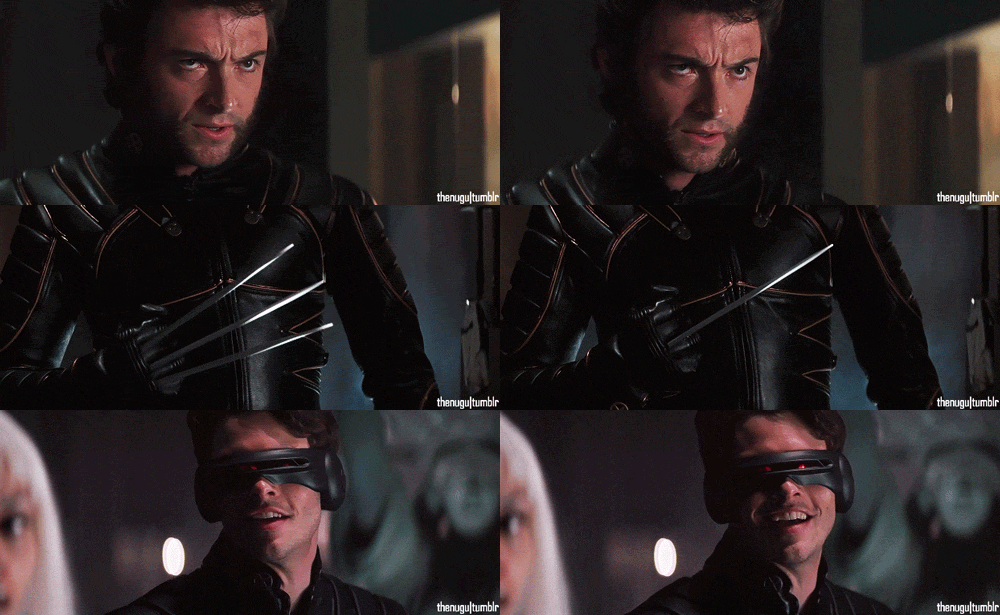
"X-MEN" (2000) Photo Gallery

mutants-x-men-2000-

Below are images from "X-MEN", the 2000 adaptation of the Marvel comic book series. Directed by Bryan Singer, the movie starred Patrick Stewart, Hugh Jackman, Ian McKellen and Anna Paquin: 


"X-MEN" (2000) Photo Gallery

3603_1893


174433__xmen_l


27889657-27889669-large


anna-paquin-and-rogue-costume-from-x-men-gallery


bruce-davison-as-senator-kelly-in-x-men-2000


james-marsden-scott-summers-cyclops-and-famke


kinopoisk.ru-X-Men-240013


kinopoisk.ru-X-Men-1366581


kinopoisk.ru-X-Men-1366582


Ray-Park-as-Toad-whose-tongue-can-extend-up-to-fifteen-feet-in-20th-Century-Foxs-X-Men-2000


bruce-davison-as-senator-kelly-in-x-men-2000-a


vlcsnap_2012_05_30_17h37m26s71_large


x1stills_001


x1stills_006


x1stills_007


X-Men


x-men3


x-men-2000_wolverine-02


X-Men2000-02


X-men-2000-15-g


X-Men-2000-lede


x-men-movie-2000_hugh_jackman


x-men-movie-jean-grey-famke-jannsen-cyclops-2000

Saturday, May 28, 2016

The Meaning of Colors

light-in-the-darkness


THE MEANING OF COLORS

Several years ago, I came across an old website about Wiccan practices and meanings. I was surprised to discover that even before the advent of Wicca in the early 20th century, Pagan worshipers associated colors with certain meanings. And those meanings turned out to be quite different than many people would today assume. 

Unlike today’s societies - especially in the Western world - white or light did not automatically mean something good, pure or noble. In fact, even the white wedding dress has nothing to do with the lack of sexual experience or innocence of the bride. The white wedding dress started out as a fashion trend . . . and remains one to this day. This fashion trend was created by Britain's Queen Victoria when she married Prince Albert of Saxe-Coburg in 1840. The young queen wanted to show that she was just a "simple" woman getting married, so she wore a white dress. She also wanted to incorporate some lace into her dress. Queen Mary of Scots wore a white wedding gown when she married Francis, Dauphin of France. Why? Because white was her favorite color. Before Victoria, women usually wore their best outfit for their wedding. 

But there are the exceptions in which white is used as a negative form of symbolism in Western culture. One of the major villains in C.S. Lewis' "THE CHRONICLES OF NARNIA" literary series is Jadis, the White Witch of Narnia. There is nothing dark about this character's physical appearance and wardrobe. She is all white. Another example of a villainous character who wore a white costume is Thomas Arashikage aka Storm Shadow from the "G.I. JOE" movie franchise. Ironically, Storm Shadow is a Japanese character portrayed by South Korean actor Lee Byung-hun. And white is usually associated with negative traits and death in Asian cultures. 

Albinism is also associated with the color white and negative traits in various forms of popular culture . Albino characters can be found in movies like "COLD MOUNTAIN""THE DA VINCI CODE""THE MATRIX RELOADED"; and in novels like "The Invisible Man" and "Blood Meridian". And all of these characters are either portrayed villains or those with negative traits. However, these are rare forms of white used as negative symbols and stereotypes.

So, what was the color white associated with . . . at least in Pagan circles? Simple. The color was associated with psychic pursuits, psychology, dreams, astral projection, imagination and reincarnation. Apparently moral goodness or purity has nothing to do with the color white. At least in old Pagan terms. Which leads me to this question . . . why do today’s Western societies insist that white has anything to do with moral compass of any form.

Finally, we come to the color black. As many people should know, modern Western societies tend to associate black or anything dark as something evil or negative. There are probably other societies that do the same. Fictional characters associated with evil in many science-fiction/fantasy stories are usually associated with black. Sorcery that has a negative effect upon someone is either called "black magic" or "the Dark Arts" (at least with the "HARRY POTTER" and Buffyverse franchises. And in the "POTTER" series, wizards and witches who have given in to evil are labeled as "dark". The "STAR WARS" franchise usually refer to evil as "the Dark Side of the Force"

In the "ONCE UPON A TIME" television series, the Rumpelstiltskin character was also called "the Dark One". Why? As it turned out, some entity called "the Darkness" had entered his body after he had stabbed the former holder of "the Dark One" title. Apparently, show runners Edward Kitsis and Adam Horowitz could not find a name for the entity and called it "The Darkness" - automatically associating its black coloring with evil. Now it seems that the series’ main character, Emma Swan, has been given the name, due to the entity entering her body. The ironic thing is that Emma's physical appearance - her skin, her eyes and hair - have become pale or white. Yet, she dresses in black and is called "the Dark One" or "the Dark Swan". I am still shaking my head over this contrast. As for magic, sorcery, or even psychic abilities in many of these movies and television shows, it is clear that their creators/show runners associate dark or black with evil and light or white with goodness. The only fictional character I can recall that go against this grain is Snake Eyes from the "G.I. JOE"movie franchise. Not only is he villain Storm Shadow's main adversary and one of the main heroes of the G.I. Joe team, he also wears a black costume.

Ironically, long time Pagans associated the color black with the following - binding, protection, neutralization, karma, death manifestation and will power. Someone might say - "A ha! Death manifestation! This is a term can be regarded as something negative or evil." But can it? Why is death constantly regarded as something negative? Because people are incapable of truly facing the idea of death. It is a natural part of our life span and yet, many people cannot accept it. And because of this negative attitude toward death, society associates death with . . . you guess it . . . the color black. Apparently the Pagans believed differently and did not associate black with anything evil or negative. I was surprised to discover that Chinese culture regard black as a symbol of water, one of the five fundamental elements believed to compose all things. The Chinese also associated black with winter, cold, and the direction North, usually symbolized by a black tortoise. Black is also associated with disorder - including the positive disorder which leads to change and new life. 

I have one last statement to make. I have noticed a growing trend on Internet message boards and forums for television shows and movies that deal with science-fiction and fantasy. This trend features a tendency by many of these fans to automatically associate white/light with goodness and black/dark with evil. The fans on these message boards no longer use the words "good" and "evil" anymore. Honestly. I am deadly serious. These fans either use the words light (lightness) or white; or . . . dark (darkness) or black. Why? And why do the creators of these television shows and movie franchises resort to the same behavior? I have to wonder. By associating anything black or dark with evil, are they associating anything or anyone with dark or black skin with evil? I suspect that many would say "of course not". Considering the notorious reputation of science-fiction/fantasy fans (or geeks) of being racist, I have to wonder.