Sunday, September 30, 2018

"THE TEN COMMANDMENTS" (1956) Review


"THE TEN COMMANDMENTS" (1956) Review

It has been a long time since I saw Cecil B. DeMille's 1956 movie, "THE TEN COMMANDMENTS". A long time. When I was young, my family and I used to watch the film on television, every Easter Sunday. By the time I reached my early to mid-twenties, I stopped watching the movie. 

I spent the next decade or two deliberately ignoring "THE TEN COMMANDMENTS". One, I had pretty much burned out on the 1956 film by then. Two, I had very little interest in Biblical films. I still do to a certain extent. And three, my opinion of DeMille's movie had pretty much sunk over the years. By the time, I reached my thirties, I came to the conclusion that it was an overrated film. So . . . what led me to change my mind for a recent viewing of "THE TEN COMMANDMENTS"? To be honest, the recent release Ridley Scott's Biblical film, "EXODUS: GODS AND KINGS". Both the 1956 and 2014 movies pretty much told the same story - the exodus of Hebrews from Egypt, under the leadership of Moses. I eventually plan to watch "EXODUS: GODS AND KINGS". But out of curiosity, I decided to watch "THE TEN COMMANDMENTS" first.

Anyone who has seen or heard about "THE TEN COMMANDMENTS" knows the story. Pharaoh Rameses I of Egypt orders the death of all firstborn Hebrew males upon hearing a prophecy in which a "Deliverer" will lead Egypt's Hebrew slaves to freedom. A Hebrew woman named Yochabel saves her infant son by setting him adrift in a basket on the Nile River. The Pharaoh's daughter Bithiah, who recently lost her husband, finds the child and adopts him as her own, despite the protests of her servant Memnet. Prince Moses grows up to be a part of Egypt's royal family. He becomes a successful general who wins a war against Ethopia and forms an alliance with the country. Moses falls in love with loves Nefretiri, who is the throne princess and must be betrothed to the next Pharaoh. He also becomes in charge of constructing a new city in honor of Pharoah Sethi's jubilee. But when his rival for the throne and Nefretiri's hand, Prince Rameses accuses him of being the Hebrew slaves' "Deliverer" after he institute reforms in regard to the slaves' treatment. Moses responses by showing the completed city and claiming that he wanted the slaves more productive in order to finish the project. Despite being on top of the world following his construction of the new city, Moses' privileged world is threatened when Nefretiri learns from a royal slave named Memnet that Moses is the son of a Hebrew slave.

I now realized why I had stopped watching "THE TEN COMMANDMENTS" for so many years. I had simply burned out on the film. My refusal to watch the movie for so many years had nothing to do with its quality. I am not saying that "THE TEN COMMANDMENTS" is one of the best films ever made. Not by a long shot. "THE TEN COMMANDMENTS", quite deservedly, is known for its over-the-top melodrama, bombastic style and preachiness. But the one thing the movie is known for it is the turgid dialogue that seemed to permeate the film. I cannot help but wonder if the screenwriters had disliked actress Anne Baxter or her character, Nefretiri. After hearing her spout lines like - "You will be king of Egypt and I will be your footstool!" - throughout the entire film, I am beginning to suspect that I may be right. Even the other performers - including Charlton Heston, Yul Brenner, Yvonne DeCarlo, Edward G. Robinson, Vincent Price, Debra Paget, John Derek, Judith Anderson, John Carradine, Martha Scott, Nina Foch and Sir Cedric Hardwicke - spoke their lines with a ponderous style that left me wondering if this movie had been shot at a slower speed. And to think, movie fans had to endure this ponderous style and turgid dialogue for slightly over three-and-a-half hours. Whew!

However, my re-watch of "THE TEN COMMANDMENTS" made me appreciate it a lot more. I appreciated the epic feel of DeMille's movie, as he guided audiences into Moses' life - from Moses' birth to his glory years as an Egyptian prince, to his years as an outcast and shepherd and finally to his years as a prophet and conflicts with Rameses - all in great detail and glorious Technicolor. DeMille even took the time to delve into the romance of supporting characters like Joshua and Lilia. There are some epic films that can bore me senseless with a ponderous style and equally ponderous pacing. Yes, the dialogue for "THE TEN COMMANDMENTS" can be quite ponderous. But I cannot say the same for DeMille's pacing. I found his direction well-paced, despite the movie's 220 minutes running time. One of the aspects of "THE TEN COMMANDMENTS" that I found truly impressive was Loyal Griggs' cinematography for the film. Shot in glorious Technicolor, Griggs' Oscar nominated photography left me breathless, especially while viewing scenes such as those shown below:

tumblr_nmcp7rgyxl1qetb0ho1_1280 

1956-Ten-Commandments-The-08

I was also impressed by other technical aspects of the film. That last scene, which featured the parting of the Red Seas, led to an Academy Award for John P. Fulton, who had created the movie's special effects. That scene hold up pretty damn well after 59 years. "THE TEN COMMANDMENTS" earned Oscar nominations for Edith Head's colorful costume designs, Anne Bauchens' film editing, Sam Comer and Ray Noyer's set decorations; and for art directors Hal Pereira, Walter H. Tyler, and Albert Nozaki.

What can I say about the movie's performances? Despite the ponderous dialogue, the performances seemed to hold up . . . okay. Charlton Heston earned a Golden Globe nomination for his portrayal of Moses. Granted, Heston projected a strong presence in his performance. But honestly . . . I would not regard Moses as one of his greatest performances. I merely found it solid. I was a little more impressed by Yul Brenner's portrayal of Ramses. He won the Best Actor National Board Review Award for his performance. Then again, Ramses proved to be a more complex and ambiguous character than Moses. As much as I liked Brenner's performance, it did not exactly blow my mind. Anne Baxter, who was already an Oscar winner by the time she did "THE TEN COMMANDMENTS", was saddled with some of the movie's worst dialogue. And there was nothing she could do to overcome the bad dialogue . . . well, except in two particular scenes. One of those scenes featured Nefretiri's discovery of Moses' origin as a Hebrew slave. And the other featured her character's angry goading of Ramses to take action against the Hebrews, following their son's death.

I read that Paramount had submitted Yvonne De Carlo, John Derek, and Debra Paget as possible nominees for a supporting Academy Award. All gave pretty good performances; especially Yvonne De Carlo, who portrayed Moses' wife Sephora, and Debra Paget, who portrayed Lilia, the slave woman who seemed doomed to attract the attention from the wrong kind of men. But none of them received any acting nominations for their work. There were other solid performances from the likes of Judith Anderson, Sir Cedric Hardwicke, Nina Foch, John Carradine, Martha Scott, Henry Wilcoxon and Woody Strode. But two particular performances really caught my attention. Ironically, they were portrayed by Vincent Price and Edward G. Robinson, who portrayed characters that proved to be the bane of Lilia's life. Both gave interesting performances as two very oily men who use Lilia as their personal bed warmer - Price as the well-born Egyptian architect Baka and Robinson as the ambitious Hebrew overseer Dathan, who later proves to be a thorn in Moses' side. 

"THE TEN COMMANDMENTS" proved to be the last film directed by Cecil B. DeMille to be seen in movie theaters. The last in a career that by 1956, had spanned forty-two years. The director passed away over two years following the movie's release. Frankly, "THE TEN COMMANDMENTS" struck me as a nice high note for DeMille to end his career. Yes, one has to endure the extremely long running time, occasional bouts of over-the-top drama and ponderous dialogue. But the movie's visual style, first-rate story, excellent direction in the hands of a legend like DeMille and solid performances from a cast led by Charlton Heston; makes this Hollywood classic worth watching over and over again.

Wednesday, September 19, 2018

"RIVER LADY" (1948) Photo Gallery

8117688879_13ef56603e_b

Below are images from "RIVER LADY", the 1948 adaptation of Frank Waters and Houston Branch's 1942 novel. Directed by George Sherman, the movie starred Yvonne DeCarlo, Rod Cameron and Dan Duryea: 


"RIVER LADY" (1948) Photo Gallery

Rivalen


image-w448


fc9bafc5d65bc530b9d34e0c0c248e7d


DeCarlo


critique-le-barrage-de-burlington-sherman11


CarterMcIntire


4887955_l2


1012311_1


1012310_5


6a00e5500c8a2a883301bb09840fc8970d

Monday, September 3, 2018

"Consequences of Lust"

PrideLydiaWickham


"CONSEQUENCES OF LUST"

All of Jane Austen's completed novels were first published during the Regency decade between 1810 and 1819, leaving present-day fans to celebrate the 200th anniversaries of each novel during this decade (2010-2019). Among those novels are "PRIDE AND PREJUDICE", now celebrating its bicentennial anniversary and "MANSFIELD PARK", which will be doing the same next year. 

"PRIDE AND PREJUDICE" told the story of five daughters of an English landowner named Mr. Bennet, whose wife is desperate to find husbands for them all. The novel was written from the viewpoint of Mr. Bennet's second daughter, Elizabeth; and she becomes engaged in a stormy relationship with a very wealthy landowner named Fitzwilliam Darcy. Elizabeth and her sisters face a major social setback when the youngest sibling, Lydia Bennet, foolishly runs off with a militia officer named George Wickham during a visit to Brighton. Wickham turns out to be the son of the Darcy family's late estate steward.

Published a year after "PRIDE AND PREJUDICE""MANSFIELD PARK" told the story of a young English girl named Fanny Price, who is sent to live with her wealthy relations at an estate called Mansfield Park. During her first ten years with the Bertram family, Fanny falls in love with her kind cousin, Edmund. Not long after her eighteenth birthday, the Bertram family become acquainted with a brother-and-sister pair named Henry and Mary Crawford. Edmund ends up falling in love with Mary, while Henry flirts with Edmund's two sisters - Maria and Julia. Eventually, Henry falls for Fanny. But due to her love for Edmund, she rejects his offers of marriage. And Henry responds by running off with one of Fanny's cousins - namely the newly married Maria Bertram Rushworth - with devastating consequences. 

The Lydia Bennet/George Wickham relationship and the Maria Bertram Rushworth/Henry Crawford relationship shared many similiarities. Both featured feelings of lust between the romantic pairs. However in Maria's case, I suspect she may have felt some love for Henry. The so-called "elopements" in both novels threatened to drag the families concerned into scandal. And the men in both relationships possessed reputations for skillful seduction and a penchant for mindless flirtations. But there are differences. 

Lydia Bennet was an unmarried girl of sixteen years old. Maria Bertram Rushworth was a married young woman in her early twenties during her disasterous affair with Henry Crawford. Two, George Wickham possessed an inability for genuine love and a mercenary's heart for money. Henry Crawford, despite his flaws, displayed a capability for genuine love; and possessed enough money to not even care about marrying an heiress. Thanks to Fitzwilliam Darcy's own feelings for Elizabeth Bennet; he searched for the missing Lydia and Wickham, paid off the latter's debts and arranged for the pair's wedding and Wickham's commission into another regiment. The Bennet family expressed relief over Lydia's marriage and Elizabeth expressed gratitude toward Mr. Darcy for solving their family problem.

Matters turned out differently over the Maria Rushworth/Henry Crawford affair. Determined to save the reputations of her family and the Bertrams, Mary Crawford suggested a similar vein of action to the Bertram family. She suggested that her brother Henry marry Maria, following the latter's divorce from Mr. Rushworth. Mary's plans never had a chance, due to Henry's refusal to marry Maria. Even worse, Edmund Bertram expressed outrage over Mary's plans and broke their engagement before marrying Fanny. And Sir Thomas punished Maria by forcing her to live in seclusion with her Aunt Norris.

I must admit that I found Austen's different methods in dealing with the fates of Lydia and Maria rather mind boggling. Did she ever realize that she had contradicted herself when she gave Maria Rushworth a harsher fate than Lydia Wickham? Mind you, Lydia's fate did not strike me as a bed of roses. She found herself married to a man who was a wastrel that did not love her. But as Austen hinted in the conclusion of "PRIDE AND PREJUDICE", Lydia and Wickham always had Elizabeth and Mr. Darcy to help them out of a financial jam. For some reason, Austen decided that Maria would face an uglier fate - banishment from Mansfield Park and her family and forced to live in seclusion with Aunt Norris. Austen also decided to punish Mary for suggestion the same thing that Mr. Darcy carried out in "PRIDE AND PREJUDICE".

Why? Why did Austen give a harsher fate for not only Maria Rushworth, but also Mary Crawford? Did she feel regret for not being harsh enough with Lydia? And what about Mr. Darcy? Why did he receive the gratitude for something that Mary Crawford was punished for suggesting? Because he was the protagonist's love interest? Did Austen expect her readers to change their views of Mr. Darcy's intervention, when she allowed Mary to not only fail in "MANSFIELD PARK" and be punished in the process? Or did Austen have another message in mind? Is it possible that Maria and Mary's cruel fates were some kind of an indictment against the Bertram family's claim of moral righteousness? Personally, I have no idea.


mp83henryelizablog

Monday, August 27, 2018

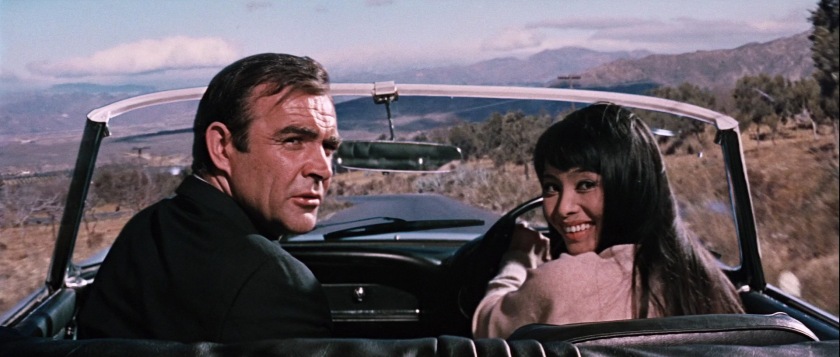
"YOU ONLY LIVE TWICE" (1967) Review

You-Only-Live-Twice-293

“YOU ONLY LIVE TWICE” (1967) Review
In recent years, EON Production’s 1967 movie, “YOU ONLY LIVE TWICE” has not been highly regarded by many Bond fans. In a way, I can understand why, judging by Sean Connery’s performance in his fifth consecutive turn as James Bond and the movie’s plot. 
The plot begins with the abduction of an American space capsule in space by a mysterious craft. The U.S. government blames the Soviet government, but the British government, who has tracked the mysterious craft to Japan, where James Bond is sent to investigate. With the help of Tiger Tanaka and Japan’s SIS agency, Bond eventually links the mysterious craft to SPECTRE, who is being paid by the People’s Republic of China to start a war between the U.S. and the Soviet Union. As one can see, the movie’s plot, written by Roald Dahl, bears very little resemblance to the novel under the same name. Characters like Kissy Suzuki, Tiger Tanaka, Ernst Blofeld and Dikko Henderson are in both the movie and the novel. But the latter dealt with a Bond (depressed over the death of his wife, Tracy) given one last chance by MI6 to get direct access from the Japanese to Magic 44, the project revealing all Soviet radio transmissions. The mission, which eventually involves Blofeld and a place called “Castle of Death”, seems like a far cry from the movie’s plot.
Not only is the movie’s plot bears very little or no resemblance to the novel (a first in the Bond franchise), there are some moments in the story that seem to defy logic. I never understood why Aki (Akiko Wakabayashi) failed to mention that she worked for Tiger Tanaka (Tetsuro Tamba) and the Japanese SIS when she first met Bond. Why would Helga Brandt (Karin Dor) go through all of that trouble in allowing Bond to “convince her” to betray Osato (Teru Shimada) before finally attempting to kill him? If she did it for sex with the British agent, then she had deserved to be consumed by the piranha fish. I never could figure out on which side was the wheel placed on Aki’s white Toyota sports car – the left or the right. What exactly did Bond plan to do once he joined the escaped American astronauts impersonating SPECTRE astronauts? Especially since he had sent Kissy Suzuki (Mie Hama) to summon Tiger and his Ninja warriors? And why in the hell did Blofeld (Donald Pleasance) shoot Osato and then force Bond to another spot before attempting to kill him? Why was it necessary for him to force Bond to move to a different spot, in the first place?
Most of the performances in the movie were satisfying. especially Akiko Wakabayashi, who memorably played the charming and very competent Aki. In fact, I would say that she practically gave one of two gem performances in the movie. It seemed a shame that she had failed to survive the movie. The other gem turned out to be the performance of Tetsuro Tambo, who played the charismatic head of Japan’s SIS, Tiger Tanaka. Teru Shimada was properly menacing as SPECTRE middleman, Mr. Osato. Charles Gray made a nice appearance as MI6 agent, Dikko Henderson, four years before his stint as Ernst Blofeld. 
Speaking of Blofeld, Pleasance was not bad, but his Middle European accent seemed a little unconvincing and the scar on his cheek seemed a little over-the-top. Karin Dor seemed like an obvious attempt on EON Production’s part to cash in on Luciana Paluzzi’s popular performance in “THUNDERBALL” . . . and it failed. Her appearance seemed like a waste of time. Mie Hama, although charming and beautiful, turned out to be one of the most boring Bond leading ladies of all time. I could not detect anything interesting about her character, Japanese SIS agent and diving girl, Kissy Suzuki. Many have commented on Sean Connery’s less than spectacular performance in this movie. And I must agree with their opinion. Granted, he had some good moments with Wakabayashi and Tambo, but overall, he seemed to be walking through the performance. And this is not surprising, since it had been reported that Connery was pretty much weary of the Bond role, by this time. But at least he did not seemed to be spoofing his role, as he did in “DIAMONDS ARE FOREVER”.
“YOU ONLY LIVE TWICE” did have high water marks, other than Wakabayashi and Tambo’s performances. The movie can boast beautiful shots of Japan, thanks to cinematographer, Freddie Young; and a lovely John Barry score, topped by a beautiful and lilting theme song, performed by Nancy Sinatra. “YOU ONLY LIVE TWICE” might not be considered the best of Bond films or those made during the Connery era, but it still turned out to be very entertaining. 

Wednesday, August 15, 2018

"G.I. JOE: THE RISE OF COBRA" Photo Gallery


Below are photos from "G.I. JOE: THE RISE OF COBRA", the 2009 adaptation of the Hasbro toy franchise.  Directed by Stephen Sommers, the movie starred Channing Tatum, Marlon Wayans and Sienna Miller: 


"G.I. JOE: THE RISE OF COBRA" Photo Gallery


Sunday, August 12, 2018

"CHARMED" RETROSPECT: (1.12) "The Wendigo"

Charmed112_590


"CHARMED" RETROSPECT: (1.12) "The Wendigo"

I really do not know what to say about the "CHARMED" Season One episode, (1.12) "The Wendigo". You know what? Of course I do. After all, it is one of my favorite episodes from that first season. In fact, it is one of my top twenty (20) "CHARMED" episodes of all time. 

"The Wendigo" began with one Piper Halliwell stranded at a local San Francisco park, thanks to a flat tire. The episode immediately kicked into high gear when a supernatural beast attacked her. The beast managed to inflict a deep scratch on her arm before a savior arrived in the form of a young man, who used a flare gun to scare off the beast. While being treated at the hospital for her scratch, Piper and her two sisters – Prue and Phoebe – learned that Prue’s old flame, Inspector Andy Trudeau of the San Francisco Police Department, had been in contact with an FBI agent named Ashley Fallon, due to previous attacks by the beast in the city. The three sisters also discovered that Piper’s savior, Billy Waters, had a previous encounter with the beast that left his fiancée dead, in Chicago. Ever since his fiancée’s death, Billy and FBI Agent Fallon have been tracking the beast. It was Piper who learned from the family’s Book of Shadows that the beast is called a Wendigo, a werewolf/Sasquatch hybrid that hunts victims during the three days of the full moon in order to eat their hearts. Because of her scratch, Piper ended up in danger of also becoming a Wendigo.

Written by Edithe Swensen and directed by James Conway, ”The Wendigo” had its flaws, despite my feelings about it. The majority of those flaws stemmed from moments of bad acting and a problem with the script. The only problem I had with the script centered on FBI Agent Fallon’s failure to work with agents from the local FBI office in San Francisco. I realize that the local law enforcement would have been drawn into the case, once the attacks in San Francisco began. But it never made sense to me that Fallon, an agent from another regional office, would be the only one from her agency working on the case in San Francisco and not an agent from the local FBI office. 

"The Wendigo" also featured a subplot in which Phoebe manages to wangle a job at Bucklands as Prue's assistant. While handling a bracelet to be sold at auction, Phoebe has flashes of a car accident. She discovered that the car in her vision had belonged to a private detective who was conveying a five year-old girl that had been kidnapped by her father. The subplot ended with Phoebe and Prue delivering the now eleven or twelve year-old girl to her mother. The subplot struck me as short, emotional and yet somewhat meaningless. Mere fodder to pad the episode. 

As for the acting, there are three moments I found . . . questionable. One involved Piper’s gradual transformation into the Wendigo. Perhaps Holly Marie Combs had been instructed by director James Conway to portray this as a comedy scene. Unfortunately, Combs did not come off as funny to me. Her timing seemed off. Nor did she seem ominous. Just awkward. Another moment featured Jocelyn Seagrave’s performance in a scene in which her Special Agent Fallon had described a past heartbreak over being rejected by a former love. No offense to Miss Seagrave, but she did come off as slightly theatrical. The last scene featured Prue and Phoebe confronting the original Wendigo and Piper, who had finally transformed into the beast. After Phoebe fired a flare gun at Wendigo Piper, the latter froze the flare and the original Wendigo. While Prue and Piper debated over who was the real Wendigo, the actor or actress (it could have been Holly Marie Combs) inside the Wendigo Piper suit stood in one spot with hands in attack position, stood in one spot and wore an idiotic expression that seemed to say "what do I do next?". It was a rather stupid moment.

But despite these minor quibbles, I genuinely enjoyed ”The Wendigo”. It was an entertaining monster-of-the-week episode that featured a first-rate performance by Holly Marie Combs as the anxiety-ridden Piper who feared she was turning into a monster. Although both Shannen Doherty and Alyssa Milano gave fine support, I was especially impressed by T.W. King, whose Andy Trudeau seemed suitably torn over his broken romance with Prue and his attraction to Special Agent Fallon. Despite my complaint over Jocelyn Seagrave’s reading over one particular scene, I must admit that she did a stand-out job of portraying a credible Federal agent and had a strong screen chemistry with King. I also have to commend actor Billy Jayne for giving a strong and charismatic performance as Piper’s savior, Billy Waters.

Thanks to director James L. Conway, ”The Wendigo” was not only entertaining, but well-paced. And despite the missing presence of local FBI agents in San Francisco and the subplot, I have to admit that Edithe Swensen wrote a lively and solid episode with plenty of horror and suspense. Swensen was also sensible enough not to reveal the human identity of the Wendigo, until two-thirds into the episode.

Watching ”The Wendigo” reminded me of how entertaining ”CHARMED” could be during its early seasons. Before the writing in the series began to decline at a serious rate. Before the dark times. With the entire series now on DVD and airing as reruns on TNT, fans have a constant reminder of its glory days . . . including episodes like ”The Wendigo”.

Friday, August 3, 2018

"BEAUTIFUL CREATURES" (2013) Review

Beautiful-Creatures_2


"BEAUTIFUL CREATURES" (2013) Review

In the tradition of the HARRY POTTER and TWILIGHT franchises, Hollywood has embarked upon another adaptation of a fantasy tale for children and young adults. This 2013  adolescent fantasy is an adaptation of a novel called "Beautiful Creatures"

The novel, written by Kami Garcia and Margaret Stohl, was published in 2009 and is considered the first in what should prove to be a literary series called Caster Chronicles. After Summit Entertainment's success with the TWILIGHT movie franchise and Warner Brothers' success with the HARRY POTTER films, the latter studio released BEAUTIFUL CREATURES to the movie theaters. Both the movie and the novel told the story about a teenager named Ethan Wate, who longs to escape the boredom of his South Carolina hometown, Gatlin. However, Ethan's boredom disappears when he meets a mysterious new girl named Lena Duchannes. Not only do Ethan and Lena uncover dark secrets about their respective families, their town and especially their history that stretches back to the Civil War; Ethan discovers that Lena and members of her family are magic practitioners - who are known in their world as "casters". 

Lena's talent as a "caster" also serves as an obstacle to her romance with Ethan. Her Uncle Macon Ravenwood disapproves of their growing romance and conspires with Ethan's family friend, Amma; to keep the two separated. Ethan learns that on Lena's 16th birthday, her true nature will steer her towards a light or dark path. And Lena fears of being consumed by evil and hurting those she loves. Even worse, the arrival of two powerful dark casters from the family hope to push Lena towards evil - her provocative cousin Ridley and her mother Sarafine, who forsees Lena becoming an even more powerful caster. Only Ethan believes that that Lena can determine her moral fate, due to her own choices.

I must admit that I really had no interest in seeing "BEAUTIFUL CREATURES". When I saw its trailer, the movie struck me as another one of those adolescent fantasies along the lines of the TWILIGHT franchise. But with nothing to do that particular weekend, I felt bored and realized that I had not experienced a first viewing of a movie since the holiday season. So, I went to see it. To my surprise, I actually enjoyed it. I cannot say that "BEAUTIFUL CREATURES" is one of the best fantasy romances I have ever seen. And it did not strike me as particularly original. But I did enjoyed it.

As I had stated earlier, "BEAUTIFUL CREATURES" does not strike me as an original film. It reminded me of numerous movie and television productions in which one half of a teen romance has magical or supernatural abilities. Two, I was a little disappointed that of all the "casters" in the film, audiences never saw Ethan's friend, Amma, display her magical abilities. The script made a big deal in building up Amma's abilities. But in the end, the script never really delivered. And three, the whole idea of a "caster" being steered to one particular moral path after a certain period of time unpleasantly reminded me of that infantile 48 Hours Window of Opportunity rule from the television series, "CHARMED". Fortunately, "BEAUTIFUL CREATURES" rose above such simple-minded nonsense by the end of the movie. Speaking of the movie's finale, I must admit that I was not that impressed by Lena's final confrontation with her mother, Sarafine. It almost struck me as anti-climatic and its ending left a sour taste in my mouth.

However, there were many aspects of "BEAUTIFUL CREATURES" that I enjoyed very much or I found admirable. First of all, I have to compliment Philippe Rousselot's photography of the Louisiana countryside that served as South Carolina. I found it lush, colorful and sharp. I especially enjoyed those scenes that featured the Ravenwood estate. Despite my disappointment over the movie's ending, I still enjoyed the movie's plot. And as I had stated earlier, I am very relieved that Garcia and Stohl's story rose above the usual black-and-white photography by the end. There was one particular scene that really blew my mind. It centered around Lena's attack upon her cousin Ridley at a family dinner and it involved a spinning dinner table. I really wish I could describe this scene in more details, but I suspect one would have to see it in order to understand my appreciation of it.

The cast of "BEAUTIFUL CREATURES" proved to be first rate. I wish I could say something about Eileen Atkins and Margo Martindale's performances as Lena's grandmother and aunt. But the script did no really give them the opportunities to display their acting skills. Emmy Rossum was luckier. She really strut her stuff as the sexy and somewhat sardonic Ridley, who seemed willing to assist Sarafine's efforts to corrupt Lena. Thomas Mann gave a rather humorous performance as Ethan's laconic, yet witty friend, "Link". Although her character was never given the opportunity to display any magical abilities, I must say that I really enjoyed Viola Davis' excellent performance as Ethan's tart-tongued and practical friend, Amma. Emma Thompson's ability to utilize an American accent has improved in the past twenty years, especially in her duel performance as Lena's mother Sarafine and Link's mother, the sanctimonious Mrs. Lincoln. More importantly, she was superb as the manipulative and cold-blooded Sarafine - especially in one scene that revealed Sarafine's possession of Mrs. Lincoln's body. Jeremy Irons' American accent struck me as somewhat shaky, but I certainly cannot say that about his performance as Lena's concerned, yet controlling and slightly arrogant uncle, Macon Ravenwood. However, the movie more or less belonged to Alden Ehrenreich and Alice Englert as the two young lovers, Ethan Wate and Lena Duchannes. One, the pair not only made a convincing pair of lovers, they had excellent screen chemistry. In fact, they complimented each other very well, thanks to Ehrenreich's energetic performance as Ethan and Englert's more subdued and moody portrayal of the introverted Lena.

I noticed that "BEAUTIFUL CREATURES" did not turn out to be the hit that Warner Brothers had hoped it would be. I could make an attempt on analyzing the movie's box office performance, but I find it would be irrelevant. To be honest, I really do not care one way or the other about its box office performance. Despite some flaws in the movie's last hour, I really enjoyed "BEAUTIFUL CREATURES". It was a surprising treat in the midst of a dismal winter movie season from five years ago.