"MILDRED PIERCE" (2011) Review
When HBO first revealed its plans to air an adaptation of James M. Cain's 1941 novel,
"Mildred Pierce", many people had reacted in some very interesting ways. Some seemed thrilled by the idea of a new version of Cain's story. But there were many who were not thrilled by the idea. And I suspect that this negative response had a lot to do with the first adaptation.
Sixty-six years ago, Warner Brothers Studios had released its own adaptation of the novel. Directed by Michael Curtiz, the movie starred Joan Crawford in the title role and Ann Blyth as her older daughter, Veda. The movie received several Academy Award nominations and a Best Actress statuette for Crawford. Due to the film's success and lasting popularity, many fans and critics viewed it as a definitive adaptation of one of Cain's works. So, when they learned about HBO's plans for a new version, many regarded the news with scorn. After all, how could any remake be just as good or superior to the classic Hollywood film?
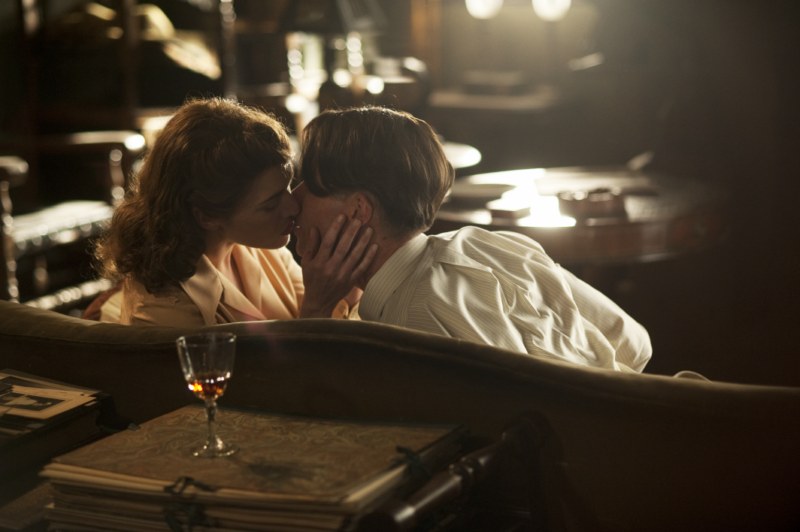
Was "MILDRED PIERCE" as a miniseries just as good or better than the 1945 movie? I will give my opinion on that topic later. I will say that I truly enjoyed both versions. The miniseries benefited from Todd Haynes serving as the director, one of the producers and one of the writers. Oscar winning actress, Kate Winslet portrayed the title role. The miniseries also possessed a talented supporting cast that included Guy Pearce, Melissa Leo, Brían F. O'Byrne, Mare Winningham, James Le Gros; along with Evan Rachel Wood ("TRUE BLOOD") and Morgan Turner. And I cannot deny that I found the miniseries' production designs first-rate, despite a few quibbles. But I have come across a good number of movies or television productions with everything in its favor that still failed to win me over in the end. Fortunately, "MILDRED PIERCE" did the opposite.
Todd Haynes had pointed out that his new miniseries would be more faithful to Cain's novel than the 1945 movie. And he was good on his word. The biggest differences between the Michael Curtiz movie and Haynes' new miniseries were the running times and the lack of a murder mystery in the miniseries. That is correct. Monty Beragon was never murdered in the novel and he certainly was not murdered in the new version. There were no flashbacks on Mildred's life, following her divorce from her first (and third) husband, Bert Pierce. And I am grateful to Todd Haynes for sparing the viewers that nonsense and sticking closer to Cain's plot. I believed that the murder plot unnecessarily dragged the Curtiz movie. And Haynes' miniseries was long enough. Due to the lack of a murder mystery, the miniseries retained Cain's slightly bleaker ending. Much to the dismay of many fans.
Since Haynes had decided to stick a little closer to the novel, the miniseries covered the story's entire time span of 1931 to 1940. Which meant that "MILDRED PIERCE" gave viewers a bird's eye view of the Depression's impact upon Southern Californians like the Pierce family. Part One began in 1931 with Mildred preparing a pie to sell to one of her neighbors. Husband Bert has joined the ranks of the broke and unemployed, thanks to the 1929 Wall Street Crash and the economic hijinks of his former business partner and friend, Wally Burgan. Bert seemed to spend most of his days engaged with chores like mowing the lawn or in an affair with a neighbor named Maggie Biderhof. Bert's announcement that he might spend another afternoon and evening with Mrs. Biderhof proves to be the last straw for Mildred. The couple have a heated quarrel that ends with Bert's departure from the family and eventually, a divorce.
Mildred realizes that she needs a steady income to support their two daughters, Veda and Ray. Unfortunately, Veda lacks any experience for a position outside of customer service. And being enamored of her upper-middle-class status, the idea of being a waitress, maid or housekeeper is abhorrent to Mildred. She also knows that such professions are abhorrent to her pretentious and class-conscious daughter, Veda. After rejecting jobs as housemaid to the future wife of a Hollywood director and waitress at a tea parlor, the realities of the Depression finally leads a desperate Mildred to take a job as waitress at a Hollywood diner. Unfortunately, Veda learns about the new job, which leads mother and daughter to their first major quarrel and Mildred's decision to make plans to open a restaurant. The quarrel also marked the real beginning of what proved to be the story's backbone - namely Mildred and Veda's tumultuous relationship.
As much as I admire "MILDRED PIERCE", it does have its flaws. I would view some of them as minor. But I consider at least one or two of them as major. One of the small problems proved to be Haynes' decision to shoot the miniseries in New York, instead of Southern California. Aside from Mildred's Glendale neighborhood, most of the locations in the miniseries do not scream "Southern California" - including the beach locations. The director claimed that he had chosen the area around New York City, because it was more cost-efficient than shooting around Los Angeles. He also claimed that it would be difficult to find "Old L.A." within the city today. Speaking as an Angeleno who has spent many weekends driving around the city, I found these excuses hard to swallow. Los Angeles and many other Southern California neighborhoods have plenty of locations that could have been used for the production. And could someone explain how filming around New York was cheaper than Los Angeles?
"MILDRED PIERCE" has received charges of slow pacing and an unnecessarily long running time. I have nothing against "MILDRED PIERCE" being shown in a miniseries format. But I have two quibbles regarding the pacing. One, the sequence featuring Mildred's job hunt dragged unnecessarily long. Haynes filled this segment with many long and silent shots of a pensive Mildred staring into the distant or dragging her body along the streets of Glendale and Los Angeles. I am aware that Haynes was trying to convey some kind of message with these shots. Unfortunately, I am not intellectually inclined and the sequence merely ignited my impatience. On the other hand, the speed in which Haynes continued Mildred's story in Episode Three left my head spinning. Aside from the sequence featuring the opening of Mildred's first restaurant, I felt that the episode moved a bit too fast . . . especially since so much happened to Mildred during the two to three year time span. I would have preferred if Episode Three had a running time of slightly over an hour - like Episodes Four and Five.
Complaints aside, this "MILDRED PIERCE" struck me as truly first-rate. As much as I had enjoyed the 1945 movie, I thank God that Todd Haynes did not add that ludicrous murder mystery into the plot. Cain's novel was not about Veda getting her comeuppance for being an ungrateful daughter to a hard-working mother. The story was about a resilient woman, who was also plagued by her personal flaws - which she refused to overcome, let alone acknowledge. Some viewers and critics have expressed confusion over Mildred's continuing obsession over her older daughter. Others have deliberately blinded themselves from Mildred's flaws and dumped all of the blame for her downfall entirely upon the heads of others - especially Veda. But there have been viewers and critics who managed to understand and appreciate the miniseries' portrayal of Mildred. I certainly did.
I have never understood the complaints that "MILDRED PIERCE" had failed to explain Mildred's unwavering obsession over Veda. I thought that Haynes perfectly revealed the reasons behind her obsession. First of all, he revealed those traits that both mother and daughter shared in numerous scenes - aspirations for entry into the upper-class, desire for wealth, snobbery, and a talent for manipulating others. Mildred's refusal to consider those jobs at a tea parlor and as the pretentious Mrs. Forrester's maid struck me as signs of her ego blinding her from the precarious state of her family's financial situation. And when she finally caved in to becoming a waitress at a Hollywood diner, Mildred considered quitting, because her sensibilities (or ego) could not fathom working in such a profession. Her contempt toward others suffering from the Depression after the successful opening of her Glendale restaurant was expressed in a scene with upper-class playboy Monty Beragon. Episode Five revealed her manipulation of Monty into marrying her . . . in order to lure Veda back to her seemed pretty obvious. But one scene not only revealed the core of Mildred's character, but also the miniseries' theme. While despairing over her decision to become a waitress at the end of Episode One, Mildred said this to neighbor Lucy Gessler:
"She (Veda) has something in her that I thought I had and now I find I don't. Pride or nobility or whatever it is. For both my girls, I want them to have all the cake in the world."
Judging from Mildred's comments, it was not difficult for me to see that she viewed Veda as an extension of herself and in some degrees, better. I believe that the quote also hinted Mildred's personal insecurities about living among the upper-class. This insecurity was revealed in a scene from Episode Three in which Mildred appeared at a polo field in Pasadena to pick up Veda, who was bidding her "babysitter" Monty good-bye. So, this argument that Haynes had failed to explain Mildred's enabling behavior toward Veda simply does not ring true with me.
Despite my complaint about Haynes' decision to shoot "MILDRED PIERCE" in New York, I must admit that I found myself impressed by Mark Friedberg's production designs. The miniseries' setting did not have a Southern California feel to me, but Friedberg certainly did an excellent job of re-creating the 1930s. He was ably supported by Peter Rogness' art designs and Ellen Christiansen's set decorations. But aside from Friedberg's work, the biggest contribution to the miniseries' Thirties look came from Ann Roth's costume designs. Not only did she provide the right costumes for the years between 1931 and 1940, she also ensured that the costumes would adhere to the characters' social positions and personalities. For example, both Roth and Haynes wisely insisted that Kate Winslet wear the same dowdy, brown print dress during Mildred's job hunt in Episode One. One last person whom I believe contributed to the miniseries' look and style was cinematographer Edward Lachman. If I must be honest, I was more impressed by Lachman's photography of various intimate scenes reflecting the characters' emotions or situations than any panoramic shot he had made. I was especially impressed by Lachman's work in Episode One's last scene and the Episode Five sequence featuring Veda's betrayal of Mildred.
Along with Todd Haynes' direction, it was the cast led by the uber-talented Kate Winslet that truly made "MILDRED PIERCE" memorable. First of all, the miniseries featured brief appearances from the likes of Richard Easton and Ronald Guttman, who each gave a colorful performance as Veda's music teachers during different periods in the story. Hope Davis was deliciously haughty as the Los Angeles socialite-turned-movie producer's wife with whom Mildred has two unpleasant encounters. In the 1945 movie, Eve Arden portrayed the character of Ida Corwin, which was a blend of two characters from Cain's novel - Mildred's neighbor Lucy Gessler and her diner co-worker Ida Corwin. The recent miniseries included both characters into the production. Fresh on the heels of her Oscar win, Melissa Leo gave an engaging performance as Mildred's cheerful and wise friend/neighbor, Lucy Gessler, who provided plenty of advice on the former's personal life. Aside from a two-episode appearance in the last season of "24", I have not seen Mare Winningham in quite a while. It was good to see her portray Mildred's blunt and business-savy friend and colleague, Ida Corwin.
At least three actors portrayed the men in Mildred's life - James LeGros, Brían F. O'Byrne and Guy Pearce. Although his sense of humor was not as sharp as Jack Carson's in 1945, I must admit that LeGros managed to provide some memorably humrous moments as Wally Burgan, Mildred's business adviser and temporary lover. Two of my favorite Wally moments turned out to be his reaction to the news of Mildred's breakup from her husband and to the revelation of her romance with Monty Beragon. Brían F. O'Byrne earned an Emmy nomination as Mildred's ex-husband, Bert Pierce. What I admired by O'Byrne's performance was the gradual ease in which he transformed Bert's character from a self-involved philanderer to a supportive mate by the end of the series. But the most remarkable performance came from Guy Pearce, who won a well-deserved Emmy for his performance as Monty Beragon, Mildred's Pasadena playboy lover and later, second husband. Thankfully, Pearce managed to avoid portraying Monty as some one-note villain and instead, captured both the good and the bad of his character's nuance - Monty's friendly nature, his condescension toward Mildred's class status, his seductive skills that kept her satisfied for nearly two years, his occasional bouts of rudeness and the hurt-filled realization that Mildred had used him to win back Veda.
Two remarkable young actresses portrayed Veda Pierce, the heroine's monstrous and talented older daughter. Morgan Turner portrayed Veda from age eleven to thirteen and I must say that she did a first-rate job. In the first three episodes, Turner convincingly developed Veda from a pretentious, yet still bearable eleven year-old to an ambitious girl in her early teens who has developed a deep contempt toward her mother. My only problem with Turner's performance were the few moments when her Veda seemed too much like an adult in a child's body. Evan Rachel Wood benefited from portraying Veda between the ages of 17 and 20. Therefore, her performance never struck me as slightly odd. However, she miss the opportunity to portray the development of Veda's monstrous personality. But that lost opportunity did not take away Wood's superb performance. Despite the awfulness of Veda's character, I must hand it to the young actress for injecting some semblance of ambiguity. Aside from portraying Veda's monstrous personality, Wood did an excellent job of conveying Veda's frustration with Mildred's overbearing love and the end of her own ambitions as a concert pianist.
I have been a fan of Kate Winslet since I first saw her in 1995's "SENSE AND SENSIBILITY". There have been and still are many talented actors and actresses with the ability to portray multifaceted characters. But I believe that Winselt is one of the few who are able to achieve this with great subtlety. Her portrayal of Glendale housewife-turned-entrepreneur Mildred Pierce is a prize example of her talent for acting in complex and ambiguous roles. Superficially, her Mildred Pierce was a long-suffering and hard-working woman, who overcame a failed marriage to become a successful entrepreneur . . . all for the love of her two daughters. Winslet not only portrayed these aspects of Mildred's character with great skill, but also conveyed the character's darker aspects, which I had already listed in this article. She more than earned that Emmy award for Best Actress in a Miniseries.
Although many have expressed admiration for "MILDRED PIERCE", these same fans and critics seemed to have done so with a good deal of reluctance or complaints. I will be the first to admit that the miniseries has its flaws. But I do not find them excessive. This reluctance to express full admiration for "MILDRED PIERCE" culminated in its loss for the Best Miniseries Emmy to the British import, "DOWNTON ABBEY". I had objected to this loss on the grounds that the British drama - a television series - was nominated in the wrong category; and that I believe "MILDRED PIERCE" was slightly superior.
Flawed or not, I believe that Todd Haynes did a superb job in adapting James M. Cain's novel. He wisely adhered to the literary source as close as possible, allowing viewers a more complex and ambiguous look into the Mildred Pierce character. Also, Haynes had a first-rate cast led by the incomparable Kate Winslet. As much as I love the 1945 movie, I must admit that this recent miniseries turned out to be a superior production. My admiration for Todd Haynes as a filmmaker has been solidified.