Sunday, October 14, 2018

"THOR: THE DARK WORLD" (2013) Photo Gallery

tumblr_mtql1m93Bp1syt6eao1_500

Below are images from "THOR: THE DARK WORLD", the sequel to Marvel Comics' 2011 movie "THOR". Directed by Alan Taylor, the movie stars Chris Hemsworth, Natalie Portman and Anthony Hopkins: 


"THOR: THE DARK WORLD" (2013) Photo Gallery

2ku5


11


18


19


22


29


30


Chris-Hemsworth-and-Tadanobu-Asano-in-Thor-The-Dark-World-2013-Movie-Image


jaimie-alexander-sif-thor-dark-world1


kinopoisk.ru-Thor_3A-The-Dark-World-2140005


kinopoisk.ru-Thor_3A-The-Dark-World-2141817


kinopoisk.ru-Thor_3A-The-Dark-World-2257233


eir


kinopoisk.ru-Thor_3A-The-Dark-World-2257234


kinopoisk.ru-Thor_3A-The-Dark-World-2257245


kinopoisk.ru-Thor_3A-The-Dark-World-2257246


kinopoisk.ru-Thor_3A-The-Dark-World-2265631


kinopoisk.ru-Thor_3A-The-Dark-World-2265632


Rene-Russo-as-Frigga


kinopoisk.ru-Thor_3A-The-Dark-World-2265635


kinopoisk.ru-Thor_3A-The-Dark-World-2265642


kinopoisk.ru-Thor_3A-The-Dark-World-2265643


kinopoisk.ru-Thor_3A-The-Dark-World-2272070


Thor-2_2709663b


thor2_tlr1_0285


thor2_tlr1_0525


thor2_tlr1_0820


thor-2-photos-fandral-zachary-levi-close


thor-the-dark-world-movie-trailer-screenshot-ray-stevenson


Thor-the-Dark-World-Thor-and-Jane


thor-the-dark-world-trailer-defends-different-worlds

Tuesday, October 9, 2018

"LOST" RETROSPECT: (2.04) "Everybody Hates Hugo"

ehh6


"LOST" RETROSPECT: (2.04) "Everybody Hates Hugo"

Unless I am mistaken, Season Two of "LOST" is not very popular with the show's fans. This season expanded on the Hatch (DHARMA Swan Station) subplot that was touched upon in the second half of Season One. This season introduced a tiresome running joke surrounding the Michael Dawson character. And it also featured the introduction of the survivors from Oceanic 815's Tail Section, which included the unpopular character, Ana-Lucia Cortez. In some way, the fourth episode - (2.04) "Everybody Hates Hugo" - seemed to be some kind of manifestation of Season Two. 

Aside from the joke regarding Michael Dawson, "Everybody Hates Hugo" touched upon most of the topics I brought up in the previous paragraph. In the previous episode, (2.03) "Orientation", the survivors of Michael's raft (Michael, James "Sawyer" Ford and Jin Kwon) were captured by a mysterious group of people upon their return to the Island. "Everybody Hates Hugo" focused on their incarceration inside a deep pit. Before Sawyer could finish plotting their escape, the mysterious group revealed to be survivors from Oceanic 815's Tail Section. Despite some hostile conflict between Sawyer and the Tailies' leader, Ana-Lucia Cortez, all agree it would be best to head for the Fuselage passengers' beach camp. Claire Littleton stumble across the bottle of messages from Michael's raft on the beach. She and several survivors worry over the fate of Michael, his son Walt Lloyd, Jin and Sawyer. Following the tiresome three-episode introduction of the Swan Station's interiors, Jack and Sayid explore the hatch. They also order a very reluctant Hugo "Hurley" Reyes to ration the food found inside the station. The episode's flashbacks reveal the consequences of Hurley winning the lottery . . . and his reasons for wanting to be in charge of food distribution on the Island.

I have to be frank. The episode's main subplot involving Hurley's job in the Hatch and his flashback did nothing for me. I found it boring. Well . . . I almost found it boring. Hurley's reasons behind his reluctance to win the lottery and be in charge of the Losties' food distribution clarified an aspect of his personality that I have always suspected. Despite some flashes of wisdom and common sense, Hurley is at heart a man-child who is reluctant to grow up. Unfortunately, this is an aspect of Hurley's character I have never admired. In fact, I found it tiresome . . . over and over again. And I never could understand why fans have never noticed in past viewings. One could point out that Hurley became more mature as the series progressed. I find that hard to believe, considering the circumstances behind Hurley's eventual fate. Hurley's minor quarrel with Charlie over the secrecy of the Swan Station struck me as infantile. It did not help that Charlie's constant rants about betrayal really irritated me. But I must admit that both Jorge Garcia and Dominic Monaghan gave first-rate performances. The only thing about this subplot that I found entertaining was Hurley's interaction with Rose Nadler, portrayed by the very talented L. Scott Caldwell.

The second subplot regarding Jack and Sayid's exploration of the Swan Station only seemed a step above the main subplot. The only reason I found it slightly more interesting was due to the mystery surrounding the Hatch. It seemed like a more mature subplot than one about Hurley's man-child issues. That even includes Jack's accidental encounter with a nearly nude Kate Austen, after she had finished taking a shower. What interested me was Sayid's discovery of an electromagnetic energy within the Hatch's walls. This discovery will end up being fully revealed by mid-to-late Season Five. The third subplot involved Claire's discovery of the bottle of messages from the raft. This subplot struck me as irrelevant . . . period. Aside from giving Shannon Rutherford a moment to see a wet manifestation of Walt - an event that will have greater impact in a future episode - this subplot did nothing to drive the series' main narrative forward. Instead, it involved some of the female survivors speculating on the fates of the raft's passengers. And nothing more.

It was the final subplot regarding Michael, Jin and Sawyer's experiences with the Tailies that really injected energy into the episode. It was not so much the mystery surrounding the raft survivors' captors that made "Everybody Hates Hugo"so interesting to me. The three men discovered they had been captured by survivors from the Tail Section before halfway into the episode. But the psychological conflict between the more familiar characters and the newcomers crackled with a lot of energy that made me take notice. I especially found the conflict between Sawyer and Ana-Lucia, thanks to Josh Holloway and Michelle Rodriguez's intense performances very entertaining. I realized that a good number of "LOST" fans disliked the Ana-Lucia Cortez character ever since this episode aired during the fall of 2005. I must admit that I had a different reaction. The powerhouse punch that Ana-Lucia delivered to Sawyer in "Orientation" had already thrilled me. Her continuing abuse of the always annoying Sawyer filled me with even more glee. I realize that most fans would probably be put off by my comments. But I do not care. I like Sawyer, but he was a real pain in the ass in this particular episode. At least to me.

"Everybody Hates Hugo" ended both on a mysterious and uplifting note. The Tailies led the raft survivors to another hatch that had been originally constructed by the DHARMA Initiative. Apparently, they had been using it as refuge from the jungle and the Others inside the nearly abandoned Arrow Station. So much for the mystery. What did I find uplifting about the episode? Certainly not the cheesy monologue featuring Hurley's generous distribution of the food from the Swan Station. It was that moment when one of the Tail Section survivors approached the raft survivors and asked if they knew Rose. Thanks to a poignant performance by Sam Anderson, I nearly cried when he revealed himself to be Rose's missing husband, Bernard. Great way to end an otherwise mediocre episode, "LOST"!

Sunday, September 30, 2018

"THE TEN COMMANDMENTS" (1956) Review


"THE TEN COMMANDMENTS" (1956) Review

It has been a long time since I saw Cecil B. DeMille's 1956 movie, "THE TEN COMMANDMENTS". A long time. When I was young, my family and I used to watch the film on television, every Easter Sunday. By the time I reached my early to mid-twenties, I stopped watching the movie. 

I spent the next decade or two deliberately ignoring "THE TEN COMMANDMENTS". One, I had pretty much burned out on the 1956 film by then. Two, I had very little interest in Biblical films. I still do to a certain extent. And three, my opinion of DeMille's movie had pretty much sunk over the years. By the time, I reached my thirties, I came to the conclusion that it was an overrated film. So . . . what led me to change my mind for a recent viewing of "THE TEN COMMANDMENTS"? To be honest, the recent release Ridley Scott's Biblical film, "EXODUS: GODS AND KINGS". Both the 1956 and 2014 movies pretty much told the same story - the exodus of Hebrews from Egypt, under the leadership of Moses. I eventually plan to watch "EXODUS: GODS AND KINGS". But out of curiosity, I decided to watch "THE TEN COMMANDMENTS" first.

Anyone who has seen or heard about "THE TEN COMMANDMENTS" knows the story. Pharaoh Rameses I of Egypt orders the death of all firstborn Hebrew males upon hearing a prophecy in which a "Deliverer" will lead Egypt's Hebrew slaves to freedom. A Hebrew woman named Yochabel saves her infant son by setting him adrift in a basket on the Nile River. The Pharaoh's daughter Bithiah, who recently lost her husband, finds the child and adopts him as her own, despite the protests of her servant Memnet. Prince Moses grows up to be a part of Egypt's royal family. He becomes a successful general who wins a war against Ethopia and forms an alliance with the country. Moses falls in love with loves Nefretiri, who is the throne princess and must be betrothed to the next Pharaoh. He also becomes in charge of constructing a new city in honor of Pharoah Sethi's jubilee. But when his rival for the throne and Nefretiri's hand, Prince Rameses accuses him of being the Hebrew slaves' "Deliverer" after he institute reforms in regard to the slaves' treatment. Moses responses by showing the completed city and claiming that he wanted the slaves more productive in order to finish the project. Despite being on top of the world following his construction of the new city, Moses' privileged world is threatened when Nefretiri learns from a royal slave named Memnet that Moses is the son of a Hebrew slave.

I now realized why I had stopped watching "THE TEN COMMANDMENTS" for so many years. I had simply burned out on the film. My refusal to watch the movie for so many years had nothing to do with its quality. I am not saying that "THE TEN COMMANDMENTS" is one of the best films ever made. Not by a long shot. "THE TEN COMMANDMENTS", quite deservedly, is known for its over-the-top melodrama, bombastic style and preachiness. But the one thing the movie is known for it is the turgid dialogue that seemed to permeate the film. I cannot help but wonder if the screenwriters had disliked actress Anne Baxter or her character, Nefretiri. After hearing her spout lines like - "You will be king of Egypt and I will be your footstool!" - throughout the entire film, I am beginning to suspect that I may be right. Even the other performers - including Charlton Heston, Yul Brenner, Yvonne DeCarlo, Edward G. Robinson, Vincent Price, Debra Paget, John Derek, Judith Anderson, John Carradine, Martha Scott, Nina Foch and Sir Cedric Hardwicke - spoke their lines with a ponderous style that left me wondering if this movie had been shot at a slower speed. And to think, movie fans had to endure this ponderous style and turgid dialogue for slightly over three-and-a-half hours. Whew!

However, my re-watch of "THE TEN COMMANDMENTS" made me appreciate it a lot more. I appreciated the epic feel of DeMille's movie, as he guided audiences into Moses' life - from Moses' birth to his glory years as an Egyptian prince, to his years as an outcast and shepherd and finally to his years as a prophet and conflicts with Rameses - all in great detail and glorious Technicolor. DeMille even took the time to delve into the romance of supporting characters like Joshua and Lilia. There are some epic films that can bore me senseless with a ponderous style and equally ponderous pacing. Yes, the dialogue for "THE TEN COMMANDMENTS" can be quite ponderous. But I cannot say the same for DeMille's pacing. I found his direction well-paced, despite the movie's 220 minutes running time. One of the aspects of "THE TEN COMMANDMENTS" that I found truly impressive was Loyal Griggs' cinematography for the film. Shot in glorious Technicolor, Griggs' Oscar nominated photography left me breathless, especially while viewing scenes such as those shown below:

tumblr_nmcp7rgyxl1qetb0ho1_1280 

1956-Ten-Commandments-The-08

I was also impressed by other technical aspects of the film. That last scene, which featured the parting of the Red Seas, led to an Academy Award for John P. Fulton, who had created the movie's special effects. That scene hold up pretty damn well after 59 years. "THE TEN COMMANDMENTS" earned Oscar nominations for Edith Head's colorful costume designs, Anne Bauchens' film editing, Sam Comer and Ray Noyer's set decorations; and for art directors Hal Pereira, Walter H. Tyler, and Albert Nozaki.

What can I say about the movie's performances? Despite the ponderous dialogue, the performances seemed to hold up . . . okay. Charlton Heston earned a Golden Globe nomination for his portrayal of Moses. Granted, Heston projected a strong presence in his performance. But honestly . . . I would not regard Moses as one of his greatest performances. I merely found it solid. I was a little more impressed by Yul Brenner's portrayal of Ramses. He won the Best Actor National Board Review Award for his performance. Then again, Ramses proved to be a more complex and ambiguous character than Moses. As much as I liked Brenner's performance, it did not exactly blow my mind. Anne Baxter, who was already an Oscar winner by the time she did "THE TEN COMMANDMENTS", was saddled with some of the movie's worst dialogue. And there was nothing she could do to overcome the bad dialogue . . . well, except in two particular scenes. One of those scenes featured Nefretiri's discovery of Moses' origin as a Hebrew slave. And the other featured her character's angry goading of Ramses to take action against the Hebrews, following their son's death.

I read that Paramount had submitted Yvonne De Carlo, John Derek, and Debra Paget as possible nominees for a supporting Academy Award. All gave pretty good performances; especially Yvonne De Carlo, who portrayed Moses' wife Sephora, and Debra Paget, who portrayed Lilia, the slave woman who seemed doomed to attract the attention from the wrong kind of men. But none of them received any acting nominations for their work. There were other solid performances from the likes of Judith Anderson, Sir Cedric Hardwicke, Nina Foch, John Carradine, Martha Scott, Henry Wilcoxon and Woody Strode. But two particular performances really caught my attention. Ironically, they were portrayed by Vincent Price and Edward G. Robinson, who portrayed characters that proved to be the bane of Lilia's life. Both gave interesting performances as two very oily men who use Lilia as their personal bed warmer - Price as the well-born Egyptian architect Baka and Robinson as the ambitious Hebrew overseer Dathan, who later proves to be a thorn in Moses' side. 

"THE TEN COMMANDMENTS" proved to be the last film directed by Cecil B. DeMille to be seen in movie theaters. The last in a career that by 1956, had spanned forty-two years. The director passed away over two years following the movie's release. Frankly, "THE TEN COMMANDMENTS" struck me as a nice high note for DeMille to end his career. Yes, one has to endure the extremely long running time, occasional bouts of over-the-top drama and ponderous dialogue. But the movie's visual style, first-rate story, excellent direction in the hands of a legend like DeMille and solid performances from a cast led by Charlton Heston; makes this Hollywood classic worth watching over and over again.

Wednesday, September 19, 2018

"RIVER LADY" (1948) Photo Gallery

8117688879_13ef56603e_b

Below are images from "RIVER LADY", the 1948 adaptation of Frank Waters and Houston Branch's 1942 novel. Directed by George Sherman, the movie starred Yvonne DeCarlo, Rod Cameron and Dan Duryea: 


"RIVER LADY" (1948) Photo Gallery

Rivalen


image-w448


fc9bafc5d65bc530b9d34e0c0c248e7d


DeCarlo


critique-le-barrage-de-burlington-sherman11


CarterMcIntire


4887955_l2


1012311_1


1012310_5


6a00e5500c8a2a883301bb09840fc8970d

Monday, September 3, 2018

"Consequences of Lust"

PrideLydiaWickham


"CONSEQUENCES OF LUST"

All of Jane Austen's completed novels were first published during the Regency decade between 1810 and 1819, leaving present-day fans to celebrate the 200th anniversaries of each novel during this decade (2010-2019). Among those novels are "PRIDE AND PREJUDICE", now celebrating its bicentennial anniversary and "MANSFIELD PARK", which will be doing the same next year. 

"PRIDE AND PREJUDICE" told the story of five daughters of an English landowner named Mr. Bennet, whose wife is desperate to find husbands for them all. The novel was written from the viewpoint of Mr. Bennet's second daughter, Elizabeth; and she becomes engaged in a stormy relationship with a very wealthy landowner named Fitzwilliam Darcy. Elizabeth and her sisters face a major social setback when the youngest sibling, Lydia Bennet, foolishly runs off with a militia officer named George Wickham during a visit to Brighton. Wickham turns out to be the son of the Darcy family's late estate steward.

Published a year after "PRIDE AND PREJUDICE""MANSFIELD PARK" told the story of a young English girl named Fanny Price, who is sent to live with her wealthy relations at an estate called Mansfield Park. During her first ten years with the Bertram family, Fanny falls in love with her kind cousin, Edmund. Not long after her eighteenth birthday, the Bertram family become acquainted with a brother-and-sister pair named Henry and Mary Crawford. Edmund ends up falling in love with Mary, while Henry flirts with Edmund's two sisters - Maria and Julia. Eventually, Henry falls for Fanny. But due to her love for Edmund, she rejects his offers of marriage. And Henry responds by running off with one of Fanny's cousins - namely the newly married Maria Bertram Rushworth - with devastating consequences. 

The Lydia Bennet/George Wickham relationship and the Maria Bertram Rushworth/Henry Crawford relationship shared many similiarities. Both featured feelings of lust between the romantic pairs. However in Maria's case, I suspect she may have felt some love for Henry. The so-called "elopements" in both novels threatened to drag the families concerned into scandal. And the men in both relationships possessed reputations for skillful seduction and a penchant for mindless flirtations. But there are differences. 

Lydia Bennet was an unmarried girl of sixteen years old. Maria Bertram Rushworth was a married young woman in her early twenties during her disasterous affair with Henry Crawford. Two, George Wickham possessed an inability for genuine love and a mercenary's heart for money. Henry Crawford, despite his flaws, displayed a capability for genuine love; and possessed enough money to not even care about marrying an heiress. Thanks to Fitzwilliam Darcy's own feelings for Elizabeth Bennet; he searched for the missing Lydia and Wickham, paid off the latter's debts and arranged for the pair's wedding and Wickham's commission into another regiment. The Bennet family expressed relief over Lydia's marriage and Elizabeth expressed gratitude toward Mr. Darcy for solving their family problem.

Matters turned out differently over the Maria Rushworth/Henry Crawford affair. Determined to save the reputations of her family and the Bertrams, Mary Crawford suggested a similar vein of action to the Bertram family. She suggested that her brother Henry marry Maria, following the latter's divorce from Mr. Rushworth. Mary's plans never had a chance, due to Henry's refusal to marry Maria. Even worse, Edmund Bertram expressed outrage over Mary's plans and broke their engagement before marrying Fanny. And Sir Thomas punished Maria by forcing her to live in seclusion with her Aunt Norris.

I must admit that I found Austen's different methods in dealing with the fates of Lydia and Maria rather mind boggling. Did she ever realize that she had contradicted herself when she gave Maria Rushworth a harsher fate than Lydia Wickham? Mind you, Lydia's fate did not strike me as a bed of roses. She found herself married to a man who was a wastrel that did not love her. But as Austen hinted in the conclusion of "PRIDE AND PREJUDICE", Lydia and Wickham always had Elizabeth and Mr. Darcy to help them out of a financial jam. For some reason, Austen decided that Maria would face an uglier fate - banishment from Mansfield Park and her family and forced to live in seclusion with Aunt Norris. Austen also decided to punish Mary for suggestion the same thing that Mr. Darcy carried out in "PRIDE AND PREJUDICE".
Why? Why did Austen give a harsher fate for not only Maria Rushworth, but also Mary Crawford? Did she feel regret for not being harsh enough with Lydia? And what about Mr. Darcy? Why did he receive the gratitude for something that Mary Crawford was punished for suggesting? Because he was the protagonist's love interest? Did Austen expect her readers to change their views of Mr. Darcy's intervention, when she allowed Mary to not only fail in "MANSFIELD PARK" and be punished in the process? Or did Austen have another message in mind? Is it possible that Maria and Mary's cruel fates were some kind of an indictment against the Bertram family's claim of moral righteousness? Personally, I have no idea.


mp83henryelizablog

Monday, August 27, 2018

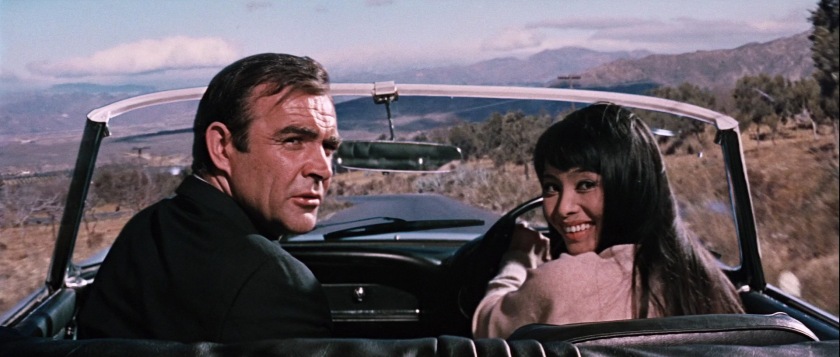
"YOU ONLY LIVE TWICE" (1967) Review

You-Only-Live-Twice-293

“YOU ONLY LIVE TWICE” (1967) Review
In recent years, EON Production’s 1967 movie, “YOU ONLY LIVE TWICE” has not been highly regarded by many Bond fans. In a way, I can understand why, judging by Sean Connery’s performance in his fifth consecutive turn as James Bond and the movie’s plot. 
The plot begins with the abduction of an American space capsule in space by a mysterious craft. The U.S. government blames the Soviet government, but the British government, who has tracked the mysterious craft to Japan, where James Bond is sent to investigate. With the help of Tiger Tanaka and Japan’s SIS agency, Bond eventually links the mysterious craft to SPECTRE, who is being paid by the People’s Republic of China to start a war between the U.S. and the Soviet Union. As one can see, the movie’s plot, written by Roald Dahl, bears very little resemblance to the novel under the same name. Characters like Kissy Suzuki, Tiger Tanaka, Ernst Blofeld and Dikko Henderson are in both the movie and the novel. But the latter dealt with a Bond (depressed over the death of his wife, Tracy) given one last chance by MI6 to get direct access from the Japanese to Magic 44, the project revealing all Soviet radio transmissions. The mission, which eventually involves Blofeld and a place called “Castle of Death”, seems like a far cry from the movie’s plot.
Not only is the movie’s plot bears very little or no resemblance to the novel (a first in the Bond franchise), there are some moments in the story that seem to defy logic. I never understood why Aki (Akiko Wakabayashi) failed to mention that she worked for Tiger Tanaka (Tetsuro Tamba) and the Japanese SIS when she first met Bond. Why would Helga Brandt (Karin Dor) go through all of that trouble in allowing Bond to “convince her” to betray Osato (Teru Shimada) before finally attempting to kill him? If she did it for sex with the British agent, then she had deserved to be consumed by the piranha fish. I never could figure out on which side was the wheel placed on Aki’s white Toyota sports car – the left or the right. What exactly did Bond plan to do once he joined the escaped American astronauts impersonating SPECTRE astronauts? Especially since he had sent Kissy Suzuki (Mie Hama) to summon Tiger and his Ninja warriors? And why in the hell did Blofeld (Donald Pleasance) shoot Osato and then force Bond to another spot before attempting to kill him? Why was it necessary for him to force Bond to move to a different spot, in the first place?
Most of the performances in the movie were satisfying. especially Akiko Wakabayashi, who memorably played the charming and very competent Aki. In fact, I would say that she practically gave one of two gem performances in the movie. It seemed a shame that she had failed to survive the movie. The other gem turned out to be the performance of Tetsuro Tambo, who played the charismatic head of Japan’s SIS, Tiger Tanaka. Teru Shimada was properly menacing as SPECTRE middleman, Mr. Osato. Charles Gray made a nice appearance as MI6 agent, Dikko Henderson, four years before his stint as Ernst Blofeld. 
Speaking of Blofeld, Pleasance was not bad, but his Middle European accent seemed a little unconvincing and the scar on his cheek seemed a little over-the-top. Karin Dor seemed like an obvious attempt on EON Production’s part to cash in on Luciana Paluzzi’s popular performance in “THUNDERBALL” . . . and it failed. Her appearance seemed like a waste of time. Mie Hama, although charming and beautiful, turned out to be one of the most boring Bond leading ladies of all time. I could not detect anything interesting about her character, Japanese SIS agent and diving girl, Kissy Suzuki. Many have commented on Sean Connery’s less than spectacular performance in this movie. And I must agree with their opinion. Granted, he had some good moments with Wakabayashi and Tambo, but overall, he seemed to be walking through the performance. And this is not surprising, since it had been reported that Connery was pretty much weary of the Bond role, by this time. But at least he did not seemed to be spoofing his role, as he did in “DIAMONDS ARE FOREVER”.
“YOU ONLY LIVE TWICE” did have high water marks, other than Wakabayashi and Tambo’s performances. The movie can boast beautiful shots of Japan, thanks to cinematographer, Freddie Young; and a lovely John Barry score, topped by a beautiful and lilting theme song, performed by Nancy Sinatra. “YOU ONLY LIVE TWICE” might not be considered the best of Bond films or those made during the Connery era, but it still turned out to be very entertaining.