”APPOINTMENT WITH DEATH” (2008) Review
Looking back on the number of Agatha Christie movie adaptations I have seen, I find it surprising that only a handful of Christie titles have been adapted for the movies or television more than once. One of those titles happened to be the author’s 1938 novel called ”Appointment With Death”.
The most well known adaptation before the 2008 one had been produced and directed by Michael Winner some twenty years earlier. Released in 1988, the movie starred Peter Ustinov in his last appearance as the Belgian-born sleuth, Hercule Poirot; and is not considered among the best of Christie adaptations before the premiere of ”Agatha Christie’s POIROT” around 1989. The production values of the 1988 version of ”APPOINTMENT WITH DEATH” almost had a cheap, B-movie quality about it. Nevertheless, I feel that it is a masterpiece in compare to this recent version that starred David Suchet as Poirot.
”APOINTMENT WITH DEATH” told the story of Hercule Poirot’s investigation into the murder of a wealthy, middle-aged American woman named Lady Boynton (Mrs. Boynton in the novel). But screenwriter Guy Andrews made so many changes from Christie’s original tale that it would seem pointless for me to recap the plot. One, the victim is not a widow. Instead, she is in the middle of a second marriage to a British peer and archeologist named Lord Boynton. Only Lennox Boynton is her stepson by marriage . . . and his name has become Leonard. The others – Carol, Raymond and Ginerva (Jinny) – had been adopted before her marriage to Lord Boynton. And yes, Jinny is no longer her child by blood. Lady Boynton never spent time as a warden for a women’s prison. Instead, she was an astute businesswoman. The character of Nadine, Lennox’s wife, did not appear in this adaptation. Jefferson Hope was transformed from the Boynton family’s attorney, into an American traveler with business ties to Lady Boynton. Dr. Gerard’s nationality and profession had been changed from French psychologist to British medical doctor. The American-born Member of Parliament, Lady Westholme, became British-born world traveler Dame Celia Westholme. And former nursery governess Miss Amabel Pierce, became known as “Nanny”; Lady Boynton’s nervous and very reluctant henchwoman in the abuse of the murder victim’s many adopted children. Andrews also added a new character – a Polish-born nun, who had befriended Jinny, named Sister Agnieszka. However, Dr. Sarah King remained intact – in both characterization and profession. The story’s setting is changed from Petra to Syria. The novel featured a single killer. This movie featured two killers . . . and a different motive. These changes allowed Andrews to give the murderers a fate straight from the finale of 1937’s ”Death on the Nile”.
I have to make one thing clear regarding the changes made by Guy Andrews. I have nothing against a writer making changes from a literary source to accommodate a screen adaptation. There are some things that do not translate well to the screen. But I feel that most of the changes made by Andrews did NOT serve the movie’s plot very well. In fact, I would say that the opposite happened. Despite its B-movie atmosphere; the 1988 movie seemed like an elegant affair in comparison to this 2008 version. Mind you, the latter had some virtues. David Suchet gave a subtle performance as Hercule Poirot. Peter Greenhalgh’s photography struck me as beautiful and rich in colors. Even Sheena Napier’s costume designs managed to capture the mid-to-late 1930s quite well. Elizabeth McGovern’s portrayal of a British or Irish female seemed surprisingly competent, despite her being American-born. Both Tim Curry (as Lord Boynton) and John Hannah (as Dr. Gerard) gave entertaining performances. And I also felt impressed by Christina Cole (Dr. Sarah King) and Mark Gatiss (Leonard) performances as well. So, why do I have such a low opinion of this movie?
My main beef with ”APPOINTMENT WITH DEATH” was the changes made to the story. I simply found them unnecessary. The change in the story's setting from Petra to Syria, created a small confusion. In the 1930s, part of Syria was under British control and the other half was under French control. Yet, the movie featured a very British Colonel Carbury (portrayed by Paul Freeman), who had French troops under his command. Confusing. And was it really necessary to include characters like Lord Boynton and Sister Agnieszka, who did not exist in the novel? No. Lord Boynton was nothing more than a red herring created to distract viewers of the teleplay. And Sister Agnieszka was used to include a subplot that was never in the novel and had nothing to do with the main narrative. Was it necessary to change the number of murderers from one to two? Again . . . no. By changing the number of murderers, Andrews changed the motive behind the victim’s murder from preserving a secret to an act of revenge. Worse, by changing the number of murderers and motive, Andrews complicated the plot to such a ridiculous level that by the end of the story, I found myself shaking my head in disbelief. Even more ridiculous was the convoluted method used by the killers to bump off Lady Boynton. Was it necessary to include a subplot about the sex slave trade, which had nothing to do with Lady Boynton’s murder? I would say no. Especially since the subplot was never included in Christie’s novel.
In the novel, Mrs. Boynton inflicted a great deal of psychological abuse upon her step-children and her daughter, Jinny. This movie had Lady Boynton bullying a hired nanny – Nanny Taylor - into inflicting physical abuse upon the many children she had adopted over the years – including Raymond, Carol . . . and Jinny. Was the change necessary? I certainly do not believe it was. Both the novel and the 1988 film made it painfully obvious how harmful Mrs. Boynton’s psychological abuse was upon her stepchildren. Apparently, Andrews, director Ashley Pierce and the producers thought it was not dramatic enough and decided to be more drastic by including physical abuse. To emphasize the horror of Lady Boynton’s domestic situation, they allowed Nanny Taylor to fall into a catatonic state following her employer’s death out of guilt. I found these changes unnecessary. I found the idea of Nanny Taylor remaining with the family after the children became adults irrelevant. And if I must be brutally honest, I was not that impressed by Angela Pleasance’s slightly hammy performance as the tormented nanny.
In a review of "MURDER ON THE ORIENT EXPRESS", the 2010 version of Christie’s 1934 novel, I had complained about the religious themes that permeated that movie. Apparently, ”MURDER ON THE ORIENT EXPRESS” was not the first movie in the series to emphasize religion. The same happened two years earlier in ”APPOINTMENT WITH DEATH”. As I had stated earlier, one of the new characters turned out to be a Polish-born Catholic nun. I had to endure a sanctimonious conversation between her and Ginerva. Lord Boynton’s archeological quest turned out to be a search for John the Baptist’s head. I had never heard of anything so ridiculous. How was anyone supposed to figure out whether the head of John the Baptist or some citizen of the region had been found? And to make matters worse, once Lord Boynton thought he had found the object of his quest, he had Sister Agnieszka lead the rest of the party into a prayer over said skull. The scene struck me as too ludicrous to believe. The over-the-top choral music that permeated Stephen McKeon’s score did not help matters.
When it comes to adapting a novel or play for the screen, I have no problems with screenwriters making changes to the story or any of the characters . . . if those changes manage to serve the film. After all, some aspects of a novel or play do not translate well into film. But the changes I found in ”APPOINTMENT WITH DEATH” struck me as unnecessary. They not only failed to serve the movie’s plot, I found them convoluted and over-the-top. The addition of a religious theme simply made matters worse. The movie had a few virtues – including a solid performance from David Suchet. But not even he could save the amount of damage inflicted upon this movie.

Below is an article I had written about a famous comfort food dish known as Macaroni and Cheese:MACARONI AND CHEESEMacaroni and Cheese is a famous dish known throughout Europe and other Western countries, especially the United States. My own memories of the dish date back to my childhood when my parents and grandmother used to serve it to me and my siblings . . . especially from the pre-packaged box form created by the company, Kraft. But I have eaten traditional homemade Macaroni and Cheese every now and then.Although known today as an American comfort dish, Macaroni and Cheese was a dish made from Parmesan cheese and past that originated in Italy. Pasta and cheese casseroles have been recorded in cookbooks as early as the 14th century's "Liber de Coquina", one of the oldest medieval cookbooks. The dish also made its first appearance in England during the same century, in the famous English medieval cookbook titled "Forme of Cury".The first modern recipe for Macaroni and Cheese appeared in Elizabeth Raffald's 1769 book "The Experienced English Housekeeper". Her recipe called for a Béchamel sauce with Cheddar cheese, which is mixed with macaroni pasta, sprinkled with Parmesan cheese and baked. The dish also appeared in the famous Victorian cookbook, "Mrs. Beeton's Book of Household Management" and included two recipes for the dish.Many would be surprised to learn that the future third President of the United States, Thomas Jefferson may have been responsible for the introduction of Macaroni and Cheese to Americans. He first sampled the dish in both in Paris and in northern Italy, and later incorporated the dish at his Virginia home, Monticello. As the country's third president, Jefferson served Macaroni and Cheese at a State dinner in 1802. Mary Randolph, sister to Jefferon's son-in-law Thomas Mann Randolph Jr., included a recipe for the dish in her 1824 cookbook, "The Virginia Housewife".Below is a recipe for "Macaroni and Cheese" from the MyRecipe website:Macaroni and CheeseIngredients2 cups milk2 tablespoons butter2 tablespoons all-purpose flour1/2 teaspoon salt1/4 teaspoon freshly ground black pepper1 (10-oz.) block extra sharp Cheddar cheese, shredded1/4 teaspoon ground red pepper (optional)1/2 (16-oz.) package elbow macaroni, cookedPreparation1. Whisk flour into butterPreheat oven to 400°. Microwave milk at HIGH for 1 1/2 minutes. Melt butter in a large skillet or Dutch oven over medium-low heat; whisk in flour until smooth. Cook, whisking constantly, 1 minute.2. Whisk in warm milkGradually whisk in warm milk, and cook, whisking constantly, 5 minutes or until thickened.3. Whisk in cheeseWhisk in salt, black pepper, 1 cup shredded cheese, and, if desired, red pepper until smooth; stir in pasta. Spoon pasta mixture into a lightly greased 2-qt. baking dish; top with remaining cheese. Bake at 400° for 20 minutes or until golden and bubbly.

"JOHN WICK: CHAPTER 3 - PARABELLUM" (2019) Review
I have seen all three films in the "JOHN WICK" franchise so far. All three of them. However, "JOHN WICK: CHAPTER 3 - PARABELLUM" is the first film I saw in the movie theaters. And it is the first I have reviewed for my blog.
"JOHN WICK: CHAPTER 3 - PARABELLUM" picked up a few minutes later after the franchise's last film, "JOHN WICK: CHAPTER 2" left off. In the latter, former assassin John Wick had been approached by Italian crime lord Santino D'Antonio to assassinate his sister Gianna, so he can claim her seat at the "High Table", a council of 12 high-level crime lords. Although reluctant to complete the task, John is forced to accept D'Antonio's request since the latter had helped him with a task that allowed him to retire as an assassin and marry his late wife. However, Gianna committed suicide before John could kill her and D'Antonio put a contract on the former under the guise of "avenging his sister's death". Determined to get revenge for this betrayal, John pursued D'Antonio to the Continental Hotel, a refuge for the underworld's assassins where no "business" is allowed, and kills the Italian gangster. Because he had broken the hotel's "no killing" rule, John is declared "excommunicado" by his handlers at the High Table and placed under a $14 million bounty.
In this third film, John struggles to evade nearly every assassin, while he tries to retrieve a crucifix necklace and a "marker" medallion from a secret cache in a book at the New York City Public Library. He needs both items to present to the Director, a woman from his past, and use as a "ticket" for safe passage to Casablanca, Morocco. With the help of an old friend and fellow assassin named Sofia, John hopes to fend off other assassins long enough to reach the Elder of the "High Table" and find a way to call off the bounty. However, John eventually learns that he will have to pay a few steep prices to achieve his goal.
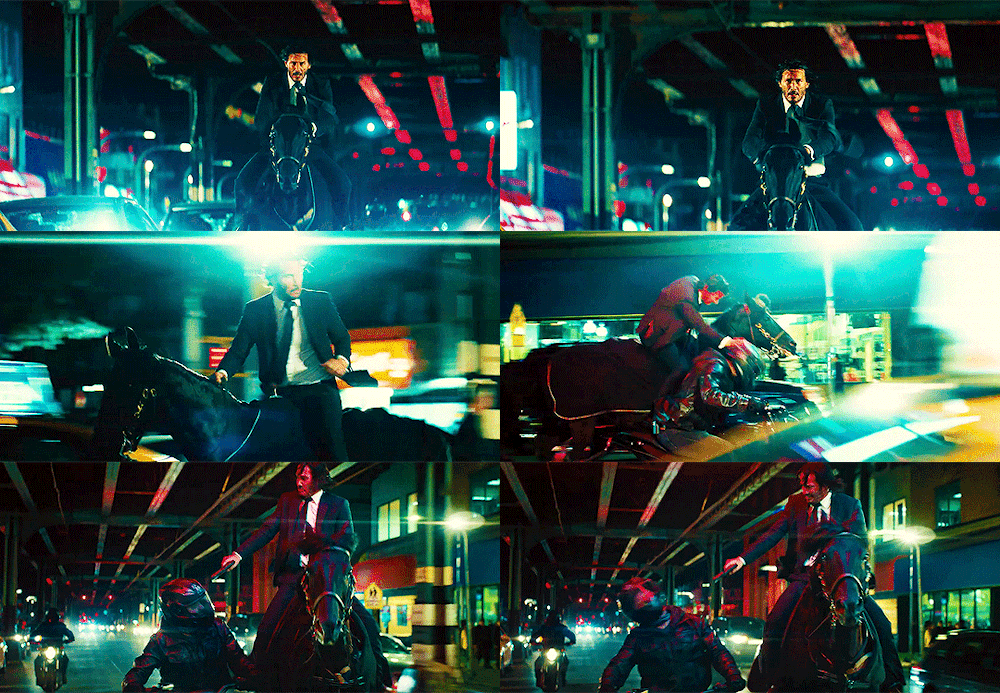
I wish I could say that I loved "JOHN WICK: CHAPTER 3 - PARABELLUM". Hell, I wish I could say that I loved all of the John Wick movies. But I did not. I merely liked them. What kept me from loving these three films? The level of action featured in them. "JOHN WICK 3" opened with the main protagonist leaving the Continental Hotel and making his way to the main New York Public Library in order to retrieve two objects that would help him leave the country. I do not know how long this sequence lasted, but it almost seemed like forever. Wick seemed to encounter one assassin after the other, city block after city block. Even when he reached the library, he had to fight off another assassin. Then he was forced to defend himself against more assassins as he struggled to reach the Director, a Russian-born who had raised him. There was such an overwhelming slew of action in this film that I was to appreciate the more dramatic moments with great relief. When I had asked one of my relatives on how she felt about the movie, her response was . . . "action porn". She liked the movie, but like me, found the amount of action in it rather overwhelming.
I honestly cannot think of anything else that turned me off about "JOHN WICK: CHAPTER 3 - PARABELLUM". Ironically, as much as I found the onslaught of action a bit off putting, there were a handful of scenes that I genuinely enjoyed, thanks to Chad Stahelski's direction. There were three sequences that stood out for me. One involved Wick's unexpected encounter with a rather large assassin inside the New York Library. His final fight against a New York City assassin named Zero and the latter's men at the New York Continental Hotel almost struck me as surreal. But if I had to select my favorite action sequence, it has to be his battle against a group of assassins in Casablanca, with the aide of his old friend, Sofia. Watching Keanu Reeves and Halle Barry fight side by side against a slew of killers proved to be more than satisfying for me. And exciting.
I also suspect that this deluge of action had allowed the film's five screenwriters to create a more streamlined narrative. Five screenwriters? This movie required five screenwriters? Anyway, one of the aspects of the John Wick films that I found refreshing is that the narratives for the three films were not repetitive. "JOHN WICK 3" marked the first time that the hero is forced to face the consequences of his actions. There is a reason why once or twice, a self-reflective Wick had to admit that he had brought his current crisis upon himself. More importantly, he also realized that his decision to become a professional assassin and criminal in the first place had brought him to this point in his life. In age in which the questionable decisions and actions of many protagonists in movies and television are either swept under the table or whitewashed, John Wick's self-reflection struck me as a breath of fresh air.
"JOHN WICK: CHAPTER 3 - PARABELLUM" featured some solid performances from its supporting cast. The likes of Lance Reddick, Anjelica Huston, Jerome Flynn, Randall Duk Kim and Yayan Ruhian did not exactly blow my mind, but I found their performances impressive. Saïd Taghmaoui gave a brief, yet impressive performance as the Elder, leader of the High Table; whom John Wick struggles to reach to overturn the contract against him. Asia Kate Dillon was memorable as the Adjudicator, a member of the High Table who castigated both Winston and the Bowery King for helping Wick in the previous film. However, I thought her character seemed like a remake of the character she portrays on Showtime's "BILLIONS". Ian McShane was elegant and charismatic as ever as Winston, the manager of the Continental Hotel, who found himself in trouble for giving Wick a head start on the contract in the second film. Laurence Fishburne was equally charismatic as the New York crime lord known as the Bowery King. But unlike McShane, I also found his performance rather theatrical in an entertaining way. Halle Berry radiated charismatic, style and gravitas as an old friend of Wick named Sofia, who helps him reach the Elder. I really enjoyed both her dramatic and action scenes with the leading man. Speaking of the latter, Keanu Reeves was perfect, as usual as the ex-assassin John Wick. I think I enjoyed his performance in this film a bit more, due to the pathos he infused in scenes that featured Wick's self reflections about his profession and past.
In a nutshell, I would never regard "JOHN WICK: CHAPER 3 - PARABELLUM" as among the best action movies I have seen. Like the other movies in the JOHN WICK franchise, I thought it was over saturated with too many action sequences. But . . . the movie did feature a solid and well-written narrative that picked up from where the second movie in the franchise left off. More importantly, I was impressed that for once, the main protagonist was paying the consequences of his past actions. In the end, I thought director Chad Stahelski had delivered a solid and entertaining film with a talented cast led by Keanu Reeves.