Saturday, April 16, 2011

"BATTLE: LOS ANGELES" (2011) Photo Gallery


Below are images from the new science fiction thriller called "BATTLE: LOS ANGELES". Directed by Jonathan Liebesman, the movie stars Aaron Eckhart, Michelle Rodriguez, Bridget Moynahan, Ramon Rodgriguez, Ne-Yo, and Michael Peña:


"BATTLE: LOS ANGELES" (2011) Photo Gallery


Tuesday, April 12, 2011

TIME MACHINE: Bombardment of Fort Sumter


TIME MACHINE: BOMBARDMENT OF FORT SUMTER

This month marked the 150th anniversary of the bombardment of Fort Sumter, near Charleston, South Carolina. Following this attack, the United States found itself plunged into a civil war that lasted four years.

Following Abraham Lincoln's election as the 16th president of the United States in November 1860, several Southern states threatened to secede from the Union, fearful that a Republican administration would pose threats to the political, social and financial agendas of their region. The one thing they generally feared was that Lincoln and his administration would abolish slavery, undermining both their social and financial power.

Nearly two months after Lincoln's victory at the polls, South Carolina became the first state to declare its secession from the Union on December 20, 1860. Within a month, six more states seceded - Mississippi, Florida, Alabama, Georgia, Louisiana, and Texas. Not long after South Carolina's secession, the state demanded that the U.S. Army abandon its facilities in Charleston Harbor. Realizing that his command might be in danger, Major Robert Anderson moved his command from the indefensible Fort Moultrie, a more substantial fortress that controlled the entrance to Charleston Harbor. Lame duck President James Buchanan sent an unarmed merchant ship named the Star of the West to deliver supplies and reinforcement troops to Major Anderson's command on in early January. But on January 9, 1861; cadets from The Citadel, stationed at the Morris Island battery, fired upon the steamer as it tried to enter Charleston Harbor. The Star of the West was hit three times before it turned around at headed back to its home port in New York.

South Carolina authorities then seized all Federal property in the Charleston area, following the Star of the West incident. Only Fort Sumter remained outside its grasp. However, the commander eventually found itself besieged by South Carolina military forces throughout the winter of 1861. In late February, the Confederate States of America was formed, with Jefferson Davis (formerly a senator from Mississippi) named as its president. The following month, two events occurred. Abraham Lincoln was inaugurated as President of the United States. And Pierre Gustave Toutant Beauregard, the first commissioned general officer of the Confederate Army, was placed in command of Confederate forces in Charleston. Beauregard immediately began strengthening the batteries around Charleston harbor, aimed at Fort Sumter. Conditions in the fort grew dire as Major Anderson found himself short of men, food, and supplies.

On April 4, President Lincoln had sent a naval expedition led by former captain Gustavus V. Fox, who had proposed a plan for nighttime landings of vessels smaller than the Star of the West. Fox's orders were to land at Sumter with supplies only. And if he was opposed by the Confederates, he was to respond with the U.S. Navy vessels following and to then land both supplies and men. This time, Major Anderson was informed of the impending expedition, although the arrival date was not revealed to him. President Lincoln informed South Carolina governor, Francis W. Pickens, that he planned to send supply ships to Fort Sumter. The Confederate government responded by sending an ultimatum to the Lincoln administration that Anderson and his men must evacuate Fort Sumter immediately. Anderson refused to surrender. On April 12, at 4:30 a.m., Confederates bombarded the fort from artillery batteries surrounding the harbor.

Lieutenant Henry S. Farley, acting upon the command of Captain George S. James, fired a single 10-inch mortar round from Fort Johnson. James had offered the first shot to Virginia secessionist Roger Pryor. But the latter declined, stating that he could not fire the first gun of the war. The shell exploded over Fort Sumter as a signal to open the general bombardment from 43 guns and mortars at Fort Moultrie, Fort Johnson, the floating battery, and Cummings Point. General Beauregard ordered the guns fired in a counterclockwise sequence around the harbor, with 2 minutes between each shot. He wanted to conserve ammunition, which he calculated would last for only 48 hours. Edmund Ruffin, another Virginia secessionist, had traveled to Charleston in order to be present for the beginning of the war, and fired one of the first shots at Sumter after the signal round - a 64-pound shell from the Iron Battery at Cummings Point. The shelling of Fort Sumter from the batteries ringing the harbor awakened Charleston's residents, including diarist Mary Chesnut.

Major Anderson withheld his fire, awaiting daylight. His troops reported for roll call at 6 a.m. and then had breakfast. At 7 a.m., Captain Abner Doubleday fired a shot at the Ironclad Battery at Cummings Point. He missed. Given the available manpower, Anderson could not take advantage of all of his 60 guns. Although the Federals had moved as many of their supplies to Fort Sumter as they could manage, the fort was nearly out of ammunition at the end of the 34-hour bombardment. Because of the shortages, Major Anderson reduced his firing to only six guns - two aimed at Cummings Point, two at Fort Moultrie, and two at the Sullivan's Island batteries.

Ships from Gustave Fox's relief expedition began to arrive on April 12. Although Fox himself arrived at 3 a.m. on his steamer Baltic, most of the rest of his fleet was delayed until 6 p.m. One of the two warships, USS Powhatan, never did arrive. Unbeknownst to Fox, it had been ordered to the relief of Fort Pickens in Florida. As landing craft were sent toward the fort with supplies, the artillery fire deterred them and they pulled back. Fox decided to wait until after dark and for the arrival of his warships. But heavy seas made it difficult to load the small boats with men and supplies on the next day. Fox was left with the hope that Anderson and his men could hold out until dark on April 13.

On April 13, Fort Sumter's central flagpole was knocked down at 1 p.m., raising doubts among the Confederates about whether the fort was ready to surrender. Colonel Louis Wigfall, a former U.S. senator, had been observing the battle and decided that this indicated the fort had had enough punishment. He commandeered a small boat and proceeded from Morris Island, waving a white handkerchief from his sword, dodging incoming rounds from Sullivan's Island. He met with Major Anderson and indicated that the latter had did all that was possible to defend the fort. He suggested that Anderson surrender, before any blood was shed. Encouraged that Wigfall had used the word "evacuate" instead of "surrender", Anderson agreed to a truce. He knew that his command was low on ammunition and his men, hungry and exhausted. He ordered that one of his men raise Wigfall's white handkerchief on its flagpole as the former senator departed in his small boat back to Morris Island. The handkerchief was spotted in Charleston and a delegation of officers that included Beauregard; Stephen D. Lee; Porcher Miles, a former mayor of Charleston, and Roger Pryor; sailed to Sumter, unaware of Wigfall's visit. Anderson was outraged when these officers disavowed Wigfall's authority, telling him that the former senator had not spoken with Beauregard for two days. He threatened to resume firing. General Beauregard sent a second set of officers, offering essentially the same terms that Wigfall had presented. And the Anderson-Wigfall agreement was reinstated.

After 34 hours, Major Anderson agreed to evacuate on April 14, at 2:30 p.m. There had been no loss of life on either side as a direct result of this engagement. During the 100-gun salute to the U.S. flag - Anderson's one condition for withdrawal - a pile of cartridges blew up from a spark, killing 36 year-old Irish born Private Daniel Hough instantly and mortally injuring another member of the gun crew, Private Edward Gallway. Hugh and Gallway were the first fatalities of the American Civil War. The salute stopped at fifty shots. Gallway died a few days later at a hospital at Charleston. The rest of Anderson's troops spent the night aboard a Confederate steamer named the Isabel. The next morning, they were transported to Gustave Fox's relief ship Baltic, resting outside the harbor bar. Major Anderson carried the Fort Sumter flag with him North, where it became a widely known symbol of the battle and a rallying point for supporters of the Union.

The bombardment of Fort Sumter became the first military action of the American Civil War. Following the surrender, Northerners rallied behind Lincoln's call of arms to recapture the fort and preserve the Union. This call for 75,000 volunteers triggered four additional states - Arkansas, Virginia, Tennessee and North Carolina - to join the Confederacy. The ensuing war lasted four years. Fort Sumter officially returned to Union hands on April 14, 1865; with Robert Anderson in attendance (who was by then, retired). The war effectively ended on April 9, 1865; with the surrender of General Robert E. Lee's Army of Northern Virginia to General Ulysses S. Grant at Appomattox Courthouse, in Virginia.

Saturday, April 9, 2011

"THE GREEN HORNET" (2011) Review


"THE GREEN HORNET" (2011) Review

My memories of the costumed hero, the Green Hornet, are pretty sketchy. I can only recall actor Van Williams portraying the character in the short-lived television series from the mid-1960s, with future martial arts icon, Bruce Lee, portraying his manservant and partner-in-crime fighting, Kato. But if I must be honest, I never saw any of the episodes from the series. My memories of Williams and Lee as the Green Hornet and Kato were limited to their guest appearances on the ABC series, ”BATMAN”.

When I had first heard about plans to release a movie about the Green Hornet featuring comic actor, Seth Rogen in the title role, I met the news with less than enthusiasm. One, I have never been a fan of the Green Hornet character. Two, I have never been a fan of Rogen’s. And three, the fact that this new version of ”THE GREEN HORNET” was filmed as a comedy-adventure put it completely out of my mind, after I received the news. It was not until the movie was released in theaters and I found myself with nothing else to do for a weekend, when I went ahead and saw the movie.

In a nutshell, ”THE GREEN HORNET” is an origins tale about Britt Reid, the playboy heir to a Los Angeles newspaper owner. Following the death of his autocratic father, Britt befriends the latter’s mechanic and assistant – a technical genius and martial arts fighter named Kato. The pair manages to save a couple from being robbed and assaulted one night, while vandalizing a statue of the late James Reid. Inspired by their act of good deed and some close calls with the criminals and the police, Britt and Kato decide to make something of their lives by becoming a masked crime fighting team called the Green Hornet and his unnamed partner. Due to their close call with the police, Britt and Kato pretend to be criminals in order to in order to infiltrate real criminals, and also to prevent enemies from using innocents against them. Their first target turns out to be a Russian mobster named Benjamin Chudnofsky (Christoph Waltz), who is uniting the criminal families of Los Angeles under his command, and whom James Reed was trying to expose. To get Chudnofsky's attention, Britt uses his newspaper, the Daily Sentinel as a vehicle to publish articles about the "high-profile criminal" the Green Hornet. Britt hires an assistant and researcher named Lenore Case, who has a degree in criminology, and uses her unwitting advice to raise the Green Hornet's profile.

What was my opinion of ”THE GREEN HORNET”? Honestly? I enjoyed it very much. I found it funny, entertaining, and exciting. First and foremost, the movie possessed plenty of laughs, thanks to Rogen and Evan Goldberg’s script. I usually do not find Rogen all that funny. But I must admit that his attempts at being the big crime fighter, while Kato saved his ass time-and-again, left me in stitches. Realizing that Britt lacked any self-defense skills, Kato created a gun filled with stun gas for the former to use against their enemies. And I found Rogen’s portrayal of Britt’s egotistical reaction to the gun rather hilarious. Not only did ”THE GREEN HORNET” provide plenty of laughs, but it also had some first-rate action sequences. My favorites include the Green Hornet and Kato’s encounter with a group of street thugs that led them to a meth lad controlled by Chudnofsky, their attempt to extract themselves from a trap set by the gangster at a construction site and the fight between Britt and Kato at the Reid mansion, over the many issues developed between the two. But the major sequence that started at the Japanese restaurant and ended at the Daily Sentinel really impressed me and I have to give kudos to Michel Gondry for his direction.

I suppose that Seth Rogen could have portrayed Britt Reid/the Green Hornet in a straight manner, but I do not know if I would have bought it. A more conventional leading man could have been hired for the role, but if I must be honest, I was too impressed by Rogen to really care. Many critics complained that Rogen portrayed Reid/the Green Hornet as a man-child. And he did . . . at first. But the script and Rogen’s performance allowed (or forced) Reid to face the consequences of his massive ego and his decision to become a crime fighter and grow up in a very painful way. I have never heard of Jay Chou, who is a well-known musician and actor from Taiwan. But I must admit that I was very impressed by his performance as Kato, Britt’s talented and exasperated partner in crime fighting. His acting style seemed to strongly remind me of Clint Eastwood and Steve McQueen’s – very subtle and very quiet. Yet, Chou also displayed a wry sense of humor that I found entertaining. And I was surprised to discover that he managed to convey not only Kato’s resentment and fear that the latter might be regulated to becoming the Green Hornet’s “sidekick”, but also his own egotistical nature. More importantly, his subtle acting style contrasted perfectly with Rogen’s more bombastic style and the two formed a first-rate screen team.

I had been appalled by the news that Christoph Waltz was cast as the main villain in ”THE GREEN HORNET”, especially on the heels of his success in 2009’s ”INGLORIOUS BASTERDS”. The idea of an acclaimed actor in a costumed hero action movie with comic overtones seemed so beneath him. But after seeing the movie, I am soooo glad that he was cast as the Russian gangster, Benjamin Chudnofsky. He was both hilarious and scary at the same time. Most villains featured in comedy action films tend to be either bland or simply ruthless and scary. Thankfully, Waltz’s Chudnofsky was not bland. But he was scary, ruthless . . . and funny as a middle-aged gangster, suffering from a mid-life crisis. Now, how often does one come across a villain like that in action movies? I had assumed Cameron Diaz’s role as Britt’s assistant, Lenore Case, would be a rehash of the Pepper Potts character from the ”IRON MAN” franchise. Thankfully, Rogen and Goldberg wrote the Lenore role as an intelligent woman, whose brains provided plenty of information for the Green Hornet and Kato; and as a no-nonsense woman who refused to replay the Tony Stark/Pepper Potts scenario or be in the middle of a love triangle between Britt and Kato, despite their attraction to her. And Diaz perfectly captured all aspects of the Lenore character with her usual charm and skill. I was also impressed by David Harbour’s performance as the charming, yet morally questionable District Attorney, Frank Scanlon. Edward James Olmos was on board to provide solidity as Britt’s personal moral guide and editor of the the Daily Sentinel.

There were a few flies in the ointment in ”THE GREEN HORNET”. One came from Tom Wilkinson’s portrayal of Britt’s father, James Reid. I realize that he was portraying a negative authority figure – the cold and demanding father. But his performance came off as bombastic and somewhat flat. I also found the pacing in the movie’s first fifteen minutes rather uneven. Britt’s relationship with his father and the latter’s death seemed to move along at a pace that I found a bit too fast. But at the same time, Chudnofsky’s meeting with a local gangster portrayed by James Franco was conveyed with more depth and at a slower pace. Fortunately, Gondry seemed to have found his pacing after this uneven beginning and movie rolled along with a balanced mixture of action, angst, and laughs.

For Green Hornet purists like actor Van Williams that were upset over Rogen’s comedic interpretation of the crime fighter, there is nothing I can say. I do not particularly agree with them that the movie should have been a straight action-drama. ”THE GREEN HORNET” could have been another ”BATMAN BEGINS” or even ”DAREDEVIL”. Perhaps I would have liked it. But I did like Rogen’s interpretation very much. Hell, I more than liked it. I enjoyed it so much that I saw it in the theaters for a second time. This is probably the first movie that I have ever enjoyed Rogen as an actor. My enjoyment increased tenfold, thanks to his screen chemistry with musician/actor Jay Chou. And this is the first time I have ever enjoyed the story of the Green Hornet.

Wednesday, April 6, 2011

Top Ten (10) Favorite "ANGEL" Episodes


Below is a list of my ten favorite episodes of "ANGEL" (1999-2004), which starred David Boreanaz:


TOP TEN (10) FAVORITE EPISODE OF “ANGEL”


1. (1.19) “Sanctuary” - The second of a two-part episode about a burnt out Faith’s appearance in Los Angeles. Following her breakdown, Angel discovers that the Watchers Council and Buffy are after her.


2. (2.07) “Darla” - Angel tries to find a way to save a human Darla from the clutches of Wolfram and Hart, while she remembers her past as a vampire.


3. (5.11) “Damage” - Angel and Spike hunt down a psychotic Slayer who has escaped from an institution and believes that Spike is the man who drove her insane.


4. (2.02) "Are You Now or Have You Ever Been" - In this send-up on the post-World War II Communist witch hunts, Angel recalls a traumatic experience during the 1950s at the Hyperion Hotel.


5. (1.18) “Five by Five” - The first half of Faith’s appearance in Los Angeles has the rogue Slayer being recruited by Wolfram and Hart to assassinate Angel.


6. (3.09) “Lullaby” – Holtz, a demon hunter from the past, hunts down Angel, while Darla endures a difficult labor.


7. (4.10) “Awakening” - In an attempt to bring down The Beast and restore the sun, Wesley brings in a dark mystic to extract Angel's soul.


8. (5.08) “Destiny” - Spike is recorporealized, and the two souled vampires battle it out to drink from the "Cup of Perpetual Torment" to settle the renewed conflict of the Shanshu Prophecy.


9. (4.16) “Players” - Gwen Raiden enlists Charles' help to steal a device to control her electrical abilities while Lorne attempts a ritual to restore his empathic powers.


10. (4.04) “Slouching Toward Bethlehem” - Cordelia inexplicably returns from her higher dimension, but she has no memory of who she is and who her friends are; and Lilah Morgan develops an interest in her reappearance, as well.

Monday, April 4, 2011

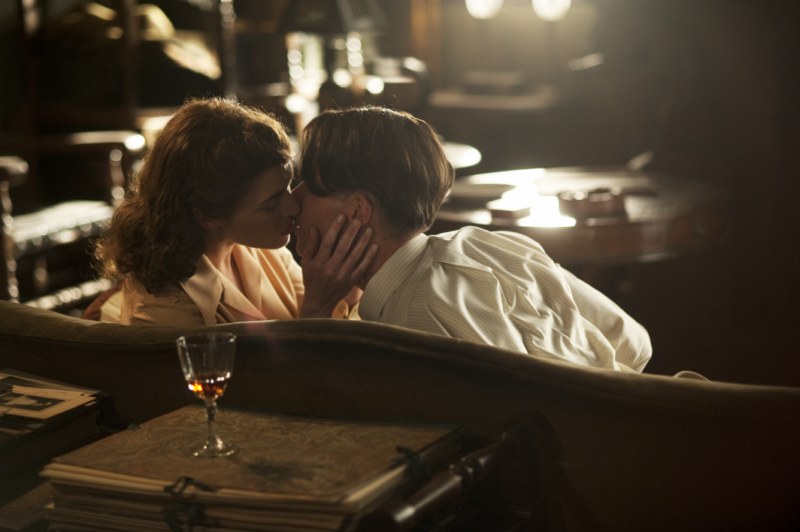
"MILDRED PIERCE" (2011) Photo Gallery


Below are images from "MILDRED PIERCE", Todd Haynes' new adaptation of James M. Cain's 1941 novel. The five-part miniseries stars Kate Winslet in the title role:


"MILDRED PIERCE" (2011) Photo Gallery