Showing posts with label talulah riley. Show all posts

Sunday, November 30, 2014

"FIVE LITTLE PIGS" (2003) Review


"FIVE LITTLE PIGS" (2003) Review

"FIVE LITTLE PIGS". That is the name of this adaptation of Agatha Christie’s 1942 novel. Who would have thought that a story with a title straight from a nursery rhyme would lead me to view it as one of the better screen adaptations of a Christie novel I have ever seen? 

I just gave the game away in the last paragraph, did I? I gave my opinion of "FIVE LITTLE PIGS" right off the bat. My recent viewing of "FIVE LITTLE PIGS" made me realize two things – a) it is a well-written and melancholy story with tragic overtones; and b) it is one of the finest Christie adaptations I have ever seen. Hmmm . . . I think I may have repeated myself. Well, I cannot help it. I feel that strongly about this movie.

The story began with Hercule Poirot receiving a visitor - a wealthy young woman from Canada named Lucy Lemarchant, who admitted to being the only child of a famous artist named Amyas Crale. According to her, Crale had been murdered fifteen years ago and Lucy’s mother, Caroline, ended up being arrested, convicted and executed for the murder. Years later, Lucy read a letter from Caroline in which the latter claimed her innocence. Despite his doubts, Poirot agreed to investigate Crale’s death. He ended up interviewing five other people who had been at the Crales’ house party fourteen years earlier – five people whom Poirot dubbed "the Five Little Pigs":

*Phillip Blake - a stockbroker and old childhood friend of Amyas Crale 
*Meredith Blake - a reclusive former amateur herbalist and Philip’s brother 
*Elsa Greer (Lady Dittisham) - a spoiled society lady who had once been Crale’s mistress and subject 
*Angela Warren - a disfigured archaeologist and Caroline Crale’s younger sister 
*Cecilia Williams - Lucy and Angela’s devoted governess 

"FIVE LITTLE PIGS" turned out to be one of those rare Agatha Christie stories in which most of the drama occurred in distant past. What started as a cold case involving the murder of a philandering, yet talented artist, ended as a tale of sad regrets and family tragedy. This was emphasized in the movie’s finale with one last flashback featuring Crayle and Caroline enjoying happier times with their daughter before murder and tragedy struck. That last scene made me realize that the murderer – in an act of emotion – had not only killed the artist, but destroyed a family.

Another one of the movie's major assets turned out to be its cast. David Suchet gave his usual competent portrayal of Belgian-born sleuth, Hercule Poirot. But I must admit that one of his finest moments – not only in the movie, but during the entire series – came when he exposed the murderer. Suchet did an excellent job of revealing Poirot’s emotional outrage toward the murderer, without any histrionics whatsoever.

There were certain cast members that I believe stood out. Toby Stephens gave a surprisingly poignant performance as Philip Blake, Aymas Crale’s boyhood friend, who harbored a secret passion for the painter. Julie Cox portrayed Aymas’ young mistress, Elsa Bell (the future Lady Dittisham) with an interesting mixture of arrogance and innocence. And Aidan Gillen’s portrayal of Aymas Crale as a self-involved, occasionally immature and passionate man seemed spot-on for a character that was supposed to be a talented artist. But my favorite performance came from Rachael Stirling, who portrayed Aymas’ long suffering wife, Caroline. The interesting thing about her performance – at least to me – was that she seemed to be at the center of the story. In the end, it was Stirling – along with Suchet – who carried the film. And she managed to do this with a very subtle performance.

I also have to give kudos to cinematographer Christopher Gunning for his lush photography in the 1920s flashbacks. And costume designer Sheena Napier did a solid job of creating costumes for two eras – the mid 1920s and the late 1930s/early 1940s. But the movie’s real gems turned out to be Kevin Elyot’s adaptation of Christie’s sad and tragic tale and Paul Unwin’s direction. Thanks to the both of them, "FIVE LITTLE PIGS" ended up being one of the best cinematic adaptations of an Agatha Christie novel I have ever seen.

Monday, September 1, 2014

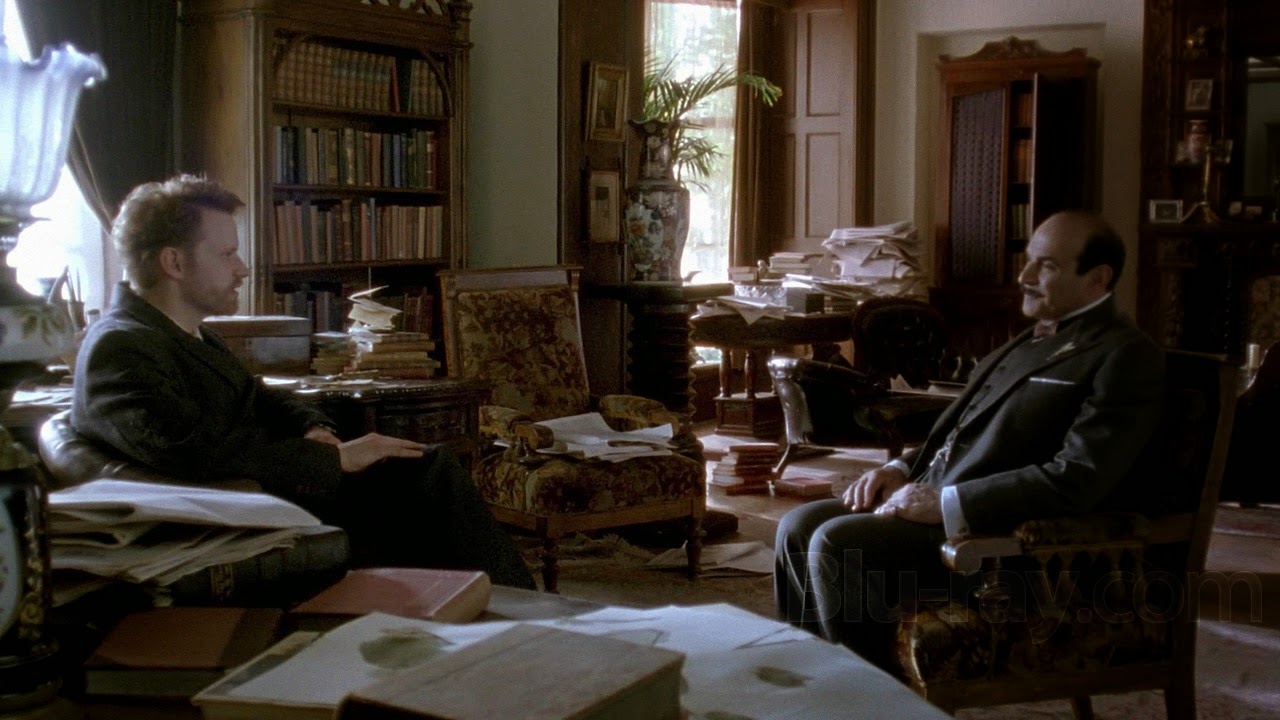
"FIVE LITTLE PIGS" (2003) Photo Gallery


Below are images from "SAD CYPRESS", the 2003 television adaptation of Agatha Christie's 1942 novel.  The movie starred David Suchet as Hercule Poirot:


"FIVE LITTLE PIGS" (2003) Photo Gallery


Tuesday, October 16, 2012

"PRIDE AND PREJUDICE" (2005) Review

Elizabeth-and-Mr-Darcy-pride-and-prejudice-9830654-1103-726


"PRIDE AND PREJUDICE" (2005) Review

To my knowledge, there have been at least ten screen (film and/or television) adaptations of Jane Austen's 1813 novel, "Pride and Prejudice". I believe it has been adapted more times than her other five novels. This is not surprising. It is probably the most beloved of her six novels. I have seen four of those adaptations, myself. And one of them is director-writer Joe Wright's 2005 film adaptation.

"PRIDE AND PREJUDICE" starred Keira Knightley and Matthew MacFadyen as Elizabeth Bennet and Fitzwilliam Darcy. The story focuses on Elizabeth's dealings with marriage, manners and other issues in the landed gentry society of late Georgian England. Elizabeth and her four sisters are encouraged by their mother to find a suitable husband before their father's estate is inherited by a distant male cousin. The Bennet family is heartened by the blossoming romance between Elizabeth's older sister Jane and a wealthy bachelor named Charles Bingley, who has rented a neighboring estate. But the family are unaware that Mr. Bingley's even wealthier friend, Fitzwilliam Darcy, has grown attracted to the extroverted Elizabeth. However, obstacles block the path of true love. Mr. Darcy and Bingley's snobbish sister Caroline disapprove of his romance with Jane, due to the poor behavior of Mrs. Bennet and her three youngest daughters. And Elizabeth has developed a deep dislike of Mr. Darcy, due to his own distant and haughty behavior. Through a series of setbacks and misunderstandings, true love finally flourishes in the end.

Wright's adaptation of Austen's novel was a box office hit and earned numerous award nominations, including a Best Actress nomination for star Keira Knightley. But like the 1940 adaptation with Greer Garson and Laurence Olivier, this 2005 film has attracted a great deal of criticism from Austen fans for its failure to be closely faithful to the novel. Many have complained how Wright changed the dynamics within the Bennet family. Others have complained by the less than sterile appearance of the Bennet estate and the movie's late 18th century. As far as many readers were concerned, "PRIDE AND PREJUDICE" should have been set between 1811 and 1820 - Britain's Regency era, since the novel was published in 1813. So, how did I feel about Wright's take on Austen's novel?

I might as well be frank. I did have problems with "PRIDE AND PREJUDICE". I could have understood Wright's decision to portray the Bennet household with a less than pristine appearance. The Bennet manor was not the first to be portray in this style. The Western home in 1963's "TOM JONES" looked a lot messier. But Squire Western lived on the estate by himself, until the arrival of his daughter Sophie and his sister Aunt Western. Mrs. Bennet managed the family estate in Wright's movie. One would think she and the house servants would be able to keep a cleaner home. And I was not that impressed by most of the costumes worn by the Bennets. I found them rather plain and worn for an upper class family from the landed gentry. Mind you, they did not have the same amount of money as Mr. Darcy or the Bingleys. Except for the Netherfield ball sequence, their costumes seemed to hint that they barely possessed enough money to scratch out a living. Yet, at the same time, they had both house and field servants?

I was not impressed by the change of dynamics between Mr. and Mrs. Bennet. They seemed a bit too affectionate in comparison to their portrayals in other movies. Wright's decision to make this change seemed to defeat the purpose of Austen's narrative. He forgot that the incompatible marriage between the well-born, yet caustic Mr. Bennet and the middle-class and boorish Mrs. Bennet was one of the major reasons that led youngest daughter Lydia to leave Brighton with the roguish George Wickham. Mrs. Bennet's shrill manners and obsession with matrimony for her daughters, and Mr. Bennet's cynical disregard for his wife and society led to their failure to discipline their youngest daughters - Lydia and Kitty. But we never see this in Wright's film. He had every right to justify Mrs. Bennet's search for future sons-in-law. But the affection between her and Mr. Bennet makes it difficult to explain their failure to discipline Lydia and Kitty.

I also had a problem with George Wickham. I felt sorry for Rupert Friend. He is a very good actor who was handed over a role that turned out to be a ghost of its former self by Wright. Friend is also a very handsome actor. But he was really not given the opportunity to display Wickham's charm and talent for emotional manipulation. Worse, the Elizabeth/Wickham scenes failed to convey any real friendship between the two, before Elizabeth's discovery of his true nature. They were simply not on screen together long enough to justify Elizabeth's outrage over Mr. Darcy's alleged treatment of Wickham. Wright's treatment of the Charles Bingley character was also a problem for me. I am aware that Mr. Bingley has always sought his friend Mr. Darcy's approval, regarding the other man as his social superior. But Mr. Bingley has also struck me as a more social and extroverted man. Wright made sure that his Mr. Bingley, portrayed by Simon Woods, was socially active. But he also transformed Bingley into a shy and reticent man. And the idea of a quiet Mr. Darcy and a shy Mr. Bingley as close friends does not quite seem right to me.

However, there is no such thing as a perfect film - at least not in my experience. Yes, "PRIDE AND PREJUDICE" is a flawed movie. But it is not the disaster that some Austen fans would have many to believe. Despite some changes in the characterization and the 129 minutes running time, Austen's tale remained intact under Wright's direction and Deborah Moggach's pen. And a few of the changes made by Wright and Moggach did not bother me one bit. In fact, I found them rather interesting. One change in the movie involved the Elizabeth Bennet character. This "PRIDE AND PREJUDICE" delved more into the impact of the Bennet family's shenanigans upon her psyche with scenes that featured Elizabeth's brief flight from the crowds of the Netherfield ball, her penchant of keeping personal secrets from her closest sister Jane, and occasional bursts of temper. Many also complained about the film's late 18th century setting, claiming that Austen's novel was a Regency tale. I said this in my review of the 1940 adaptation and I will state it again. There was no law that "PRIDE AND PREJUDICE" had to be set in the 1810s because of its final publishing date. Austen's tale is not a historical drama, merely a comedy of manners and a romantic tale. Besides, her novel was originally completed some time in the late 1790s - the same time frame as this movie.

Despite my complaints about the plain wardrobe for the Bennet family, I must admit that I was impressed by most of Jacqueline Durran's costumes - especially for the Netherfield Ball sequence. I felt that the most interesting costume was worn by Kelly Reilly (as Caroline Bingley in the aforementioned sequence:

netherfield-ball-miss-bingley-in-modern-dress

Some fans felt that Durran made a misfire in the creation of this particular costume, which they believed evoked the high-waisted fashions of the first two decades of the 19th century. They especially took umbrage at her gown's lack of sleeves. What they failed to realize was that women's fashion was in a stage of transition between the late 18th and early 19th century. Older women like Mrs. Bennet and Lady Catherine de Bourgh wore the older 18th century fashions, while younger females began wearing dresses and gown with a higher waistline. It made sense that Caroline Bingley, being familiar with the more sophisticated London society, would wear such a gown. There is a 1798-99 painting called "Madame Raymond de Verninac" in which the subject wore a similar looking gown:

1799-Verninac-David

Other technical aspects of the movie that proved to be a lot less controversial. Roman Osin's photography proved to be one of the movie's biggest assets. I found it lush, yet sharp and rich in color. And it certainly did justice to Sarah Greenwood's production designs and Katie Spencer's set decorations, which captured the look of Britain at the end of the 18th century and the beginning of the 19th century beautifully. I especially enjoyed the photography featured in Elizabeth's journey with her Gardiner relations to Derbyshire. Another segment that displayed Osin's photography and Greenwood's work beautifully was the Netherfield Ball. I especially enjoyed the tracking shot that touched upon the behaviors and emotional states of the major characters, before finally settling upon a secluded Elizabeth, heaving a sigh of relief.

Wright had the good luck to find himself with a first-rate cast for his movie. Jena Malone's Lydia Bennet struck me as more of a show boater or poseur than any other interpretation of the role. Carey Mulligan gave ample support as her slightly older sister and emotional pet, Kitty. Talulah Riley did a very good job in capturing Mary Bennet's self-righteous nature. Yet, at the same, she was surprisingly poignant - especially during the Netherfield ball sequence. Despite Moggach and Wright's attempts to paint Mrs. Bennet's determination to marry off her daughters in a more positive light, Brenda Blethyn still managed to capture the character's gauche manners and silliness. And for that I am grateful to the actress. Donald Sutherland's take on Mr. Bennet seemed less cynical than Austen's take on the character. Thanks to Moggach's script, Sutherland's Mr. Bennet almost loses his bite. But not completely. Sutherland managed to retain some of the character's sardonic humor. And I really enjoyed his performance in the scene that featured Mr. Bennet and Elizabeth's discussion about her feelings for Mr. Darcy.

Despite my complaints about the characterizations of Charles Bingley and George Wickham, I cannot deny that both Simon Woods and Rupert Friend gave first-rate performances. However, I suspect that Woods was given more to work with, even if Moggach's portrayal of his character struck a wrong note within me. There is an interesting post-script regarding Woods' casting - he was Rosamund Pike's (Jane Bennet) ex-boyfriend, when they filmed "PRIDE AND PREJUDICE" together. The movie featured only one of Mr. Bingley's sisters - namely the gold-digging Caroline Bingley. Kelly Reilly's take on the role strongly reminds me of Frieda Inescort's performance in the 1940 movie - cool and sarcastic. Reilly had some choice lines, my favorite being her comment about her brother's guests at the Netherfield Ball:

"I can't help thinking that at some point someone is going to produce a piglet and we'll all have to chase it."

Yes, I realize that Jane Austen did not write it. But who cares? It is such a droll line, even if it was spoken by the unspeakable Caroline. I read somewhere that Joe Wright had convinced Judi Dench to portray Lady Catherine de Bourgh, claiming that he loved it when she "played a bitch". And yes . . . Dench's Lady Catherine was deliciously bitchy. On the other hand, Claudie Blakely gave a nice performance as Elizabeth's best friend, Charlotte Lucas. She also had one memorable moment in which her character tried to explain her decision to marry William Collins, Elizabeth's unpalatable cousin. "PRIDE AND PREJUDICE" marked the first time Keira Knightley worked with Tom Hollander. His Mr. Collins did not strike me as obsequious as previous versions. For some reason, Hollander reminded me of a socially awkward geek. The scene featuring Mr. Collins' attempt to get Mr. Darcy's attention struck me as particularly funny. Penelope Wilton and Peter Wight gave solid performances as Elizabeth's aunt and uncle, the Gardiners. But I did not find them particularly memorable. Rosamund Pike made a very beautiful and charming Jane Bennet. She perfectly conveyed the character's shyness and penchant for thinking too good of others.

Matthew MacFadyen was not that well known to U.S. audiences when he was cast in the role of Mr. Darcy. I realize that I am going to attract a good deal of flak for this, but I am glad that MacFadyen did not try to recapture Colin Firth's take on the role. An actor or actress should never try to copy another's performance. Frankly, I thought MacFadyen did a fine job on his own. He is the only actor to openly convey Mr. Darcy's inability to easily socialize before the story's second half, due to some silent acting on his part. I especially enjoyed his performance with Knightley featuring Elizabeth's rejection of Mr. Darcy's first marriage proposal. But Keira Knightley, as Elizabeth Bennet, contributed just as much to the scene as he did. For some reason, the actress has attracted a great deal of bashing from moviegoers. I will not try to determine the reason behind their behavior. But I will compliment Knightley for her performance. Like the other actresses who have portrayed Elizabeth, she conveyed all of the character's wit, prejudices and exuberant nature. But thanks to Moggach's screenplay, Knightley was given a chance to put a new spin on Elizabeth's character. Due to the Bennet family's behavior, Knightley was able to convey Elizabeth's increasing emotional distance from them. Many critics did not care for this new spin on the character. I, on the other hand, found it fascinating and new.

Joe Wright's "PRIDE AND PREJUDICE" has its flaws. There is no denying it. But I can say the same for the other three adaptations of Jane Austen's novel that I have seen. For me, the movie's virtues outweighed its flaws. And its biggest virtues were Roman Osin's photography and a memorable cast led by the talented Keira Knightley and Matthew MacFadyen. This was Joe Wright's first film and so far, my favorite he has done during his seven years as a director.

Tuesday, July 10, 2012

"PRIDE AND PREJUDICE" (2005) Photo Gallery


Below are images from "PRIDE AND PREJUDICE", the 2005 adaptation of Jane Austen's 1813 novel. Directed by Joe Wright, the movie starred Keira Knightley and Matthew MacFadyen:


"PRIDE AND PREJUDICE" (2005) Photo Gallery