Showing posts with label gemma jones. Show all posts

Sunday, November 30, 2014

"FIVE LITTLE PIGS" (2003) Review


"FIVE LITTLE PIGS" (2003) Review

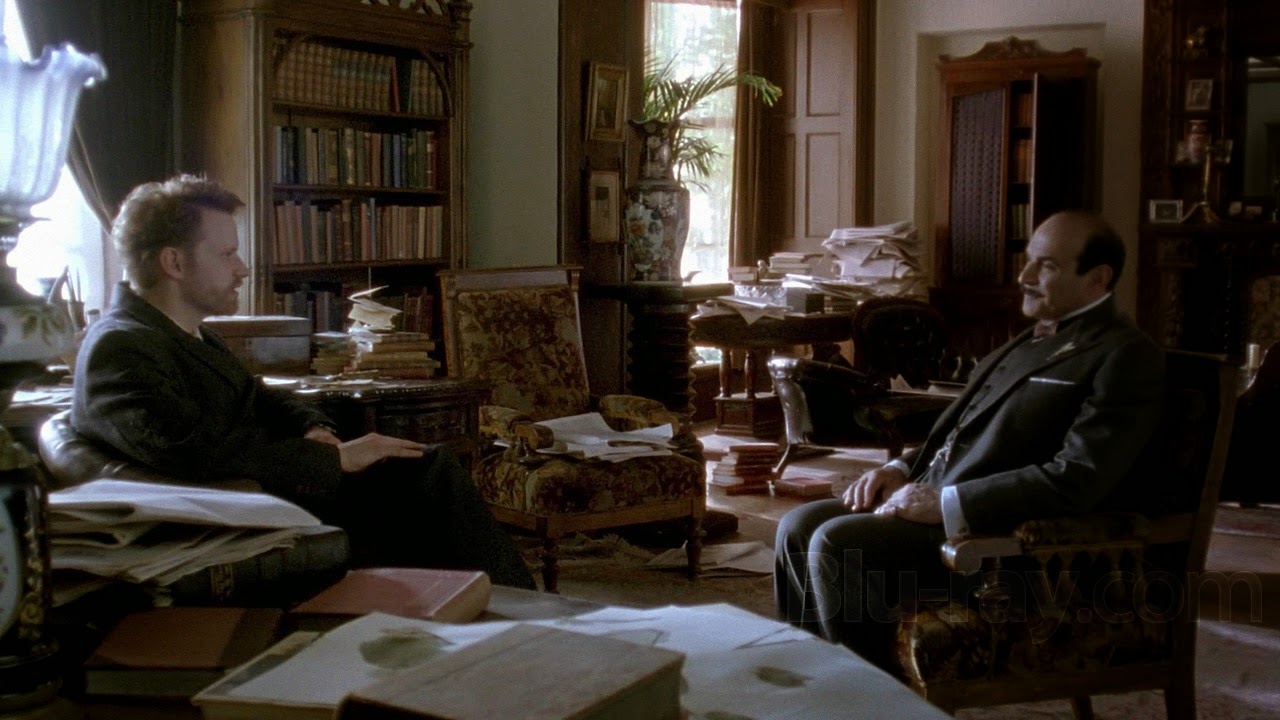
"FIVE LITTLE PIGS". That is the name of this adaptation of Agatha Christie’s 1942 novel. Who would have thought that a story with a title straight from a nursery rhyme would lead me to view it as one of the better screen adaptations of a Christie novel I have ever seen? 

I just gave the game away in the last paragraph, did I? I gave my opinion of "FIVE LITTLE PIGS" right off the bat. My recent viewing of "FIVE LITTLE PIGS" made me realize two things – a) it is a well-written and melancholy story with tragic overtones; and b) it is one of the finest Christie adaptations I have ever seen. Hmmm . . . I think I may have repeated myself. Well, I cannot help it. I feel that strongly about this movie.

The story began with Hercule Poirot receiving a visitor - a wealthy young woman from Canada named Lucy Lemarchant, who admitted to being the only child of a famous artist named Amyas Crale. According to her, Crale had been murdered fifteen years ago and Lucy’s mother, Caroline, ended up being arrested, convicted and executed for the murder. Years later, Lucy read a letter from Caroline in which the latter claimed her innocence. Despite his doubts, Poirot agreed to investigate Crale’s death. He ended up interviewing five other people who had been at the Crales’ house party fourteen years earlier – five people whom Poirot dubbed "the Five Little Pigs":

*Phillip Blake - a stockbroker and old childhood friend of Amyas Crale 
*Meredith Blake - a reclusive former amateur herbalist and Philip’s brother 
*Elsa Greer (Lady Dittisham) - a spoiled society lady who had once been Crale’s mistress and subject 
*Angela Warren - a disfigured archaeologist and Caroline Crale’s younger sister 
*Cecilia Williams - Lucy and Angela’s devoted governess 

"FIVE LITTLE PIGS" turned out to be one of those rare Agatha Christie stories in which most of the drama occurred in distant past. What started as a cold case involving the murder of a philandering, yet talented artist, ended as a tale of sad regrets and family tragedy. This was emphasized in the movie’s finale with one last flashback featuring Crayle and Caroline enjoying happier times with their daughter before murder and tragedy struck. That last scene made me realize that the murderer – in an act of emotion – had not only killed the artist, but destroyed a family.

Another one of the movie's major assets turned out to be its cast. David Suchet gave his usual competent portrayal of Belgian-born sleuth, Hercule Poirot. But I must admit that one of his finest moments – not only in the movie, but during the entire series – came when he exposed the murderer. Suchet did an excellent job of revealing Poirot’s emotional outrage toward the murderer, without any histrionics whatsoever.

There were certain cast members that I believe stood out. Toby Stephens gave a surprisingly poignant performance as Philip Blake, Aymas Crale’s boyhood friend, who harbored a secret passion for the painter. Julie Cox portrayed Aymas’ young mistress, Elsa Bell (the future Lady Dittisham) with an interesting mixture of arrogance and innocence. And Aidan Gillen’s portrayal of Aymas Crale as a self-involved, occasionally immature and passionate man seemed spot-on for a character that was supposed to be a talented artist. But my favorite performance came from Rachael Stirling, who portrayed Aymas’ long suffering wife, Caroline. The interesting thing about her performance – at least to me – was that she seemed to be at the center of the story. In the end, it was Stirling – along with Suchet – who carried the film. And she managed to do this with a very subtle performance.

I also have to give kudos to cinematographer Christopher Gunning for his lush photography in the 1920s flashbacks. And costume designer Sheena Napier did a solid job of creating costumes for two eras – the mid 1920s and the late 1930s/early 1940s. But the movie’s real gems turned out to be Kevin Elyot’s adaptation of Christie’s sad and tragic tale and Paul Unwin’s direction. Thanks to the both of them, "FIVE LITTLE PIGS" ended up being one of the best cinematic adaptations of an Agatha Christie novel I have ever seen.

Monday, September 1, 2014

"FIVE LITTLE PIGS" (2003) Photo Gallery


Below are images from "SAD CYPRESS", the 2003 television adaptation of Agatha Christie's 1942 novel.  The movie starred David Suchet as Hercule Poirot:


"FIVE LITTLE PIGS" (2003) Photo Gallery


Sunday, July 24, 2011

"SENSE AND SENSIBILITY" (1995) Review


Below is my review of the 1995 version of Jane Austen's 1811 novel, "Sense and Sensibility":


"SENSE AND SENSIBILITY" (1995) Review

The year 1995 saw the beginning of an onslaught of Britain and the United States’ love affair with British author, Jane Austen. A love affair that has not abated after fourteen (14) years. In 1995, the BBC aired Andrew Davies’ miniseries adaptation of Austen’s most famous novel, ”Pride and Prejudice”. And later that year, Hollywood released its adaptation of another Austen, ”Sense and Sensibility” - which I had just recently watched.

Directed by Ang Lee, ”SENSE AND SENSIBILITY”, starred Emma Thompson (who also wrote the screenplay), Kate Winslet, Alan Rickman and Hugh Grant. The story centered around Elinor (Thompson) and Marianne (Winslet), two daughters of Mr. Dashwood (Tom Wilkinson) by his second wife (Gemma Jones). They have a younger sister, Margaret (Emilie François), and an older half-brother named John (James Fleet). When their father dies, the family estate passes to John, and the Dashwood women are left in reduced circumstances. The story follows the Dashwood sisters to their new home, a cottage on a distant relative's property (Robert Hardy), where they experience both romance and heartbreak. The contrast between the quiet and sensible Elinor and the extroverted and occasionally impetuous Marianne is eventually resolved as each sister finds love and lasting happiness. This leads some to believe that the story’s title described how Elinor and Marianne find a balance between sense and sensibility in life and love.

Producer Lindsay Doran made an excellent choice in selecting Lee to direct the film. First of all, he drew some excellent performances from his cast - especially from Thompson, Winslet, and Rickman. Lee also effectively drew filmgoers back into Regency England without allowing the film to resemble some kind of stiff painting or a museum piece. Although he initially had trouble with dealing with Western-style of filmmaking – especially in dealing with British cast members who questioned his direction and made suggestions regarding shots. He could be rather authoritarian with the cast, especially with Hugh Grant. The actor ended up calling him ”the Brute” behind his back. But he and the cast eventually got used to each other. Lee was also responsible for insisting that Thompson play the oldest Dashwood sister. And he Lee ordered Winslet to read poetry and novels from the late 18th century and early 19th century in order to get her to connect to Marianne’s romantic nature. And to give the movie its emotional core, he asked both Thompson and Winslet to room together during production. The two actresses remain close friends to this day.

Not only was Lee ably assisted by his superb cast, but also by crew members such as costume designers Jenny Beavan and John Bright, production designer Luciana Arrighi, set decorator Ian Whittaker, art directors Philip Elton and Andrew Sanders; and cinematographer Michael Coulter, whose photography beautifully captured the English countryside in all of its glory. I especially have to give kudos to Coulter’s photography and Arrighi’s production design for a beautiful re-creation of Regency London. I also enjoyed composer Patrick Doyle’s score for the film. His use of John Dowland’s song, "Weep You No More Sad Fountains" as Marianne’s own theme song struck me as very impressive. But I have to especially give kudos to Emma Thompson for her marvelous adaptation of Austen’s novel. It may not have adhered exactly to the novel, but I found it well written, lively and paced just right.

With the exception of two performances, I felt more than impressed with the cast. When Ang Lee had signed on as the movie’s director, he immediately suggested that Emma Thompson portray the oldest Dashwood sister, Elinor. Thompson considered herself too old for the role, considering that Elinor was at least 19-20 years old in the novel. But Lee suggested that she increase Elinor’s age to 27 in the screenplay, which would also make her distress at being a spinster easier for contemporary audiences to understand. Frankly, I feel that Lee made a good choice. Emma Thompson gave a superb performance as Elinor Dashwood, whose practical mind led her to act as the family’s de facto leader, following her father’s death. She also brilliantly conveyed Elinor’s emotional nature behind a mask of reticence via her eyes and various expressions. Kate Winslet had no need to be subtle as the more openly emotional Marianne Dashwood. Winslet was at least 20 years old when she filmed ”SENSE AND SENSIBILITY’. Yet, even at that tender age, Winslet proved that she had the talent and acting chops to portray the very complex Marianne. I found it ironic that although her character was not what I would describe as subtle. And yet, Winslet managed to convey all aspects of Marianne’s personality – romantic, willful, emotional and sometimes a bit self-involved.

I found Alan Rickman impressive as one of the Dashwoods’ new neighbors, the quiet and dependable Colonel Christopher Brandon. I enjoyed the subtle manner in which Rickman expressed Brandon’s reluctance in expressing his love for Marianne, due to her feelings for another man. That other man proved to Greg Wise, who gave a surprisingly effective performance as the dashing, yet rakish Edward Willoughby. Wise has never struck me as an exceptional actor, but I must admit that I consider Willoughby to be one of his two best performances. The movie’s supporting cast also included Robert Hardy and the late Elizabeth Spriggs, who gave amusing performances as Sir John Middleton, the Dashwoods’ cousin and benefactor; and Mrs. Jennings, Sir John’s mother-in-law. Gemma Jones was excellent as the emotional and sometimes girlish mother of the Dashwood sisters. I was also impressed by Harriet Walter, who portrayed the sisters’ shrewish sister-in-law, Fanny Dashwood. And Hugh Laurie gave a hilarious performance as the sardonic and long-suffering Mr. Palmer, Mrs. Jennings’ other son-in-law. And I must say that Imogen Stubbs also impressed me by her subtle performance as the cunning and manipulative Lucy Steele, who seemed to have a claim for the same man that Elinor Dashwood longs for.

Speaking of Elinor Dashwood’s love, I finally come to the two performances that had failed to impress me. One of them belonged to Hugh Grant. He portrayed Edward Ferrars, one of Fanny Dashwood’s brothers that happened to be in love with Elinor and is claimed by the manipulative Lucy Steele as her fiancé. Remember his charming, yet modest performance in the hit 1994 comedy, ”FOUR WEDDINGS AND A FUNERAL”? Well, his Edward Ferrars turned out to be an early 19th century version of his ”FOUR WEDDINGS” role. Grant simply gave the same performance, but with more stuttering and less charm. What had been fresh and original in 1994, ended up as old news a year later in ”SENSE AND SENSIBILITY”. Fortunately, he managed to create some kind of chemistry with both Thompson and Emilie François, who portrayed the young Margaret Dashwood. Another performance that did nothing for me belonged to Imelda Staunton. She portrayed Charlotte Jennings Palmer, Mrs. Jennings’ daughter and Mr. Palmer’s wife. I realize that she was supposed to be an annoying character, but one could say the same about Sir John and Mrs. Middleton. But whereas I found Robert Hardy and Elizabeth Spriggs’ performances amusing, Staunton’s slightly over-the-top portrayal of Charlotte Palmer ended up irritating the hell out of me.

I understand that Andrew Davies had produced his own version of the Austen novel, last year. Since I have yet to see it, I cannot compare it to the 1995 version, directed by Ang Lee. I do know that I am more than impressed with this particular version. It came as no surprise to me that it earned seven (7) Academy Award nominations and won one (1) for Thompson’s Adapted Screenplay. ”SENSE AND SENSIBILITY” is one movie I could watch over again without ever getting tired of it.

Sunday, May 1, 2011

"SENSE AND SENSIBILITY" (1995) Photo Gallery


Below are photos from director Ang Lee's 1995 adaptation of Jane Austen's novel, "SENSE AND SENSIBILITY". The movie starred Emma Thompson and Kate Winslet:


"SENSE AND SENSIBILITY" (1995) Photo Gallery