Showing posts with label donald sutherland. Show all posts

Tuesday, November 20, 2018

"THE HUNGER GAMES: CATCHING FIRE" (2013) Review

Catching-Fire


"THE HUNGER GAMES: CATCHING FIRE" (2013) Review

Despite my enjoyment of the 2012 movie, "THE HUNGER GAMES", I must admit that I had regarded its sequel, "THE HUNGER GAMES: CATCHING FIRE" with a wary eye. One, the movie franchise had replaced Gary Ross with a new one, Francis Lawrence. And two, a relative who had read all three of Suzanne Collins' novels expressed a less-than-impressed opinion of the second installment, which this movie is based upon. But enamored of the first film, I decided to give this second one a chance. 

"CATCHING FIRE" picked up not long after the ending of the first installment. The winners of the 74th Hunger Games, Katniss Everdeen and Peeta Mellark, have returned to their homes in the impoverished District 12. But due to their winnings, both now reside in upscale neighborhoods. Before they are scheduled to embark upon their victory tour of Panem, Katniss receives a visit from the tyrannical President Snow, who reveals that her actions in the recent Games have inspired rebellions across the districts. He orders her to use the upcoming tour to convince everyone her actions were out of genuine love for Peeta, not defiance against the Capitol. The victory tour goes off well, aside from an emotionally difficult and violent visit to District 11, the home of the deceased tributes, 12 year-old Rue (whom Katniss had befriended) and Thesh (who had saved Katniss). 

Despite the tour and the installment of violent Peacekeepers in District 12 to crack down on any signs of rebellion, President Snow remains fearful of Katniss being used as a symbol of any possible upheavals. The new Head Gamekeeper, Plutarch Heavensbee, proposes a special Hunger Games called the Third Quarter Quell (the 75th Hunger Games), in which the tributes will be selected from previous victors. He believes the Games would either ruin Katniss' reputation, or kill her. As the only female victor from District 12, Katniss is naturally selected. However, her mentor Haymitch Abernathy is chosen as the male tribute. Peeta immediately volunteers to take his place. Haymitch informs the pair that most of the tributes are angry over being forced to participate again and suggests they make alliances. Although Katniss is against the idea, she and Peeta adhere to Haymitch's advice and find themselves in competition that ends with surprising results.

Despite becoming a fan of "THE HUNGER GAMES", I continued to resist watching Suzanne Collins' novels. Perhaps one day I will read them. But due to my unfamiliarity with the plots, the end of "CATCHING FIRE" pretty much took me by surprise. And this is a good thing. The movie's first third hinted of a growing rebellion against President Snow's rule over Panem in scenes that included Katniss and Peeta's harrowing visit to District 11, the beating of Gale Hawthorne (Katniss' closest friend and possible lover) at the hands of the Peacekeepers, and Snow's growing paranoia over Katniss. Even the scenes featuring Katniss' participation in the 75th Hunger Games continued hint the growing rebellion against Snow's administration and the Capitol through the characters like Haymitch, Katniss' friend and costume designer Cinna, and those serving as tributes. Characters like Beetee Lasnier and Johanna Mason expressed their dismay or anger at being forced to participate in another Hunger Game during their pre-Game interviews with Caesar Flickerman. Even Peeta tried to manipulate Snow into stopping the Game with false hint that Katniss might be pregnant. And during the Game, I found it interesting that Katniss and Peeta ended up forming an alliance with Lasnier and his District 3 counterpart Wiress, Johanna, and the two tributes from District 4, Finnick Odair and Mags - the only tributes to express any hostility toward the Games and President Snow. I had figured that all of them would eventually openly defy Snow by getting out of the Games. But thanks to some very good writing from Suzanne Collins, along with screenwriters Simon Beaufoy and Michael deBruyn; the circumstances behind the beginning of the rebellion really took me by surprise.

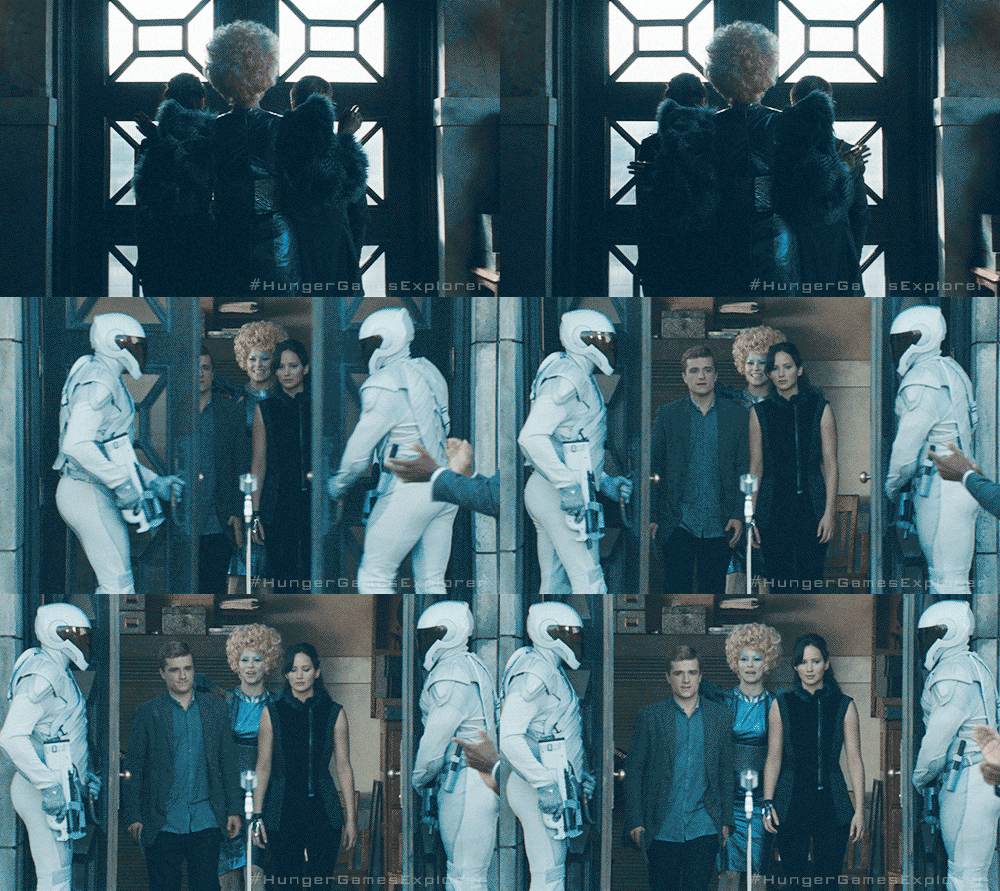
Another aspect of "CATCHING FIRE" that took me by surprise, turned out to be its cinematography. With the change of director, the franchise acquired a new cinematographer, Jo Willems. And I liked the way Willems expanded the look of Panem in the film. I suppose one could thank the movie's plot, which allowed viewers a look at the exclusive neighborhood of District 12, into which Katniss and Peeta moved following their victory at the 74th Games; the other country's districts, and the tropical environment that served as the 75th Games' new setting. But more importantly, Willems expanded the visual style of the Capitol . . . especially in a scene that featured Katniss and Peeta's arrival. This expanded visual really took me by surprise. The movie also acquired a new costume designer, Trish Summerville. I have to be honest. I found her costume designs similar to the ones created by Judianna Makovsky. I really do not see the differences . . . especially for those costumes worn by the cast for the Capitol sequences. Mind you, they are just as imaginative and beautiful as the ones featured in the first film. I simply cannot see the differences. There was one outfit - worn by Elizabeth Banks - that I found very original:

rs_634x1024-131113180118-634.banks-catchingfire.cm.111313

I understand that the song "Atlas", written and performed by the group Coldplay have earned both Golden Globe and Grammy nominations. Congratulations to the band. However, I do not remember the song. Sorry. I simply did not find it memorable. I was also a little disappointed in how Lawrence (the director) seemed to rush the first third of the movie - namely the sequence featuring Katniss and Peeta's victory tour and District 12's problems with the so-called Peacekeepers that culminated in Gale's beating. It seemed as if he was in a hurry for the movie to focus on the 75th "Quarter Quell" Hunger Games. And if I may be blunt, I was also not that impressed by Alan Edward Bell's editing. It struck me as a little choppy - especially in the movie's first half.

The performances by the cast struck me as first rate. Jennifer Lawrence and Josh Hutcherson did superb jobs in continuing the development of their characters, Katniss Everdeen and Peeta Mallark. I noticed in this film that Lawrence conveyed a great deal of realism in Katniss' growing difficulty in containing her emotions regarding those she cared about. This was especially apparent in the scene following Gale's public whipping, Peeta's near death experience during the first day of the Games and the visit to District 11. Someone once described Peeta as a saint. I never could view him in this manner. He strikes me as a rather manipulative individual, who can also be a very good liar. What is amazing about Hutcherson's performance is that he perfectly balanced Peeta's manipulative skills with his near all consuming love for Katniss and willingness to do anything for her. 

Liam Hemsworth got a chance to develop his portrayal of Katniss' childhood best friend, Gale Hawthorne. Hemsworth, like Hutcherson, did an excellent job in balancing the different layers of Gale's personality - namely his love for Katniss and his ever-growing obsession with rebellion against President Snow and the Capitol. Woody Harrelson continued to knock it out of the ballpark as Katniss and Peeta's alcoholic mentor, Haymitch Abernathy. I think this is the first time moviegoers got a real look at Haymitch's hostility toward President Snow, especially in the scene which featured the announcement of past winners participating in the Quarter Quell. Harrelson portrayed that small moment with such intense anger. Donald Sutherland continued his brilliant portrayal of the brutal, yet manipulative politician, President Coriolanus Snow. 

Sutherland perfectly captured Snow's quiet machinations that could rival Palpatine from the STAR WARS franchise. Yet, the actor also did a subtle job in conveying Snow's growing paranoia over Katniss' popularity and growing role as a symbol of rebellion. I had greatly enjoyed Elizabeth Banks' performance as Effie Trinket in the first movie. I loved her performance in this film, as the actress allowed filmgoers a deeper look into the chaperone's persona, beyond her usual shallowness. I am also happy that Lenny Kravitz reprised the role of Cinna, Katniss and Peeta's stylist for the Games. As usual, the actor/musician gave a warm and beautiful performance as Katniss' emotional solace before the Games. One particular scene in which Cinna endured a brutal beating over a dress he had created for Katniss proved to be a very painful one to watch, thanks to Kravitz and Lawrence's performances, along with the other Lawrence's direction. Stanley Tucci was marvelous as ever in his continuing portrayal of Caesar Flickerman, the Games' announcer and commentator. Toby Jones reprised his role as Flickerman's fellow commentator, Claudius Templesmith. But his role had been reduced considerably.

The movie also featured some newcomers to the franchise. Philip Seymour Hoffman gave a sly and subtle performance as the Games' new Head Gamemaker, who schemes with President Snow to destroy Katniss' reputation and possibly, her life. Sam Claflin continued to surprise me at how charismatic he could be, in his engaging portrayal of Finnick Odair, one of the tributes from District 4, during the 75th Games. Jena Malone was a hoot as the outspoken and aggressive female tribute from District 7, Johanna Mason. The strip scene inside the elevator is one that I remember for years to come. I was surprised to see Jeffrey Wright appear in this film. He gave a subtle, yet intelligent performance as the male tribute for District 3, Beetee Latier. Wright also clicked very well with Amanda Plummer, whose performance as Latier's fellow District 3 tribute Wiress, struck me as deliciously off-center. Lynn Cohen nearly stole the show as Finnick's fellow tribute from District 4, Mags. I thought she did a pretty good job, although I am at a little loss over the fanfare regarding her performance.

Many seemed to regard "CATCHING FIRE" as superior to the original 2012. I cannot agree with this opinion. I am not saying that "CATCHING FIRE" is a disappointment or inferior to "THE HUNGER GAMES". But I certainly do not regard it as better. I would say that it is just as good. And considering my very high opinion of the first film, one could assume that my opinion of this second film is equally positive, thanks to an excellent screenplay written by Simon Beaufoy and Michael deBruyn, first rate direction from Francis Lawrence, and a superb cast led by Jennifer Lawrence and Josh Hutcherson.

image

Wednesday, April 25, 2018

"THE HUNGER GAMES: CATCHING FIRE" (2013) Photo Gallery

the-hunger-games-catching-fire-comic-con-trailer

Below are images from "THE HUNGER GAME: CATCHING FIRE", the 2013 adaptation of Suzanne Collins' 2009 novel and sequel to the 2012 movie, "THE HUNGER GAME". Directed by Francis Lawrence, the movie stars Jennifer Lawrence and Josh Hutcherson: 


"THE HUNGER GAMES: CATCHING FIRE" (2013) Photo Gallery

001


14


17


18


550x298_Sam-Claflin-and-Donald-Sutherland-in-new--Catching-Fire--portraits-2397


catching-fire_620x350


catching-fire1


catching-fire-comic-con-trailer


catching-fire-johanna


catching-fire-photo-plutarch-haymitch


catching-fire-pics-katniss


catching-fire-sutherland3


Donald-Sutherland-and-Philip-Seymour-Hoffmans-maniacal-laughter


hq-scan-catching-fire-calendar-2


hunger-games-catching-fire-lenny-kravitz


hunger-games-catching-fire-trailer-1


Liam-Hemsworth-als-Gale-Hawthorne-in-Catching-Fire_article_600x348


movies-the-hunger-games-catching-fire-jeffrey-wright-beetee


movies-the-hunger-games-catching-fire-liam-hemsworth-gale


Katniss-and-Peeta-in-The-Hunger-Games-Catching-Fire


the-hunger-games-catching-fire-teaser-trailer-katniss-peeta-haymitch


gale-katniss


katniss_and_peeta_catching_fire_edit___by_gleeklytribute-d60ln69

Thursday, April 14, 2016

"HORRIBLE BOSSES" (2011) Review


"HORRIBLE BOSSES" (2011) Review

The summer of 2011 provided moviegoers with a slew of what I would call raunchy black comedies. May saw the release of "BRIDESMAIDS" and "THE HANGOVER, PART II""BAD TEACHER" premiered in late June. And two weeks later saw the release of the most successful of the bunch, "HORRIBLE BOSSES"

Directed by Seth Gordon, "HORRIBLE BOSSES" starred Jason Bateman, Charlie Day and Jason Sudeikis. The trio co-starred as three best friends who decide to murder their respective overbearing, abusive bosses (portrayed by Kevin Spacey, Jennifer Aniston and Colin Farrell) who they believe are standing in the way of their happiness. Nick (Bateman) works at a financial firm for emotionally-abusive Dave Harken (Spacey), who dangles the possibility of a promotion to Nick, only to award it to himself. Dale (Day) endures sexual harassment from his boss, Dr. Julia Harris (Aniston), who threatens to falsely tell Dale's fiancee that he had sex with her unless he actually has sex with her. And Kurt (Sudeikis) actually enjoys his job under his boss Jack Pellitt (Donald Sutherland). But after Jack dies from a heart attack, the company is taken over by Jack's cocaine-addicted, amoral son Bobby (Farrell). One night at a bar, Kurt jokingly suggests that their lives would be happier if their bosses were no longer around. After a brief hesitation, the trio agree to the idea. In search of a hit-man, the friends travel to a bar and meet Motherfucker Jones (Jamie Foxx), an ex-con who agrees to be their "murder consultant". Jones suggests that Dale, Kurt and Nick kill each other's bosses to hide their motive while making the deaths look like an accident.

I really did not know how I would accept "HORRIBLE BOSSES". Being a fan of the 2009 movie, "THE HANGOVER", I had found myself slightly disappointed by the recent sequel, "THE HANGOVER, PART II". And I was not really anticipating "HORRIBLE BOSSES". But since I was in the mood to watch a new movie, I went ahead and saw it anyway. And I enjoyed it . . . very much.

Screenwriters Michael Markowitz, John Francis Daley and Jonathan Goldstein did a great job in finalizing a script that took several years to finalize. Superficially, the idea of three amateurs committing murder without attracting the attention of the police seems rather ridiculous. Two of the characters, Nick and Dale, certainly viewed the idea with amusement or disbelief. But further transgressions by their respective bosses finally pushed them to the idea with hilarious results. One of the funniest aspects of "HORRIBLE BOSSES" was the problem that the three friends endured to find a professional hit man to do the job. Their search led to a hilarious meeting at a motel with a man who does "wet work" (Ioan Gruffudd) - namely pissing on his clients. The three friends' second search for a hit man leads them to a local bar, where Kurt manages to insult an African-American bartender in an effort to be "politically correct". Their trip to the bar also leads them to "Motherfucker" Jones, an ex-convict who claims to be a hit man. As it turns out, Jones went to prison for video piracy and merely conned the three friends for money. But after agreeing to be their "murder consultant", his advice for them to kill each other's boss led to some hilarious scenes, including one that featured Dale's encounter with the psychotic Dave Harken, when the latter nearly died from accidentally consuming some peanuts.

"HORRIBLE BOSSES" benefited from some funny performances by the supporting cast. Well, most of the supporting cast was funny. Only Donald Sutherland, who portrayed Kurt's amiable boss, was never given a chance to display his talent for comedy. Thankfully, the likes of Ioan Gruffudd, Julie Bowen, P.J. Byrne and Bob Newhart received the chance to tickle the audiences' funny bones. The three actors hired to portray the "horrible bosses" proved to be horrifying in a hilarious way. If I have to be honest, Dave Harken was not the first aggressive psycho he has portrayed in a comedy. His performances in"SWIMMING WITH SHARKS" and "THE MEN WHO STARED AT GOATS" come to mind. Despite his past experiences with such characters, Spacey still managed to make it all look fresh in his portrayal of Nick's manipulative and aggressively controlling boss. Jennifer Aniston's performance as Dr. Julia Harris was a revelation. Mind you, her Rachel Green character on the television series, "FRIENDS" was very complex. But I have never seen her portray such a scummy character before . . . and with such comedic skills. Colin Farrell's appearance in the movie was not as long as Spacey and Aniston's, but it was just as funny. In fact, I would cite Farrell's performance as coke-addicted and self-delusional Bobby Pellitt as the funniest of the three performances. His rants against the employees he wanted fired struck me as one of the funniest scenes in the movie. And finally, it was good to see Jamie Foxx in a comedy again. Actually, he had a supporting role in the 2010 movie, "DUE DATE" and he was funny. But his role in that movie seemed mildly amusing in compare to his hilarious portrayal of "Motherfucker" Jones, the criminal wannabe, who seemed more adept at video pirating and posing than being a hardened criminal. 

But the craziness of "HORRIBLE BOSSES" could have easily fallen apart without Seth Gordon's direction and especially the performances of the three leads - Jason Bateman, Charlie Day and Jason Sudeikis. As funny as the movie was, it was bizarre enough to fall apart at the slightest misstep. One, the trio made a solid and charismatic comedy team. I would go as far to add that they could easily rival the comedic team from the "HANGOVER" movies. Jason Bateman is deliciously sardonic and witty as the ass-kissing Nick Hendricks, who spent most of his professional career toadying to guys like Dave Harken. I have never been aware of Jason Sudeikis before this movie. I am aware that he had co-starred with Aniston in the 2010 comedy, "THE BOUNTY HUNTER", but I do not even remember him. He was certainly memorable as the trio's verbose lady's man, who first talked his two friends into committing murder. But the funniest performance came from Charlie Day, who portrayed the slightly nervous and "hopelessly romantic" Dale Arbus. It is quite apparent that most of the other characters - including his two buddies - have no real respect for him. Nick and Kurt did not take his complaints of sexual harassment by his boss seriously. One, I suspect they find it hard to believe that any female would find him attractive and two, society views the idea of a man complaining of sexual harassment by a woman seems ludicrous. But it was the hilarious and socially awkward Dale who found an effective way of dealing with the sexually aggressive Julia without any problems, whatsoever.

There have been some complaints about "HORRIBLE BOSSES". Some critics have complained that the movie was racially or gender-wise offensive. Others have complained that it was silly. I agree that"HORRIBLE BOSSES" was silly . . . but in a positive way. Besides, most comedies of this manner tend to be rather silly. But thanks to a wacky script and a first-rate cast, the silliness in "HORRIBLE BOSSES"made it the most enjoyable comedy I have seen in quite a while. I really look forward to its DVD release.

Wednesday, December 16, 2015

"HORRIBLE BOSSES" (2011) Photo Gallery


Below are images from the 2011 black comedy, "HORRIBLE BOSSES". Directed by Seth Gordon, the movie stars Jason Bateman, Charlie Day and Jason Sudeikis: 


"HORRIBLE BOSSES" (2011) Photo Gallery


Tuesday, October 16, 2012

"PRIDE AND PREJUDICE" (2005) Review

Elizabeth-and-Mr-Darcy-pride-and-prejudice-9830654-1103-726


"PRIDE AND PREJUDICE" (2005) Review

To my knowledge, there have been at least ten screen (film and/or television) adaptations of Jane Austen's 1813 novel, "Pride and Prejudice". I believe it has been adapted more times than her other five novels. This is not surprising. It is probably the most beloved of her six novels. I have seen four of those adaptations, myself. And one of them is director-writer Joe Wright's 2005 film adaptation.

"PRIDE AND PREJUDICE" starred Keira Knightley and Matthew MacFadyen as Elizabeth Bennet and Fitzwilliam Darcy. The story focuses on Elizabeth's dealings with marriage, manners and other issues in the landed gentry society of late Georgian England. Elizabeth and her four sisters are encouraged by their mother to find a suitable husband before their father's estate is inherited by a distant male cousin. The Bennet family is heartened by the blossoming romance between Elizabeth's older sister Jane and a wealthy bachelor named Charles Bingley, who has rented a neighboring estate. But the family are unaware that Mr. Bingley's even wealthier friend, Fitzwilliam Darcy, has grown attracted to the extroverted Elizabeth. However, obstacles block the path of true love. Mr. Darcy and Bingley's snobbish sister Caroline disapprove of his romance with Jane, due to the poor behavior of Mrs. Bennet and her three youngest daughters. And Elizabeth has developed a deep dislike of Mr. Darcy, due to his own distant and haughty behavior. Through a series of setbacks and misunderstandings, true love finally flourishes in the end.

Wright's adaptation of Austen's novel was a box office hit and earned numerous award nominations, including a Best Actress nomination for star Keira Knightley. But like the 1940 adaptation with Greer Garson and Laurence Olivier, this 2005 film has attracted a great deal of criticism from Austen fans for its failure to be closely faithful to the novel. Many have complained how Wright changed the dynamics within the Bennet family. Others have complained by the less than sterile appearance of the Bennet estate and the movie's late 18th century. As far as many readers were concerned, "PRIDE AND PREJUDICE" should have been set between 1811 and 1820 - Britain's Regency era, since the novel was published in 1813. So, how did I feel about Wright's take on Austen's novel?

I might as well be frank. I did have problems with "PRIDE AND PREJUDICE". I could have understood Wright's decision to portray the Bennet household with a less than pristine appearance. The Bennet manor was not the first to be portray in this style. The Western home in 1963's "TOM JONES" looked a lot messier. But Squire Western lived on the estate by himself, until the arrival of his daughter Sophie and his sister Aunt Western. Mrs. Bennet managed the family estate in Wright's movie. One would think she and the house servants would be able to keep a cleaner home. And I was not that impressed by most of the costumes worn by the Bennets. I found them rather plain and worn for an upper class family from the landed gentry. Mind you, they did not have the same amount of money as Mr. Darcy or the Bingleys. Except for the Netherfield ball sequence, their costumes seemed to hint that they barely possessed enough money to scratch out a living. Yet, at the same time, they had both house and field servants?

I was not impressed by the change of dynamics between Mr. and Mrs. Bennet. They seemed a bit too affectionate in comparison to their portrayals in other movies. Wright's decision to make this change seemed to defeat the purpose of Austen's narrative. He forgot that the incompatible marriage between the well-born, yet caustic Mr. Bennet and the middle-class and boorish Mrs. Bennet was one of the major reasons that led youngest daughter Lydia to leave Brighton with the roguish George Wickham. Mrs. Bennet's shrill manners and obsession with matrimony for her daughters, and Mr. Bennet's cynical disregard for his wife and society led to their failure to discipline their youngest daughters - Lydia and Kitty. But we never see this in Wright's film. He had every right to justify Mrs. Bennet's search for future sons-in-law. But the affection between her and Mr. Bennet makes it difficult to explain their failure to discipline Lydia and Kitty.

I also had a problem with George Wickham. I felt sorry for Rupert Friend. He is a very good actor who was handed over a role that turned out to be a ghost of its former self by Wright. Friend is also a very handsome actor. But he was really not given the opportunity to display Wickham's charm and talent for emotional manipulation. Worse, the Elizabeth/Wickham scenes failed to convey any real friendship between the two, before Elizabeth's discovery of his true nature. They were simply not on screen together long enough to justify Elizabeth's outrage over Mr. Darcy's alleged treatment of Wickham. Wright's treatment of the Charles Bingley character was also a problem for me. I am aware that Mr. Bingley has always sought his friend Mr. Darcy's approval, regarding the other man as his social superior. But Mr. Bingley has also struck me as a more social and extroverted man. Wright made sure that his Mr. Bingley, portrayed by Simon Woods, was socially active. But he also transformed Bingley into a shy and reticent man. And the idea of a quiet Mr. Darcy and a shy Mr. Bingley as close friends does not quite seem right to me.

However, there is no such thing as a perfect film - at least not in my experience. Yes, "PRIDE AND PREJUDICE" is a flawed movie. But it is not the disaster that some Austen fans would have many to believe. Despite some changes in the characterization and the 129 minutes running time, Austen's tale remained intact under Wright's direction and Deborah Moggach's pen. And a few of the changes made by Wright and Moggach did not bother me one bit. In fact, I found them rather interesting. One change in the movie involved the Elizabeth Bennet character. This "PRIDE AND PREJUDICE" delved more into the impact of the Bennet family's shenanigans upon her psyche with scenes that featured Elizabeth's brief flight from the crowds of the Netherfield ball, her penchant of keeping personal secrets from her closest sister Jane, and occasional bursts of temper. Many also complained about the film's late 18th century setting, claiming that Austen's novel was a Regency tale. I said this in my review of the 1940 adaptation and I will state it again. There was no law that "PRIDE AND PREJUDICE" had to be set in the 1810s because of its final publishing date. Austen's tale is not a historical drama, merely a comedy of manners and a romantic tale. Besides, her novel was originally completed some time in the late 1790s - the same time frame as this movie.

Despite my complaints about the plain wardrobe for the Bennet family, I must admit that I was impressed by most of Jacqueline Durran's costumes - especially for the Netherfield Ball sequence. I felt that the most interesting costume was worn by Kelly Reilly (as Caroline Bingley in the aforementioned sequence:

netherfield-ball-miss-bingley-in-modern-dress

Some fans felt that Durran made a misfire in the creation of this particular costume, which they believed evoked the high-waisted fashions of the first two decades of the 19th century. They especially took umbrage at her gown's lack of sleeves. What they failed to realize was that women's fashion was in a stage of transition between the late 18th and early 19th century. Older women like Mrs. Bennet and Lady Catherine de Bourgh wore the older 18th century fashions, while younger females began wearing dresses and gown with a higher waistline. It made sense that Caroline Bingley, being familiar with the more sophisticated London society, would wear such a gown. There is a 1798-99 painting called "Madame Raymond de Verninac" in which the subject wore a similar looking gown:

1799-Verninac-David

Other technical aspects of the movie that proved to be a lot less controversial. Roman Osin's photography proved to be one of the movie's biggest assets. I found it lush, yet sharp and rich in color. And it certainly did justice to Sarah Greenwood's production designs and Katie Spencer's set decorations, which captured the look of Britain at the end of the 18th century and the beginning of the 19th century beautifully. I especially enjoyed the photography featured in Elizabeth's journey with her Gardiner relations to Derbyshire. Another segment that displayed Osin's photography and Greenwood's work beautifully was the Netherfield Ball. I especially enjoyed the tracking shot that touched upon the behaviors and emotional states of the major characters, before finally settling upon a secluded Elizabeth, heaving a sigh of relief.

Wright had the good luck to find himself with a first-rate cast for his movie. Jena Malone's Lydia Bennet struck me as more of a show boater or poseur than any other interpretation of the role. Carey Mulligan gave ample support as her slightly older sister and emotional pet, Kitty. Talulah Riley did a very good job in capturing Mary Bennet's self-righteous nature. Yet, at the same, she was surprisingly poignant - especially during the Netherfield ball sequence. Despite Moggach and Wright's attempts to paint Mrs. Bennet's determination to marry off her daughters in a more positive light, Brenda Blethyn still managed to capture the character's gauche manners and silliness. And for that I am grateful to the actress. Donald Sutherland's take on Mr. Bennet seemed less cynical than Austen's take on the character. Thanks to Moggach's script, Sutherland's Mr. Bennet almost loses his bite. But not completely. Sutherland managed to retain some of the character's sardonic humor. And I really enjoyed his performance in the scene that featured Mr. Bennet and Elizabeth's discussion about her feelings for Mr. Darcy.

Despite my complaints about the characterizations of Charles Bingley and George Wickham, I cannot deny that both Simon Woods and Rupert Friend gave first-rate performances. However, I suspect that Woods was given more to work with, even if Moggach's portrayal of his character struck a wrong note within me. There is an interesting post-script regarding Woods' casting - he was Rosamund Pike's (Jane Bennet) ex-boyfriend, when they filmed "PRIDE AND PREJUDICE" together. The movie featured only one of Mr. Bingley's sisters - namely the gold-digging Caroline Bingley. Kelly Reilly's take on the role strongly reminds me of Frieda Inescort's performance in the 1940 movie - cool and sarcastic. Reilly had some choice lines, my favorite being her comment about her brother's guests at the Netherfield Ball:

"I can't help thinking that at some point someone is going to produce a piglet and we'll all have to chase it."

Yes, I realize that Jane Austen did not write it. But who cares? It is such a droll line, even if it was spoken by the unspeakable Caroline. I read somewhere that Joe Wright had convinced Judi Dench to portray Lady Catherine de Bourgh, claiming that he loved it when she "played a bitch". And yes . . . Dench's Lady Catherine was deliciously bitchy. On the other hand, Claudie Blakely gave a nice performance as Elizabeth's best friend, Charlotte Lucas. She also had one memorable moment in which her character tried to explain her decision to marry William Collins, Elizabeth's unpalatable cousin. "PRIDE AND PREJUDICE" marked the first time Keira Knightley worked with Tom Hollander. His Mr. Collins did not strike me as obsequious as previous versions. For some reason, Hollander reminded me of a socially awkward geek. The scene featuring Mr. Collins' attempt to get Mr. Darcy's attention struck me as particularly funny. Penelope Wilton and Peter Wight gave solid performances as Elizabeth's aunt and uncle, the Gardiners. But I did not find them particularly memorable. Rosamund Pike made a very beautiful and charming Jane Bennet. She perfectly conveyed the character's shyness and penchant for thinking too good of others.

Matthew MacFadyen was not that well known to U.S. audiences when he was cast in the role of Mr. Darcy. I realize that I am going to attract a good deal of flak for this, but I am glad that MacFadyen did not try to recapture Colin Firth's take on the role. An actor or actress should never try to copy another's performance. Frankly, I thought MacFadyen did a fine job on his own. He is the only actor to openly convey Mr. Darcy's inability to easily socialize before the story's second half, due to some silent acting on his part. I especially enjoyed his performance with Knightley featuring Elizabeth's rejection of Mr. Darcy's first marriage proposal. But Keira Knightley, as Elizabeth Bennet, contributed just as much to the scene as he did. For some reason, the actress has attracted a great deal of bashing from moviegoers. I will not try to determine the reason behind their behavior. But I will compliment Knightley for her performance. Like the other actresses who have portrayed Elizabeth, she conveyed all of the character's wit, prejudices and exuberant nature. But thanks to Moggach's screenplay, Knightley was given a chance to put a new spin on Elizabeth's character. Due to the Bennet family's behavior, Knightley was able to convey Elizabeth's increasing emotional distance from them. Many critics did not care for this new spin on the character. I, on the other hand, found it fascinating and new.

Joe Wright's "PRIDE AND PREJUDICE" has its flaws. There is no denying it. But I can say the same for the other three adaptations of Jane Austen's novel that I have seen. For me, the movie's virtues outweighed its flaws. And its biggest virtues were Roman Osin's photography and a memorable cast led by the talented Keira Knightley and Matthew MacFadyen. This was Joe Wright's first film and so far, my favorite he has done during his seven years as a director.

Tuesday, September 18, 2012

"THE HUNGER GAMES" (2012) Review


"THE HUNGER GAMES" (2012) Review

The year 2008 saw the publication of a best-selling novel for young adults called "The Hunger Games".  Written by Suzanne Collins, the novel's success led to the publication of two sequels and a Hollywood adaptation of the first film.

Directed by Gary Ross and adapted by him, Collins and Billy Ray; "THE HUNGER GAMES" is about a sixteen year-old girl named Katniss Everdeen, who lives in  a dystopian post-apocalyptic future in the nation of Panem, which consists of a wealthy city called the Capitol that  is surrounded by 12 less affluent districts. As punishment for a past rebellion against the government, the Capitol created the Hunger Games – a televised annual event in which one boy and one girl from each of the 12 districts are selected in a lottery as "tributes".  They are required to fight to the death in a wilderness arena until there is one remaining victor. When the name of Katniss' sister, Primrose, is called as the female tribute for their district, the 16 year-old volunteers to take Primrose's place in order to save the latter from participating in the 74th Hunger Games.  Katniss is joined by her district's male tribute, the son of a baker named Peeta Mellark.  They travel to the Capitol to train for the Hunger Games, under the guidance of former victor Haymitch Abernathy.

When the media blitz for "THE HUNGER GAMES" had first began, I dismissed it.  Especially since all I  heard were comparisons to the HARRY POTTER franchise.  The comparisons merely led me to roll my eyes in contempt.  Not even the publicity blitz surrounding Suzanne Collins' literary trilogy could generate my interest.  However, by the time "THE HUNGER GAMES" was a week or two away from its theater release, I suddenly became interested.  My interest was ignited by the fact that over a month had passed since I last saw a decent new movie.  I went to see the movie at my local movie theater and left feeling more than satisfied.

I might as well admit it.  I was very impressed by "THE HUNGER GAMES".  I was more than impressed.  Director Gary Ross did a superb job in bringing Suzanne Collins' novel to life on the movie screen.  More importantly, the movie's dark portrayal of a post-apocalyptic future not only impressed me, but frightened me a little.  Considering the present economic state of the world, it was pretty easy to image such a future for this country.  "THE HUNGER GAMES" was not the first science-fiction movie with a setting featuring a wide disparity between the haves and have-nots.  Last fall saw the release of a movie called  "IN TIME".  Whereas that movie suffered from a plot that went nowhere in its last act, "THE HUNGER GAME" ended on a more satisfying note - aside from the last minute or two.  There were two main aspects of "THE HUNGER GAME" that made this movie so terrifying to me.  One, the participants of this deadly game were children between the ages of 12 and 18, not adults.  And more importantly, the actual games, which unfolded through two-thirds of the movie, came damn close to be a young adult remake of the chilling 1972 movie, "DELIVERANCE".  Watching a group of adolescents and pre-adolescents being forced to ruthlessly kill each other pretty much made my skin crawl.  Kudos to Suzanne Collins for creating a very effective tale and the same to Ross for translating it so well to the screen.

I was not surprised to learn that the exteriors for "THE HUNGER GAMES" were filmed in North Carolina.  The movie's opening sequence, along with the setting for the actual games did look as they had been filmed somewhere in that state.  However, I was surprised to learn that the entire movie was filmed there.  Apparently, Lionsgate took advantage of an $8 million tax break from North Carolina in order for the movie's principal photography to take place there.  Most of the outdoor scenes - the arena and the District 12 outskirts - were filmed at the DuPont State Forest.  And cinematographer Tom Stern did an excellent job in doing justice to the location's natural beauty.  But he, along with Ross, did an even better job in transforming the cities of Shelby and Charlotte.  They were aided by production designer Phil Messina, whose designs for the Capitol were inspired by 1939 New York's World Fair, along with Tiananmen Square in Beijing and Red Square in Moscow.  Messina's designs gave the Capitol an extravagant and decadent feel, in sharp contrast to the rural poverty of District 12.  I was also impressed by Judianna Makovsky's colorful costume designs, along with the outrageous hairstyles and make up - especially for the characters in the Capitol.

But the movie's plot, production designs, cinematography and other aspects of "THE HUNGER GAMES" would not have worked without Gary Ross' direction and the outstanding cast led by Jennifer Lawrence.  I have only seen Lawrence in one previous movie - last year's "X-MEN: FIRST CLASS" - and I was impressed by her performance.  But she was even more impressive as this movie's leading character, Katniss Everdeen.  Many have not only gushed over Lawrence's portrayal of the 16 year-old Katniss, but they have also labeled her as a new breed of female action heroes and a feminist icon that has not been seen  on television or in the movies for years.  I do not know if I agree with the latter assessment, but I cannot deny that Lawrence did a superb job in portraying an adolescent girl who is not only strong-willed and intelligent, but also very complex.  Another performance that took me by surprise came from  Josh Hutcherson, who portrayed Katniss' fellow combatant from District 12, Peeta Mellark.  Hutcherson's Peeta has such a mild-mannered persona, I had assumed that the character would not last very long in the competition . . . or would at least proved to be a weak character that would eventually turn on Katniss.  Color me surprised.  But Hutcherson's performance seemed so subtle and skillful that I was surprised to discover that his character had really grown on me by the end of the movie.

"THE HUNGER GAMES" was also lucky to possess solid performances from the supporting cast.  Liam Hemsworth - brother of Chris - gave a nice performance as Katniss' childhood friend, Gale Hawthorne.  Fortunately for Hemsworth, he will be given the opportunity to strut his stuff, when his role becomes bigger in the upcoming sequels.  Woody Harrelson already managed to show what a first-rate actor he could be in his superb performance as the complex and alcoholic Haymitch Abernathy, a former District 12 winner of the Hunger Games, who is assigned to act as mentor for Katniss and Peeta.  There was a good deal of controversy surrounding the casting of Amandla Stenberg as the Games' youngest participant, Rue.  Certain fans took issue with her racial background.  Pity.  Because I was very impressed by her subtle, yet charming peformance as Katniss' competitor and ultimate friend.  Elizabeth Banks gave a rather funny performance as Katniss and Peeta's uptight chaparone, Effie Trinket.  Singer Lenny Kravitz (and father of Lawrence's "X-MEN" co-star and friend, ZoĆ« Kravitz) was surprisingly first-rate as Katniss and Peeta's stylist, Cinna.  It has been a while since I have seen Wes Bentley in a movie.  And it was heartening to see that he had not lost his touch in his ability to portray very complex characters.  He certainly gave a superb and complex performance as the 74th Hunger Games' Head Gamekeeper, Seneca Crane.  Donald Sutherland was also superb as President Coriolanus Snow, the introverted, yet ruthless leader of the Capitol and all of Panem.  The movie also boasted fine performances from Stanley Tucci, Toby Jones, Dayo Okeniyi, Isabelle Fuhrman and Alexander Ludwig.

What else can I say about "THE HUNGER GAMES"?  It is one of the top-grossing movies in recent years or perhaps even of all time.  Whether it deserves this honor or not, I cannot deny that it turned out to be a surprisingly well made movie, thanks to Gary Ross, Suzanne Collins, the movie's production team and a superb cast led by Jennifer Lawrence and Josh Hutcherson.  I heard that Ross has not signed up to do the movie's sequel, "CATCHING FIRE".  Pity.  I only hope that his successor will do as good of a job as he has done.