Showing posts with label late 20th century. Show all posts

Monday, March 2, 2020

"STEVE JOBS" (2015) Review


"STEVE JOBS" (2015) Review

I might as well say it up front. "STEVE JOBS" is a strange film. At least to me. It is probably the oddest film I have ever seen in 2015. There are a good number of aspects about this film that makes it so odd to me.

Judging from the title of this film, it is not hard to surmise that "STEVE JOBS" is a biography about the late co-founder of Apple, Inc. Directed by Danny Boyle and written by Aaron Sorkin, the movie was inspired by Walter Isaacson's 2011 biography. Sorkin's screnplay was also inspired by a series of interviews he had conducted with people who had known Steve Jobs. So far . . . there seemed to be nothing odd about this film. And it is not the first biopic about Jobs. But what made this movie so odd? Well, I will tell you.

The movie is divided into three acts. Each act is set during an event in which Jobs launches one of his computer products. Act One is set in 1984 in which Jobs and marketing executive Joanna Hoffman deal with problems before the Apple Macintosh launch. Act Two features Jobs preparing for the NeXT Computer launch at San Francisco's Davies Symphony Hall in 1988. The final act is set in 1998, in which Jobs, who has been named CEO of Apple, Inc., prepares to launch the iMac, the computer that restored the company's fortunes. All three acts also feature Jobs interacting with the following people:

*Joanna Hoffman - Jobs' marketing executive and confidant
*Steve Wozniak - Apple, Inc. co-founder and creator of the Apple II
*John Sculley - CEO of Apple from 1983 to 1993
*Chrisann Brennan - Jobs' former girlfriend
*Andy Hertzfeld - Member of the original AppleMacintosh team
*Joel Pforzheimer - GQ Magazine journalist, who interviews Jobs throughout the film
*Lisa Brennan-Jobs - the daughter of Steve Jobs and Chrisann Brennan

By now, many would realize that the movie really is not about those new products being launched by Jobs throughout the film. It seemed to be about his relationships with the other major characters featured in this movie. However, by the time I watched the movie's final frame, it occurred to me that "STEVE JOBS" was really about his relationship with his oldest offspring, Lisa Brennan-Jobs, who aged from six to twenty years old in this film. What was so special about this particular relationship? Well, according to Sorkin's screenplay, Jobs and Brennan had a brief fling toward the end of the 1970s, which resulted in Lisa's conception. However, Jobs had refused to acknowledge Lisa as his daughter for several years. Once he did, their relationship continued to be fraught with tensions, due to Jobs' suspicions that Lisa's mother was an erratic parent who was using the girl to acquire a lot more money from him. By the time Lisa is a twenty year-old college student, father and daughter have a spat over her apparent failure to prevent her mother from selling the house he had given them and his threat to withhold her college tuition.

And this is the problem I had with "STEVE JOBS". Do not get me wrong. Most of the performances in this movie were excellent - including those by Seth Rogen, Jeff Daniels, Katherine Waterston, Michael Stuhlbarg and Perla Haney-Jardine, who portrayed the 19-20 year-old Lisa. Michael Fassbender, in my opinion, gave a performance worthy of an Oscar nomination. In fact, I feel he really deserves one. So does Kate Winslet, whom I thought was brilliant as the pragmatic and loyal Joanna Hoffman. Whether the Motion Picture Academy and the Hollywood community will remember Fassbender and Winslet's performances when the award season begins, I do not know.

I also felt that the subject of this movie was interesting. I also found the various products launched by Jobs, along with his impact or lack thereof on Apple, Inc. throughout this period rather interesting, as well. And Jobs' relationships with Hoffman, Wozniak, Sculley and Hertzfeld were also interesting. But I eventually realized these topics were minor in compare to Jobs' relationship with Lisa. Even during his conversations with the other characters, the topics of Lisa, Chrisann and his own complicated childhood were brought up by the other characters. This movie was really about Jobs' role as a father. And that is why it ended in such an abrupt manner, when he and Lisa finally managed to reconcile right before the iMac launch. And honestly, I feel this was a mistake.

Despite the fine performances and the interesting topics featured in this film, I left the theaters feeling somewhat gypped. I thought I was going to see a biographical movie about Steve Jobs and his impact upon the high tech community and the people he knew. To a certain extent, that is what Boyle and Sorkin gave the audiences. But this movie was really about Jobs' relationship with his daughter Lisa. And instead of admitting it outright, I feel that Boyle and Sorkin manipulated the audiences into realizing this. No wonder everyone else kept bringing up the topic of Lisa. No wonder the movie was only set between 1984 and 1998. No wonder it ended so abruptly, following his reconciliation with Lisa. And no wonder this movie failed to make a profit at the box office. For a movie with such potential, I found it rather disappointing in the end.

Tuesday, August 27, 2019

"STEVE JOBS" (2015) Photo Gallery

Screen-Shot-2015-05-18-at-07.31.11

Below are images from "STEVE JOBS", the 2015 movie biography of the Apple, Inc. co-founder. Written by Aaron Sorkin and directed by Danny Boyle, the movie stars Michael Fassbender: 


"STEVE JOBS" (2015) Photo Gallery

14702-10471-14472-10030-steve-jobs_612x380_1-l-l


3052092-slide-s-2-fictions-in-the-steve-jobs-biopic


B9319160948Z.1_20151006172427_000_GMAC57N3R.2-0


download


kinopoisk.ru-Steve-Jobs-2588365


kinopoisk.ru-Steve-Jobs-2588366


kinopoisk.ru-Steve-Jobs-2662833


STEVE_JOBS_MICHAEL_STUHLBARG


steve_jobs_still_5_-_h_2015


steve-jobs-movie-2015-holding


the-steve-jobs-movie-will-be-released-in-october-2015


we-talked-to-former-apple-ceo-john-sculley-about-the-new-steve-jobs-movie-and-he-said-one-scene-gave-him-goosebumps

Sunday, April 7, 2019

Television Friendships


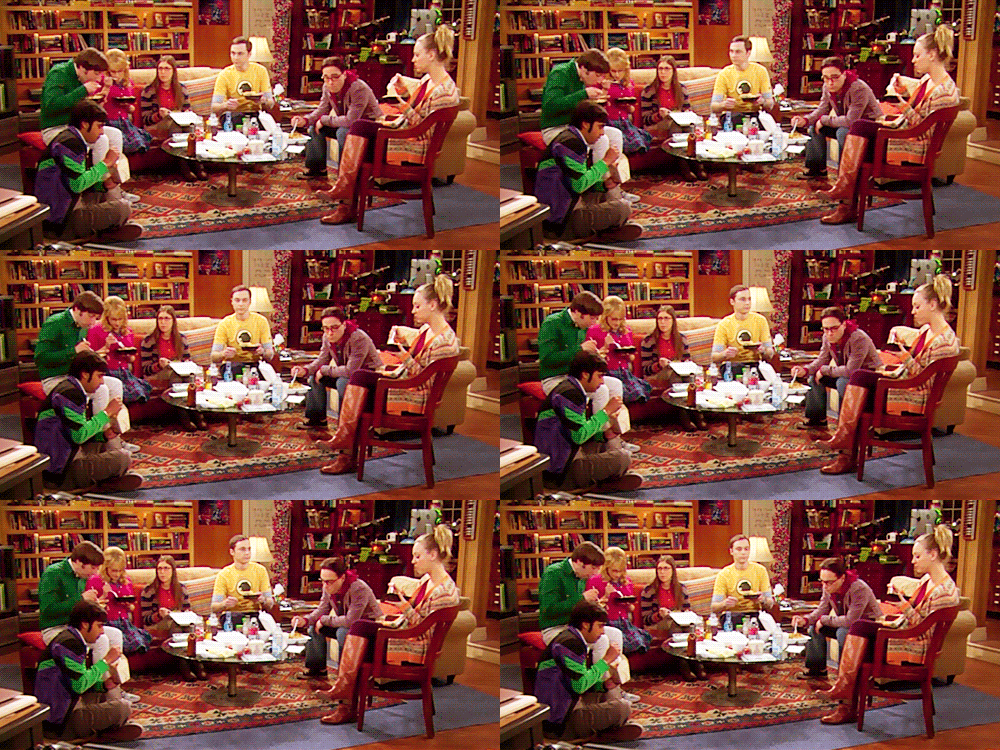
Below is a list of my favorite ensemble television shows that feature twenty and thirty somethings:


TELEVISION FRIENDSHIPS


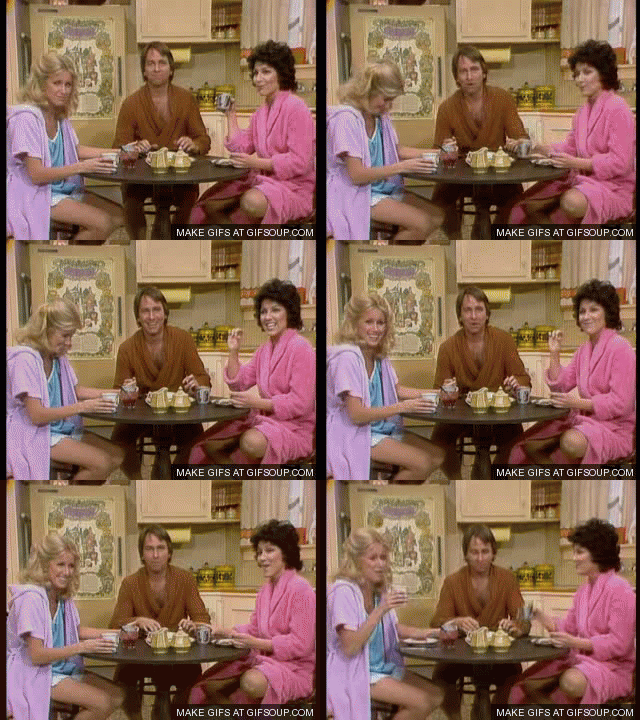
“Three’s Company” (ABC) 1977-1984


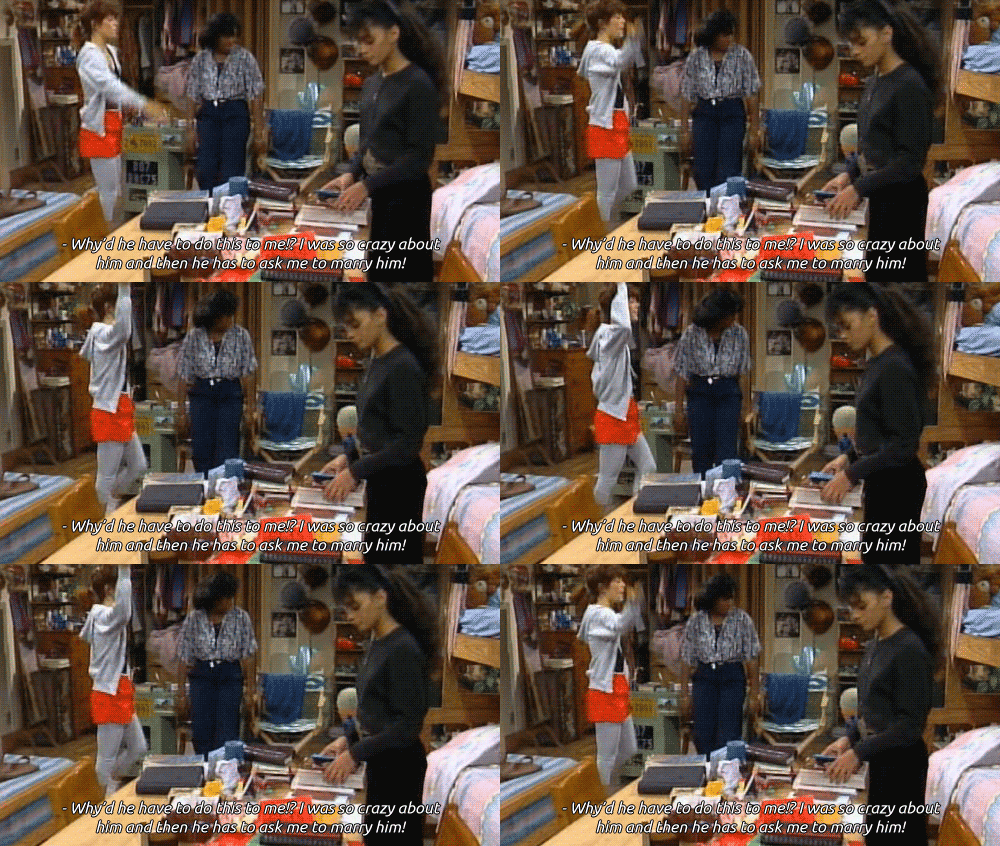
“A Different World” (NBC) 1987-1993


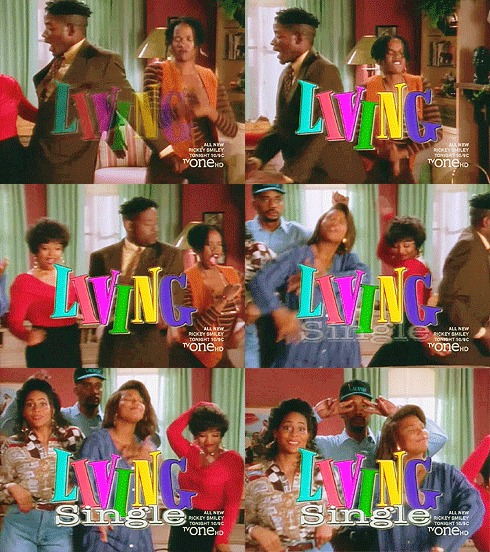
“Living Single” (FOX) 1993-1998


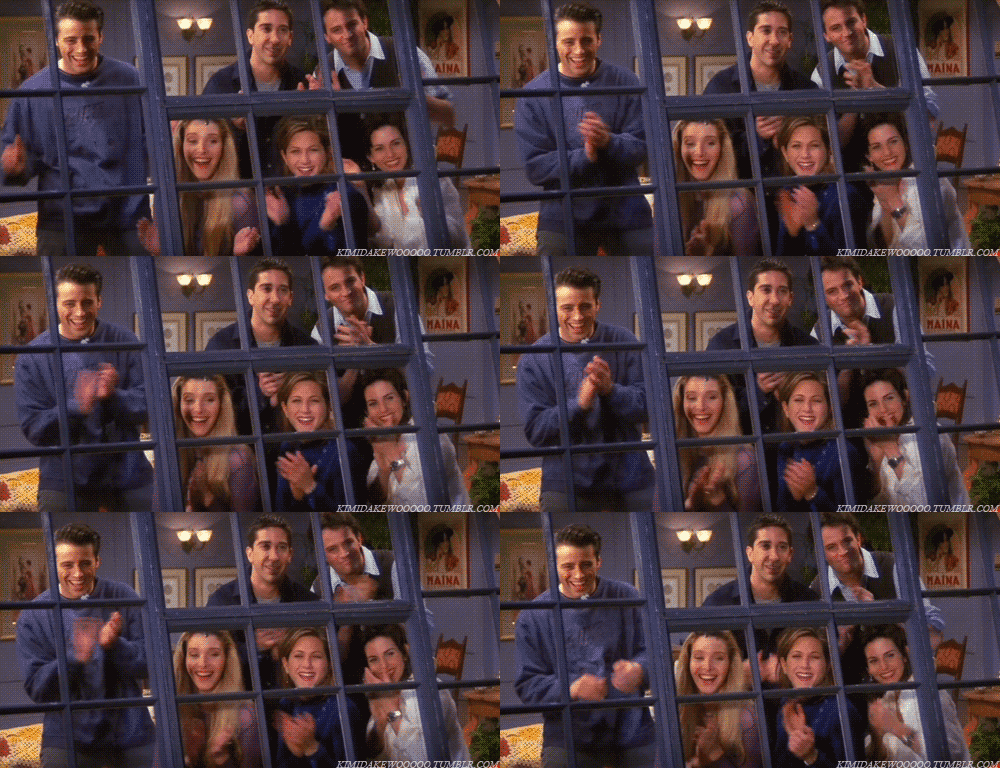
“Friends” (NBC) 1994-2004


“Sex and the City” (HBO) 1998-2004


“How I Met Your Mother” (CBS) 2005-2014


“The Big Bang Theory” (CBS) 2007-2019


“2 Broke Girls” (CBS) 2011-2017

Sunday, February 11, 2018

Gumbo

ee2d19_gumbo_ya_ya_lg


GUMBO

Gumbo is a dish that is not only popular throughout Deep South states like Louisiana, Mississippi, Alabama and South Carolina; but is available to many Americans at restaurants that featured Gulf State cuisine throughout the country. For me, my first real introduction to gumbo was at a food stand inside Los Angeles' Farmers Market called "The Gumbo Pot". It is probably one of my favorite dishes ever . . . if prepared properly. 

It is believed that gumbo was first introduced in southern Louisiana sometime during the 18th century. No one knows exactly where in Louisiana or when it first appeared in the Americas. It is basically a stew that consisted of stock, meat or shellfish, a thickener, and seasoning vegetables that usually included celery, bell peppers and onions (known as the "holy trinity"). Gumbo is often categorized by the type of thickener used. Cooks usually used the African vegetable okra, the Choctaw spice filé powder (dried and ground sassafras leaves), or roux. The name of the dish either came from the Bantu word for okra - "ki ngombo" or the Choctaw word for filé - "kombo".

Gumbo combines the ingredients and culinary practices of several cultures like West African, French, Spanish, German, and Choctaw. Gumbo may have been based on traditional West African or native dishes, or may be a derivation of the French dish bouillabaisse. Some believed that gumbo is a reinterpretation of traditional West African cooking. West Africans used the vegetable okra as a base for many dishes, including soups, often pairing okra with meat and shrimp, with salt and pepper as seasonings. In Louisiana, the dish was modified to include ingredients introduced by other cultural groups. Surviving records indicate that by 1764, African slaves in New Orleans mixed cooked okra with rice to make a meal. Some believe that gumbo may have been derived from traditional French soups, particularly the fish stew bouillabaisse. When the Acadians moved to Louisiana in the mid-18th century, they were unable to find many of their traditional ingredients for the soups they usually made for the winter months, so they substituted fish, turnips and cabbage with shellfish and ingredients from other cultures. Culinary experts like Celestine Eustis insisted that gumbo was an early dish for native tribes. It was first described in 1802 and was later listed in various cookbooks in the second half of the 19th century. Gumbo gained more widespread popularity in the 1970s, after the United States Senate cafeteria added it to the menu in honor of Louisiana Senator Allen Ellender. It is now the official state dish of Louisiana.

There are many types of variations on gumbo. Among them are:

*Gumbo Ya-Ya
*Seafood Gumbo
*Chicken and Sausage Gumbo


Considering there are so many different types of gumbo dishes out there, I tried to find a recipe of the most basic kind prepared in Louisiana. Below is a recipe found on the Smithsonian Institute magazine website, from an article written by Southern Louisiana native, Lolis Eric Elie. The recipe came from his mother:

Creole Gumbo

Ingredients

• 5 quarts water
• 1 dozen fresh crabs, raw, boiled or steamed 
• 2 pounds medium to large shrimp, peeled and deveined (reserve the shells and heads to make seafood stock) 
• 2 pounds smoked sausage, cut into 1 inch rounds (1 pound each of two different sausages is optimal)
• 3/4 pound Creole hot sausage (if available), cut into 1 inch rounds 
• 2 pounds okra cut into rounds
• 1/2 cup plus 2 tablespoons vegetable oil 
• 1/2 cup all-purpose flour
• 2 large onions, coarsely chopped
• 6 large cloves garlic, chopped
• 1 bunch flat-leaf parsley, chopped
• 5 stalks celery, chopped 
• 1 bunch green onions, tops and bottoms, chopped
• 1 large green bell pepper, chopped
• 1 pound crab meat, picked and cleaned of shells and cartilage 
• 2 tablespoons Creole seasoning, such as Tony Chachere’s Original Creole Seasoning
• 4 bay leaves 
• 4 tablespoons filé powder 
• Salt and pepper to taste 
• 6 cups steamed white rice


Preparation

Clean the crabs, removing the lungs, heart and glands and other parts so that only the pieces of shell containing meat (including the legs, swimmers and claws) remain. Refrigerate the meaty parts of the crabs. Put the portions of the crabs that have been removed into a 6- or 8-quart stockpot. Add the shrimp heads and shells and 5 quarts water to the pot and bring to a boil over high heat. Reduce the heat to low and simmer for 30 minutes. Remove from the heat. 

Cook the sausages in a skillet in batches over medium heat, turning occasionally, until the pieces are slightly brown and much of the fat has been rendered. Remove the sausage and set aside on a paper towel-lined plate to drain. Discard the excess fat remaining in the skillet before cooking the next batch of sausage.

Once all the sausage has been cooked, wipe the excess oil from the skillet, being careful not to scrub away those bits of sausage that have stuck to the bottom of the skillet. Add the 2 tablespoons vegetable oil. Heat the oil over medium heat and then add the okra. Lower the heat to medium and cook the okra until it is slightly brown and dried, stirring frequently, about 45 minutes. 

While the okra cooks, place the 1/2 cup vegetable oil in a 12-quart stockpot. Heat the oil over medium heat. Once the oil is hot, a tablespoon at a time slowly add the 1/2 cup flour to prepare the roux, stirring constantly. Once all the flour has been added, continue heating and stirring the roux until it becomes a medium brown color, somewhere between the color of caramel and milk chocolate, about 10-15 minutes. Add the onions to the roux, stirring constantly. Once the onions are wilted, add the garlic, parsley, celery, green onions and bell pepper. Strain the seafood stock into the large stockpot. Add the browned sausage and bay leaves and bring everything to a boil over medium-high heat. Then reduce the heat to medium and continue to cook.

Once the okra is cooked, add it to the gumbo pot. Continue cooking the gumbo for 60 minutes. Add the reserved crabs and shrimp and cook for 15 minutes longer. Remove the gumbo from the heat and stir in the Creole seasoning and filé powder. Let the gumbo rest for 15 to 20 minutes. As it cools, oil should form on the top. Skim the oil with a ladle or large spoon and discard. Stir in the picked crab meat. Taste the gumbo and adjust seasoning with more salt and pepper as needed. Serve the gumbo ladled over steamed rice.


chebert

Wednesday, March 9, 2016

Top Ten Favorite Movies Set in the 1970s

1970-films-initials-and-graphics

Below is my current list of favorite movies set in the 1920s: 


FAVORITE MOVIES SET IN THE 1970s

1 - American Gangster

1. American Gangster (2007) - Denzel Washington and Russell Crowe starred in this biopic about former Harlem drug kingpin, Frank Lucas and Richie Roberts, the Newark police detective who finally caught him. Ridley Scott directed this energetic tale.


2 - Munich

2. Munich (2005) - Steven Spielberg directed this tense drama about Israel's retaliation against the men who committed the Munich massacre at the 1972 Summer Olympics. Eric Bana, Daniel Craig and Ciarán Hinds starred.


Rush-2013

3. Rush (2013) - Ron Howard directed this account of the sports rivalry between James Hunt and Niki Lauda during the 1976 Formula One auto racing season. Chris Hemsworth and Daniel Brühl starred.


4 - Casino

4. Casino (1995) - Martin Scorsese directed this crime drama about rise and downfall of a gambler and enforcer sent West to run a Mob-owned Las Vegas casino. Robert De Niro, Joe Pesci and Sharon Stone starred.


5 - Super 8

5. Super 8 (2011) - J.J. Abrams directed this science-fiction thriller about a group of young teens who stumble across a dangerous presence in their town, after witnessing a train accident, while shooting their own 8mm film. Joel Courtney, Elle Fanning and Kyle Chandler starred.


6 - Tinker Tailor Soldier Spy

6. Tinker, Tailor, Soldier, Spy (2011) - Gary Oldman starred as George Smiley in this recent adaptation of John le Carré's 1974 novel about the hunt for a Soviet mole in MI-6. Tomas Alfredson directed.


7 - Apollo 13

7. Apollo 13(1995) - Ron Howard directed this dramatic account about the failed Apollo 13 mission in April 1970. Tom Hanks, Bill Paxton and Kevin Bacon starred.


8 - Nixon

8. Nixon (1995) - Oliver Stone directed this biopic about President Richard M. Nixon. The movie starred Anthony Hopkins and Joan Allen.


9 - Starsky and Hutch

9. Starsky and Hutch (2004) - Ben Stiller and Owen Wilson starred in this comedic movie adaptation of the 70s television series about two street cops hunting down a drug kingpin. Directed by Todd Phillips, the movie also starred Vince Vaughn, Jason Bateman and Snoop Dogg.


10 - Frost-Nixon

10. Frost/Nixon (2008) - Ron Howard directed this adaptation of the stage play about David Frost's interviews with former President Richard Nixon in 1977. Frank Langella and Michael Sheen starred.

Wednesday, February 3, 2016

”THE TERMINATOR 2: JUDGMENT DAY” (1991) Review


”THE TERMINATOR 2: JUDGMENT DAY” (1991) Review

Seven years following the release of the 1984 movie, ”THE TERMINATOR”, James Cameron wrote, produced and directed the first of three sequels called ”TERMINATOR 2: JUDGMENT DAY”. Like its predecessor, the film starred Arnold Schwarzenegger and Linda Hamilton. It also became one of the most highly critical and successful action films of the 1990s. 

Although released in 1991, the movie is set in 1995 – eleven years after the first one. John Connor (Edward Furlong) is now ten years old and living in Los Angeles with foster parents. His mother Sarah Connor (Linda Hamilton) had been preparing him throughout his childhood for his future role as the leader of the human Resistance against Skynet. Unfortunately, was arrested after attempting to bomb a computer factory and sent to a hospital for the criminally insane under the supervision of Dr. Silberman (Earl Boen), the psychiatrist who had examined time traveler Kyle Reese (Michael Biehn) in the first film. Skynet sends a newly advanced Terminator, a T-1000 (Robert Patrick) that assumes the identity of a police officer, back in time to 1995 to kill John. Meanwhile, the future John Connor has sent back a reprogrammed Terminator (Arnold Schwarzenegger), identical to the one that attacked Sarah, to protect his younger self.

Like the first film, ”TERMINATOR 2: JUDGMENT DAY” is a thrilling and tense action film that made breakthroughs in the area special effects in film. And like in the first film, Cameron and his co-writer, William Wisher Jr. (sans Gale Anne Hurd, who only served as a producer for this film), created a story that centered around a future cyborg sent back in time to prevent a certain John Connor from ever becoming the leader of the Human Resistance against the future self-aware computer system, Skynet. Perhaps I should have said one of the storylines. Thanks to information garnered by young John’s Terminator protector, the Connors learns that the man most directly responsible for Skynet's creation is Miles Bennett Dyson (Joe Morton), a Cyberdyne Systems engineer working on a revolutionary new microprocessor that will form the basis for Skynet. This particular storyline lead to one of the film’s more interesting scenes that feature Dyson’s reaction to the consequences his work and a great performance by Joe Morton. Another favorite scene featured the Terminator’s first rescue of John Connor from the T-1000 that had been sent to kill the latter. Arnold Schwarzenegger’s interactions with Edward Furlong not only provided some laughs in these scenes, but also a great deal of poignancy, as the two quickly form an immediate bond.

If I have to name one sequence that struck me as the movie’s pièce de résistance, it had to be the one that featured John and the T-800’s attempt to rescue Sarah from the Pescadero State Hospital, during one of her escape attempts. The entire sequence began with John convincing his T-800 savior to rescue his mother from the mental hospital in case the T-1000 came after her. John’s decision came at a time when Sarah decided to make her own escape after Dr. Silberman had rejected her request to receive a visit from her son. This exciting sequence culminated in a bizarre moment that featured Sarah’s first terrified glimpse of the T-800 coming to her rescue. By this time, the T-1000 had arrived at the hospital, killing anyone who stood in its way. This is probably one of the finest action sequences I have ever seen on screen in the past decade or two. And it is not surprising that it is the one sequence that many recall when speaking of the movie.

The movie had received a great deal of accolades for its special effects. Did it deserve it? In regard to the Industrial Light & Magic’s design of the T-1000, I would say yes. As for Stan Winston’s effects, I thought he did a good job. But I could find nothing to get excited about.

The movie also featured some pretty solid performances from the cast. Arnold Schwarzenegger gave a better performance in this film, considering that he was allowed to project more emotion than he did in the 1984 film. This is not surprising considering that the T-800 he portrayed in this film got to learn a great deal about human emotions from the 10 year-old John. Robert Patrick found himself in the same as Schwarzenegger was in the last film – portraying a remorseless and efficient killer with little emotion. And frankly, I found him just as scary. I had commented earlier on Joe Morton’s performance in a very important scene featuring his character, Myles Dyson. Not only do I stand by my comments, I would also like to add that I was impressed by his acting altogether. It was nice to see Earl Boen reprise his role as Dr. Silberman, the police psychiatrist who had examined Kyle Reese in the first film. My only gripe is that the movie never mentioned his first meeting with Sarah, back in 1984. Linda Hamilton had certainly wowed many fans of her transformation of the Sarah Connor character. In this movie, her Sarah is a tough and ruthless woman determined to ensure her son’s survival at any costs. And from the moment the camera first focuses upon her doing arm lifts inside her hospital cell, the audience gets a strong idea on how much Sarah had changed. But for me, the movie belonged to Edward Furlong, the first actor to portray future Human Resistance leader, John Connor. Furlong was around 13-14 years old at the time. And he did a superb job in combining the different aspects of the 10 year-old John’s personality – the child who had clung to his T-800 protector as a father figure, the bold and wayward delinquent that robbed from ATM machines and the tough street kid taught to survive by his high strung mother. It is not surprising that Furlong ended up winning both a Saturn Award and a MTV Movie Award for his performance.

Is ”TERMINATOR 2: JUDGMENT DAY” perfect? No. In fact I have more than a few “quibbles” about the movie. Let me start with my first problem with this film . . . Linda Hamilton. Yes, I realize that I had complimented her performance in the previous paragraph. There were some positive aspects to it. But it also annoyed me. I had read that it was Hamilton who suggested that Sarah Connor become psychotic in the intervening years after her encounter with the Terminator in 1984. Frankly, I wish to God that Cameron had NOT taken her advice. I realize that fans loved this new aspect of Sarah’s personality. I did not. I saw no reason to turn her into a borderline psychotic in order to make her seem tough. And the movie never really explained why after so many years, Sarah had mentally gone around the bend. My second problem with the movie centered on the T-1000. I had no problem with Robert Patrick’s performance. I did have a problem that the movie’s main villain managed to disappear from the screen for nearly an hour. After Sarah, John and the T-800 managed to evade him following Sarah’s escape from the mental hospital, he simply disappeared, while they a) headed south toward the U.S.-Mexico border and then b) returned to Malibu and met Myles Dyson; and c) helped Dyson steal the central processing unit(CPU) and arm of the 1984 Terminator.. At least 45-50 minutes had passed before the T-1000 appeared on the screen again. And my biggest problem with this film centered around the finale and the T-1000’s attempt to use Sarah to capture and kill John. Why do I have a problem with this entire sequence? It was TOO . . . DAMN . . . LONG!! It was too long. Why did Cameron forced the audience to watch the T-1000 chase down and attempt to kill John for nearly a half hour? It was not necessary. And why on earth did Sarah believe or even hope that following the destruction of the CPU, the old Terminator’s arm and the 1995 T-800’s sacrifice; Judgment Day may have been averted? She had proof standing next to her that it would happen – namely her son, John. If they had really averted Judgment Day, John would cease to exist. Without Judgment Day, Kyle Reese would never have a reason to travel back to 1984 and meet Sarah Connor.

Do not get me wrong. I enjoyed ”TERMINATOR 2: JUDGMENT DAY” a lot. It was a first-rate continuation of the original movie’s plot that involved one time traveler trying to prevent John Connor from becoming the Humans’ resistance leader and another time traveler sent to act as a protector. And in this movie, the protagonists also try to prevent Judgment Day. But there were times when I felt that its reputation as one of the finest science-fiction films ever made is overrated. I did not care for the psychotic turn of Sarah Connor’s character. The T-1000 managed to disappear from the story longer than necessary. In fact, the showdown between the Connors, the T-800 and the T-1000 dragged the film’s last half hour. But I would still recommend this movie to anyone who asked about it.

Saturday, October 17, 2015

"TERMINATOR 2: JUDGMENT DAY" (1991) Photo Gallery


Below are photos from the 1991 sequel called "TERMINATOR 2: JUDGMENT DAY". Directed by James Cameron, the movie starred Arnold Schwarzenegger, Linda Hamilton, Edward Furlong, Robert Patrick and Joe Morton: 


"TERMINATOR 2: JUDGMENT DAY" (1991) Photo Gallery