
"SILAS MARNER" (1985) ReviewI have seen a handful of television and movie adaptations of novels written by George Eliot. But the very first adaptation I ever saw was "SILAS MARNER", the 1985 version of Eliot's third novel published back in 1861. My recent viewing of the production led me to reasses it."SILAS MARNER" begins with an English weaver living with a small Calvinist congregation in Lantern Yard, a slum street in a Northern England city. His life falls apart when he is framed for stealing the church's funds, while watching over the congregation's ill deacon. Worse, his fiancee leaves him for his so-called best friend, the very man who may have framed him. Shattered and embittered, Silas leaves Lantern Yard and arrives at a rural village in the Midlands called Raveloe. Although he resumes his trade as a weaver, Silas' traumatized past leads him to achieve a reputation as a miser and a loner in the community.Silas' move to Raveloe eventually leads him to cross paths with the community's leading citizens, the Cass family. The head of the latter is the elderly Squire Cass who has two sons - Godfrey and Dunstan. Godfrey, who is the squire's heir is secretly married to one Molly Farren, a lower-class woman and opium addict from another town, who has given birth to his young daughter. Godfrey is also engaged to a young middle-class woman named Nancy Lammeter. Dunstan is a dissolute wastrel who constantly loses money via excessive gambling. One night, a drunken Dunstan breaks into Silas' cottage, steals the gold coins that the latter has been hoarding and disappears. Through a series of events, Molly plots to expose her marriage to Godfrey and their child during the Cass family's New Year party, but dies in the snow before she can reach it. Silas, who is emotionally upset over the loss of his coins, finds both the dead Molly and the child. Although he informs the partygoers of Molly's death and the child, he assumes guardianship of the latter (renamed Hephzibah "Eppie"), much to the relief of Godfrey, who can now legally marry Nancy. All goes well until Godfrey and Nancy's failure to have children threaten Silas' newfound happiness as Eppie's father years later.What can I say about "SILAS MARNER"? I can honestly say that it was not one of the best adaptations of a George Eliot novel. Then again, I do not consider the 1861 novel to be one of her best works. I realized that Eliot had set the story either around the end of the 18th century or around the beginning of the 19th century. It was her prerogative. But both the novel and the movie seemed to reek of Victorian melodrama that I found myself feeling that Eliot or any adaptation could have set the story around the time it was originally written and published - the mid 19th century. The story is, at best, a good old-fashioned Victorian melodrama. I would never consider it as particularly original in compare to the likes of "MIDDLEMARCH" or "DANIEL DERONDA"."SILAS MARNER" tries its best to be profound on the same level as the other two Eliot stories I had mentioned. But I had a few problems with the narrative. What was the point behind Dunstan Cass' disappearance and theft? Yes, he stole Silas' hard earned money before he disappeared. I got the feeling that the stolen coins seemed to serve as a prelude to Silas' emotional attachment to Eppie. But why have Dunstan take it? How else did his disappearance serve the story . . . even after his dead remains were found close by, years later? In Eliot's novel, the discovery of Dunstan led brother Godfrey to form a guilty conscience over his own secret regarding young Eppie and confess to his wife. But in the movie, it was Godfrey and Nancy's inability to conceive a child that seemed to finally force the former to confess. Unless my memories have played me wrong. Frankly, Dunstan struck me as a wasted character. Anyone else could have stolen Silas' money.I also noticed that Giles Foster, who had served as both screenwriter and director for this production, left out a few things from Eliot's novel. I have never expect a movie or television to be an accurate adaptation of its literary source. But I wish Foster had shown how Eppie's presence in Silas' life had allowed him to socially connect with Raveloe's villagers. Eliot did this by allowing her to lead him outside, beyond the confines of his cottage. The only person with whom Silas managed to connect was neighbor Dolly Winthrop, who visited his cottage to deliver him food or give advice on how to raise Eppie. I also noticed that in the movie, Silas had never apologized to another villager named Jem Rodney for his false accusation of theft. And Jem had never demanded it. How odd. I also wish that Foster could have included the segment in which Silas had revisited his former neighborhood, Lantern Yard. In the novel, Silas' visit revealed how the neighborhood had transformed into a site for a factory and its citizens scattered to other parts. Silas' visit to his old neighborhood served as a reminder of how his life had improved in Raveloe and it is a pity that audiences never saw this on their television screens.Yes, I have a few quibbles regarding "SILAS MARNER". But if I must be really honest, I still managed to enjoy it very much. Eliot had written a very emotional and poignant tale in which a lonely and embittered man finds a new lease on life through his connection with a child. Thanks to George Eliot's pen and Giles Foster's typewriter, this story was perfectly set up by showing how Silas Marner's life fell into a social and emotional nadir, thanks to the betrayal of a "friend" and the easily manipulated emotions of his neighbors.Once Silas moved to Raveloe, the television movie did an excellent, if not perfect, job of conveying how he re-connected with the world. It was simply not a case of Silas stumbling across a foundling and taking her in. Even though he had formed a minor friendship with Mrs. Winthrop, having Eppie in his life managed to strengthen their friendship considerably. The movie's narrative also took its time in utilizing how the Cass family dynamics played such an important role in Silas' life in Raveloe. After all, Godfrey' secret marriage to Molly Farren brought Eppie into his life. And Dunstan's theft of his funds led Silas to re-direct his attention from his missing coins to the lost Eppie. And both Godfrey and Nancy Cass proved to be a threat to Silas and Eppie's future relationship.The production values for "SILAS MARNER" proved to be solid. But if I must be honest, I did not find any of it - the cinematography, production designs and costume designs - particularly memorable. The performances in the movie was another matter. "SILAS MARNER" featured solid performances from the likes of Rosemary Martin, Jim Broadbent (before he became famous), Nick Brimble, Frederick Treves, Donald Eccles, Rosemary Greenwood; and even Elizabeth Hoyle and Melinda White who were both charming as younger versions of Eppie Marner.Angela Pleasence certainly gave a memorable performance as Eppie's drug addicted mother, Molly Farren. Patsy Kensit not only gave a charming performance as the adolescent Eppie, I thought she was excellent in one particular scene in which Eppie emotionally found herself torn between Silas and the Casses. Freddie Jones gave his usual competent performance as the emotional Squire Cass, father of both Godfrey and Dunstan. I was especially impressed by Jonathan Coy's portrayal of the dissolute Dunstan Cass. In fact, I was so impressed that it seemed a pity that his character was only seen in the movie's first half.I initially found the portrayal of Nancy Lammeter Cass rather limited, thanks to Eliot's novel and Foster's screenplay. Fortunately, Nancy became more of a central character in the film's second half and Jenny Agutter did a skillful job in conveying Nancy's growing despair of her inability to have children and her desperation to adopt Eppie. I thought Patrick Ryecart gave one of the two best performances in "SILAS MARNER". He did an excellent job of conveying Godfrey Cass' moral ambiguity - his secrecy over his marriage to Molly Farren, the passive-aggressive manner in which he "took care" of Eppie through Silas and his willingness to use Eppie as a substitute for his and Nancy's failure to have children. Ryecart made it clear that Godfrey was basically a decent man . . . decent, but flawed. The other best performance in "SILAS MARNER" came from leading man Ben Kingsley, who portrayed the title character. Kingsley did a superb job of conveying Silas' emotional journey. And it was quite a journey - from the self-satisfied weaver who found himself shunned from one community, to the embittered man who stayed away from his new neighbors, to a man experiencing the joys and fears of fatherhood for the first time, and finally the loving man who had finally learned to re-connect with others.Overall, "SILAS MARNER" is more than a solid adaptation of George Eliot's novel. I did not find its production designs particularly overwhelming. I did enjoy Eliot's narrative, along with Giles Foster's adaptation rather enjoyable . . . if not perfect. But I cannot deny that what really made this movie work for me were the first-rate performances from a cast led by the always talented Ben Kingsley. Victorian melodrama or not, I can honestly say that I have yet to grow weary of "SILAS MARNER".
 "BUFFY THE VAMPIRE SLAYER" RETROSPECT: (4.08) "Pangs"
Tomorrow is the Thanksgiving holiday. And another three to four weeks will pass until Christmas arrives. I originally had no intentions to watch the Season Four episode from "BUFFY THE VAMPIRE SLAYER" called (4.08) "Pangs". But I could not stop thinking about it and decided . . . why not?
"BUFFY THE VAMPIRE SLAYER" RETROSPECT: (4.08) "Pangs"
Tomorrow is the Thanksgiving holiday. And another three to four weeks will pass until Christmas arrives. I originally had no intentions to watch the Season Four episode from "BUFFY THE VAMPIRE SLAYER" called (4.08) "Pangs". But I could not stop thinking about it and decided . . . why not?
Season Four has never been that popular with fans of "BUFFY THE VAMPIRE SLAYER". It was the first season that did not feature the vampire Angel as a regular character. And it marked the beginning of Buffy Summer's romance with university teaching assistant/Army demon hunter Riley Finn. And many fans were not that thrilled by the Initiative storyline. I have never had a problem with Season Four. Mind you, I would not count it as among my top four out of seven seasons. But it featured at least two of my favorite "BUFFY" episodes of all time. And one of them is the holiday-themed "Pangs".
While preparing a Thanksgiving feast for her close friends in the absence of her mother, University of California Sunnydale student and vampire slayer Buffy Summers encounters the restless and vengeful spirit of a Native American, called Hus, whose people - the Chumash tribe - were wiped out by Spanish and American settlers. Hus's spirit was released during a groundbreaking ceremony for U.C. Sunnydale's new Anthropology building. Hus managed to murder the Curator for the building's museum and a local priest who had attending the ceremony. During her frantic efforts to prepare Thanksgiving and deal with Hus, Buffy is unaware that former boyfriend Angel has returned to Sunnydale to keep an eye on her, after a friend of his (former regular character Cordelia Chase) has received a vision of her being in danger. She is also unaware that soon-to-be boyfriend Riley Finn is part of an U.S. Army program called the Initiative, which hunts down and experiments on demons. One of the Initiative's victims turned out to be Buffy's current nemesis, vampire Spike, who had managed to escape from his Initiative prison in the previous episode, (4.07) "The Initiative". Due to his inability to feed upon or commit violence against humans, Spike is slowly starving. He first seeks help and refuge from fellow vampire Harmony, who refuses to have anything to do with him. Desperate, he turns to Buffy and the other Scoobies for refuge in exchange for information about the Initiative.
"Pangs" did provide a few problems for me. One, the episode's writer, Jane Espenson, erroneously stated that the Chumash had been wiped out. Despite the Spanish, Mexican and American governments; the band still exists. Two, Buffy informed her friends that her mother Joyce left Sunnydale to spend Thanksgiving with an aunt. Why did Buffy, who was eighteen at the time, stay in Sunnydale? Why did she fail to accompany her mother for what was obviously a family gathering? Did Buffy have something against this particular "Aunt Pauline"? Three, during her last fight with Hus and the Chumash spirits he had summoned, Buffy unsuccessfully used her knife on Hus and claimed that he and his fellow spirits do not die. Yet, in a scene later, Angel managed to break the neck of one Chumash spirit and impale another with a knife. Hmmmm . . . I smell inconsistency in the air. And four, Angel's visit to Sunnydale led to the "ANGEL" Season One episode, (1.08) "I Will Remember You", which I loathe with every fiber of my being.
Aside from these narrative hiccups, "Pangs" remains a personal favorite of mine. At first glance, it seemed like a stand-alone episode that had nothing to do with the season and series' plot arc. As it turned out, it did. "Pangs" marked the first time Spike would hang out with the Scoobies. It led to another setback in Buffy and Angel's relationship. It marked the first time that the Scoobies became aware of the Initiative, thanks to Spike. And it provided another chapter in Buffy's growing relationship with Riley Finn. This seems like an awful lot, considering that this episode mainly focused on Buffy dealing with a Thanksgiving feast and a vengeance spirit - two topics that were quickly resolved by the end. But Espenson and director Michael Lange. But the best things I can say about "Pangs" is that it featured superb performances and some incredibly funny dialogue and camera visuals.
I tried to think of some of the best dialogue found in the episode and came across several lines. Among my favorites featured Buffy's ability to remain focused . . . or obssessed with her feast, while discussing their problems with Hus. However, one should not be surprised that Spike was responsible for the funniest moment in the episode in a scene that featured both Buffy and her friend Willow Rosenberg's reluctance to destroy Hus, due to their guilt over the country's past with Native Americans:
BUFFY: Will, you know how bad I feel. This is eating me up -- (to Anya, who holds up the bottle of brandy) -- a quarter cup, and let it simmer -- (to Willow, as Anya goes back) -- but even though it's hard, we
have to end this. Yes, he's been wronged, and I personally would be ready to apologize...
SPIKE: Oh, someone put a stake in me!
XANDER: You got a lot of volunteers in here...
SPIKE: I just can't take this mamby-pamby boo-hooing over the bloody Indians!
WILLOW: The preferred term is --
SPIKE: You won! All right? You came in and you killed them and you took their land. That's what conquering nations do! That's what Caesar did, he's not going around saying "I came, I conquered, I felt really bad about it!" The history of the world is not people making friends. You had better weapons, you massacred them, end of story!
BUFFY: Well, I think the Spaniards actually did a lot of... not that I don't like Spaniards...
SPIKE: Listen to you! How are you gonna fight anybody with that attitude?
WILLOW: We don't want to fight anybody.
BUFFY: I just want to have Thanksgiving.
SPIKE: Yeah, good luck.
WILLOW: If we could talk to him --
SPIKE: You exterminated his race. What could you possibly say that would make him feel better? It's kill
or be killed here. Take your bloody pick.
James Marsters really acted the hell out of that scene. And I am not surprised. To this day, I believe that his portrayal of Spike was one of the best television performances I have ever seen . . . period. And he was really marvelous in this episode. So were Anthony Stewart Head, who did a top-notch job in giving a comic twist to a Rupert Giles who found himself manipulated by Buffy into holding the Scoobies' Thanksgiving feast at his apartment; Alyson Hannigan, who was also superb as best friend/witch Willow Rosenberg, who did not hesitate to express her conflict between dealing with Hus and her guilt over the region's ugly past in dealing with the Chumash people. Nicholas Brandon and Emma Caufield gave fine support as Buffy's two other friends, Xander Harris and former vengeance demon Anya Jenkins. Marc Blucas was charming as Buffy's soon-to-be boyfriend, Riley Finn. And he was ably supported by an exuberant Leonard Roberts. Mercedes McNab displayed excellent comic timing in scenes that featured recently sired vampire Harmony Kendall's encounters with Spike and Xander. David Boreanaz took a break from his new series at the time, "ANGEL" to give an intense, yet at times funny performance as Buffy's ex-vampire squeeze, Angel. But the real star of this episode was Sarah Michelle Gellar. She gave both a hilarious, yet poignant performance, revealing Buffy's somewhat obssessive determination to make her Thanksgiving a success. In fact, I believe I enjoyed her performance even more than Marsters. And that is quite an accomplishment, considering that Marsters is a natural-born scene stealer.
Yes, "Pangs" had a few problems. And its main narrative surrounding the dangers of a Native American vengeance spirit did not exactly strike me as memorable. However, I do believe that the narrative made an interesting comment on how conflicted Americans have become in viewing our county's history. More importantly, Spike's comments on the cirumstances that led to Hus' path of vengeance is a brutal reminder of how monstrous human beings can be - a foreshadow of the Scoobies' future behavior later in the series. Thanks to Jane Espenson's hilarious script, Michael Lange's direction and a superb cast led by Sarah Michelle Geller, "Pangs" remains one of my favorite "BUFFY THE VAMPIRE SLAYER" episodes to this day.

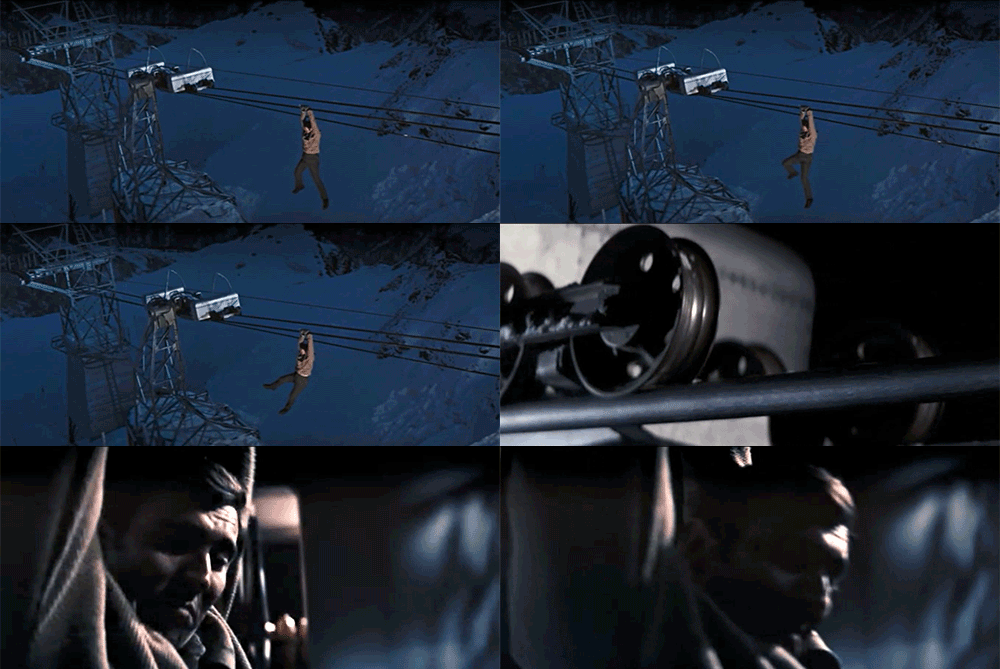
"ON HER MAJESTY’S SECRET SERVICE" (1969) ReviewAt least ten years or more must have passed since I last saw the 1969 Bond movie, “ON HER MAJESTY’S SECRET SERVICE (OHMSS)”. EON Production’s sixth entry in the Bond franchise has the distinction of being the only movie that starred Australian male model-turned-actor, George Lazenby. It was the first EON movie that did not star Sean Connery – already fixed in the public’s mind as the only actor who can portray James Bond. And it was the only movie that was directed by former film editor, Peter Hunt. I first became aware of “OHMSS” back in the mid-1980s. I had seen it on television once, when I was a child. But ABC Television’s botched editing had turned me off from the movie. I eventually became a fan during repeated viewings of the movie during the mid and late 1980s. By the beginning of the 1990s, “OHMSS” had been fixed as my favorite Bond movie. For years, it remained in this position, despite repeating viewings of other Bond movies, the release of the Brosnan films and my own mysterious reluctance to watch “OHMSS”. It seemed as if I was afraid to watch it again, fearful that my earlier adulation of the film might prove to be misguided. And then EON Productions released “CASINO ROYALE” in the theaters back in 2006. "CASINO ROYALE"had impressed me so much that my doubts about “OHMSS” increased even further. After seeing “CASINO ROYALE” for the third time and 2008's "QUANTUM OF SOLACE", I finally decided to watch “OHMSS” for the first time in years.In the end, my fears seemed groundless. My latest viewing of “OHMSS” proved that I had every right to view it as one of my all time favorite Bond movies. After 41 years, the movie still holds up as one of the finest Bond movies in the entire franchise, if not the finest. And it also one of the few Bond films to closely follow its source, namely the 1963 novel penned by Ian Fleming. What makes the latter remarkable is that the previous Bond entry, “YOU ONLY LIVE TWICE” barely resembled its literary source, aside from a few characters and the setting.“OHMSS” picks up with Bond searching for Blofeld, now wanted by various governments for his past forays into international terrorism and extortion. His search leads to meeting the most important woman in his life other than Vesper Lynd – Teresa (Tracy) Draco di Vicenzo. Not only will his meeting with Tracy lead to a serious change in his private life, it will also affect his professional life, thanks to Tracy’s father, Marc-Ange Draco when he provides Bond with information leading to Blofeld. Of course, Draco was only willing to provide this information, if Bond courts his daughter. In the end, Bond not only tracks down Blofeld, but destroy the latter’s latest attempt to extort the United Nations. But as many know, Bond’s latest professional conflict will result in tragedy for his private life.I only have a few problems with “OHMSS”. One of them was the director Peter Hunt’s decision to have actor George Baker (portraying the real Sir Hilary Bray), dub Lazenby’s voice, while Bond is impersonating Sir Hilary at Piz Gloria. Why they had decided to do this confounds me. It seemed very unnecessary, unless the director was aiming for Sir Hilary to sound like a cliché of a British scholar. Another problem I had were some of the jokes that came out of Bond’s mouth. I consider this problem minor, since “OHMSS” – like many other Bond movies had its share of good and bad jokes. One particularly good joke was the St. Bernard who came to Bond’s “rescue” after the latter had survived his bobsled fight against Blofeld. And last, but not least, there were a few moments when the editing seemed a bit . . . questionable. A good example would be the scene that featured Bond’s first meeting with Draco. There is a moment when it seemed that Bond had asked Draco for Blofeld’s whereabouts. It seemed as if Lazenby had spoken too soon, cutting off actor Gabriele Ferzetti’s lines too soon. Another viewing seemed to reveal that poor editing might have been at fault and not Lazenby’s acting. And another review seemed to agree with my findings.Aside from the previously mentioned quibbles, I had no problems with “OHMSS”. In fact there is so much to enjoy about this movie – including the main star, George Lazenby. Many critics and fans either tend to dismiss his performance as wooden or give him minor credit for his valiant attempt at a decent performance. Frankly, I think that he was a lot better than many give him credit for. I must admit that he has a rather odd voice (which I suspect has been influenced by his Australian accent), but so did most of the other Bonds – including Connery’s tendency to indulge in pre-adolescent diction, Moore’s drawl, Dalton’s Welsh accent and Brosnan’s . . . well, I cannot really describe Brosnan’s voice. I just find it odd. But despite Lazenby’s odd voice, his acting comes off very natural and he seems to project Bond’s emotions with an ease that should not have come easy to him. But he does. And instead of portraying Bond as some kind of action/sexual icon, he portrays the character as very human. This is very obvious in the following scenes:-Bond’s growing impatience with Tracy’s antics
-Bond’s surprise that M had given him leave instead of accepting his resignation
-Bond’s breakthrough with Tracy
-the Piz Gloria dinner sequence
-Bond’s fear of capture during his escape from Piz Gloria
-Bond’s proposal of marriage to Tracy
-Bond’s quarrel with M over Tracy and Blofeld
-Tracy’s deathPersonally, I thought that Lazenby really shined in the marriage proposal scene, those scenes that featured Bond’s quarrels with M and the Piz Gloria dinner sequence. Despite having his voice dubbed by George Baker in the latter, Lazenby managed to express Bond’s emotions during that scene effortlessly without having to say a word.The movie also benefited from the presence of Diana Rigg, who had recently left “THE AVENGERS” to begin a movie career. What can one say about the great Diana? Not only did she effortlessly combine all the complex personality traits of Tracy di Vicenzo – witty, emotional, sad, brave, determined, etc. Is it any wonder that Tracy is viewed by many actresses as the ultimate Bond woman? Even better, both Rigg and Lazenby managed to create great chemistry together as the romantically doomed pair.Not only did “OHMSS” benefited from both Lazenby and Rigg’s performances, the pair was ably supported by a fine cast that included the warm and charismatic Gabriele Ferzetti as Tracy’s father, the talented Ilse Steppat who portrayed the intimidating Irma Bunt shortly before her death (she never lived to experience the movie’s release), the always dependable Bernard Lee as M – giving one of his better performances, and the charming and fun Angela Scoular as Blofeld’s English patient, Ruby. Of course one cannot forget the legendary Telly Savalas, who became the second actor to portray Ernst Blofeld on-screen. And as far as I’m concerned, he was the best. He was not impeded by Donald Pleasance’s ridiculous scar and questionable accent or Charles Gray’s foppish portrayal. Instead, he radiated intelligence and menace, making him the only Blofeld (in my opinion) worthy of being Bond’s nemesis.I also have to commend Peter Hunt’s direction. “OHMSS” was his first time at bat as a director. Any other inexperienced director could have turned one of Ian Fleming’s best novels into a hash job. Fortunately, Hunt proved to be a talented director and did justice to the novel – although I did have a problem with the editing of a few of his scenes. Hunt was not only ably supported by a fine cast, but by screenwriter Richard Maibaum, editor and future director John Glen, and John Barry’s marvelous score and Hal David’s haunting lyrics to the song, “We Have All the Time In the World”. Cinematographer Michael Reed superbly recaptured the majesty of the Swiss Alps and the exotic elegance of Portugal with his photography. And one cannot forget skier Willy Bogner Jr. and Alex Barbey for creating the first and probably best ski chase in the Bond franchise.I could probably go on about how much I love “OHMSS”, but I do not want to sound repetitive. What can I say? After 38 years, I consider to still be one of the best Bond movies in the franchise . . . and definitely one of my favorites. And I am happy to see that “OHMSS” is finally being recognized by many as the fine film it is. If you have not seen this film, I suggest that you rent or buy it as soon as possible. Or else you will be missing something special.10/10 stars

"THE THIN MAN" (1934) Review
Between 1934 and 1947, Metro-Goldwyn-Mayer (MGM) released at least six movies based upon the characters created by detective novelist, Dashiell Hammett. The first and one of the two best was 1934’s "THE THIN MAN", based upon Hammet’s novel that was also released in 1934.
Produced by Hunt Stromberg and directed by W.S. Van Dyke, "THE THIN MAN" is a murder mystery about a former detective named Nick Charles and his wealthy wife, Nora, who investigate the disappearance of an old friend of Nick’s named Clyde Wynant. When the latter’s mistress is found murdered, Wynant becomes the police’s prime suspect. Wynant’s daughter, Dorothy, asks Nick to not only find her missing father, but discover the identity of the real murderer.
William Powell and Myrna Loy first appeared in a movie with Clark Gable called "MANHATTAN MELODRAMA". Not only did that movie proved to be a hit, it also begat a very famous Hollywood screen couple. Producer Hunt Stromberg liked what he saw and decided to pair the two as Nick and Nora Charles, the witty and sophisticated married couple from Hammet’s mystery novel. Powell and Loy not only portrayed Nick and Nora simply as a loving husband and wife, but also as two friends who clearly enjoyed each other’s company. And more so than in "MANHATTAN MELODRAMA", Powell and Loy were magic together. The two ended up working on twelve other films together. And even in mediocre fare like the later THIN MAN movies, they sizzled with a wit and charm that made them one of the best Hollywood screen teams in history.
Stromberg also included in the cast, the Irish-born ingénue Maureen O’Sullivan (from the "TARZAN" movies fame) as the missing Clyde Wynant’s daughter, Dorothy; Nat Pendleton in his first of two THIN MAN movies as New York Police detective, Lieutenant Guild; Minna Gombell as Wynant’s greedy ex-wife, Mimi Wynant Jorgensen; future Hollywood legend Cesar Romero as Mimi’s gigolo husband, Chris Jorgenson; Porter Hall as Wynant’s attorney Herbert MacCauley; Natalie Moorhead as Wynant’s mistress, Julia Wolf; Edward Brophy as Julia’s gangster friend, Joe Morelli; as Harold Huber as the stool-pigeon Arthur Nunnheim; and Edward Ellis as the missing Clyde Wynant. As much as I try, I could not spot a bad performance from any of them. I was especially impressed by O’Sullivan’s performance as the seemingly normal Dorothy who seemed stuck in the middle of an eccentric and/or amoral family.
Albert Hackett and Frances Goodrich, a married couple that also happened to be contract screenwriters at MGM, wrote the screenplay. They also received Academy Award nominations for their adaptation of Hammett’s novel and I have to say that they deserved the nomination. "THE THIN MAN" is a witty and rich story filled with memorable characters and an intriguing mystery that was neither too complicated or insulted the moviegoers’ intelligence. Even more interesting is the fact that ”THE THIN MAN” would prove to be one of the last Pre-Code movies that would be released before the onslaught the Hays Code enforcement on July 31, 1934. "THE THIN MAN" was released in theaters on May 23, 1934. Hackett and Goodrich’s screenplay was filled with risqué dialogue and situations that made it clear that "THE THIN MAN" was a Pre-Code film.
And director W.S. ("Woody") Van Dyke did justice with not only a talented cast, but also with Hackett and Goodrich’s script. During his tenure as a contract director for MGM, Van Dyke had a nickname – "One Take Woody". Van Dyke usually shot his scenes in one take, which guaranteed that he would complete his assignment on time. MGM boss, Louis B. Mayer loved him for this. Although Van Dyke was never known as one of Hollywood’s more gifted directors, he had a reputation for coaxing natural performances from his stars. This was very apparent in his direction of "THE THIN MAN". There is not a bad performance within the entire cast. Even better, he managed to keep the story rolling with a first-rate pacing – something that is very difficult to do for murder mysteries.
Some eight to nine months after its release, "THE THIN MAN" collected Academy Award nominations – Best Director (Van Dyke), Best Actor (Powell), (Best Adapted Screenplay) Hackett and Goodrich, and Best Picture. Unfortunately for MGM, the movie was shut out by Frank Capra’s classic screwball comedy, "IT HAPPENED ONE NIGHT". Well . . . even if the movie had failed to collect one Academy Award, I believe that it is still one of the best movies that was released during the 1930s.
"THE THIN MAN" was such a success that it spawned five sequels. Aside from 1936’s "ANOTHER THIN MAN", which proved to be just as good; the other four sequels turned out to be a ghost of its original success. If you want to see William Powell and Myrna Loy in action as Nick and Nora Charles, I suggest that you stick with this film and its 1936 sequel.
 Below are images from the 1934 movie, "THE THIN MAN". Adapted from Dashiell Hammet's 1934 novel and directed by W.S. "Woody" Van Dyke, the movie starred William Powell and Myrna Loy:
"THE THIN MAN" (1934) Photo Gallery


_01.jpg)
_03.jpg)
_04.jpg)
_05.jpg)
_06.jpg)
_01.jpg)
_02.jpg)


