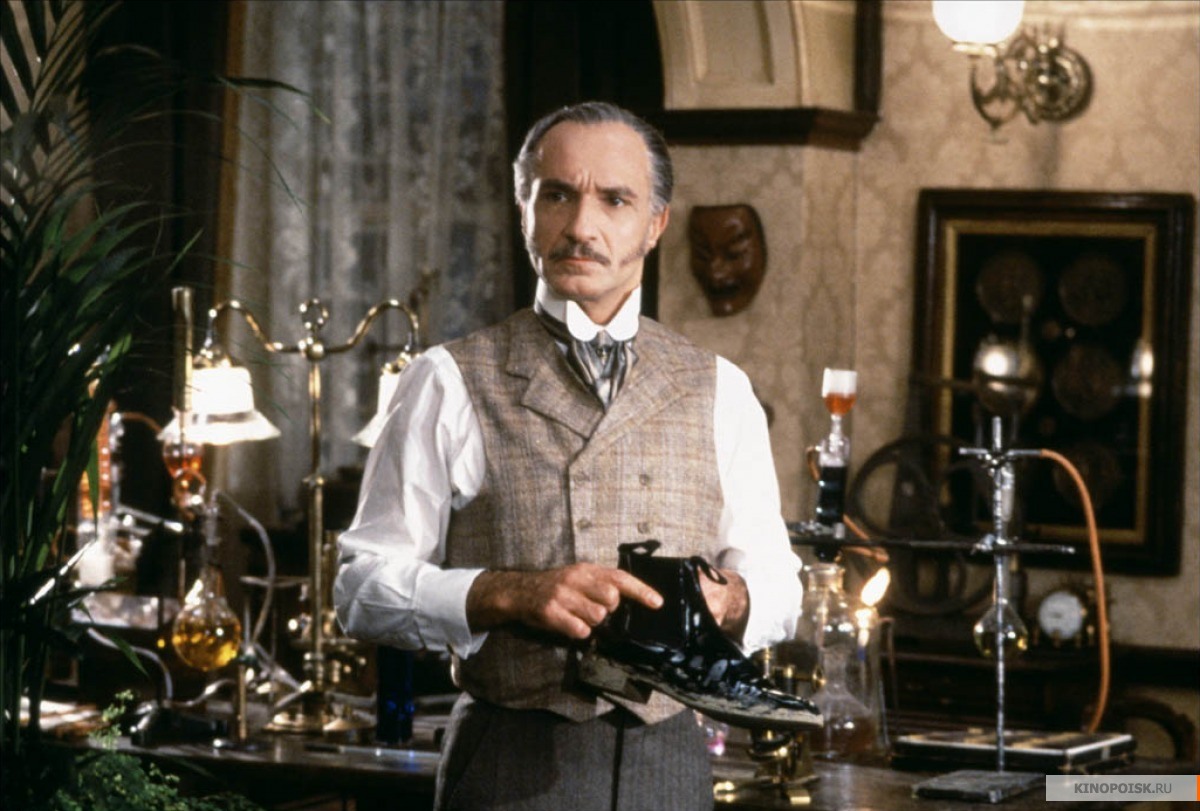
"SILAS MARNER" (1985) Review
I have seen a handful of television and movie adaptations of novels written by George Eliot. But the very first adaptation I ever saw was "SILAS MARNER", the 1985 version of Eliot's third novel published back in 1861. My recent viewing of the production led me to reasses it.
"SILAS MARNER" begins with an English weaver living with a small Calvinist congregation in Lantern Yard, a slum street in a Northern England city. His life falls apart when he is framed for stealing the church's funds, while watching over the congregation's ill deacon. Worse, his fiancee leaves him for his so-called best friend, the very man who may have framed him. Shattered and embittered, Silas leaves Lantern Yard and arrives at a rural village in the Midlands called Raveloe. Although he resumes his trade as a weaver, Silas' traumatized past leads him to achieve a reputation as a miser and a loner in the community.
Silas' move to Raveloe eventually leads him to cross paths with the community's leading citizens, the Cass family. The head of the latter is the elderly Squire Cass who has two sons - Godfrey and Dunstan. Godfrey, who is the squire's heir is secretly married to one Molly Farren, a lower-class woman and opium addict from another town, who has given birth to his young daughter. Godfrey is also engaged to a young middle-class woman named Nancy Lammeter. Dunstan is a dissolute wastrel who constantly loses money via excessive gambling. One night, a drunken Dunstan breaks into Silas' cottage, steals the gold coins that the latter has been hoarding and disappears. Through a series of events, Molly plots to expose her marriage to Godfrey and their child during the Cass family's New Year party, but dies in the snow before she can reach it. Silas, who is emotionally upset over the loss of his coins, finds both the dead Molly and the child. Although he informs the partygoers of Molly's death and the child, he assumes guardianship of the latter (renamed Hephzibah "Eppie"), much to the relief of Godfrey, who can now legally marry Nancy. All goes well until Godfrey and Nancy's failure to have children threaten Silas' newfound happiness as Eppie's father years later.
What can I say about "SILAS MARNER"? I can honestly say that it was not one of the best adaptations of a George Eliot novel. Then again, I do not consider the 1861 novel to be one of her best works. I realized that Eliot had set the story either around the end of the 18th century or around the beginning of the 19th century. It was her prerogative. But both the novel and the movie seemed to reek of Victorian melodrama that I found myself feeling that Eliot or any adaptation could have set the story around the time it was originally written and published - the mid 19th century. The story is, at best, a good old-fashioned Victorian melodrama. I would never consider it as particularly original in compare to the likes of "MIDDLEMARCH" or "DANIEL DERONDA".
"SILAS MARNER" tries its best to be profound on the same level as the other two Eliot stories I had mentioned. But I had a few problems with the narrative. What was the point behind Dunstan Cass' disappearance and theft? Yes, he stole Silas' hard earned money before he disappeared. I got the feeling that the stolen coins seemed to serve as a prelude to Silas' emotional attachment to Eppie. But why have Dunstan take it? How else did his disappearance serve the story . . . even after his dead remains were found close by, years later? In Eliot's novel, the discovery of Dunstan led brother Godfrey to form a guilty conscience over his own secret regarding young Eppie and confess to his wife. But in the movie, it was Godfrey and Nancy's inability to conceive a child that seemed to finally force the former to confess. Unless my memories have played me wrong. Frankly, Dunstan struck me as a wasted character. Anyone else could have stolen Silas' money.
I also noticed that Giles Foster, who had served as both screenwriter and director for this production, left out a few things from Eliot's novel. I have never expect a movie or television to be an accurate adaptation of its literary source. But I wish Foster had shown how Eppie's presence in Silas' life had allowed him to socially connect with Raveloe's villagers. Eliot did this by allowing her to lead him outside, beyond the confines of his cottage. The only person with whom Silas managed to connect was neighbor Dolly Winthrop, who visited his cottage to deliver him food or give advice on how to raise Eppie. I also noticed that in the movie, Silas had never apologized to another villager named Jem Rodney for his false accusation of theft. And Jem had never demanded it. How odd. I also wish that Foster could have included the segment in which Silas had revisited his former neighborhood, Lantern Yard. In the novel, Silas' visit revealed how the neighborhood had transformed into a site for a factory and its citizens scattered to other parts. Silas' visit to his old neighborhood served as a reminder of how his life had improved in Raveloe and it is a pity that audiences never saw this on their television screens.
Yes, I have a few quibbles regarding "SILAS MARNER". But if I must be really honest, I still managed to enjoy it very much. Eliot had written a very emotional and poignant tale in which a lonely and embittered man finds a new lease on life through his connection with a child. Thanks to George Eliot's pen and Giles Foster's typewriter, this story was perfectly set up by showing how Silas Marner's life fell into a social and emotional nadir, thanks to the betrayal of a "friend" and the easily manipulated emotions of his neighbors.
Once Silas moved to Raveloe, the television movie did an excellent, if not perfect, job of conveying how he re-connected with the world. It was simply not a case of Silas stumbling across a foundling and taking her in. Even though he had formed a minor friendship with Mrs. Winthrop, having Eppie in his life managed to strengthen their friendship considerably. The movie's narrative also took its time in utilizing how the Cass family dynamics played such an important role in Silas' life in Raveloe. After all, Godfrey' secret marriage to Molly Farren brought Eppie into his life. And Dunstan's theft of his funds led Silas to re-direct his attention from his missing coins to the lost Eppie. And both Godfrey and Nancy Cass proved to be a threat to Silas and Eppie's future relationship.
The production values for "SILAS MARNER" proved to be solid. But if I must be honest, I did not find any of it - the cinematography, production designs and costume designs - particularly memorable. The performances in the movie was another matter. "SILAS MARNER" featured solid performances from the likes of Rosemary Martin, Jim Broadbent (before he became famous), Nick Brimble, Frederick Treves, Donald Eccles, Rosemary Greenwood; and even Elizabeth Hoyle and Melinda White who were both charming as younger versions of Eppie Marner.
Angela Pleasence certainly gave a memorable performance as Eppie's drug addicted mother, Molly Farren. Patsy Kensit not only gave a charming performance as the adolescent Eppie, I thought she was excellent in one particular scene in which Eppie emotionally found herself torn between Silas and the Casses. Freddie Jones gave his usual competent performance as the emotional Squire Cass, father of both Godfrey and Dunstan. I was especially impressed by Jonathan Coy's portrayal of the dissolute Dunstan Cass. In fact, I was so impressed that it seemed a pity that his character was only seen in the movie's first half.
I initially found the portrayal of Nancy Lammeter Cass rather limited, thanks to Eliot's novel and Foster's screenplay. Fortunately, Nancy became more of a central character in the film's second half and Jenny Agutter did a skillful job in conveying Nancy's growing despair of her inability to have children and her desperation to adopt Eppie. I thought Patrick Ryecart gave one of the two best performances in "SILAS MARNER". He did an excellent job of conveying Godfrey Cass' moral ambiguity - his secrecy over his marriage to Molly Farren, the passive-aggressive manner in which he "took care" of Eppie through Silas and his willingness to use Eppie as a substitute for his and Nancy's failure to have children. Ryecart made it clear that Godfrey was basically a decent man . . . decent, but flawed. The other best performance in "SILAS MARNER" came from leading man Ben Kingsley, who portrayed the title character. Kingsley did a superb job of conveying Silas' emotional journey. And it was quite a journey - from the self-satisfied weaver who found himself shunned from one community, to the embittered man who stayed away from his new neighbors, to a man experiencing the joys and fears of fatherhood for the first time, and finally the loving man who had finally learned to re-connect with others.
Overall, "SILAS MARNER" is more than a solid adaptation of George Eliot's novel. I did not find its production designs particularly overwhelming. I did enjoy Eliot's narrative, along with Giles Foster's adaptation rather enjoyable . . . if not perfect. But I cannot deny that what really made this movie work for me were the first-rate performances from a cast led by the always talented Ben Kingsley. Victorian melodrama or not, I can honestly say that I have yet to grow weary of "SILAS MARNER".