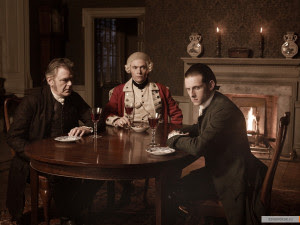
Below is a list of my five favorite episodes from Season One of AMC" "TURN: WASHINGTON'S SPIES". Created by Craig Silverstein, the series stars Jamie Bell:FIVE FAVORITE EPISODES OF "TURN: WASHINGTON'S SPIES" SEASON ONE (2014) 1. (1.08) "Challenge" - Against the wishes of Abraham "Abe" Woodhull, one of the Culper Ring spies, fellow spy Anna Strong earches for enemy intelligence at an exclusive gentleman's party hosted by British spymaster Major John Andre.
 2. (1.10) "The Battle of Setauket" - Mary Woodhull discovers that Abe is a rebel spy. Other members of the spy ring, Major Benjamin Tallmadge and Lieutenant Caleb Brewster, lead a raid on the Long Island community, Setauket, to save the local Patriot families.
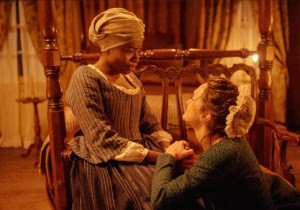
 3. (1.05) "Epiphany" - During the 1776 Christmas holidays, Caleb and Ben follow mysterious orders, while General George Washington's army crosses into enemy territory in New Jersey. Meanwhile, one of Anna's recently freed slaves, Abigail, agrees to spy for the Rebels after she is assigned to work for Major Andre, if the former would agree to look after her son Cicero.
 4. (1.09) "Against Thy Neighbor" - British Army Captain John Graves Simcoe (at least the fictional version) ignites a political witch-hunt to weed out rebel conspirators in Setauket. General Washington assigns Ben to a secret mission.
 5. (1.06) "Mr. Culpeper" - En route to New York, Abe is ambushed by a desperate patriot. Washington charges Ben with the task of creating America's first official spy ring.

"POLDARK" SERIES ONE (1975): EPISODES ONE TO FOURA few years ago, I had tried a stab at the first episode of the 1975-1977 series, "POLDARK", which starred Robin Ellis. After viewing ten minutes of theatrical acting and dated photography in Episode One on You Tube, I gave up. Last summer, I read all of the hullaballoo surrounding this new adaptation with Aidan Turner in the lead. Utilizing Netflix, I tried my luck again with the 1975 series and ended up enjoying the first four episodes (I have yet to watch any further episodes) and quite enjoyed it. I enjoyed both versions so much that I took the trouble to purchase both the entire 1975-77 series and the 2015 series. In fact, I have decided to watch both versions simultaneously. But I am here to discuss the first four episodes of the 1975 series.Series One of "POLDARK", which aired in 1975, is based upon Winston Graham's first four novels in the saga - 1945's "Ross Poldark: A Novel of Cornwall, 1783-1787", "Demelza: A Novel of Cornwall, 1788-1790" (1946), 1950's "Jeremy Poldark: A Novel of Cornwall, 1790-1791 and 1953's "Warleggan (Poldark). Episodes One to Four seemed to be an adaptation of the first novel. The series begins with a young Ross Poldark returning home to Cornwall following military service with the British Army during the American Revolution. Ross spent the last year or two as a prisoner-of-war, unaware that he had been declared dead. He learns from a fellow coach passenger and later, his father's solicitor that Joshua Poldark had died financially broke. More bad news follow with Ross' discovery that his Uncle Charles Poldark had promised to sell his estate Nampara to the banking family, the Warleggans. And lady love, Elizabeth Chynoweth, had become engaged to Charles' son, his cousin Francis, after receiving news of his "death". The only possessions Ross has left are his father's estate, Nampara, which is now in ruins, two mines that had been closed for some time and two servants - the drunken Jud and Prudie Paynter - to help him work the estate. Even worse, the Warleggans, who have risen from being blacksmiths to bankers, seemed to be gaining financial control over the neighborhood. In Episode Two, Ross rescues a miner's daughter named Demelza Carne from a mob trying to use her dog Garrick as part of a vicious dogfight at a local fair. Taking pity on her, he decides to hire her as his new kitchen maid.When I finally began to embark upon this series, I had no idea of its reputation as one of Britain's most beloved period dramas. I discovered that "POLDARK" was regarded just as highly in the 1970s, as "DOWNTON ABBEY" had become some thirty-five to forty years later. Mind you, I regard Julian Fellowes' series as the inferior series. My viewing of the first four episodes of this series made me finally appreciate why it was so highly regarded. It really is first-rate production. However . . . it had its problems. What movie or television production does not?When it comes to an accurate adaptation of any novel or play, I tend to harbor ambiguous views on the matter. It depends upon how well it serves the story on screen or if it makes sense. Anyone familiar with Graham's novels know that the 1975 adaptation is not accurate. I had no problems with the production starting with Ross' stage journey to his home in Cornwall, considering that the novel started with a meeting between Ross' dying father and his Uncle Charles. I had no problems with Elizabeth's final reason for marrying Francis - to ensure that Charles Poldark would pay off her father's debts. This little scenario even included an interesting scene in which Ross had volunteered to use his loan for Wheal Leisure to pay off Mr. Chynoweth's debts in order to gain Elizabeth's hand in marriage. Fortunately, she stopped him from committing such a stupid act. But I had a problem with one major change and a few minor ones.My biggest problem with these first four episodes of "POLDARK" centered on the circumstances that led Ross to marry his kitchen maid, Demelza Carne. Apparently, the series' producers and screenwriter Jack Pulman must have found Graham's portrayal of this situation hard to swallow and decided to change the circumstances leading to Ross and Demelza's marriage. In this version, Ross became drunk following his failure to prevent his former farmhand Jim Carter from being sentenced to prison for poaching. Demelza, who had been harboring a yen for Ross, decided to comfort him with sex. The following morning, Ross decided it would be better if Demelza no longer work at Nampara, so that he would not be tempted to have sex with her again. And what happened? Demelza eventually went to live with her father Tom Carne, now a religious zealot, and his new wife. She also discovered that she was pregnant. To make matter worse, Ross managed to convince his former love, Elizabeth Poldark, to leave his adulterous cousin Francis and live with him.One, I found it very implausible that a man of Ross' station and time would marry his kitchen maid. He might sleep with her . . . yes. But marry her? A "responsible" man like Ross would have settled money upon Demelza, find a man of her class willing to accept her as a wife and the baby as his . . . or both. He would not marry her. As for Elizabeth's willingness to leave Francis for Ross . . . I really found this implausible. Elizabeth is too pragmatic to be willing to sacrifice her respectability to leave her husband for another man. Nor would she be willing to risk losing her son Geoffrey Charles, for Francis would have never allowed her to see the boy again. The only way this whole situation could have worked is if Ross had been in love with Demelza at the time. If he had, he would have never suggested that Elizabeth leave Francis for him.There were other problems - minor problems - that I found in these first four episodes.h sex. The following morning, Ross decided it would be better if Demelza no longer work at Nampara, so that he would not be tempted to have sex with her again. And what happened? Demelza eventually went to live with her father Tom Carne, now a religious zealot, and his new wife. She also discovered that she was pregnant. To make matter worse, Ross managed to convince his former love, Elizabeth Poldark, to leave his adulterous cousin Francis and live with him.One, I found it very implausible that a man of Ross' station and time would marry his kitchen maid. He might sleep with her . . . yes. But marry her? A "responsible" man like Ross would have settled money upon Demelza, find a man of her class willing to accept her as a wife and the baby as his . . . or both. He would not marry her. As for Elizabeth's willingness to leave Francis for Ross . . . I really found this implausible. Elizabeth is too pragmatic to be willing to sacrifice her respectability to leave her husband for another man. Nor would she be willing to risk losing her son Geoffrey Charles, for Francis would have never allowed her to see the boy again. The only way this whole situation could have worked is if Ross had been in love with Demelza at the time. If he had, he would have never suggested that Elizabeth leave Francis for him.There were other problems - minor problems - that I found in these first four episodes. One episode featured Francis' violent encounter with Verity's wannabee suitor, Captain Blamey and the other, a fight between Ross and his future father-in-law, Tom Carne. And I thought Christopher Barry handled both scenes in a rather clumsy manner. Both situations seemed to be a case of "now you see it, now you don't". In Ross' fight with Carne, the 17 year-old Demelza got into the melee (which did not happen in the novel), allowing her to spout some nonsense about women's right in one of those "a woman's travails" speeches that came off as . . . well, clumsy and contrived. It did not help that actress Angharad Rees seemed to be screeching at the top of her voice at the time. In fact, screeching seemed to be the hallmark of Rees' early portrayal of the adolescent Demelza in an emotional state. Some fans have waxed lyrical over Clive Francis' portrayal of Francis Poldark. So far, I have yet to see what the big deal was about. Other than three scenes, Francis spent these first four episodes portraying a cold and rather aloof Francis. I found it difficult to get emotionally invested in the character.Considering all of the problems I had with Episodes One-Four, one would wonder why I enjoyed "POLDARK". The series may not be perfect, but it was damn entertaining. Some have compared the production to the 1939 film, "GONE WITH THE WIND". But honestly, it reminds me of the television adaptation of John Jakes' literary trilogy, "North and South". Both the Seventies series and the "NORTH AND SOUTH" Trilogy between 1985 and 1994 share so many similarities. Both series featured their own set of flaws, entertaining melodrama, strong characterizations and a historical backdrop. In the case of "POLDARK", the historical backdrop featured Great Britain - especially Cornwall - after the American Revolution, during the last two decades of the 18th century. It is a period of which I have never been familiar - especially in Britain. I never knew that Britain's conflict with and the loss of the American colonies had such a negative impact upon the country's economic state. I had heard of the United States and France's economic struggles during this period, but I never knew about Britain's struggles. I also recently learned about the impact of the fallen tin and copper prices on Cornwall, during the 1770s and especially the 1780s. This economic struggle contributed to the slow decline of the aristocracy and the landed gentry for Cornish families like the Poldarks and the Chynoweths. I thought this economic depression was well-handled by the production team. Not once did the producers, Barry or Pulman rush through Ross' struggles to establish a new fortune. They also took their time in conveying the struggles of nearly everyone else in the neighborhood - the other members of the Poldark family, the Cynoweths, and especially the working-class. This struggle of the working-class manifested not only Demelza's story arc, but also that of Jim and Jinny Carter in the first three episodes. This struggled boiled down to a heartbreaking moment in which Jim was caught poaching on a local estate and sentenced to prison - despite Ross' futile efforts to help him. I noticed that although the Warleggan family loomed menacingly in the background, only one member had made at least two appearances in these first four episodes - Nicholas Warleggan. The most famous member of the family - George Warleggan - had yet to make an appearance.And despite my complaints about the situation that led to Ross and Demelza's marriage, I must admit that the emotional journey of Ross and the other leading characters managed to grab my attention. Being familiar with Graham's novel, I am well aware that Ross' return, Elizabeth's decision to marry Francis, Ross' meeting with Demelza, the marital fallout between Elizabeth and Francis and Ross' inability to get over losing Elizabeth will have consequences down the road. I have to admit that "POLDARK" did a pretty damn good job in setting up the entire saga . . . despite a few hiccups. I found it interesting that Episode One solely featured Ross' return and his emotional reaction to Elizabeth's decision to marry Francis. He did not even meet Demelza until Episode Two. These first four episodes also set up a conflict between Demelza and Elizabeth. I have mixed feelings about this. Personally, I rather liked how Debbie Horsfield managed to set up a quasi-friendship between the two women in the new adaptation. But since Demelza and Elizabeth were probably doomed not to be friends, I see that screenwriter Jack Pulman decided to immediately go for the jugular and set up hostilities between the pair. In Episode Three, a jealous Demelza had maliciously blamed Elizabeth for Francis' infidelity, even though she had yet to meet the pair. I found this even more ironic, considering the episode also featured a minor scene in which Elizabeth actually made an attempt to emotionally reach out to Francis. He rejected her due to an assignation with some prostitute. And the whole scenario regarding Ross' suggestion that Elizabeth leave Francis and Demelza's pregnancy boiled down to a long scene in which Ross informed Elizabeth of the situation and her angry reaction. Which included calling Demelza a whore. By the end of Episode Four, Pulman and Barry had firmly established hostility between the two women.Much has been said about the series' exteriors shot in Cornwall. Yes, they looked beautiful, wild and almost exotic for Great Britain. Not even the faded photography can hide the beauty of the Cornish landscape. I also found John Bloomfield's costume designs very attractive, but not exactly mind blowing. Also, a few of the costumes for actress Jill Townsend seemed a bit loose - especially in the first two episodes. As for the series' score written by Kenyon Emrys-Roberts . . . not exactly memorable.I might as well come to the performances featured in Episodes One to Four. Overall, I found them pretty solid. Although I came away with the feeling that some of the cast members and director Christopher Barry thought "POLDARK" was a stage play. Yes, I found some of the performances a bit theatrical. And I have to include some of the main cast members. I have always liked the Charles Poldark character - not because he was likable. I simply found him rather colorful. And I thought actor Frank Middlemass did an excellent job in conveying this aspect of Mr. Poldark Senior. Jonathan Newth gave a solid, yet intense performance as the barely volatile Captain Blamey. Both Paul Curran and Mary Wimbush gave very colorful performances as Ross' slothful servants, Jud and Prudie Paynter. And yet, some of that color threatened to become very theatrical. On the other hand, Stuart Doughty gave a solid and subtle performance as Ross' former servant-turned-miner, Jim Carter. I could also say the same for Jillian Bailey, who portrayed Jim's wife, Jinny. By the way, fans of the 1983 miniseries, "JANE EYRE" should be able to spot Zelah Clarke (a future Jane Eyre) in a small role as one of the stagecoach passengers in the opening scene of Episode One.There have been a great deal of praise for Angharad Rees' portrayal of Demelza Carne, Ross' kitchen maid and soon-to-be wife. And yes, I believe she earned that praise . . . at least in the second half of Episode Three and all of Episode Four. I found her performance very lively and when the scene demanded it, subtle. I thought she was outstanding in the scene that featured Demelza's seduction of Ross. However, she was at least thirty or thirty-one when she portrayed Demelza in Series One. And her portrayal of a Demelza in early-to-mid adolescence struck me as loud and over-the-top. Thankfully, the screeching ceased in the second half of Episode Three. Clive Francis' portrayal of Francis Poldark struck me as somewhat subdued or a bit on the cold side - except in two scenes. One of them featured Francis' near death inside the Wheal Leisure mine, when he feared Ross would allow him to drown. Another featured his confrontation with Captain Blamey, the sea captain who became romantically interested in Francis' sister Verity. In both cases, the actor came off as a bit theatrical. But I thought his performance in Episode Four, which featured Elizabeth's announcement that she would leave Francis, seemed more controlled, yet properly emotional at the same time.If I have to give awards for the best two performances in these first four episodes, I would give them to Jill Townsend as Elizabeth Chynoweth Poldark and Norma Streader as Verity Poldark. It seemed to me they were the only two members of the cast who managed to avoid any theatrical acting in any of their scenes. Even when their characters were in an emotional state. One of Streader's finest moments occurred in Season Two, when she expressed her feelings about Captain Blamey in a conversation with her cousin Ross. Despite expressing Verity's emotions in a fervent manner, Streader still managed to maintain control of her performance. For me, Townsend's finest moments occurred throughout Episode Four. From the moment Ross suggested that Elizabeth leave Francis for good, Townsend conveyed Elizabeth's emotional journey throughout this episode - from surprise to hopeful to desperation, relief, happiness, disbelief, anger and finally bittersweet disappointment. I may not have approved the producers' decision to include a scene featuring Demelza's pregnancy and Elizabeth's decision to leave Francis. But dammit, Townsend acted her ass off and gave the best performance from the entire cast during this particular sequence. One of her best scenes featured a one-on-one conversation with Streader's Verity.I have seen actor Robin Ellis in other movie and television productions, including 1971's "SENSE AND SENSIBILITY" and 1981's "THE GOOD SOLDIER". If I were to pick his best roles, I would choose two - the passive aggressive American John Dowell in "THE GOOD SOLDIER" and of course, Ross Poldark. The producers of the series selected the right actor to portray the volatile war veteran-turned-mine owner from Graham's saga. He is Ross Poldark . . . of the 1970s that is. Granted, Ellis had his moments of theatrical acting. There were times during the first four episodes in which I had to turn down my television volume. But despite this, I thought he did an excellent job in capturing all aspects - both good and bad - of his character's personality. Two scenes featuring his performance caught my attention. Ellis seemed a bit scary and intense when he expressed Ross' reaction to being rejected by Elizabeth Chynoweth in Episode One. And I thought he gave a poignant performance in the scene that featured Demelza's seduction of Ross.There you have it . . . my impression of the first four episodes from the 1975 series, "POLDARK". So far, this adaptation of the first novel in Winston Graham's literary series had its share of flaws. But I feel that its virtues overshadowed the former. In fact, I found myself so captivated by Episodes One to Four that I feel more than ready to continue this saga. Onward to Episode Five!
 "I'LL NEVER FORGET YOU" (1951) Review
I have seen my share of time travel movies and television programs over the years. But I do not believe that I have never seen one as ethereal as the 1951 movie called "I'LL NEVER FORGET YOU".
A second adaptation of John L. Balderston's 1927 play, which was an adaptation of Henry James' incomplete novel, "The Sense of the Past"; "I'LL NEVER FORGET YOU" told the story of an American nuclear physicist named Dr. Peter Standish, who is transported to London of the late 18th century. The story begins when a co-worker of Peter's with the British nuclear program, Dr. Roger Forsyth, expresses concern about the former's lack of social life. As the two become friends, Peter reveals that he had inherited an old house located at London's Berkeley Square by a distant relative. He also also reveals that he was a descendant of an American Tory who had immigrated to Britain after the Revolutionary War to marry a cousin named Kate Pettigrew. Not long after this revelation, a thunderstorm sends Peter back to 1784, where he takes the place of his late 18th century ancestor, the other Peter Standish.
However, once 20th century Peter settles into his new life, he is struck by a series of surprises. One, he finds himself slowly falling in love with his fiancée's younger sister, Helen Pettigrew. Peter discovers that Georgian era London is not the paradise he had assumed it to be for years. He also realizes that his occasional lapses of judgment, in which he uses modern day language and revealing information he could not have known if he had actually grown up in the 18th century. Peter's occasional lapses and his feelings for Helen lead to growing antagonism toward him from not only his fiancée Kate, but also from Mr. Throstle, the man to whom Helen had been promised; leading to potential disaster for him.
I am usually a big fan of time travel movies. But if I must be honest, my reason for watching "I'LL NEVER FORGET YOU" stemmed from sheer curiosity and nothing else. I never really thought I would be impressed by this movie. And I was . . . much to my surprise. Mind you, the film's method of time travel - a bolt of lightning - struck me as unrealistic, even from a fictional point of view. There was no machine or vehicle like a Delorean to channel the energy from that bolt of lightning. Instead, the Peter Standish was struck by lightning and transported some 160 years back to the past. That he survived being struck is a miracle.
Nevertheless, I still enjoyed "I'LL NEVER FORGET YOU" very much. At its heart, the movie featured two genres - time traveling and romance. And both seemed to intertwine perfectly, thanks to director Roy Ward Baker, who directed the 1958 classic, "A NIGHT TO REMEMBER". There have been time travel movies in which the protagonists are slightly taken aback by the "primative" conditions of the time period in which they end up. But I found Peter Standing's reaction to the reality of 18th century London rather enjoyable on a perverse level. I found it satisfying to watch him come to the realization that 1784 London was not the social paradise that he had assumed it was. "I'LL NEVER FORGET YOU" is also one of the rare works of fiction that pointed out the lack of decent hygiene that permeated Western society before the 20th century. Between Peter's disgust at London society's array of body odors and their bafflement at his habit of a daily bath, I was nearly rolling on the floor with laughter. But more importantly, "I'LL NEVER FORGET" is a poignant love story between Peter and Helen. What made it very satisfying for me is that Helen was the only one who seemed to have a bead on Peter's personality. More importantly, she seemed to be interested in Peter's comments about the future, instead of repelled by them.
But what really made the romance between Peter Standing and Helen Pettigrew worked were the performances of the two leads, Tyrone Power and Ann Blyth. Thanks to their intelligent and subtle performances, they made Peter and Helen's love story believable. I was surprised that Michael Rennie had such a small screen presence in the movie, considering that he had received third billing. Nevertheless, I thought he gave a pretty good performance as Peter's 20th century friend and colleague, Dr. Roger Forsyth. Another performance that caught my attention came from Dennis Price, who gave a very entertaining performance as Helen and Kate's brother, a dye-in-the-wool late 18th century cad, Tom Pettigrew. Kathleen Byron gave an energetic and brief performance as Georgiana Cavendish, Duchess of Devonshire. The movie also featured solid performances from Beatrice Campbell, Raymond Huntley and Irene Browne, who not only portrayed the Pettigrew matriarch in this film, but also in the 1933 version, "BERKELEY SQUARE".
Although I found the mode of time travel rather implausible - being struck by lightning, I must admit that I enjoyed "I'LL NEVER FORGET YOU". In fact, I enjoyed it a lot more than I thought I would. And I have to thank Ranald MacDougall's adaptation of John L. Balderston's play, intelligent performances from a cast led by Tyrone Power and Ann Blyth, and more importantly, intelligent and subtle direction from Roy Ward Baker.
"I'LL NEVER FORGET YOU" (1951) Review
I have seen my share of time travel movies and television programs over the years. But I do not believe that I have never seen one as ethereal as the 1951 movie called "I'LL NEVER FORGET YOU".
A second adaptation of John L. Balderston's 1927 play, which was an adaptation of Henry James' incomplete novel, "The Sense of the Past"; "I'LL NEVER FORGET YOU" told the story of an American nuclear physicist named Dr. Peter Standish, who is transported to London of the late 18th century. The story begins when a co-worker of Peter's with the British nuclear program, Dr. Roger Forsyth, expresses concern about the former's lack of social life. As the two become friends, Peter reveals that he had inherited an old house located at London's Berkeley Square by a distant relative. He also also reveals that he was a descendant of an American Tory who had immigrated to Britain after the Revolutionary War to marry a cousin named Kate Pettigrew. Not long after this revelation, a thunderstorm sends Peter back to 1784, where he takes the place of his late 18th century ancestor, the other Peter Standish.
However, once 20th century Peter settles into his new life, he is struck by a series of surprises. One, he finds himself slowly falling in love with his fiancée's younger sister, Helen Pettigrew. Peter discovers that Georgian era London is not the paradise he had assumed it to be for years. He also realizes that his occasional lapses of judgment, in which he uses modern day language and revealing information he could not have known if he had actually grown up in the 18th century. Peter's occasional lapses and his feelings for Helen lead to growing antagonism toward him from not only his fiancée Kate, but also from Mr. Throstle, the man to whom Helen had been promised; leading to potential disaster for him.
I am usually a big fan of time travel movies. But if I must be honest, my reason for watching "I'LL NEVER FORGET YOU" stemmed from sheer curiosity and nothing else. I never really thought I would be impressed by this movie. And I was . . . much to my surprise. Mind you, the film's method of time travel - a bolt of lightning - struck me as unrealistic, even from a fictional point of view. There was no machine or vehicle like a Delorean to channel the energy from that bolt of lightning. Instead, the Peter Standish was struck by lightning and transported some 160 years back to the past. That he survived being struck is a miracle.
Nevertheless, I still enjoyed "I'LL NEVER FORGET YOU" very much. At its heart, the movie featured two genres - time traveling and romance. And both seemed to intertwine perfectly, thanks to director Roy Ward Baker, who directed the 1958 classic, "A NIGHT TO REMEMBER". There have been time travel movies in which the protagonists are slightly taken aback by the "primative" conditions of the time period in which they end up. But I found Peter Standing's reaction to the reality of 18th century London rather enjoyable on a perverse level. I found it satisfying to watch him come to the realization that 1784 London was not the social paradise that he had assumed it was. "I'LL NEVER FORGET YOU" is also one of the rare works of fiction that pointed out the lack of decent hygiene that permeated Western society before the 20th century. Between Peter's disgust at London society's array of body odors and their bafflement at his habit of a daily bath, I was nearly rolling on the floor with laughter. But more importantly, "I'LL NEVER FORGET" is a poignant love story between Peter and Helen. What made it very satisfying for me is that Helen was the only one who seemed to have a bead on Peter's personality. More importantly, she seemed to be interested in Peter's comments about the future, instead of repelled by them.
But what really made the romance between Peter Standing and Helen Pettigrew worked were the performances of the two leads, Tyrone Power and Ann Blyth. Thanks to their intelligent and subtle performances, they made Peter and Helen's love story believable. I was surprised that Michael Rennie had such a small screen presence in the movie, considering that he had received third billing. Nevertheless, I thought he gave a pretty good performance as Peter's 20th century friend and colleague, Dr. Roger Forsyth. Another performance that caught my attention came from Dennis Price, who gave a very entertaining performance as Helen and Kate's brother, a dye-in-the-wool late 18th century cad, Tom Pettigrew. Kathleen Byron gave an energetic and brief performance as Georgiana Cavendish, Duchess of Devonshire. The movie also featured solid performances from Beatrice Campbell, Raymond Huntley and Irene Browne, who not only portrayed the Pettigrew matriarch in this film, but also in the 1933 version, "BERKELEY SQUARE".
Although I found the mode of time travel rather implausible - being struck by lightning, I must admit that I enjoyed "I'LL NEVER FORGET YOU". In fact, I enjoyed it a lot more than I thought I would. And I have to thank Ranald MacDougall's adaptation of John L. Balderston's play, intelligent performances from a cast led by Tyrone Power and Ann Blyth, and more importantly, intelligent and subtle direction from Roy Ward Baker.

"ROSS POLDARK: A NOVEL OF CORNWALL, 1783-1787" (1945) Book Review
During a period of fifty-seven, writer Winston Graham wrote a series of twelve historical novels that centered around a former British Army officer from Cornwall, who had fought for king and country during the American Revolutionary War. The first of the novels, "ROSS POLDARK: A NOVEL OF CORNWALL, 1783-1787" had been published in 1945.
"ROSS POLDARK" begins in the fall of 1783. Ross Poldark returns home to Cornwall after spending three years in the Army. The former officer returns to discover that his father had been dead for several months. The estate he had inherited, which includes Nampara and a failing copper mine, had fallen in arrays. His home is being occupied by his father's two slovenly servants - Jud and Prudie Paynter. Worst of all, he learns that his former love, Elizabeth Chynoweth, had given him up for dead and become engaged to his cousin, Francis Poldark. Ross sets out to restore his fortunes by acquiring financing for one of his family's derelict tin mines. But dealing with the loss of Elizabeth prove to be a real problem. Emotional salvation seemed to come in the form of a young 13-14 urchin girl named Demelza Carne, whom Ross saves from a mob at the Reduth Fair. Ross hires her as his new kitchen maid. Over the course of three years, she develops into a beautiful 17 year-old, for whom he develops emotional feelings and eventually marries.
I have read a good number of reviews about this novel. With the exception of one or two, most of them seemed pretty positive. Personally, I believe that Winston Graham did a solid job in setting his multi-novel series in motion. I was impressed at how he introduced his major characters, the story's historical setting and the story lines that reverberated throughout the series. One of those story lines proved to be the various love triangles that centered around Ross Poldark and Elizabeth Chynoweth Poldark. I find it amazing that most these different love triangles centered around Ross and Elizabeth, instead of Ross and the woman he would eventually marry - Demelza, who happened to be the saga's leading lady. The 1945 novel included at least two triangles and a potential third:
*Ross Poldark-Elizabeth Chynoweth Poldark-Francis Poldark
*Demelza Carne Poldark-Ross Poldark-Elizabeth Chynoweth Poldark
*Ross Poldark-Elizabeth Chynoweth Poldark-George Warleggan
Anyone familiar with "ROSS POLDARK" would automatically know that no such triangle existed between Ross, Elizabeth and George. I would agree . . . to a certain extent. George Warleggan was more or less portrayed as a minor supporting character in this novel. His father, Nicholas Warleggan, had a more prominent role. Yet, Graham provided a hint of the Ross-Elizabeth-George triangle during the 1787 Trenwith Christmas party, in which George projected a deferential and infatuated attitude toward her. A sign of things to come, indeed.
In fact, the Christmas party proved to be one of those scenes in which I believe Graham did an excellent job in portraying life in Cornwall during the late 18th century. Other scenes that impressed me include Ross' arrival at Truro upon his return from the war; Francis and Elizabeth's wedding reception; Ross' first meeting with Demelza at the Redruth Fair; and the trial of Jim Carter for poaching, one of Ross' employees, at Truro's court of assize. These scenes conveyed to me that Graham did some extended research of Britain's history during the late Georgian era and life in Cornwall during that period. And although I found his use of this research impressive, I would not say that Graham was the best novelist in conveying historical research into stories. I have read novels that have a stronger historical background.
"ROSS POLDARK" is foremost a story about a war veteran who returns home to find his world drastically changed. I suppose one could compare Graham's tale to the 1946 movie, "THE BEST YEARS OF OUR LIVES". But the Ross Poldark character seemed traumatized . . . so to speak, by the ruined state of his fortunes and his loss of fiancee Elizabeth Chynoweth, instead of any combat experiences during the war. It did not take Ross very long to set about restoring his fortunes. But the loss of Elizabeth proved to be another matter. He spent a long period of time drinking heavily over her marriage to his cousin Francis. And when he finally realized that he had fallen in love with Demelza near the novel's end, he came to another realization that his marriage had not erased his feelings for Elizabeth. It is very rare to come upon a fictional story about war veteran trying to overcome a past trauma that focused on lost love, instead of past combat experiences. Very odd. And rather original, if I must add.
Another aspect of "ROSS POLDARK" that I found impressive was Graham's strong portrayal of most of its characters. Ross Poldark came off as a very strong and well-rounded character. While many fans tend to view him as some borderline ideal fictional hero, I was too busy noticing his personal flaws to immediately accept this view. And I regard this as a good thing. At a younger age, I would have eagerly accepted Ross as something close to a perfect hero. But not at my current age. One, I find ideal characters rather boring. And two, while I found his virtues - especially his concern for the lower classes - rather admirable, I must admit that Ross' flaws - his stubbornness, quick temper, massive ego, and occasional bouts of hypocrisy - made him more interesting to me than any personal virtue ever could. A good example would be his attitude toward women. Despite his respectful attitude toward most women below his class, Ross still managed to retain a strong patronizing and slightly sexist attitude. This was especially apparent in one scene in which his cousin-in-law, Elizabeth Chynoweth Poldark, requested his help in dealing with Francis' growing penchant for reckless gambling. Instead of taking Elizabeth seriously, Ross dismissed her request as one from an over-emotional woman exaggerating about a husband's flaws:
"It occurred to Ross in that moment that half of Elizabeth's worry might be the eternal feminine bogey of insecurity. Francis drank. Francis gambled and lost money. Francis had been seen about with another woman. Not an amiable story. But not an uncommon one. Inconceivable to Ross in that case, and for Elizabeth it had the proportions of a tragedy. But it was unwise to lose one's sense of perspective. Other men drank and gambled. Debts were fashionable. Other men found eyes to admire the beauty that was not theirs by right of marriage and to overlook the familiar beauty that was. It did not follow that Francis was taking the shortest route to perdition."
What I found ironic is that Ross' sexist dismissal of Elizabeth's concerns about Francis will eventually bite him in the ass.
Thanks to Graham's sharp writing, the novel featured other strong characters. One of them include his kitchenmaid-turned-wife, Demelza Carne Poldark. At first I did not know what to make of Demelza. Perhaps the reason I had such difficulty in embracing her as a character is that she was so young. Demelza remained a adolescent throughout the novel, despite becoming a wife who ends the story pregnant. I noticed that anyone in Ross' life - namely his family and Elizabeth - made her incredibly jealous. And Demelza expressed her jealousy in a rather infantile manner. This was apparent in her internal reaction to Elizabeth's discovery that she and Ross had sex, following Jim Carter's trial:
"She is one day too late; just one day. How beautiful she is. How I hate her."
This jealousy was also evident in her determination to avoid the company of Ross' cousin Verity Poldark following her marriage to Ross. I find it interesting that neither of the two television adaptations of the novel never explored this situation between the two cousins-in-law. Another example of Demelza's infantile expression of her jealousy appeared near the end of the novel, when she contemplated on her social success at the Trenwith Christmas party. Even though Demelza had internally expressed pity toward Elizabeth's marriage to Francis, she also reveled in the idea that Ross still wanted her and not Elizabeth - unaware that Ross' feelings for Elizabeth have not abated. Demelza's hostility even managed to shift toward Ruth Treneglos, who had originally expressed hope to become Ross' wife a few years earlier. I can understand why Graham had portrayed Demelza's jealousy in such a volatile manner. She was - after all - an adolescent in this story. Despite marrying Ross two-thirds into the story, Demelza remained a teenager from the beginning of the novel to the end.
Graham's portrayal of Francis and Elizabeth Poldark seemed a bit more . . . limited. Especially Elizabeth. Considering that Ross' reaction to their marriage played such a major role in the novel's plot, I found it odd that Graham did not explore the couple's characters a bit deeper. Ironically, Elizabeth suffered from Graham's superficial portrayal a lot more than Francis. I am not claiming that her character had suffered from a weaker portrayal than Francis'. I have noticed that many fans of the saga have claimed that she is a cold and haughty character. But after my recent re-reading of "ROSS POLDARK", I found this hard to accept. Elizabeth struck me as slightly conservative, quiet and private woman, with a pragmatic streak. The only time she became "haughty" was when she lost her temper after Ross had insulted her mother at hers and Francis' wedding reception. More importantly, she proved to be a very warm and caring parent. But I was surprised to discover upon my last reading of this novel that Elizabeth also harbored an inferiority complex, as revealed in a scene following Geoffrey Charles' christening:
"Verity had gotten over her disappointment very well, Elizabeth thought. A little quieter, a little more preoccupied with the life of the household. She had wonderful strength of mind and self-reliance. Elizabeth was grateful for her courage. She thought, quite wrongly that she had very little herself, and admired it in Verity."
Quite wrongly. It seemed as if Graham had inserted those words to explain to the readers that Elizabeth underestimated her own inner strength. And considering the number of times Elizabeth resorted to fainting in dealing with many crisis, I got the feeling that instead of acknowledging or even being aware of her own inner strength, Elizabeth had decided the best way to survive in a world that did not favor women was to play the role that society demanded of her - that of a quietly submissive woman. Francis, on the other hand, had three things going for him - he was not portrayed as an introvert, he did not stand in the way of Ross and Demelza's relationship, and he is a man. Even though Francis tend to resort to infantile behavior to hide his own securities, sometimes I got the impression that many of Graham's readers are more tolerant of his character than of Elizabeth's. Is this due to modern society's intolerance toward reserved or introverted women? Or is this due to many of Graham's readers view of Elizabeth as a threat to Ross and Demelza's romance? I wonder.
"ROSS POLDARK" featured an array of interesting supporting characters. The most colorful to me seemed to be Jud and Prudie Paynter, Ross' servants; a fellow landowner by the name of Sir Hugh Bodrugan; Ross' former schoolmaster Reverend Doctor Halse; Demelza's father, Tom Carne; Elizabeth's mother Mrs. Chynoweth and Ross' great-aunt, Agatha Poldark. Ross' Uncle Charles struck me as a particularly interesting character. If there was one character who matched Elizabeth in terms of pragmatism, it was Charles Poldark. Yet, for such a pragmatic man, I am amazed that he was unable to produce a bigger fortune for his family. And his determination to ensure Francis' marriage to Elizabeth literally smacked of sheer manipulation. When I first read this novel, I had wondered why Charles was determined to set this marriage in motion. After all, the Chynoweths were cash poor. Did Charles have designs on the Chynoweth land, which would eventually go to the man who marries Elizabeth? I wish Graham had been a little clear on the matter.
The novel featured another love story - one between Francis' sister, Verity Poldark and a sea captain by the name of Andrew Blamey. I thought Graham did an excellent job in portraying the charming and subtle love story between the plain, yet sweet and soft-spoken Verity and the intense Captain Blamey. But the latter's revelation of how his alcoholism and temper led to the manslaughter of his wife led both Verity's father and brother to put a stop in the romance before it could continue. A part of me felt sorry for Verity. Another part of me felt that both Charles and Francis Poldark had done the smart thing. I could not blame them for not wanting a former alcoholic who had killed his wife in a drunken rage anywhere near Verity or within the family ranks. Which makes me wonder why Graham had created this character in the first place.
As I had earlier hinted, I found "ROSS POLDARK" was a solid novel. Solid . . . not perfect or anywhere near perfect. The novel proved to be a good starting point for Graham's saga, but it was certainly not one of his best. It had its flaws. I have already hinted at one of the novel's flaws - namely Graham's portrayal of Francis and Elizabeth Poldark. I realize that Francis and Elizabeth are not the story's main protagonists. Yet, they are among the saga's main characters after Ross and Demelza. And the couple played major roles in the protagonists' lives. Especially Elizabeth. Unfortunately, I discovered upon re-reading the novel that Graham had not explored their characters as much as I wish he had. Characters like Verity Poldark, the Paynters, Jim Carter, Reuben Clemmow and Jinny Carter née Martin seemed to have been written with more depth than either Francis or Elizabeth.
Speaking of Jinny Carter and Reuben Clemmow, this brings me to the sequence that featured Reuben's attack upon her. I have no problems with Graham's portrayal of the incident. I thought the scene reeked with tension and violence. What irritated me to no end was that Graham had ended the sequence on a cliffhanger with Clemmow stabbing Jinny before accidentally falling out of a window, while trying to opening it. Following those violent moments, the novel jumped two years later in which the next chapter featured Ross in a meeting with potential shareholders for Wheal Leisure. Readers had to wait until another chapter before learning that Jinny had survived the stabbing and Reuben had fallen to his death. Perhaps other readers had no problems with Graham ending the Jinny-Clemmow sequence on this note. I did. I found it irritating. It seemed as if Graham had spent a great deal of energy in building up to Jinny and Clemmow's confrontation, only to end it by "telling" how it ended, instead of "showing" it. And why on earth Graham felt the need to jump the story another two years before revealing the conclusion of this plot line?
As someone who has read countless number of novels over the years, I have encountered a good share of them in which the writer has a tendency to shift the point-of-view from one character to another in the middle of the scene. And unfortunately, Winston Graham seemed to be onen of those novelists that share this flaw. This was especially apparent in one scene between Francis and Elizabeth Poldark, following the christening of their son. The scene started with Elizabeth's point-of-view, as she contemplated on the christening's success, her love for young Geoffrey Charles and her anticipation for more rest, as she continued her recovery from childbirth. Just before Francis could enter her bedroom for a little marital sex, the scene shifted to his point-of-view and readers experience his anticipation and his disappointment at Elizabeth's rejection of his attempt to seduce her. To this day, I still wonder why Graham had shifted the viewpoint from one character to another. Why could he not reveal Elizabeth's point-of-view, when Francis tried to seduce her for some post-natal sex? Or explain to viewers - from her point-of-view - why she wanted more rest, instead of sex with Francis? Was it easier for him to convey Francis' disappointment? This shift in viewpoint seemed to have left many fans of the saga to assume that Elizabeth simply wanted no more sex with her husband - or that she was sexually frigid.
One last sequence that bothered me in "ROSS POLDARK" focused on Ross and Demelza. Not long after meeting the thirteen (or fourteen) year-old Demelza at the Reduth Fair, Ross brought her home to Nampara. He had wanted Prudie to clean the lice-infested Demelza before the latter could step foot inside the house. But since Prudie was not there, he set about cleaning her himself. Ross ordered Demelza to remove all of her clothes so that he could clean her, using water from the water pump behind the house:
"He worked the handle with vigor. The first rinsing would not get rid of everything but would at least be a beginning. It would leave his position uncompromised. She had an emaciated little body, on which womanhood had onl just begun to fashion its designs."
The idea of a 23-24 year-old man washing the naked body of a 13-14 year old girl left me feeling very uncomfortable. Squemish. I had noticed that the topic had been mentioned on the The Winston Graham & Poldark Literary Societymessage board, but those members who had responded did not seem bothered by the scene. I had mentioned it on Tumblr and someone had the same response as me. Perhaps an adult man washing the naked body of an early adolescent girl he had recently met and hired as a servant did not seem out of place in the late 18th century. But as a woman of the late 20th and early 21st centuries, it seemed out of place to me. And I can only wonder how many early-to-mid 20th century readers felt about this scene when the novel was first published in 1945. And honestly . . . why on earth did Graham include this scene in the novel in the first place? Why not allow Prudie to be at Nampara to wash the very young Demelza? Especially since the latter ended up as Ross' wife some three years later? I mean . . . honestly . . . all I can say is "Ewww!".
Speaking of Demelza, how old was she? The handling of Demelza's age struck me as confusing. According to the novel, she was 13 years old when she and Ross first met at the Reduth Fair in the early spring of 1794. When she married Ross in June 1787, she was 17 years old. And during the Christmas party at Trenwith near the end of 1787, she told Francis and Elizabeth's guests that she was 18 years old. Exactly when was Demelza born? In 1769 or 1770? Perhaps it is wise if I just give up on the matter.
Unlike many fans of the literary POLDARK series, I cannot say that "ROSS POLDARK: A NOVEL OF CORNWALL, 1783-1787"was among the best. In fact, I would not regard it as one of the best historical novels I have ever read. It possessed some flaws that prevent me from proclaiming it as such. But . . . I must admit that Graham had created a solid story that maintained my interest from the beginning to the end. And more importantly, I thought Graham did a pretty good job in using this novel to set up the twelve-book series.