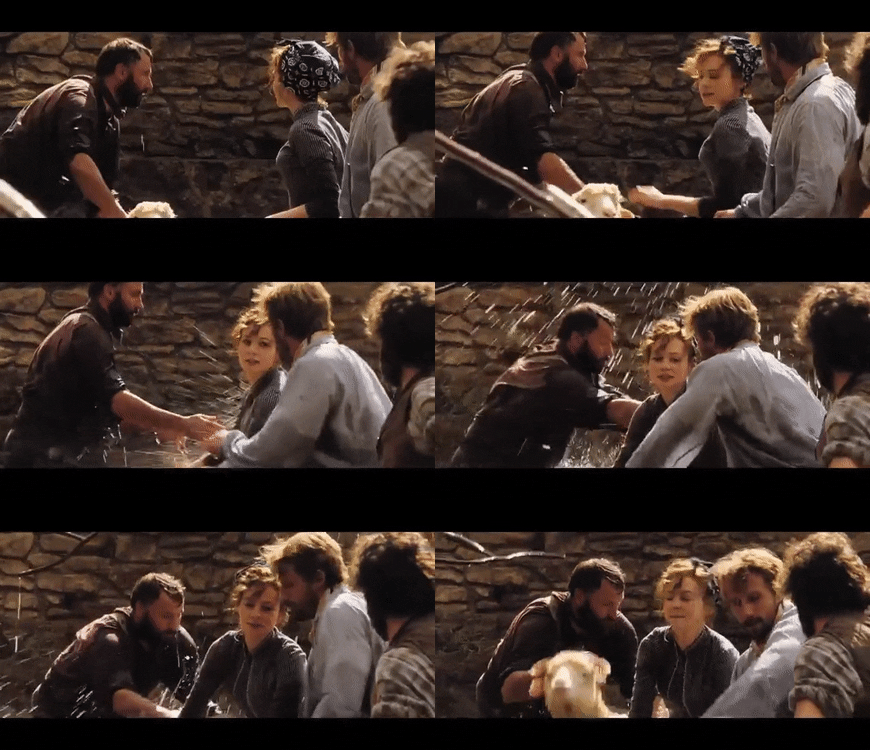
Below is a list of my top five favorite Season Two episodes from the AMC series "HELL ON WHEELS". Created by Joe and Tony Gayton, the series stars Anson Mount, Colm Meany, Common and Dominique McElligott:
TOP FIVE FAVORITE "HELL ON WHEELS" Season Two (2012) Episodes
 1. (2.06) "Purged Away With Blood" - Thor Gundersen (aka "The Swede") and the Reverend Nathaniel Cole aid the Lakota in their war against the railroad with the hijacking of a Chicago-bound train.
 2. (2.02) "Durant, Nebraska" - Businessman and investor Thomas "Doc" Durant discover that the Lakota had ransacked a town named after him and declared war on his railroad construction. Meanwhile, Cullen Bohannon is freed from an U.S. Army prison by an unlikely ally, following his brief stint as a robber.
 3. (2.09) "Blood Moon" - While being interrogated by an Army officer, Cullen reveals the string of incidents that led to an attack on the Hell on Wheels by the Lakota. Matters come to a head between Elam Ferguson, former prostitute Eva and her new husband, Gregory Toole.
 4. "Scabs" (2.04) - Following the torture of a railroad worker by the Lakota, the rail crews go on strike. Meanwhile, Eva announces her pregnancy to both Elam and Toole.
 5. "The White Spirit" (2.07) - Gundersen returns to Hell on Wheels to help the widowed Lily Bell with the railroad's accounts - against Cullen's wishes, who wants to arrest him for the attack led by Reverend Cole.

"VANTAGE POINT" (2008) Review"VANTAGE POINT" is a tightly woven thriller about eight strangers with eight different points of view of an assassination attempt on the President of the United States, during an anti-terrorism summit in Salamanca, Spain. Directed by Pete Travis and written by Barry Levy, the movie starred Dennis Quaid, Matthew Fox, Forest Whitaker, Sigourney Weaver and William Hurt.When I had first saw the trailer for "VANTAGE POINT" four years ago, I had assumed it would be one of those remakes of the Japanese film, "RASHOMON" (1950). I figured there would be an assassination attempt on the President and the film would follow with various points of view on the incident. This is what actually happened in "VANTAGE POINT" . . . but not quite. "VANTAGE POINT" did reveal the assassination attempt from various points of view. In "RASHOMON" and other versions of the film, those views are shown as flashbacks. But in "VANTAGE POINT" each point of view is not a flashback. Instead, each POV merely gives a certain view of the story, while the story moves forward. For example, the movie started out with the point of view of a news producer (Sigourney Weaver), before ending at a particular point in the story. The next point of view belongs to Secret Service agent Thomas Barnes (Dennis Quaid), which ends a little further in the story than the news producer’s POV. And so on. The movie ends with an exciting action sequence told from the various viewpoints of the major characters – heroes and villains.The more I think about "VANTAGE POINT", the more I realize how much I enjoyed it. I enjoyed the tight setting of Salamanca, Spain (actually the film was shot in Mexico). I must add that one of the things I enjoyed about this movie was that Levy’s script had a way of putting a twist on any assumptions anyone might form about the plot. I loved how Travis handled the film’s action, making it well-paced. I enjoyed the performances of the major cast members. I was especially impressed by the performances of Dennis Quaid as the emotionally uncertain Barnes, who eventually pieced together the real plot. I also enjoyed the performances of Matthew Fox as his fellow Secret Service agent, Forest Whitaker as an American tourist and Edgar Ramirez ("THE BOURNE ULTIMATUM") as a Spanish Special Forces soldier involved in the plot against the President. But more importantly, I loved Barry Levy’s script, which put a twist on any assumptions the moviegoer may have formed about the story’s plotlines and characters. My only quibble with "VANTAGE POINT" was the interaction between Whitaker’s character and a Spanish girl, which I found slightly contrived near the end of the movie."VANTAGE POINT" did pretty well at the box office. Unfortunately, most critics compared it unfavorably to "RASHOMON". Personally, I do care about the critics' opinion. "VANTAGE POINT" was the type of movie that forced the audience to think. And I suspect that many moviegoers and critics would have preferred a film that laid everything out in the open. And since I have a history of liking movies that are not popular with the public or film critics, all I can say is that I am personally glad that I had purchased the DVD for this movie. It ended up becoming one of my favorite 2008 movies.
 "BUFFY THE VAMPIRE SLAYER" RETROSPECT: (4.08) "Pangs"
Tomorrow is the Thanksgiving holiday. And another three to four weeks will pass until Christmas arrives. I originally had no intentions to watch the Season Four episode from "BUFFY THE VAMPIRE SLAYER" called (4.08) "Pangs". But I could not stop thinking about it and decided . . . why not?
Season Four has never been that popular with fans of "BUFFY THE VAMPIRE SLAYER". It was the first season that did not feature the vampire Angel as a regular character. And it marked the beginning of Buffy Summer's romance with university teaching assistant/Army demon hunter Riley Finn. And many fans were not that thrilled by the Initiative storyline. I have never had a problem with Season Four. Mind you, I would not count it as among my top four out of seven seasons. But it featured at least two of my favorite "BUFFY" episodes of all time. And one of them is the holiday-themed "Pangs".
While preparing a Thanksgiving feast for her close friends in the absence of her mother, University of California Sunnydale student and vampire slayer Buffy Summers encounters the restless and vengeful spirit of a Native American, called Hus, whose people - the Chumash tribe - were wiped out by Spanish and American settlers. Hus's spirit was released during a groundbreaking ceremony for U.C. Sunnydale's new Anthropology building. Hus managed to murder the Curator for the building's museum and a local priest who had attending the ceremony. During her frantic efforts to prepare Thanksgiving and deal with Hus, Buffy is unaware that former boyfriend Angel has returned to Sunnydale to keep an eye on her, after a friend of his (former regular character Cordelia Chase) has received a vision of her being in danger. She is also unaware that soon-to-be boyfriend Riley Finn is part of an U.S. Army program called the Initiative, which hunts down and experiments on demons. One of the Initiative's victims turned out to be Buffy's current nemesis, vampire Spike, who had managed to escape from his Initiative prison in the previous episode, (4.07) "The Initiative". Due to his inability to feed upon or commit violence against humans, Spike is slowly starving. He first seeks help and refuge from fellow vampire Harmony, who refuses to have anything to do with him. Desperate, he turns to Buffy and the other Scoobies for refuge in exchange for information about the Initiative.
"Pangs" did provide a few problems for me. One, the episode's writer, Jane Espenson, erroneously stated that the Chumash had been wiped out. Despite the Spanish, Mexican and American governments; the band still exists. Two, Buffy informed her friends that her mother Joyce left Sunnydale to spend Thanksgiving with an aunt. Why did Buffy, who was eighteen at the time, stay in Sunnydale? Why did she fail to accompany her mother for what was obviously a family gathering? Did Buffy have something against this particular "Aunt Pauline"? Three, during her last fight with Hus and the Chumash spirits he had summoned, Buffy unsuccessfully used her knife on Hus and claimed that he and his fellow spirits do not die. Yet, in a scene later, Angel managed to break the neck of one Chumash spirit and impale another with a knife. Hmmmm . . . I smell inconsistency in the air. And four, Angel's visit to Sunnydale led to the "ANGEL" Season One episode, (1.08) "I Will Remember You", which I loathe with every fiber of my being.
Aside from these narrative hiccups, "Pangs" remains a personal favorite of mine. At first glance, it seemed like a stand-alone episode that had nothing to do with the season and series' plot arc. As it turned out, it did. "Pangs" marked the first time Spike would hang out with the Scoobies. It led to another setback in Buffy and Angel's relationship. It marked the first time that the Scoobies became aware of the Initiative, thanks to Spike. And it provided another chapter in Buffy's growing relationship with Riley Finn. This seems like an awful lot, considering that this episode mainly focused on Buffy dealing with a Thanksgiving feast and a vengeance spirit - two topics that were quickly resolved by the end. But Espenson and director Michael Lange. But the best things I can say about "Pangs" is that it featured superb performances and some incredibly funny dialogue and camera visuals.
I tried to think of some of the best dialogue found in the episode and came across several lines. Among my favorites featured Buffy's ability to remain focused . . . or obssessed with her feast, while discussing their problems with Hus. However, one should not be surprised that Spike was responsible for the funniest moment in the episode in a scene that featured both Buffy and her friend Willow Rosenberg's reluctance to destroy Hus, due to their guilt over the country's past with Native Americans:
BUFFY: Will, you know how bad I feel. This is eating me up -- (to Anya, who holds up the bottle of brandy) -- a quarter cup, and let it simmer -- (to Willow, as Anya goes back) -- but even though it's hard, we
have to end this. Yes, he's been wronged, and I personally would be ready to apologize...
SPIKE: Oh, someone put a stake in me!
XANDER: You got a lot of volunteers in here...
SPIKE: I just can't take this mamby-pamby boo-hooing over the bloody Indians!
WILLOW: The preferred term is --
SPIKE: You won! All right? You came in and you killed them and you took their land. That's what conquering nations do! That's what Caesar did, he's not going around saying "I came, I conquered, I felt really bad about it!" The history of the world is not people making friends. You had better weapons, you massacred them, end of story!
BUFFY: Well, I think the Spaniards actually did a lot of... not that I don't like Spaniards...
SPIKE: Listen to you! How are you gonna fight anybody with that attitude?
WILLOW: We don't want to fight anybody.
BUFFY: I just want to have Thanksgiving.
SPIKE: Yeah, good luck.
WILLOW: If we could talk to him --
SPIKE: You exterminated his race. What could you possibly say that would make him feel better? It's kill
or be killed here. Take your bloody pick.
James Marsters really acted the hell out of that scene. And I am not surprised. To this day, I believe that his portrayal of Spike was one of the best television performances I have ever seen . . . period. And he was really marvelous in this episode. So were Anthony Stewart Head, who did a top-notch job in giving a comic twist to a Rupert Giles who found himself manipulated by Buffy into holding the Scoobies' Thanksgiving feast at his apartment; Alyson Hannigan, who was also superb as best friend/witch Willow Rosenberg, who did not hesitate to express her conflict between dealing with Hus and her guilt over the region's ugly past in dealing with the Chumash people. Nicholas Brandon and Emma Caufield gave fine support as Buffy's two other friends, Xander Harris and former vengeance demon Anya Jenkins. Marc Blucas was charming as Buffy's soon-to-be boyfriend, Riley Finn. And he was ably supported by an exuberant Leonard Roberts. Mercedes McNab displayed excellent comic timing in scenes that featured recently sired vampire Harmony Kendall's encounters with Spike and Xander. David Boreanaz took a break from his new series at the time, "ANGEL" to give an intense, yet at times funny performance as Buffy's ex-vampire squeeze, Angel. But the real star of this episode was Sarah Michelle Gellar. She gave both a hilarious, yet poignant performance, revealing Buffy's somewhat obssessive determination to make her Thanksgiving a success. In fact, I believe I enjoyed her performance even more than Marsters. And that is quite an accomplishment, considering that Marsters is a natural-born scene stealer.
Yes, "Pangs" had a few problems. And its main narrative surrounding the dangers of a Native American vengeance spirit did not exactly strike me as memorable. However, I do believe that the narrative made an interesting comment on how conflicted Americans have become in viewing our county's history. More importantly, Spike's comments on the cirumstances that led to Hus' path of vengeance is a brutal reminder of how monstrous human beings can be - a foreshadow of the Scoobies' future behavior later in the series. Thanks to Jane Espenson's hilarious script, Michael Lange's direction and a superb cast led by Sarah Michelle Geller, "Pangs" remains one of my favorite "BUFFY THE VAMPIRE SLAYER" episodes to this day.
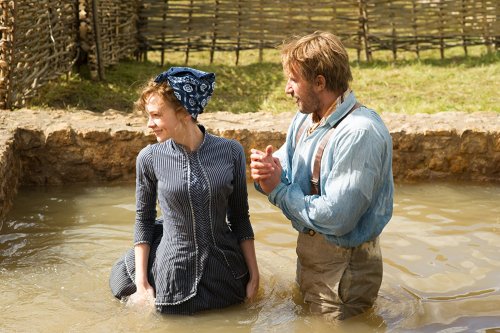 "FAR FROM THE MADDING CROWD" (2015) ReviewI have never seen "FAR FROM THE MADDING CROWD", the 2015 adaptation of Thomas Hardy's 1874 novel. And yet . . . my knowledge of this film led me to view two previous adaptations. And finally, I found the chance to view this adaptation, directed by Thomas Vinterberg."FAR FROM THE MADDING CROWD" told the story of a young 19th century rural English woman named Bathsheba Everdeene and the three men in her life - a sheep farmer-turned-shepherd named Gabriel Oak; her neighbor and owner of the neighborhood's largest farm, William Boldwood; and an illegitimate Army sergeant named Frank Troy. Bathsheba first met Gabriel Oak, a former shepherd who had leased and stocked a sheep farm. Gabriel proposed marriage, but Bathsheba rejected his proposal even though she liked him. She valued her independence more. Later, Bathsheba inherited her uncle's prosperous farm, while Gabriel's fortune disappeared when his inexperienced sheep dog drove his flock over a cliff. When the pair's paths crossed again, Bathsheba ended up hiring Gabriel as her new shepherd. Meanwhile, Bathsheba became acquainted with her new neighbor, a wealthy farmer named William Boldwood. He became romantically obsessed with her after she sent him a Valentine's Day card as a joke. But before she could consider Mr. Boldwood as a potential husband, Sergeant Frank Troy entered her life and she immediately fell in love and married him. Eventually, Bathsheba came to realize that Frank was the wrong man for her.A good number of people compared this adaptation of Hardy's novel to the 1967 movie adapted by John Schlesinger. Personally, I did not. As much as I enjoyed the 1967 movie, I have never regarded it as the gold-standard for any movie or television adaptation of the 1874 novel. But like the other two version, Thomas Vinterberg's recent adaptation had its flaws. Looking back on "FAR FROM THE MADDING CROWD", I can honestly say that I had at least a few problems with it.I wish the running time for "FAR FROM THE MADDING CROWD" had been a bit longer than 119 minutes. I believe a longer running time would have given the film's narrative more time to explore the downfall of Bathsheba and Frank's marriage. Unfortunately, it seemed as if Vinterberg and screenwriter David Nicholls had rushed through this entire story arc. I was surprised when Bathesheba admitted to Gabriel that her marriage to Frank had been a mistake on the very night of hers and Frank's harvest/wedding party, when an upcoming storm threatened to ruin her ricks. I realize that this conversation also occurred during the night of the harvest/wedding party in the novel. But from a narrative point-of-view, I believe this conversation between Bathsheba and Gabriel would have worked later in the story . . . when it has become very obvious that her marriage to Frank has failed.In fact, Frank Troy's entire character arc seemed to be rushed in this film. Many have complained that Tom Sturridge's portrayal of Frank was flawed. I do not agree. I did not have a problem with the actor's performance. I had a problem with Vinterberg and Nicholls' portrayal of Frank. In my review of the 1967 adaptation, I had complained about the overexposure of Frank's character in that film. In this version of "FAR FROM THE MADDING CROWD", Frank's character seemed to be underexposed. Aside from a few scenes that included Bathsheba and Frank's first meeting, his display of swordsmanship, his revelation about his true feelings for Bathsheba and Boldwood's Christmas party; I do not think that this movie explored Frank's character as much as it could have.Another aspect of Frank Troy's arc that suffered in this film was the character of Fanny Robin. Anyone familiar with Hardy's novel should know that Fanny was a local girl who worked at the Everdene farm. Before Gabriel's arrival, she had left to become Frank's wife. Unfortunately, the wedding never happened because Fanny went to the wrong church. Frustrated angry, Frank prematurely ended their relationship. If Frank was underexposed in "FAR FROM THE MADDING CROWD", poor Fanny was barely developed. I could solely blame Thomas Hardy for this poor use of Fanny's character, since he was also guilty of the character's underdevelopment. But I have to blame Vinterberg and Nicholls as well. They could have easily added a bit more to Fanny's character, which is what the 1998 miniseries adaptation did. Alas . . . audiences barely got to know poor Fanny Robin."FAR FROM THE MADDING CROWD" may not have been perfect, but I still found it to be a first-rate film. One, it is a beautiful movie to watch. "FAR FROM THE MADDING CROWD" may have lacked the sweeping cinematography featured in the 1967 movie, but I must admit that I enjoyed Charlotte Bruus Christensen's elegant, yet colorful photography. I can also say the same about the Art Design team of Julia Castle, Tim Blake and Hannah Moseley; and Kave Quinn's production designs, which did a stupendous job of re-creating a part of rural England in the late 19th century. But I really enjoyed Janet Patterson's costume designs, as shown in the images below:

 Although the novel was published in 1874, Patterson's costumes made it apparent to me that Vinterberg had decided to set this adaptation during the late 1870s or early 1880s. Did this bother me? No. I was too distracted by Patterson's elegant, yet simple costumes to care.Yes, I had a problem with the film's limited portrayal of Frank Troy and especially Fanny Robin. But I still enjoyed this adaptation very much. The reason I enjoyed it so much is that Vinterberg and Nicholls did an excellent job of staying true to the narrative's main theme - namely the character development of Bathsheba Everdene. From that first moment when Gabriel Oak spotted the spirited Bathsheba riding bareback on her horse, to her early months as moderately wealthy farmer, to the infatuated bride of an unsuitable man, to the emotionally battered but not bowed woman who learned to appreciate and love the right man in her life; "FAR FROM THE MADDING CROWD" allowed filmgoers share Bathsheba's emotional journey during an important period in her life.The ironic thing is that Bathsheba's story arc is not the only one featured in this film. Both Vinterberg and Nicholls also explored Gabriel Oak's personal journey, as well. Superficially, Gabriel seemed to be the same man throughout the film. And yet, I noticed that Gabriel seemed a bit too sure of himself in the film's opening sequence. He seemed sure of his possible success with a sheep farm and his efforts to woo Bathsheba. And yet, between the loss of his herd and Bathsheba's rejection, Gabriel found himself forced to start all over again with his life. Although he remained constant in his love for Bathsheba and his moral compass, it was interesting to watch him struggle with his personal frustrations and setbacks - especially in regard to his feelings for Bathsheba.Whereas audiences watch Bathsheba and Gabriel develop, they watch both John Boldwood and Francis Troy regress to their tragic fates. The strange thing about Frank was that he had a chance for a happier life with Fanny Robin. I still remember that wonderful sequence in which Frank waited for Fanny to appear at the church for their wedding. It was interesting to watch his emotions change from mild fear, hope and joy to outright anger and contempt toward Fanny for leaving him at the altar, all because she went to the wrong church. I still find it interesting that Frank allowed his pride and anger to get the best of him and reject the only woman that he truly loved. Boldwood . . . wow! Every time I watch an adaptation of Hardy's story, I cannot help but feel a mixture of pity, annoyance and some contempt. He truly was a pathetic man in the end. Perhaps he was always that pathetic . . . even from the beginning when he seemed imperious to Bathsheba's presence. After all, it only took a Valentine's card - given to him as some kind of joke - to send him on a path of obsessive love and murder.The performances in "FAR FROM THE MADDING CROWD" certainly added to the film's excellent quality. The movie featured some pretty first-rate performances from the supporting cast. This was apparent in Juno Temple's charming and poignant portrayal of the doomed Fanny Robin. I was also impressed by Jessica Barden for giving a very lively performance as Liddy, Bathsheba's extroverted boon companion. The movie also featured solid performances from Sam Phillips, who portrayed Frank's friend, Sergeant Doggett; Victor McGuire as the corrupt Bailiff Pennyways; and Tilly Vosburgh, who portrayed Bathsheba's aunt, Mrs. Hurst.As I had earlier pointed out, many have criticized Tom Sturridge's portrayal of Frank Troy. I do not disagree with this criticism. If I must be honest, I was very impressed with Sturridge's performance. I thought he conveyed the very aspect of Frank's nature - both the good and the bad. This was especially apparent in three scenes - Frank's aborted wedding to Fanny, his initial seduction of Bathsheba, and his emotional revelation of his true feelings for Fanny. It really is a pity that Vinterberg did not give Sturridge more screen time to shine. Thankfully, Michael Sheen was given plenty of screen time for his portrayal of Bathsheba's possessive neighbor, John Boldwood. I must confess . . . I have never seen Sheen portray any other character like Boldwood. It was a revelation watching the actor beautifully embody this emotionally stunted man, who allowed a silly Valentine's Day joke to lead him to desperately grasped at at prospect for love.I had never heard of Belgian actor Matthias Schoenaerts until I saw this film. This is understandable, considering that "FAR FROM THE MADDING CROWD" was the first English-speaking movie in which I had seen him. Vinterberg must have been a major fan of Schoenaerts to be willing to cast him as the obviously 19th century English shepherd, Gabriel Oak. I am certainly a fan of his portrayal of the stalwart Gabriel. Schoenaerts did a superb job in conveying Gabriel's emotional journey - especially in regard to the ups and downs in the character's relationship with Bathsheba. I am still amazed by how the actor managed to convey Gabriel's emotional state, while maintaining the character's reserve nature.I believe Carey Mulligan may have been at least 28 or 29 years old, when "FAR FROM THE MADDING CROWD", making her the second oldest actress to portray Bathsheba Everdene. Some have complained that Mulligan seemed a bit too old to be portraying the early 20s Bathsheba. I can honestly say that I do not agree. During the film's first 20 minutes or so, Mulligan's Bathsheba did come off as a bit sophisticated and all knowing. It eventually occurred to me that the actress was merely conveying the character's youthful arrogance. And yet, Mulligan skillfully the character's personal chinks in that arrogance throughout the movie - whether expressing Bathsheba's insistence that Gabriel regard her solely as an employer, the character's embarrassment over being pursued by the obsessive Boldwood or Frank's overt sexual attention to her, or her desperation and humiliation from his emotional abuse. Mulligan gave an excellent and memorable performance.I cannot say that the 2015 movie, "FAR FROM THE MADDING CROWD" is perfect. Come to think of it, none of the adaptations I have seen are. Despite its flaws, I can honestly say that it is another excellent adaptation of Thomas Hardy's 1874 novel, thanks to Thomas Vinterberg's direction, David Nicholls' screenplay and a superb cast led by Carey Mulligan.