 "IRONCLADS" (1991) ReviewBetween the late 1980s and the first few years of the 21st century, communications mogul Ted Turner had produced or oversaw a series of period dramas in the forms of movies and miniseries. Aside from two or three productions, most of them were aired as television movies on the cable network TNT, which is owned by the Turner Broadcasting System. One of those productions was the 1991 movie, "IRONCLADS".Set during the first year of the U.S. Civil War, "IRONCLADS" is a fictional account of the creations of the first two American ironclads, C.S.S. Virginia (also known as the U.S.S. Merrimack) and the U.S.S. Monitor, and their clash during the Battle of Hampton Roads in March 1862. The movie began in April 1861 with the U.S. Navy personnel being forced to evacuate the Gosport Navy Yard at Norfolk, Virginia, following the state of Virginia's secession from the United States. During the evacuation, Quartermaster's Mate Leslie Harmon deliberately interfered with the militarily necessary demolition of the Navy Yard's dry dock at Hampton Roads Naval Base in order to prevent collateral damage and civilian casualties in the city, as Confederates overran the base. While stationed in Norfolk, Leslie had made friends. Unfortunately, his actions were noticed and he found himself facing court-martial. It seemed the newly formed Confederate Navy used the undamaged naval yard to raise the sunken U.S.S. Merrimack and refit it into an ironclad ship.Union officer Commodore Joseph Smith gave him the choice between facing court-martial or serving as a Union spy. Leslie was assigned to work with a Virginia belle from Norfolk named Betty Stuart, who had become an abolitionist and Unionist during her years at a boarding school in Baltimore. Betty had also recruited her mother's maid named Opal and the latter's husband, Cletus, as part of her spy ring. Using Leslie's past actions during the Union evacuation as an excuse to label him a Confederate sympathizer, Betty introduced him to Norfolk society. This allowed the pair to spy upon the activities surrounding the development of the Confederate Navy's new ironclad ship. At the same time, the Union Navy recruited John Ericsson to design their own ironclad ship.Many years - and I do mean many of them - had passed since I last saw "IRONCLADS". It is a miracle that I was able to watch it, considering that it has yet to be released on DVD. When I first saw "IRONCLADS" over twenty years ago, I had been impressed, despite it being a low-budget television movie that aired on a Basic cable station. But seeing it again after twenty-five years or so . . . I am still impressed. I honestly did not think this movie would hold up after a quarter of a century. Mind you, "IRONCLADS" had its flaws. I think this movie could have been longer . . . at least thirty (30) to forty-five (45) minutes longer. After all, it is about the first two ironclads in both U.S. and world history and I believe that Leslie and Betty's activities as spies in Norfolk could have been expanded a bit.But my one real problem with the movie is the romance between Betty Stuart and Lieutenant Catesby ap Roger Jones of the Confederate Navy. It was bad enough that Lieutenant Jones, who was roughly 39 to 40 years old during the movie's setting was portrayed by actor Alex Hyde-White, who must have been at least roughly 31 years old during the movie's production. Worse, Betty Stuart was a fictional character. Lieutenant Jones . . . was not. The movie did an excellent job in portraying historical characters such as John Ericsson, Commodore Joseph Smith, Captain Franklin Buchanan of the C.S.S. Virginia, Secretary of the Navy Gideon Welles and yes, President Abraham Lincoln. But the movie made a major misstep in creating a romance between the fictional Betty and the historical Lieutenant Jones. I hate it when writers do that. I still have bad memories of George MacDonald Fraser allowing a historical character to be the illegitimate son of his fictional character, Harry Flashman. And the real Catesby ap Jones was already a married man with children during that first year of the Civil War. For the likes of me, I could not understand why screenwriter Harold Gast could not allow Betty to have a romance with another fictional character, who happened to serve aboard the C.S.S. Virginia under Buchanan and Jones.Despite the above problems, I can honestly say that I still managed to enjoy "IRONCLADS". Thanks to Delmar Mann's direction and Harold Gast's screenplay, the movie proved to be a heady mixture of espionage, military conflict and history. Step-by-step, the movie took television viewers on a road mixed with fiction and fact to that famous sea battle that stunned the rest of the world. What I found even more interesting - and I am sure that many might find this a reason to criticize - is that in an odd way, the production provided well-rounded characters from both the North and the South.The Betty Stuart character proved to be rather ambiguous. She was a product of the Virginia upper-class, who became an abolitionist and pro-Union . . . without informing her friends and family about her change of allegiance. And yet, her love for Lieutenant Jones led her to betray her allegiance and beliefs. Her situation proved to be so complicated that the only advice I can give is to watch the film, if you can find it. Another complicated character proved to be the Northern-born navy quartermaster-turned-spy, Leslie Harmon. He got into trouble in the first place, because he thought more of the Norfolk civilians than destroying that dry dock. And while one can admire him for his humanity, I found it interesting that he never really considered the slaves who served the upper-and-middle-class citizens of that city. Until he became a spy and witnessed a Confederate Naval intelligence officer named Lieutenant Gilford harshly ordered Cletus to provide another glass of champagne for him. Leslie eventually confessed that he had never paid attention to Norfolk's slaves before the war.As anyone can see, the topic of slavery managed to play a strong role in this production. After all, Betty's embrace of the abolitionist movement led her to become a pro-Union spy against her fellow Virginians. And she had recruited two of her mother's slaves as part of her slave ring. What I found interesting about this movie is that it presented two incidents in which Opal and Cletus had individually faced the price of being slaves. I have already mentioned Leslie witnessing Lieutenant Gilford's harsh and racist attitude toward Cletus. But for me, I was really put off by Mrs. Stuart's decision to limit Opal's "visit" to her sister to once a year. It was the manner in which she made this order. I found it cool, subtle, indifferent and self-involved. Naturally, Opal serving Mrs. Stuart's needs was more important than the latter having the opportunity to see a relative.However, this story is about the Monitor and the Merrimack. As I had earlier stated, the movie did a pretty damn good job in leading up to the events of the Battle of Hampton Roads. But let us be honest . . . the actual battle proved to be the movie's pièce de résistance - from that first day when the Merrimack nearly made the Union blockade near Norfolk and Newport News obsolete; to the second in which the two ironclads faced each other. In fact, the battle took up the entire second half. Here, I think Mann, along with film editor Millie Moore, visual effects artist Doug Ferris and the special effects team led by Joel P. Blanchard did an exceptional job of re-creating the Battle of Hampton Roads.However, the Battle of Hampton Roads sequence was not the only aspect of "IRONCLADS" that I enjoyed. Moore, Ferris and the visual and special effects teams did an admirable job in recreating Washington D.C. and Northern Virginia circa 1861-62. Their work was ably supported by Joseph R. Jennings' production designs; the sound effects created by the sound editing team led by Burton Weinstein; the sound mixing team led by Kenneth B. Ross; Joseph R. Jennings' production designs. By the way, the two sound teams both earned Emmy nominations for their work. I was surprised to discover that another Emmy nomination was given to Noel Taylor for his costume designs. Do not get me wrong. I enjoyed looking at them, especially those costumes worn by Virginia Masden, as shown below:
 I found Taylor's costumes colorful and yes . . . beautiful to look at. But if I must be honest, his costumes seemed to have a touch of late 20th century glamour - namely those worn by the Virginian elite - that I found unrealistic.Looking back at "IRONCLADS", I can honestly say that there was not a performance that blew my mind. The television movie did not feature a performance I would consider worthy of an Emmy nomination. Solid performances came from the likes of E.G. Marshall, Kevin O'Rourke, Leon B. Stevens, Carl Jackson, Andy Park, Burt Edwards and Marty Terry. I thought James Getty was pretty serviceable as President Abraham Lincoln. However, I think he managed to really evoke the memory of "Old Abe" with one particular line - "All I can say is what the girl said when she put her foot in the stocking. It (the U.S.S. Monitor) strikes me there's something in it."But there were performances that I found very noticeable and effective. One would think that Philip Casnoff's portrayal of naval intelligence officer, Lieutenant Guilford, to be a remake of the villainous character he had portrayed in the television adaptations of John Jakes' "North and South" novels. However, Casnoff's Guilford was no copycat of Elkhannah Bent. The actor effectively portrayed a cool and ruthless spymaster willing to do what it took to protect his new nation. Joanne Dorian gave a very interesting and varied performance as Betty Stuart's shallow and self-involved mother, Blossom Stuart. At times, I found her portrayal of Mrs. Stuart hilarious or amusing. And yet . . . there was that scene in which the actress conveyed the ugliness of her character's selfishness and racism.Another performance that caught my eye came from Beatrice Bush, who portrayed Mrs. Stuart's enslaved maid, Opal and Betty's fellow spy. During the teleplay's first half, Bush gave a solid performance. But I was truly impressed by how the actress had expressed Opal's shock and suppressed anger over Betty's decision to inform Catesby about their findings regarding the C.S.S. Virginia's plating. I wsa impressed by how Bush effortlessly expressed Opal's anger without allowing the character to lose control. I also enjoyed Fritz Weaver's portrayal of John Ericsson, the Swedish-born immigrant, who became one of the best naval engineers of the 19th century and designer of the U.S.S. Monitor. Weaver gave a very entertaining performance as the tart-tongued engineer who was constantly irritated by U.S. Navy and the Lincoln Administration's doubts over his work or the use of iron clad ships.Alex Hyde-White gave a charismatic portrayal of Confederate Naval officer, Lieutenant Catsby ap Jones. The actor did a good job in conveying his character charm, professionalism. He also effectively conveyed Jones' anger and confusion upon discovering his love's role as a Union spy. I really enjoyed Reed Diamond's engaging portrayal of the earnest Union Navy quartermaster, Leslie Harmon. I enjoyed how his character had learned a lesson about himself and what this war was about. He also gave, what I believe to be one of the best lines in the movies. Both Hyde-White and Reed managed to create solid chemistry with leading actress, Virginia Madsen.Speaking of Madsen, and managed to create a solid screen chemistry with lead Virginia Madsen. Superficially, Madsen's Betty Stuart seemed like the typical lead in a period drama - a beautiful and noble woman of high birth who has become dedicated to a cause. What made Betty interesting is that she was a Southern-born woman from a slave-owning family who became a dedicated abolitionist. And this led her to become an effective and yes, manipulative spy. But what I found interesting about Madsen's skillful portrayal is that her character proved to be surprisingly a bit complicated . . . especially when her role as a spy and her feelings for Catsby Jones produced a conflict within her.I am not going to push the idea that TNT's "IRONCLADS" was a television hallmark or masterpiece. It was a solid 94-minute account of the circumstances that led to the creations of the world's first two ironclads - the C.S.S. Virginia (Merrimack) and the U.S.S. Monitor - and their historic clash in Virginia waters. A part of me wished that this movie - especially the details leading to the Battle of Hampton Roads - had been a bit longer. And I am not that thrilled over screenwriter Harold Gast using a historical figure like Catesby ap Jones as the love interest of the fictional Betty Stuart. But I believe that both Gast and director Delmar Mann had created an interesting, complex and exciting narrative that was enhanced by excellent performances from a cast led by Virginia Madsen.
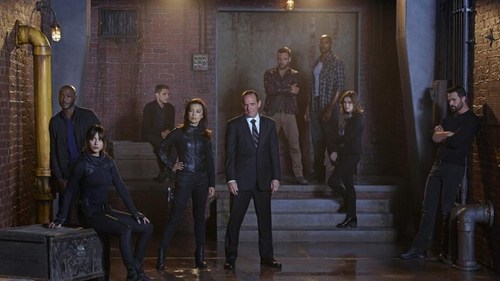
"AGENTS OF S.H.I.E.L.D." SEASON TWO - AT MID-POINTWhen the second season of Marvel's "AGENTS OF S.H.I.E.L.D." first aired, many television viewers and critics have waxed lyrical over their belief over the series' improvement from Season One. And yet . . . the ratings for the show seemed to reflect differently from this view. Regardless of the opinions of others or the ratings, I have my own views about the show's Season Two. I am going to be blunt. I did not like Season Two of "AGENTS OF S.H.I.E.L.D.". My feelings have not changed over the years. In fact, it turned out to be a major disappointment for me. During the series' first season, many fans and critics complained about the show's pacing and slow revelation of the season's main story arc. For them, Mutant Enemy's handling of Season Two's story arc has improved a great deal. I disagree. I had no problems with the development of Season One's story arc. For me, it was no different from the formats for previous Sci-Fi/Fantasy serial television shows like "BABYLON 5", along with Mutant Enemy's "BUFFY THE VAMPIRE SLAYER" and "ANGEL". All three shows began their story arcs for each season slowly and eventually build up the story arc to a mind boggling conclusion. "AGENTS OF S.H.I.E.L.D." did the same. Many fans, critics and even Marvel claimed that Season One's slow build up and occasional breaks had more to do with allowing the season's story arc to build up to the plot for "CAPTAIN AMERICA: THE WINTER SOLDIER". I say bullshit to that."AGENTS OF S.H.I.E.L.D.", like many other television shows with twenty-two (22) episodes per season, usually took occasional breaks in order to stretch out 22 episodes within a time period of seven to eight months. This is nothing new. These breaks have been going on for many television shows for a long time. In their impatience and occasional stupidity, many forgot that. Many also seemed to have forgotten that "AGENTS OF S.H.I.E.L.D." was a serial drama about government agents that work for an intelligence organization . . . not about superheroes and superheroines. For some reason, many fans ignored the show's title and honestly expected the constant appearances of costumed Marvel superheroes and superheroines. Why? I have no idea. But Disney (who owns the ABC Network), Marvel and Mutant Enemy decided to heed the complaints for the sake of ratings and change the series' style.What did they do? Well, they introduced new characters - especially new agents - in the wake of the downfall of S.H.I.E.L.D. from the spring of 2014. How did Mutant Enemy introduce these new characters? Actually, they did not. Instead, new characters such as Alphonse "Mack" McKenzie, Lance Hunter and Isabelle Hartley had already been recruited as S.H.I.E.L.D. agents when the first episode, (2.01) "Shadows". The episode also quickly introduced a new villain, a HYDRA official known as Daniel Whitehall, with a flashback to the past. The new characters, along with familiar characters such as Phil Coulson, Melinda May, Skye and Antoine Triplett, were quickly thrust into a new mission, which quickly morphed into part of the season's new story arc - the recovery of an alien object known as the Obelisk. Everything about this episode seemed to hint "speed". Missing from "Shadows" was Agent In fact, "speed" seemed to be the essence of the plotting and pacing for the first half of Season Two.I find it ironic that many fans complained about how certain characters like Akela Amador, Chan Ho Yin and the Asgardian refugee Dr. Elliot Randolph seemed to have come and gone with the wind. Yet, they failed to realize that similar characters in Season Two did the same . . . or appeared in at least two to three episodes before disappearing. I refer to characters like Isabelle Hartley, Carl Creel, and Senator Christian Ward. But this did not bother me . . . except for their handling of Agent Amador and Senator Ward. What really bothered me was the handling of certain recurring or main characters. There have been complaints about Mutant Enemy's handling of its minority characters . . . well, its African-American characters. I never understood why it was so important for the Mike Peterson character to disappear after the Season One episode, (1.22) "Beginning of the End". What the hell happened to him? Ten Season Two episodes have aired since and not once has the series revealed his whereabouts. Come to think of it . . . what happened to Akela Amador? She was imprisoned by Coulson's team . . . even after they had learned that HYDRA had coerced her into pulling off several robberies on their behalf. HYDRA had released prisoners such as Raina and Ian Quinn, after the S.H.I.E.L.D. Civil War. What about Agent Amador? What happened to her? Off all the new S.H.I.E.L.D. agents introduced during Season Two, only two got the shot end of the stick. One of them was Isabelle Hartley, who was killed off in "Shadows". The other character was Alphonso "Mack" MacKenzie, who was more or less used as some kind of therapy tool for the Leo Fitz character, before being transformed into some kind of zombie in the episode, (2.09) "...Ye Who Enter Here". As of the season's mid-season finale, (2.10) "What They Become", Mack is no longer a "zombie". But no one knows if he has fully recovered. I fear that Mack's fate will become similar to the fate of the Elam Ferguson character from AMC's "HELL ON WHEELS". Ruth Negga continued her role as Raina, the mysterious woman who had aligned herself with HYDRA and later, a man named Calvin Zabo who might be an Inhuman. As it turned out, Raina is also an Inhuman . . . like Skye. However, she underwent a physical transformation:
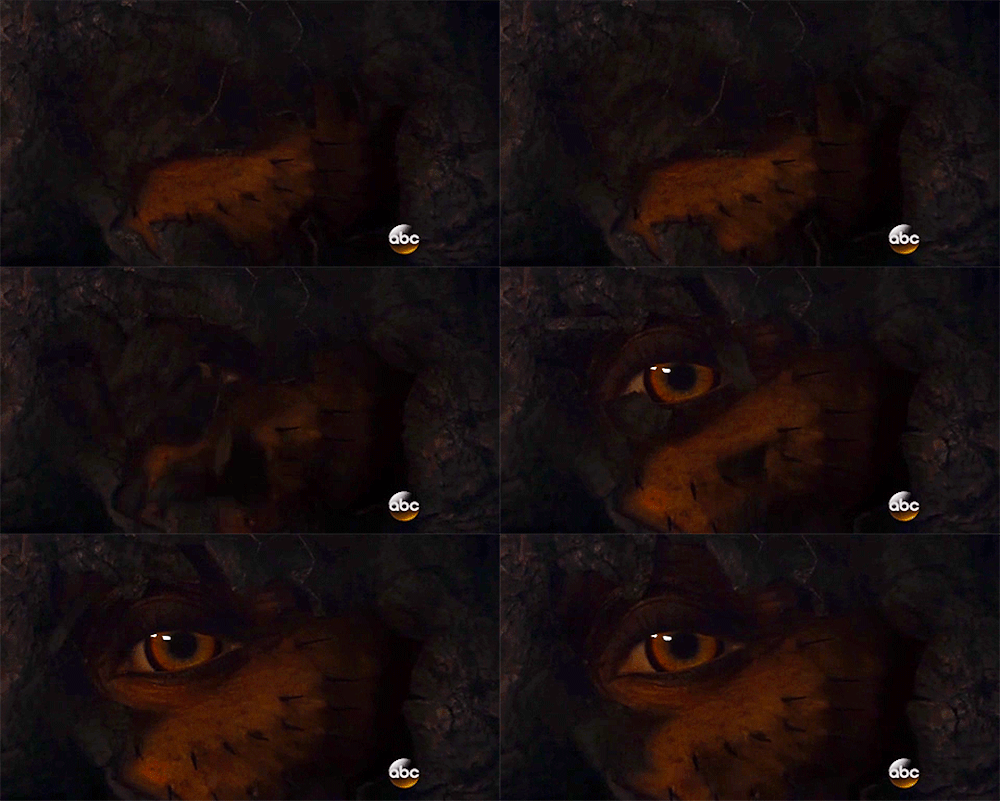 And Skye . . . did not:
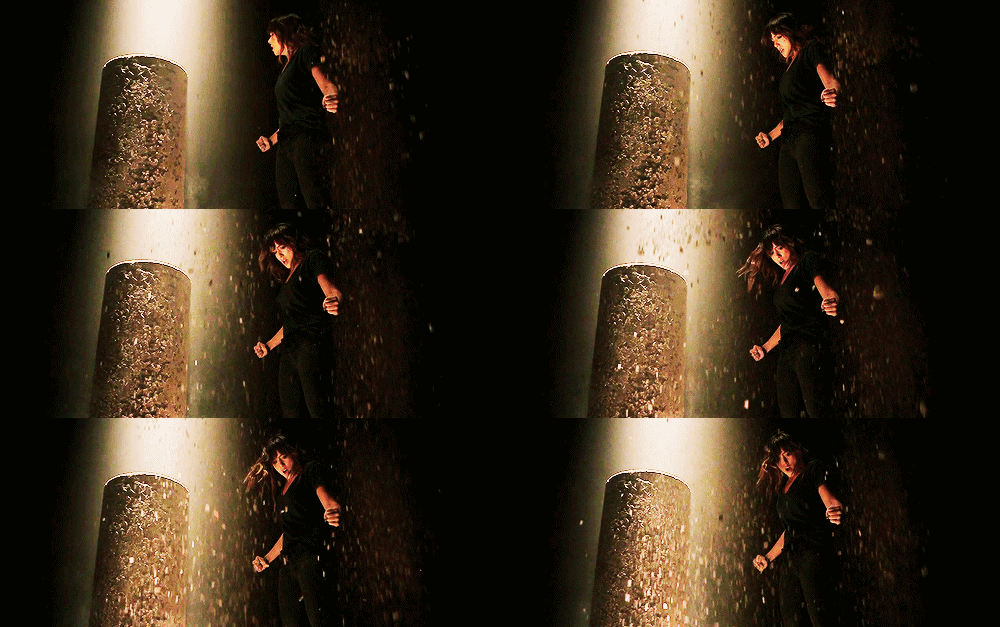 Why? Why Raina and not Skye? Why did a character portrayed by an actress of Irish and African ancestry transformed into a non-Human form . . . and not the character portrayed by an actress of Asian and European ancestry? Finally, I come to Antoine "Trip" Triplett. The show's "Legacy" agent, who had played a major role in the defeat of John Garrett, a S.H.I.E.L.D. agent-turned-HYDRA mole at the end of Season One, seemed to have been shoved to the background by the writers under showrunners Joss and Jed Whedon, Maurissa Tancharoen and producer Jeffrey Bell. Why? Mutant Enemy and Marvel claimed that Britt was under contract to the BET series, "BEING MARY JANE", which meant in their eyes, they could not use him as much as they "wanted". Hmmm . . . more bullshit. They were able to use a great deal of Britt in the second half of Season One. And the actor appeared in less than half of the latest season for "BEING MARY JANE". In fact, the latter has been scheduled by BET to end in 2015. What was the point in sidelining Britt in that manner? And why did they killed off Britt's character with some of the most contrived writing I have seen on this show in "What They Become", without allowing him to have a major appearance in said episode? It was just disgusting to watch.Speaking of contrived writing, I encountered a good deal of it in Season Two. The writers for "AGENTS OF S.H.I.E.L.D." went through of minor story arcs with the speed of a ballistic missile. I realize that Season One had its share of one-shot episodes - especially in its first half. Again, I have no problems with this. One-shot episodes were pretty common in televised serial dramas like "BUFFY" and "BABYLON 5". But in Season Two of "AGENTS OF S.H.I.E.L.D.", the writers would set up a story arc with a great deal of build up and end the story arc within two to five episodes. The series ended up wasting potential characters and story arcs like Carl Creel, Jemma Simmons' role as a S.H.I.E.L.D. mole within HYDRA, the introduction of Senator Christian Ward and the Daniel Whitehall character. Mind you, Whitehall lasted for ten episodes. Only, I had not expected him to be introduced so fast . . . and killed off so soon. Speaking of speed, I had no idea that the Skye character would be exposed as an Inhuman - part of a race of superhumans who had been engineered by aliens such as the Kree - so soon. Halfway into Season Two? I found this rather quick, considering that Marvel has plans to release a movie about the Inhumans in 2018, four years from now. Do they really expect "AGENTS OF S.H.I.E.L.D.", with its sketchy ratings, to last that long? If so, they could have waited a little longer. One last example of the show's fast-paced narration was its tendency to shove two or three subplots into one episode. Other television shows have done this as well. But in a serial drama format, most writers would include the main story arc and a minor subplot that had little to do with the former. Mutant Enemy's writers did not utilize this style. In order to keep the story arc going at neck break speed, they would shove two plotlines that had a great deal to do with the main story arc into one episode. This resulted in several episodes coming off as convoluted and very confusing. Several critics have complained about this, but most viewers and critics are pretending that this is a sign of improved writing from last season. Apparently rushed storytelling is now Mutant Enemy/Marvel's idea of writing for sci-fi serial drama. Really? Speed writing for viewers or critics with the attention span of lice?Another problem I had with Season Two of "AGENTS OF S.H.I.E.L.D." is the character of Grant Ward - former S.H.I.E.L.D. agent and HYDRA mole. Why is he still alive? Why? I suppose Marvel and especially Mutant Enemy still want actor Brett Dalton around. Just recently, producer Jeffery Bell said the following about the character and the actor:"What we love is that Brett Dalton is this actor that brings this complexity to this guy, a lot of the way that James Marsters brought it to Spike on Buffy and Angel."Okay, it is official. Mutant Enemy has a hard-on for Brett Dalton. But when I read the above quote, I did not know whether to laugh or upchuck. Look . . . Dalton is a tolerable actor. He is pretty solid. But I CANNOT believe that Bell had the nerve to compare Dalton with the likes of James Marsters. To this day, I consider Marsters to be one of the best actors or actresses I have ever seen in a Mutant Enemy production hands down. One of the best . . . ever. Dalton is nowhere that good. Now, I will admit that although Spike proved to be one of my favorite television characters, I have no love for Grant Ward. I disliked Ward when he was one of the "good guys" during most of Season One. When he proved to be a HYDRA mole, my feelings for him did not change on whit. I realize that Mutant Enemy was trying to make him complex. But thanks to Dalton's performance, I simply failed to be impressed. But my dislike of the Ward character has nothing to do with my opinion of Dalton as an actor. I also disliked the vampire character Angel, also featured in "BUFFY" and "ANGEL". But despite my dislike, I cannot deny that actor David Boreanaz's portrayal of the character was superb. Another actor that made a name for himself portraying a morally questionable fantasy character was Julian McMahon, who portrayed the human-demon hybrid for three seasons in "CHARMED". Like Marsters and Boreanaz, McMahon was superb in the role, despite producer Brad Kern's shabby handling of the character during his last year on the show. Hell, he proved to be the best actor during the show's eight season run. I noticed something else. Ever since the premiere of "AGENTS OF S.H.I.E.L.D." Season Two, Brett Dalton seems hellbent upon impersonating McMahon. Why, I do not know. Brett Dalton is no Julian McMahon. He should simply give up the effort.Also, Mutant Enemy's efforts to retain the Grant Ward character has resulted in some seriously contrived writing. After Ward's capture in "Beginning of the End", new S.H.I.E.L.D. Director Phil Coulson decided to keep the former agent at the new hidden base. Why? So that he can provide the new S.H.I.E.L.D. with information on HYDRA? What could Ward possibly know? He was a low-level HYDRA mole. I doubt that John Garrett knew everything. Hell, I doubt that Garrett, who can be very manipulative, told Ward everything. Anyone with brains or common sense should have realized this. Why keep Ward around? So that Dalton can do his Julian McMahon impersonation every now and then? Then Mutant Enemy decided to hire actor Tim DeKay to portray Ward's older brother, Senator Christian Ward. DeKay appeared in two episodes - (2.06) "A Fractured House" and (2.08) "The Things We Bury" - before his character was killed off camera by Ward. Aside from giving the writers an opportunity for Ward to escape imprisonment, what was the purpose of DeKay's presence on the show? I cannot decide what was more wasted - the Jemma Simmons w/HYDRA mini arc, Antoine Triplett's Season Two presence, or the use of the Senator Christian Ward character. Even when the writers finally had a chance to rid the show of Ward in the mid-season finale, "What They Become", they kept him alive with some ridiculously contrived writing. I suspect this is Mutant Enemy and Marvel's way of giving Ward some kind of redemption by the end of the season. If so, this will proved to be the fastest redemption arc in television history. And right now, I found myself feeling disgusted over the whole matter. I really do not know what else to say about "AGENTS OF S.H.I.E.L.D.". It is a miracle that I did not wash my hands of this show four years ago. I could not believe this is the same television series that I had fallen in love with during its premiere season. Fortunately for Mutant Enemy, Marvel and the Disney Studios, I stuck with the series and the three seasons that followed managed to redeem Season Two.
 "AGENTS OF S.H.I.E.L.D." (2.01) "Shadows" Commentary
Ohmigod! Did "AGENTS OF S.H.I.E.L.D." lose its sense of humor? I realize that the show is supposed to take a darker turn, but they seemed to be overdoing it.
After an hour of viewing, I realized that the only flash of real humor came from Antoine "Trip" Triplett. The episode revealed that Jemma Simmons left the agency during hiatus. And we do not know the circumstances that led her to finally leave. This is a scenario that should have happened either in the Season One finale, (1.22) "Beginning of the End" or in this episode. Instead, it happened off screen. And what was up with that speech from new S.H.I.E.L.D. Director, Phil Coulson near the end of the episode? He sounded as if he had a burr up his ass.
The scene between Skye and Ward was simply wince inducing. Were they trying to make Ward seductive? How can I be brutally frank? I never really cared about Ward. In fact, what was he doing there in the first place? I doubt that he knows everything about HYDRA. I even doubt that he knows everything that Garrett knew. His presence with Coulson and the others make NO SENSE to me whatsoever. As for Skye, she has more or less lost her sense of humor, let alone personality. Now, she is bland.
Why would the U.S. Army give Glenn Talbot a promotion for losing Coulson and his crew in the last season? What were the circumstances that led Lucy Lawless and her crew of mercenaries to join the new S.H.I.E.L.D.? As for Nick Blood - the so-called "sexy" British mercenary and television cliché - could Whedon and Company be more unoriginal? And what was up with that ridiculous slow motion scene near the end of the episode? Was this episode directed by John Woo or something?
Well, it happened . . . just as I had feared. The producers caved in to the public's inability to deal with the serial drama format . . . and they ended up forcing the action for this season - to the extreme - down our throats. In fact, everything about the writing in "Shadows" was rushed - including the introduction of new characters and situation. Whedon and Co. dumped its usual style of storytelling and rushed the story in order to satisfy the critics, the viewers and the Disney corporate suits who had complained about Season One's slow development of the story line. Apparently these critics know nothing about story development in a serial drama format. And I guess Whedon and Co. lost that knowledge as well.
The only interesting aspect about this episode was the 1940s flashback featuring Peggy Carter, "Dum Dum" Dugan, Jim Morita and the new Big Bad, Daniel Whitehall. The rest of it was a rushed job filled with over-the-top action, along with grim and humorless characterization. If this episode had been the very first episode of "AGENTS OF S.H.I.E.L.D." I had seen, I would have given up on this series with the drop of a hat.
"AGENTS OF S.H.I.E.L.D." (2.01) "Shadows" Commentary
Ohmigod! Did "AGENTS OF S.H.I.E.L.D." lose its sense of humor? I realize that the show is supposed to take a darker turn, but they seemed to be overdoing it.
After an hour of viewing, I realized that the only flash of real humor came from Antoine "Trip" Triplett. The episode revealed that Jemma Simmons left the agency during hiatus. And we do not know the circumstances that led her to finally leave. This is a scenario that should have happened either in the Season One finale, (1.22) "Beginning of the End" or in this episode. Instead, it happened off screen. And what was up with that speech from new S.H.I.E.L.D. Director, Phil Coulson near the end of the episode? He sounded as if he had a burr up his ass.
The scene between Skye and Ward was simply wince inducing. Were they trying to make Ward seductive? How can I be brutally frank? I never really cared about Ward. In fact, what was he doing there in the first place? I doubt that he knows everything about HYDRA. I even doubt that he knows everything that Garrett knew. His presence with Coulson and the others make NO SENSE to me whatsoever. As for Skye, she has more or less lost her sense of humor, let alone personality. Now, she is bland.
Why would the U.S. Army give Glenn Talbot a promotion for losing Coulson and his crew in the last season? What were the circumstances that led Lucy Lawless and her crew of mercenaries to join the new S.H.I.E.L.D.? As for Nick Blood - the so-called "sexy" British mercenary and television cliché - could Whedon and Company be more unoriginal? And what was up with that ridiculous slow motion scene near the end of the episode? Was this episode directed by John Woo or something?
Well, it happened . . . just as I had feared. The producers caved in to the public's inability to deal with the serial drama format . . . and they ended up forcing the action for this season - to the extreme - down our throats. In fact, everything about the writing in "Shadows" was rushed - including the introduction of new characters and situation. Whedon and Co. dumped its usual style of storytelling and rushed the story in order to satisfy the critics, the viewers and the Disney corporate suits who had complained about Season One's slow development of the story line. Apparently these critics know nothing about story development in a serial drama format. And I guess Whedon and Co. lost that knowledge as well.
The only interesting aspect about this episode was the 1940s flashback featuring Peggy Carter, "Dum Dum" Dugan, Jim Morita and the new Big Bad, Daniel Whitehall. The rest of it was a rushed job filled with over-the-top action, along with grim and humorless characterization. If this episode had been the very first episode of "AGENTS OF S.H.I.E.L.D." I had seen, I would have given up on this series with the drop of a hat.
Below are my top ten (10) episodes from NBC's "HOMICIDE: LIFE ON THE STREETS" (1993-1999):
TOP TEN FAVORITE EPISODES OF "HOMICIDE: LIFE ON THE STREETS" (1993-1999)
 1. (5.19) "Deception" - The murder of a Nigerian drug courier sets the scene for an explosive encounter between gangster Luthor Mahoney and Detectives Mike Kellerman, Meldrick Lewis and Terri Stivers. Kellerman's action will result in repercussion for the squad in over a year.
 2. (1.06) "Three Men and Adena" - Tim Bayliss and Frank Pembleton bring in an arabber named Risley Tucker as the prime suspect in the murder of the 11 year-old girl, Adena Watson. With a 12-hour time limit, the two partners try one last interrogation in a desperate attempt to get a confession. Writer Tom Fontana won an Emmy for writing this episode.
 3. (3.04) "Crosetti" - The squad reels with shock over the news of Detective Steve Crosetti's suicide death - especially former partner Lewis, who has difficulty accepting the detective's death.
 4. (3.10) "Every Mother's Son" - Pembleton and Bayliss investigate the shooting of a 13-year-old boy, Darryl Nawls. During the course of their investigation, the mother of the shooter unknowingly meets the mother of the victim and finds that they have much in common.
 5. (6.22) "Fallen Heroes (Part 1) - Junior Bunk is arrested for the death of a corrupt judge named Gibbons. After stealing a revolver from an officer's death while no one is looking, Junior engages in a shooting spree, killing and wounding several officers - including Laura Ballard and Stu Gharty.
 6. (6.23) "Fallen Heroes (Part 2) - The squad goes after the Mahoney organization, following Junior Bunk's shooting spree in Part 1. This leads to Bayliss getting seriously wounded. Meanwhile, Lieutenant Al Giardello and Pemberton eventually learn about Kellerman's killing of Luthor Mahoney.
 7. (2.02) "Black and Blue" - The department and community pressure the Homicide Unit to solve a cop-involved killing. With the lives and reputations of fellow officers at stake, Giardello clashes with Pembleton over the investigations. Giardello demands a pursuit of civilian suspects, but Pembleton's instincts tell him the cops are lying.
 8. (5.13) "Betrayal" - Bayliss's shaky history with child victims leads him to reveal a family secret to Pemberton after the two work the beating death of a young girl found by the interstate. Kellerman rejects the Fifth Amendment before a grand jury, and is let off the hook.
 9. (7.10) "Shades of Gray" - Rene Sheppard is assaulted when she and Lewis investigate an incident involving the accidental death of a West Indian immigrant at the hands of a white bus driver.
 10. (1.07) "And the Rockets' Dead Glare" - When a student who was a political refugee is murdered, Lewis and Crosetti take it upon themselves to investigate individuals at the Chinese Embassy in Washington, DC. Kay Howard and Beau Felton spend the day in court testifying in the ongoing case against "Pony" Johnson. Pembleton weighs the pros and cons of a possible promotion within the department.


