Showing posts with label temuera morrison. Show all posts

Wednesday, April 15, 2020

"THE GREEN LANTERN" (2011) Review


“GREEN LANTERN” (2011) Review
The year 2011 marked the end of the television series, “SMALLVILLE”.  The same year saw the release of “THE GREEN HORNET”, starring Seth Rogen and Jay Chou. And a few months later, Warner Brothers Studios released their adaptation on the DC Comics superhero, the Green Lantern. 
Directed by Martin Campbell, “THE GREEN LANTERN” told the story of a hotshot test pilot for Ferris Aircraft named Hal Jordan, who becomes the Green Lantern . . . or one of them. Before Earth was formed, a group of beings called the Guardians of the Universe used the green essence of willpower to create an intergalactic police force called the Green Lantern Corps. One such Green Lantern, Abin Sur defeated a fear-essence being Parallax and imprisoned him in the Lost Sector on the ruined planet Ryut. However, Parallax eventually escapes from his prison, kills four Green Lanterns and destroys two planets. After Parallax mortally wounds Abin Sur. Dying, the latter crashes on Earth and commands his Green Lantern ring to find a worthy successor. 
Hal Jordan is chosen by the ring and transported to the crash site, where Abin Sur appoints him a Green Lantern, by telling him to take the lantern and speak the oath. At home he says the oath of the Green Lanterns while under trance from the glow of the lantern. Hal is whisked away to the Green Lantern Corps home planet of Oa, where he meets and trains with Tomar-Re and Kilowog. He encounters Corps leader Sinestro, who is not pleased that a human, which is primitive compared to other species, has become a Green Lantern. Meanwhile, scientist Hector Hammond is summoned by his father, Senator Robert Hammond to a secret government facility to perform an autopsy on Abin Sur’s body. A piece of Parallax from inside the corpse inserts itself inside Hector, mutating the latter and giving him telepathic and telekinetic abilities . . . at the cost of his sanity. Throughout the movie, Hal not only has to deal with his private insecurities and fears about being a Green Lantern; the uneasy state of his relationship with his boss/ex-girlfriend, Carol Ferris; and most importantly, the increasingly dangerous Hector and Parallax, who is slowly making its way toward Earth. 
Unfortunately for “GREEN LANTERN”, it flopped at the box office. Because of its $200 million budget, it is considered one of the biggest failures of the 2011 summer season and a major embarrassment for Warner Brothers. The critics tore the film apart before it even reached the movie theaters. And a good number of moviegoers stayed away in droves. In fact, its failure reminded me of what happened to “SPEED RACER” back in 2008, another Warner Brothers release. Pity. Because I managed to enjoy “GREEN LANTERN” and thought it was a pretty solid adaptation of the famous comic book hero.
Now, “GREEN LANTERN” was not the best superhero movie that I have ever seen. To be honest, I found it rather mediocre.  The movie’s plot struck me as one of those typical superhero origins tale that every fan of this type of movie genre has to . . . well, endure. Some of these origins have managed to knock my socks off. “GREEN LANTERN” failed to do so. And I do have a major complaint about the screenplay written by Greg Berlanti, Michael Green, Marc Guggenheim and Michael Goldenberg. I thought it had failed to form a stronger connection . . . or relationship between the infected Hector Hammond and Parallax. The two characters only shared one scene and seemed over pretty damn quick. 
But I do believe that the critics’ enmity was undeserved. “GREEN LANTERN” provided plenty of drama, laughs, action and special effects. The screenwriters did a great job in developing Hal Jordan’s character, allowing actor Ryan Reynolds plenty of dramatic meat to show off his acting skills. The screenplay also provided some strongly written supporting characters – especially Carol Ferris, Sinestro, and Hector Hammond, who was provided a strong subplot involving his relationship with his father. And aside from my disappointment over the Hector-Parallax connection, I thought the screenwriters did an excellent job in providing a strong connection between Hal’s personal demons, his introduction to the Green Lantern Corps and the dangers of Parallax.
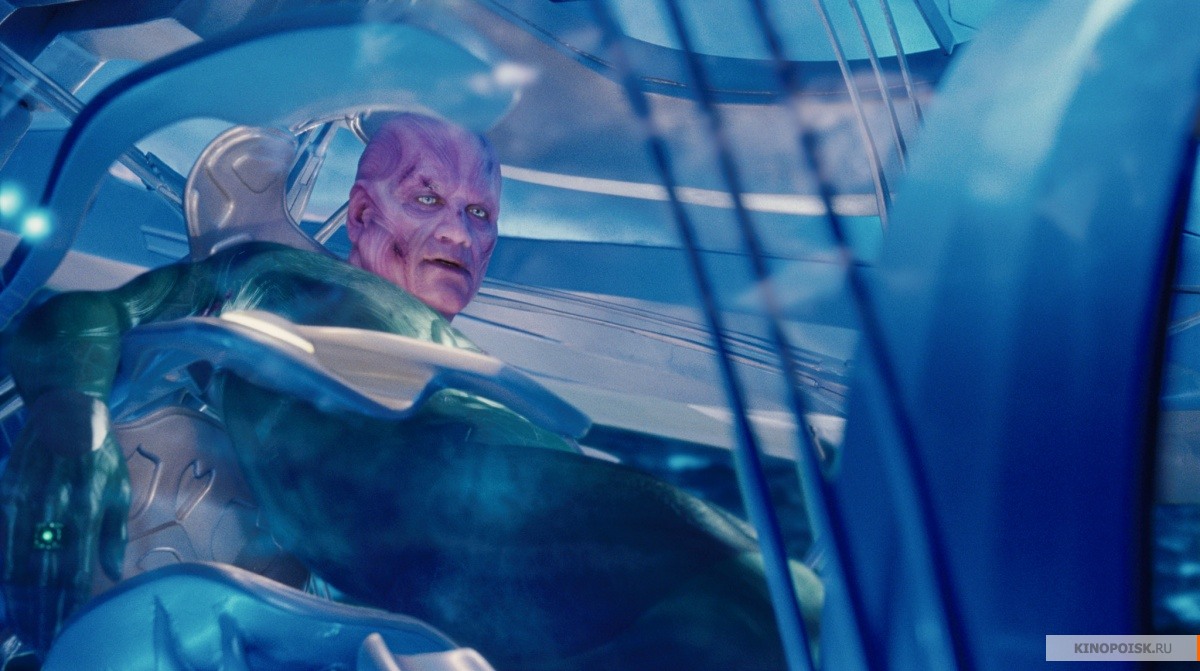
The behind-the-scenes production for “GREEN LANTERN” struck me as outstanding. I was very impressed. Felicity Browning lead a team that provided first rate makeup for some of the cast. I was especially impressed by their work on Mark Strong, Peter Sarsgaard, and even Ryan Reynolds’ eyes, while in his Green Lantern garb. But Grant Major’s production designs for both the planet of Oa really blew me away. I believe the visual effects supervised by Jim Berney and special effects by John S. Baker probably helped. Not only was I impressed by the designs and effects featured in the Oa sequences, but also the design of Parallax, which freaked me out a bit.
As I had earlier pointed out, the movie’s screenwriters did a solid job in their characterization of Hal, making him a complex and interesting character. But it would have never worked without Ryan Reynolds, who not only provided his trademark wit to his performance, but also provided Hal with a great deal of pathos and complexity. Reynolds also created great chemistry with his co-star Blake Lively. I had been very impressed by her performance in last year’s movie, “THE TOWN”. And her performance as Hal’s ex-girlfriend, boss and fellow test pilot, Carol Ferris; only proved that my original opinion of her acting talents was not a fluke. She still managed to be very impressive. 
Ever since I saw him in “JARHEAD”, I have been a fan of Peter Sarsgaard. His portrayal of Hector Hammond, the insecure senator’s son and scientist, has made me into an even bigger fan. I think it was a testament to Sarsgaard’s acting talent that he allowed Hector to remain a sympathetic character, despite his transformation into a villain from the Parallax infection. And it has been a while since I have seen Mark Strong portray a good guy – three years to be exact. For me, his portrayal of fellow Green Lantern Sinestro, was spot on . . . and a breath of fresh air. Both Angela Bassett and Tim Robbins provided solid support as government scientist Dr. Waller and Hector’s father, Senator Robert Hammond. Mind you, I found nothing remarkable about Bassett’s role, which is not surprising, thanks to the screenwriters. But it was interesting to see Robbins portray a somewhat smarmy personality, who seemed more interested in his son’s ambitions (or lack of) than in his son. 
Look, “GREEN LANTERN” may not be the one of the best comic book hero movies ever made. And it does not strike me as one of the most original I have ever seen. But I do not believe it deserved the harsh words that many movie critics dumped on it. Thanks to the behind-the-scenes production, Martin Campbell’s direction and the cast led by Ryan Reynolds, I thought that “GREEN LANTERN” turned out to be a solid and entertaining film.

anigif_enhanced-29127-1501524605-3

Sunday, September 22, 2019

"THE GREEN LANTERN" (2011) Photo Gallery


Below are images from the 2011 DC Comics movie, "THE GREEN LANTERN".  Directed by Martin Campbell, the movie starred Ryan Reynolds as Hal Jordan aka the Green Lantern:


"THE GREEN LANTERN" (2011) Photo Gallery


Wednesday, January 11, 2012

Notes and Observations on "STAR WARS: Episode II - ATTACK OF THE CLONES"


The following is a list of minor notes and observations that came to me, during my recent viewing of “Episode II: Attack of the Clones”. I hope that you enjoy them:


Notes on "STAR WARS: Episode II – Attack of the Clones"

*It is interesting that the story starts out with Coruscant – the seat of the Republic’s power – covered in a shroud of fog. Was this an allegory of the Republic’s impending doom? Or a sign of hidden secrets within the seats of power?

*Why did the Jedi believe they would have to protect the Republic in a military action, if the Separatists broke away? It seems as if the Republic and the Jedi were prepared to consider using military force to draw the Separatists back into the Republic, against their will.

*I noticed that both Mace and Ki-Adi had the same condescending attitude that the entire Council had in TPM, when explaining to Padme that Dooku could never be behind her assassination attempt.

*Why was it so important to Obi-Wan that he and Anakin follow the Council’s instructions regarding Padme, to the letter?

*I wonder if Jango would have killed Zam if she had succeeded in killing Padme.

*Are dreams usually dismissed by the Jedi in such a cavalier fashion?

*No wonder the Jedi and senators like Bail Organa had never formed a strong bond by ROTS, if Obi-Wan’s general attitude toward all politicians (which the Order shares, I suspect) is anything to go by.

*The more I look at Anakin and Obi-Wan’s interactions in AOTC, the more I realize how unsuited they were for a master/padawan relationship. Anakin would have been better off being trained by someone more suited to deal with his emotional and non-conformist personality. However, I see nothing wrong with Anakin and Obi-Wan forming a strong friendship, once Anakin becomes a Jedi Knight.

*I wonder if Anakin’s feelings about Palpatine would have remained the same if Obi-Wan had been less strident in his teaching.

*How interesting. Obi-Wan ended up following Anakin’s suggested mandate regarding Padme’s would-be assassin, after all.

*The Coruscant chase sequence is another major favorite with me. Note the slightly chubby woman with Ahmed Best and a silver-blond woman with too much eye make-up, both giving Anakin lust-filled glances in the nightclub scene. Come to think of it, I believe I had spotted two other women doing the same.

*”Until caught this killer is, our judgement she must respect.” – Why did Yoda believe that Padme MUST accept the Jedi’s decision that she return to Naboo? I realize that he is concerned for her safety. But why would he assume that she had no choice but to accept the Council’s decision on where she should be? At least Mace seemed to realize that Padme would obey if Palpatine, as the Supreme Chancellor, had given the order.

*When discussing his abilities with Palpatine, Anakin is polite and practically modest. Yet, whenever he is around Obi-Wan or discussing the latter, he becomes arrogant about his abilities and bitter at what he perceives as Obi-Wan’s inability to recognize them.

*”Anakin . . . don’t try to grow up too fast.” – It is ironic that Padme would say this to Anakin, considering that she has been trying to do this very thing for most of her life.

*Although Captain Typho’s assumption on the safety of Padme’s arrival on Coruscant proved to be false, his fear that she might do something foolish or rash proved to be very accurate.

*”If an item does not appear in our records, it does not exist.” – ah, another prime example of the Jedi’s arrogant belief in themselves. Who would have thought it would come from the Archives’ librarian?

*Anakin might be pretty close to the truth in the definition of love he had given to Padme.

*Despite the sweet and charming overtones of the younglings scene, it still has a sinister sense of the foreboding.

*It is interesting how ALL of the Separatists are tainted with the same brush as the Trade Federation and the Banking Union, because they had sought the latter for help. Guilt by association.

*When Sio Biddle had asked Anakin a question about Padme’s safety, Padme rudely interrupts and brushes off Anakin. Now, why did she do that? And in such a rude manner?

*It’s interesting how the imagery and symbolism on Kamino seemed to be of the fertile kind.

*I just realized that if Palpatine had eventually accused the Jedi of creating the Clone Army, he would have been correct. Especially since Master Sifo-Dyas really did order the creation of the clones for the Republic.

*For someone with hardly any experience in romance, Anakin managed to do a good job in winning over Padme without resorting to smooth lines and a cocky manner.

*Of course . . . Padme seemed to be a bit of a flirt, herself. She certainly knows how to use her voice effectively.

*In an article on Anakin and Padme’s relationship, I read a segment from a poem or story written hundreds of years ago that was compared to Anakin’s fireside speech. What amazed me was how similar Anakin’s speech was to what is considered courtly love.

*I noticed that once Padme had rejected Anakin’s offer of love, he turned away from her. And she, in turn, began to pursue him in a very subtle manner.

*It is ironic that Anakin believes that he did not have a choice in leaving Naboo to help his mother. In reality, he did have a choice . . . and he exercised it. Like the other characters around him, Anakin has become adept at deluding himself.

*I see that Obi-Wan had made the first move in his fight with Jango Fett on Kamino. Not only did it result in him nearly falling over a ledge, it was the movie’s first sign of the “good guys” acting as the aggressors.

*”Those Tusken Raiders. They may walk like men, but they’re nothing more than vicious, mindless monsters.” – Judging from Cliegg Lars’ words, I cannot help but wonder if Anakin’s murder of the Tusken Raiders was something rare on Tatooine. Would Anakin’s actions have been condoned by Tatooine’s moisture farmers? Cliegg’s words seemed to have a xenophobic ring to them.

*When Padme told Anakin that it was okay to be angry, she was right. It was okay. It would have been a lot unhealthier for Anakin to pretend otherwise. But where Anakin went wrong was that he had allowed his anger to overwhelm him . . . which led to his murder of the Tuskens.

*Anakin’s claim that he would even learn to stop people from dying seemed to foreshadow his opera conversation with Palpatine in ROTS.

*If Jar-Jar had not proposed that Palpatine should be given emergency powers, I wonder who would have made the proposition? Bail Organa had been certain that the Senate would never grant such powers to the Chancellor or authorize a clone army. Boy, was he wrong!

*Did Obi-Wan’s own prejudices and beliefs in the Jedi’s infallibility led him to easily dismiss Dooku’s claim that a Sith Lord had control over the Senate?

*I think that Padme’s arrogant belief in her diplomatic skills were in overdrive, when she and Anakin learned about Obi-Wan’s predicament. I can see why Typho had been worried that she would do something rash.

*It seems interesting that Anakin was the only one who had managed to control the attacking him in the Geonosis area, without resorting to brute force. Was this a metaphor of his potential to control (but not suppress) the animus within himself? A potential that he had failed to attain until the end of his life?

*Obi-Wan, on the other hand, succeeded in dealing with his animal attacker with brute force . . . just as he had succeeded with Maul and Anakin. Was this a foreshadow of his advocacy of Luke using violence to deal with Vader/Anakin in the Original Trilogy?

*I suspect that Jango’s success in killing Jedi Master Coleman Trebor had gone to his head, when he had decided to attack Mace. Just as many of the Jedi have discovered in this movie and will discover in ROTS, Jango will learn that it does not pay to be the aggressor.

*I did not realize that the Republic and the Jedi had acquired both troops and weapons from the Kaminoans.

*It is interesting that Obi-Wan’s threat of expulsion from the Jedi Order did not faze Anakin one bit, in his concern for the fallen Padme. Either the Jedi Order was never that important enough to Anakin . . . or it was too important to Obi-Wan. Or perhaps it was both.

*Both Anakin and Obi-Wan made the mistake of aggressively moving against Dooku, first. And both had failed. Again, this seemed to be another example of the Jedi’s acceptance of using aggression in this movie.

*Anakin vs. Dooku – it’s ironic that this was the first duel between Palpatine’s present and future apprentices.

*Dooku, who had wisely allowed both Obi-Wan and Anakin to be the aggressors, became the aggressor, himself, in his duel against Yoda. He had barely managed to escape with his life.

*The failure of aggression committed by our heroes and by villains like Dooku and Jango seemed to be the theme for this movie . . . and perhaps the Prequel Trilogy overall. This theme seems especially true for the Jedi, who had agreed to use the clone troopers against the Separatists. The same clone troopers that will become the tools of their destruction. Irony at its most tragic.

*Looking back on AOTC, it strikes me as being a very nourish story, despite the some of the usual STAR WARS elements. Perhaps that is why so many people have difficulty in accepting it. Film noir can be highly regarded – or not. But people rarely understand it, or bother to watch it in the movie theaters.