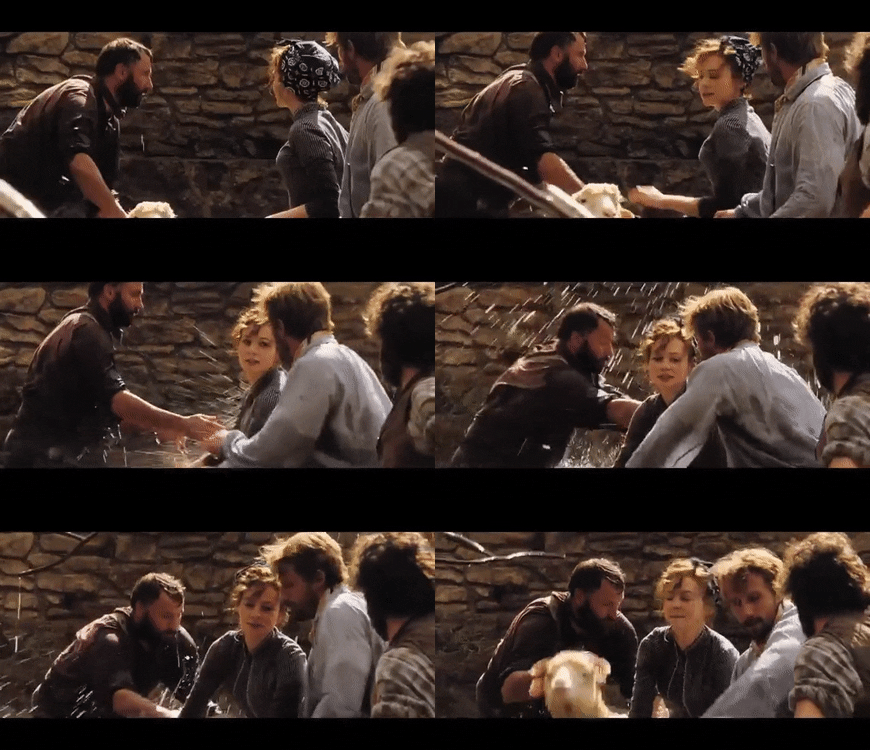
"FAR FROM THE MADDING CROWD" (2015) Review
I have never seen "FAR FROM THE MADDING CROWD", the 2015 adaptation of Thomas Hardy's 1874 novel. And yet . . . my knowledge of this film led me to view two previous adaptations. And finally, I found the chance to view this adaptation, directed by Thomas Vinterberg.
"FAR FROM THE MADDING CROWD" told the story of a young 19th century rural English woman named Bathsheba Everdeene and the three men in her life - a sheep farmer-turned-shepherd named Gabriel Oak; her neighbor and owner of the neighborhood's largest farm, William Boldwood; and an illegitimate Army sergeant named Frank Troy. Bathsheba first met Gabriel Oak, a former shepherd who had leased and stocked a sheep farm. Gabriel proposed marriage, but Bathsheba rejected his proposal even though she liked him. She valued her independence more. Later, Bathsheba inherited her uncle's prosperous farm, while Gabriel's fortune disappeared when his inexperienced sheep dog drove his flock over a cliff. When the pair's paths crossed again, Bathsheba ended up hiring Gabriel as her new shepherd. Meanwhile, Bathsheba became acquainted with her new neighbor, a wealthy farmer named William Boldwood. He became romantically obsessed with her after she sent him a Valentine's Day card as a joke. But before she could consider Mr. Boldwood as a potential husband, Sergeant Frank Troy entered her life and she immediately fell in love and married him. Eventually, Bathsheba came to realize that Frank was the wrong man for her.
A good number of people compared this adaptation of Hardy's novel to the 1967 movie adapted by John Schlesinger. Personally, I did not. As much as I enjoyed the 1967 movie, I have never regarded it as the gold-standard for any movie or television adaptation of the 1874 novel. But like the other two version, Thomas Vinterberg's recent adaptation had its flaws. Looking back on "FAR FROM THE MADDING CROWD", I can honestly say that I had at least a few problems with it.
I wish the running time for "FAR FROM THE MADDING CROWD" had been a bit longer than 119 minutes. I believe a longer running time would have given the film's narrative more time to explore the downfall of Bathsheba and Frank's marriage. Unfortunately, it seemed as if Vinterberg and screenwriter David Nicholls had rushed through this entire story arc. I was surprised when Bathesheba admitted to Gabriel that her marriage to Frank had been a mistake on the very night of hers and Frank's harvest/wedding party, when an upcoming storm threatened to ruin her ricks. I realize that this conversation also occurred during the night of the harvest/wedding party in the novel. But from a narrative point-of-view, I believe this conversation between Bathsheba and Gabriel would have worked later in the story . . . when it has become very obvious that her marriage to Frank has failed.
In fact, Frank Troy's entire character arc seemed to be rushed in this film. Many have complained that Tom Sturridge's portrayal of Frank was flawed. I do not agree. I did not have a problem with the actor's performance. I had a problem with Vinterberg and Nicholls' portrayal of Frank. In my review of the 1967 adaptation, I had complained about the overexposure of Frank's character in that film. In this version of "FAR FROM THE MADDING CROWD", Frank's character seemed to be underexposed. Aside from a few scenes that included Bathsheba and Frank's first meeting, his display of swordsmanship, his revelation about his true feelings for Bathsheba and Boldwood's Christmas party; I do not think that this movie explored Frank's character as much as it could have.
Another aspect of Frank Troy's arc that suffered in this film was the character of Fanny Robin. Anyone familiar with Hardy's novel should know that Fanny was a local girl who worked at the Everdene farm. Before Gabriel's arrival, she had left to become Frank's wife. Unfortunately, the wedding never happened because Fanny went to the wrong church. Frustrated angry, Frank prematurely ended their relationship. If Frank was underexposed in "FAR FROM THE MADDING CROWD", poor Fanny was barely developed. I could solely blame Thomas Hardy for this poor use of Fanny's character, since he was also guilty of the character's underdevelopment. But I have to blame Vinterberg and Nicholls as well. They could have easily added a bit more to Fanny's character, which is what the 1998 miniseries adaptation did. Alas . . . audiences barely got to know poor Fanny Robin.
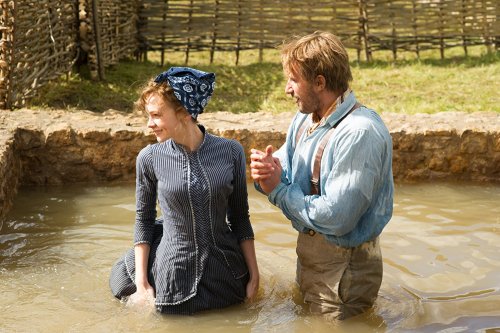
"FAR FROM THE MADDING CROWD" may not have been perfect, but I still found it to be a first-rate film. One, it is a beautiful movie to watch. "FAR FROM THE MADDING CROWD" may have lacked the sweeping cinematography featured in the 1967 movie, but I must admit that I enjoyed Charlotte Bruus Christensen's elegant, yet colorful photography. I can also say the same about the Art Design team of Julia Castle, Tim Blake and Hannah Moseley; and Kave Quinn's production designs, which did a stupendous job of re-creating a part of rural England in the late 19th century. But I really enjoyed Janet Patterson's costume designs, as shown in the images below:


Although the novel was published in 1874, Patterson's costumes made it apparent to me that Vinterberg had decided to set this adaptation during the late 1870s or early 1880s. Did this bother me? No. I was too distracted by Patterson's elegant, yet simple costumes to care.
Yes, I had a problem with the film's limited portrayal of Frank Troy and especially Fanny Robin. But I still enjoyed this adaptation very much. The reason I enjoyed it so much is that Vinterberg and Nicholls did an excellent job of staying true to the narrative's main theme - namely the character development of Bathsheba Everdene. From that first moment when Gabriel Oak spotted the spirited Bathsheba riding bareback on her horse, to her early months as moderately wealthy farmer, to the infatuated bride of an unsuitable man, to the emotionally battered but not bowed woman who learned to appreciate and love the right man in her life; "FAR FROM THE MADDING CROWD" allowed filmgoers share Bathsheba's emotional journey during an important period in her life.
The ironic thing is that Bathsheba's story arc is not the only one featured in this film. Both Vinterberg and Nicholls also explored Gabriel Oak's personal journey, as well. Superficially, Gabriel seemed to be the same man throughout the film. And yet, I noticed that Gabriel seemed a bit too sure of himself in the film's opening sequence. He seemed sure of his possible success with a sheep farm and his efforts to woo Bathsheba. And yet, between the loss of his herd and Bathsheba's rejection, Gabriel found himself forced to start all over again with his life. Although he remained constant in his love for Bathsheba and his moral compass, it was interesting to watch him struggle with his personal frustrations and setbacks - especially in regard to his feelings for Bathsheba.
Whereas audiences watch Bathsheba and Gabriel develop, they watch both John Boldwood and Francis Troy regress to their tragic fates. The strange thing about Frank was that he had a chance for a happier life with Fanny Robin. I still remember that wonderful sequence in which Frank waited for Fanny to appear at the church for their wedding. It was interesting to watch his emotions change from mild fear, hope and joy to outright anger and contempt toward Fanny for leaving him at the altar, all because she went to the wrong church. I still find it interesting that Frank allowed his pride and anger to get the best of him and reject the only woman that he truly loved. Boldwood . . . wow! Every time I watch an adaptation of Hardy's story, I cannot help but feel a mixture of pity, annoyance and some contempt. He truly was a pathetic man in the end. Perhaps he was always that pathetic . . . even from the beginning when he seemed imperious to Bathsheba's presence. After all, it only took a Valentine's card - given to him as some kind of joke - to send him on a path of obsessive love and murder.
The performances in "FAR FROM THE MADDING CROWD" certainly added to the film's excellent quality. The movie featured some pretty first-rate performances from the supporting cast. This was apparent in Juno Temple's charming and poignant portrayal of the doomed Fanny Robin. I was also impressed by Jessica Barden for giving a very lively performance as Liddy, Bathsheba's extroverted boon companion. The movie also featured solid performances from Sam Phillips, who portrayed Frank's friend, Sergeant Doggett; Victor McGuire as the corrupt Bailiff Pennyways; and Tilly Vosburgh, who portrayed Bathsheba's aunt, Mrs. Hurst.
As I had earlier pointed out, many have criticized Tom Sturridge's portrayal of Frank Troy. I do not disagree with this criticism. If I must be honest, I was very impressed with Sturridge's performance. I thought he conveyed the very aspect of Frank's nature - both the good and the bad. This was especially apparent in three scenes - Frank's aborted wedding to Fanny, his initial seduction of Bathsheba, and his emotional revelation of his true feelings for Fanny. It really is a pity that Vinterberg did not give Sturridge more screen time to shine. Thankfully, Michael Sheen was given plenty of screen time for his portrayal of Bathsheba's possessive neighbor, John Boldwood. I must confess . . . I have never seen Sheen portray any other character like Boldwood. It was a revelation watching the actor beautifully embody this emotionally stunted man, who allowed a silly Valentine's Day joke to lead him to desperately grasped at at prospect for love.
I had never heard of Belgian actor Matthias Schoenaerts until I saw this film. This is understandable, considering that "FAR FROM THE MADDING CROWD" was the first English-speaking movie in which I had seen him. Vinterberg must have been a major fan of Schoenaerts to be willing to cast him as the obviously 19th century English shepherd, Gabriel Oak. I am certainly a fan of his portrayal of the stalwart Gabriel. Schoenaerts did a superb job in conveying Gabriel's emotional journey - especially in regard to the ups and downs in the character's relationship with Bathsheba. I am still amazed by how the actor managed to convey Gabriel's emotional state, while maintaining the character's reserve nature.
I believe Carey Mulligan may have been at least 28 or 29 years old, when "FAR FROM THE MADDING CROWD", making her the second oldest actress to portray Bathsheba Everdene. Some have complained that Mulligan seemed a bit too old to be portraying the early 20s Bathsheba. I can honestly say that I do not agree. During the film's first 20 minutes or so, Mulligan's Bathsheba did come off as a bit sophisticated and all knowing. It eventually occurred to me that the actress was merely conveying the character's youthful arrogance. And yet, Mulligan skillfully the character's personal chinks in that arrogance throughout the movie - whether expressing Bathsheba's insistence that Gabriel regard her solely as an employer, the character's embarrassment over being pursued by the obsessive Boldwood or Frank's overt sexual attention to her, or her desperation and humiliation from his emotional abuse. Mulligan gave an excellent and memorable performance.
I cannot say that the 2015 movie, "FAR FROM THE MADDING CROWD" is perfect. Come to think of it, none of the adaptations I have seen are. Despite its flaws, I can honestly say that it is another excellent adaptation of Thomas Hardy's 1874 novel, thanks to Thomas Vinterberg's direction, David Nicholls' screenplay and a superb cast led by Carey Mulligan.