Showing posts with label james badge dale. Show all posts

Wednesday, January 1, 2020

"WORLD WAR Z" (2013) Review

world-war-z

“WORLD WAR Z” (2013) Review
I might as well state it outright. I am not a fan of horror movies. Actually, I hate them. I had once considered ignoring “THE MUMMY”, Stephen Sommer’s 1999 remake of an old Boris Karloff film, until my sister convinced me that it was more of an adventure flick than a horror film. But my dislike of horror films remained intact when I first learned of the new Brad Pitt movie, “WORLD WAR Z”. 
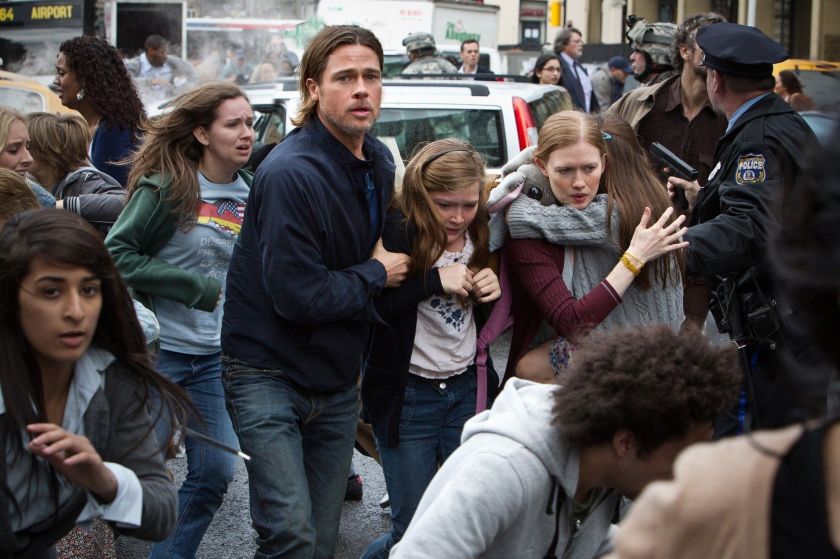
Barely based upon Max Brooks’ 2006 novel, “WORLD WAR Z” is an apocalyptic tale about a former a former United Nations investigator who must travel the world to find a way to stop a zombie-like pandemic. The movie starts in Philadelphia, where Gerry Lane and his family are stuck in heavy traffic in Philadelphia, while they listen to a radio report of a rabies outbreak that has spread all over the world. Following a series of explosions, the Lanes are attacked by zombies. Those bitten are transformed into zombies after 12 seconds. While the attacks continue, the Lanes narrowly escape to an apartment complex and seek refuge with another family to wait for extraction by a helicopter sent by Gerry’s former UN colleague, the Deputy Secretary-General Thierry Umutoni. After a brief struggle in which Gerry is almost infected, the family reaches the helicopter and is taken to a U.S. Navy vessel off the coast of New York City. There, a team of analysts and military personnel analyze the zombie virus outbreak. A virologist name Dr. Andrew Fassbach suggests that they need to find the origin of the zombie plague in order for a vaccine to be developed. Because of his expertise as a former UN investigator, Gerry is tasked – actually blackmailed by a high-ranking Naval officer – with helping Dr. Fassback to find the source of the zombie virus.
Considering my initial declaration of my dislike toward horror films, one would probably speculate on why I went to see “WORLD WAR Z” in the first place. Like 1999’s “THE MUMMY”, the movie seemed more like an adventure film than a horror flick – especially since the plot required a worldwide apocalypse and a great deal of traveling for the main character. And if I must brutally honest, cast members such as Brad Pitt, James Badge Dale and Matthew Fox were the deciding factor. I could never envision any of them in a typical horror film and assumed there must be more to “WORLD WAR Z”than a bunch of shuffling zombies in a darkened room. To my utter relief, my assumptions proved to be right.
Max Brooks’ novel focused upon a collection of individual accounts about a zombie pandemic and war that had just ended after a decade. The producers; writers J. Michael Straczynski and Michael Carnahan; and screenwriters Carnahan, Drew Goddard and Damon Lindelof decided that Brooks’ story structure would not sustain a viable movie. Instead, they changed the story’s structure to make it more action oriented tale that centered around a main character. Aside from a few quibbles about the plot, I had no problems with this decision. “WORLD WAR Z” still proved to be an exciting and rather frightening tale that provided plenty of family drama, action and a great deal of traveling. In one way, “WORLD WAR Z” reminded me of Steven Soderbergh’s 2011 film, “CONTAGION” – but with some horror and traveling thrown into it.
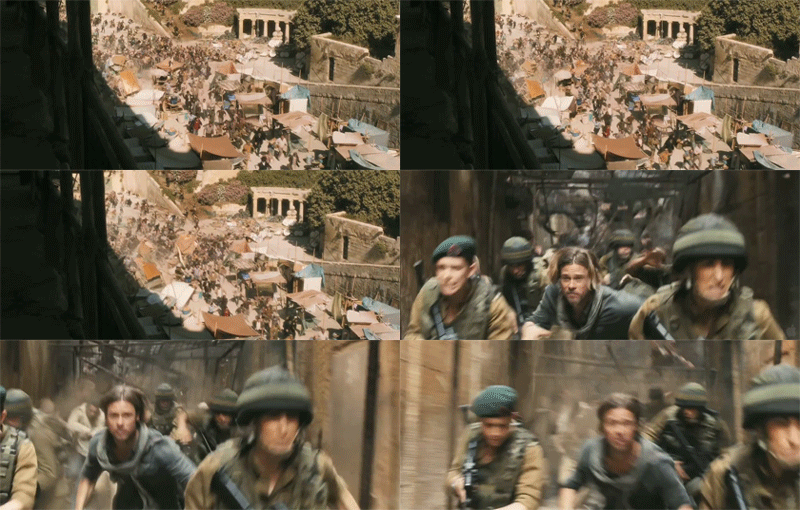
There were certain action scenes that I found particularly exciting and are particular favorites of mine. Two of these scenes feature escape – namely the Lanes’ rescue by a team of Navy SEALs from a New Jersey apartment building rooftop and Gerry’s escape from Tel Aviv with an Israeli soldier named Segen. I found two scenes – the Lanes’ search for sanctuary at the New Jersey apartment building; and Lane and Segen’s attempt to get their hands on a pathogen for a cure at a World Heath’s Organization (W.H.O.) in Wales – particularly spine-tingling. Almost nerve wracking. But the movie also featured a few excellent dramatic scenes. Among my favorites include Umutoni and Captain Mullenaro’s successful attempt to convince Lane to search for the zombie virus’ origins; Lane’s good-byes to his wife Karin and their daughter; Lane and Army Captain Speke’s conversation with a former CIA operative, who led the former to Israel; and Lane’s initial meeting with a grieving WHO medical researcher.
Although I enjoyed “WORLD WAR Z”, I must admit that I had a few problems with some of plot. I was annoyed that either the screenwriters or director Marc Forster failed to do a proper setup of the story’s main narrative – namely the zombie virus. The movie featured a montage of news reports during the opening credits and a few television and radio reports before the Lane family found themselves overwhelmed by the zombie outbreak on the streets of Philadelphia – some five to ten minutes after the movie began. I was also disappointed that the movie’s plot dropped Lane’s search for the zombie pandemic’s origins and instead solely focused on finding a cure during the last 30 to 40 minutes. So, although the W.H.O. managed to develop a vaccine to prevent the rest of the world’s population from getting infected, the movie ended with no knowledge of the pandemic’s origins. Just a outbreak of military hostilities against the zombies. I found all of this somewhat unsatisfying.
However, I did not find the performances unsatisfying. Once again, Brad Pitt proved that he could be a satisfying action hero and dramatic actor all rolled into one, thanks to his first-rate performance as former U.N. investigator, Gerry Lane. Mireille Enos’ portrayal of Lane’s wife Karin struck me as perfectly poignant and emotional, as she struggled to keep her family together during Gerry’s absence. I have never heard of Fana Mokoena before this movie. But I must admit that I found his performance as the compassionate, yet professional U.N. Deputy Secretary-General Thierry Umutoni very impressive. I hope that “WORLD WAR Z” will make Daniella Kertesz a star. I was very impressed by her performance as Lane’s Israeli companion, “Segen”.
“WORLD WAR Z” also featured some excellent performances from cast members who made brief appearances. One of them came from David Andrews, who gave an intense portrayal of the U.S. Navy captain that convinced Lane to search for the zombie pandemic’s origins. David Morse was equally intense and rather humorous as a traitorous ex-CIA agent, who provided Lane with information that led the latter to Israel. James Badge Dale, who seemed to be having a banner year in 2013, was even more witty as U.S. Army Ranger Captain Speke, who was in charge of a base in South Korea. Ludi Boeken gave a solid performance as a Mossad official responsible for preparing Israel’s pre-emptive defences. Peter Capaldi’s performance as a W.H.O. researcher also struck me as very solid and at times, rather witty. Matthew Fox reminded me just how very effect he could be in action films in his very brief role as a U.S. Navy SEAL officer who saves the Lanes from a zombie attack on the rooftop of the New Jersey apartment building. But the one cameo appearance that really impressed me came from Pierfrancesco Favino, who gave a poignant and intense performance as a W.H.O. researcher, who reminded Lane that the latter was not the only one who suffered from separation family members.
Yes, I had a few problems with the plot for “WORLD WAR Z”. I wish the screenwriters had put more detail in the zombie pandemic’s setup. And I was disappointed that the search for the pandemic’s origins had been dropped. But overall, I enjoyed “WORLD WAR Z” very much, despite it being a movie about zombies. Overall, Marc Forster did an excellent job as the movie’s director. And he was ably supported by fine performances from a skillful cast led by Brad Pitt. But do not expect me to become a fan of zombie stories in films and television in the future.
genki-world-war-z-gerry-brad-pitt-runs-away-from-the-crowd

Thursday, July 11, 2019

"WORLD WAR Z" (2013) Photo Gallery

world-war-z-still

Below are images from the new apocalyptic horror movie, "WORLD WAR Z", an adaptation of Max Brooks' 2006 novel. Directed by Marc Forster, the movie stars Brad Pitt: 


"WORLD WAR Z" (2013) Photo Gallery

41206


kinopoisk.ru-World-War-Z-2020610


kinopoisk.ru-World-War-Z-2169533


kinopoisk.ru-World-War-Z-2177066


sy78bbc9


kinopoisk.ru-World-War-Z-2179697


kinopoisk.ru-World-War-Z-2179699


kinopoisk.ru-World-War-Z-2179700


kinopoisk.ru-World-War-Z-2179701


kinopoisk.ru-World-War-Z-2179702


4bf5874164630030addfd18bad2822c4


kinopoisk.ru-World-War-Z-2179704


kinopoisk.ru-World-War-Z-2179870


kinopoisk.ru-World-War-Z-2179872


kinopoisk.ru-World-War-Z-2179875


kinopoisk.ru-World-War-Z-2179876


sy78bbf1


kinopoisk.ru-World-War-Z-2179881


kinopoisk.ru-World-War-Z-2179882


kinopoisk.ru-World-War-Z-2179883


worldz767


kinopoisk.ru-World-War-Z-2179884


kinopoisk.ru-World-War-Z-2179885


kinopoisk.ru-World-War-Z-2179886

Friday, July 13, 2012

"THE PACIFIC" (Episode Ten) Commentary


I wrote this commentary on the tenth and final episode of "THE PACIFIC": 


"THE PACIFIC" (Episode Ten) Commentary

Well. After two months or so, "THE PACIFIC" ended. Finally. I could discuss the entire miniseries, but this is about Episode Ten. The full review will have to wait for another article.

Episode Ten focused upon our three main characters – Robert Leckie, Eugene Sledge and John Basilone – returning home after the war in the Pacific Theater. Or perhaps I should say two characters, considering that Basilone was killed on Iwo Jima in Episode Eight. This allowed his story to be shown from the viewpoint of his widow, Sergeant Lena Riggi Basilone. It is through her eyes that viewers got to peek at the Basilone family for the third and final time. The episode also focused upon Sledge’s attempts to put the horrors of the war behind him, and Leckie’s reunions with his family and Vera Keller.

Lena Basilone’s visit to her in-laws in New Jersey turned out to be a strange and uncomfortable affair. Perhaps this sense of discomfort came from the family’s reaction to her presence. Mr. Basilone Senior commented politely on Lena’s good looks. Brother-in-law was just as polite, but slightly warmer. Mrs. Basilone, on the other hand, seemed to regard Lena with a wary eye. This wariness finally broke down when Lena handed over John’s medal to her. Considering that Lena’s ties with the Basilones eventually dissipated into the wind, one might as view this moment in the Basilone family history as very rare moment.

Following the Japanese surrender to the Allied forces in August 1945, Eugene Sledge and fellow combatants such as ‘Snafu’ Shelton and R.V. Burgin remained in Asia – specifically China – for several months, before finally returning home in 1946. The eastbound train journey included a humorous moment in which ‘Snafu’ tried to pick up a young woman and earned a slap for his troubles. The three Marines surmised that they would have been luckier with women if they had returned home back in 1945. In two poignant moments, Sledge and Shelton bid Burgin good-bye, after the train arrived at the Texan’s hometown. Upon the train’s arrival in New Orleans, Shelton decided to leave the train without saying good-bye to the sleeping Sledge. And the Alabama native eventually returned home and was warmly greeted by his old friend, Sid Phillips and his parents. But despite this warm and emotional homecoming, adjusting to civilian proved to be difficult for Sledge. Nightmares of the war plagued his sleep. He seemed more inclined to stay at home at hang around, instead of continuing his education or getting a job. It all came to a head during a hunting trip with his father, in which he burst into tears over his bad memories.

Robert Leckie learned of the Japanese surrender, while staying a Navy hospital. Considering that he had been wounded at Peleliu in late September 1944, I was surprised to learn that he was still being hospitalized some ten to eleven months later. He was eventually discharged from the hospital and the Marines and returned home to New Jersey by the fall of 1945. It did not take him long to regain his old job as a sportswriter for the local paper. Courting Vera Keller proved to be another matter. It seemed she had never received any of the letters he had written to her for nearly three years and a recent West Point graduate-turned Army officer was courting her. But with a great deal of chutzpah and charm, he finally managed to win her over. Leckie’s greatest challenge centered on his reunion with his family. When he had revealed his pre-war life to his former Australian girlfriend Stella in Episode Three, I had no idea that the relationship between him and the rest of his family was that chilly. Now I know.

I never expected Episode Ten to be any great shakes, in compare to the other episodes. I still recall how the last episode of ”BAND OF BROTHERS” seemed rather . . . mellow. Mind you, this last episode did not feature any accidental deaths. But it did provide a glimpse of how returning war veterans dealt with civilian life. Sledge’s difficulty in adjusting to civilian life did not strike me as surprising. I have been aware of his difficulties for quite a while. Although I must admit that I found his emotional breakdown during a hunting trip with his father rather poignant and sad. Joseph Mazzello did an excellent job of conveying Sledge’s unexpected emotional outburst. And actress Annie Paarisse also gave a first-rate performance portraying the now saddened Lena Basilone, who seemed slightly intimidated by her in-laws’ coolness. James Badge Dale seemed to be enjoying himself in the scenes featuring Leckie’s return to his sportswriters job and his courtship of Vera Keller. But if there is one scene that really took me by surprise was the chilly reception that the former Marine received from his family. I was very impressed by the subtle hostility that both Badge Dale and actress Betty Buckley (who portrayed Marion Leckie) conveyed between the two characters. I also have to say a word for Rami Malek, who did an excellent job in portraying ‘Snafu’ Shelton’s regret and determination not to bid Sledge good-bye upon the train’s arrival in New Orleans. It was a subtle cap to a very flamboyant performance.

I did have a few problems with Episode Ten. I wish it could have revealed how Lena Basilone became estranged from her in-laws. But I suppose that Bruce C. McKenna and Robert Schenkkan were unable to collect any material on the matter, considering that she had passed away in 1999 and the Basilone family might be reluctant to discuss their relationship with her. And I also could have enjoyed a post-war reunion between Leckie and his three friends – ‘Chuckler’, ‘Hoosier’, and ‘Runner’. Perhaps he did not reunite with them until after 1946. Pity. It would have a great emotional cap to a very charismatic friendship.

Despite the above-mentioned problems, Episode Ten was not a bad episode. I never expected it to be. And the only way it could have knocked my socks off was if it became part of a sequel in which Spielberg, Hanks and Goetzman explored the post-war lives of Leckie, Sledge and Lena Basilone. Their own version of ”THE BEST YEARS OF OUR LIVES”. But it still proved to be a nice little epilogue to an outstanding miniseries.


Monday, May 28, 2012

“24″ and the Breaking Point


After watching the April 12, 2010 episode of ”24”, it occurred to me that I had put up a lot with this series during most of its eight seasons run. Perhaps a bit too much – especially since Season Three.  But the above-mentioned episode proved to be the final straw for me. 
“24″ AND THE BREAKING POINT
It seems a miracle to me that I managed to remain a steady viewer of FOX-TV’s ”24”. Despite being a pretty good series, it has presented its viewers with some mind boggling plotlines. Mind you, some of the series’ plotlines from Seasons One and Two left me scratching my head. Kim Bauer’s (Elisha Cuthbert) Season Two adventures that included encounters with a murderous employer, the law and a slightly demented survivalist portrayed by Kevin Dillon come to mind. And the circumstances that led to Nina Myers’ (Sarah Clarke) revelation as a mole inside CTU left me wondering if she had any senses. The fact that Season One featured two intelligence moles who had no idea that the other was a mole seemed to be skimming on thin ice to me. As did the subplot involving Presidential candidate David Palmer (Dennis Haysbert) and his family.
Then came Season Three. Personally, I thought it was a pretty good season. Jack Bauer (Kiefer Sutherland) and CTU found themselves battling a former MI6 agent named Stephen Saunders (Paul Blackthorne), who wanted revenge for being abandoned during a disastrous operation against the Season One main villain, Victor Drazen (Dennis Hopper) by unleashing a deadly virus upon Los Angeles. This season also featured a con job perpetrated by Jack, Tony Almeida (Carlos Bernard) and a CTU employee named Gael Ortega (Jesse Borrego); the return of Nina Myers; the introduction of Chase Edmunds (James Badge Dale) as the first (and my personal favorite) of several younger partners for Jack; a virus outbreak in Los Angeles and an exciting showdown in which Jack and Chase attempt to prevent one of Saunders’ men from carrying out his threat.
Unfortunately, Season Three seemed to have kick started many major mistakes created by the series’ writers over the next six years. I tried to deal with the introduction of the Chloe O’Brian character (Mary Lynn Rajskub). But I failed. After another five seasons, I still dislike her. From Season Three to the present, serious mistakes piled on one after the other – Jack’s murder of Nina Myers; the subplot involving Wayne Palmer’s (D.B. Woodside) involvement with a billionaire’s wife and Sherry Palmer (Penny Johnson); Tony’s arrest for the so-called “treason” charge for exchanging Jack’s kidnapped victim for his kidnapped wife – CTU’s own Michelle Dressler (Reiko Aylesworth); the loss of Chase’s hand and his departure from the series (I rather liked him . . . a lot). In Season Four, I had to deal with Jack’s dull ass romance with the senator’s daughter Audrey Raines (Kim Ravner), that stupid plot to infiltrate the Chinese consulate and extract a terrorist, which ended in the death of the Chinese consul, the return of that traitorous ass, Mike Novik (Jude Ciccolella); and a disjointed and badly written season. Season Five brought about a series of deaths that I still believe was heavy-handed – former President Palmer, Michelle Dressler and the near death of Tony Almeida. Many fans have claimed that Season Five – which centered around President Charles Logan’s attempt to sign some treaty with the Russians – was the best. I would have been more tolerant of it, if it were not for the series of murders that occurred in the season’s first episode, Kim’s reaction to Jack’s fake death, and a major plot that really did not require a 24-hour setting. Season Six – with a badly written storyline about suicide bombers and Jack’s family (James Cromwell and Paul McCrane) – was the worst. Wayne Palmer became the new president, but he ended up in a coma from a bombing before mid-season. Chloe’s husband – the equally annoying Morris O’Brian (Carlos Rota) – played a major role in this season . . . unfortunately. I found Season Seven tolerable, especially since it introduced FBI Agent Renee Walker (Annie Wersching) and brought back Tony Almeida. However, Season Eight proved to be another matter.
Mind you, I did not hate Season Eight, like I did Seasons Four and Six. But . . . its plot about a group of Middle Eastern terrorists trying to prevent the president of their country from signing a peace treaty with the United States proved to be . . . old hat. Many fans could see that this series seemed a little tired and filled with some plot holes. The worst and dumbest subplot in the series’ history centered on CTU Agent Dana Walsh’s (Katee Sackhoff) problems involving her criminal ex-boyfriend and some of the dumbest plot lines in television history. But last week’s episode – (8.17) “Day 8: 8:00 a.m. – 9:00 a.m.” - proved to be the last, fucking straw for me. Two things happened. Renee Walker – whom Jack had fallen in love with – ended up murdered by a Russian assassin. And Tim Woods (Frank John Hughes), Director of Homeland Security, fired CTU New York director Brian Hastings (Mykelti Williamson).
It was bad enough that producers Joel Surnow and Robert Cochran, along with screenwriter David Fury had killed off Renee. One, she turned out to be one of my favorite characters from the series. And she also seemed to be the only female capable of dealing with the real Jack Bauer – warts and all. Two, Renee’s murder has jumpstarted an old and tired subplot – namely Jack’s desire to go after the person or persons responsible for the death of a loved one. We saw this in his murder of Nina Myers in Season Three. We also saw this in Season Five, when he murdered the man who had assassinated David Palmer. Some fans see this as a return of the old Jack Bauer. For years, I had disliked Jack for his murderous inclinations, his hypocrisy and the fans’ hypocritical view of his crimes. For the first time in years, I managed to enjoy Jack as a character. With Renee’s murder, it looks as if that enjoyment has come to an end. I do not see any possible hope of an emotional recovery for Jack after this. And honestly . . . if Surnow and Cochran wanted to kill someone off, they could have waited to bump off Jack either in the last episode or in the damn movie. But no . . . they drummed up some contrived plot line to kill off Renee in order to bring back Killer Jack.
But the worst thing I ever saw during Season Eight and during the series’ entire run the demotion of Brian Hastings by Homeland Security Director Tim Woods as director of CTU New York and being replaced by that whining bitch, Chloe O’Brian. I had stated earlier, I do not like Chloe. I never have. I have always found her whining and personality disorders a pain in my ass. But this latest plot development regarding her promotion as CTU New York’s new director was truly the most utterly stupid thing I have ever seen on ”24”. On television period. First of all, Chloe was a computer analyst for CTU. A computer geek. Chloe has had at least one or two hours of experience in the field. And yet, that idiot Woods had decided she would be a better person to run CTU New York than Hastings. Why? Because Hastings had failed to sniff out Dana Walsh as a mole. No intelligence official in his or her right mind who allow a computer analyst to assume command of an intelligence field office. It is an utter act of idiocy. And yet, Surnow and Cochran allowed this to happen. And instead of realizing the stupidity of such a plot twist, many fans have been cheering Chloe’s promotion. Why? Because Hastings had failed to do two things – immediately follow Jack’s lead and sniff out Dana Walsh as a mole. Damn hypocrites!
Why do I call the fans, David Fury and the producers hypocrites over this situation with Chloe, Hastings and Dana? Hastings was not that popular with fans. Chloe is very popular fans. And the fans were impatient with Hastings’ failure to spot Dana as a mole. Well if that is the case, then allow me bring up another name. Nina . . . Myers. Have fans and television critics actually forgotten that for several years, Nina was Jack’s second-in-command at CTU Los Angeles? In fact, they even had an affair. Jack eventually learned that she was a mole out of sheer . . . dumb . . . luck.  Nina was ordered to tell a lie about Kim in order to lure Jack into the clutches of Victor Drazen. No one has ever complained about Jack’s inability to sniff out Nina as a mole, until it was almost too late. Hell, in Season Seven, Jack never knew that a vengeful Tony Almeida was playing a double game against him, the FBI and the Allison Taylor Administration until it was almost too late. Yet, Brian Hastings is criticized for failing to sniff out a mole. This is an example of the fans’ hypocrisy at its worst. And all of this happened six or seven episodes before the end of the series.
I did not bother to watch tonight’s episode of ”24”. After the debacle of last week’s episode, I decided that I finally had enough. In fact, I will NOT be looking forward to any ”24” movie in the future. Thank you, Joel Surnow, Robert Cochran and David Fury for allowing any leftover enjoyment I might have of “24″ to hit rock bottom. This is how I will always remember the series – with two of the dumbest plot developments I have ever seen.

Tuesday, May 8, 2012

"THE PACIFIC" (Episode Six) Commentary


I wrote this commentary on the sixth episode of "THE PACIFIC": 


”THE PACIFIC” (Episode Six) Commentary

Before the first episode of ”THE PACIFIC” first aired, the producers had pointed out that the miniseries’ centerpiece would focus upon the Battle of Peleliu. Fought between September and November 1944, the battle is considered controversial amongst war historians. Many U.S. Marines had been decimated in a campaign that historians now view as unnecessary, because of the island's questionable strategic value and the very high death toll. In fact, Peleliu had the highest casualty rate of any battle in the Pacific Theater.

Since many Marine veterans have considered Peleliu as an important battle in their personal history, the miniseries’ producers decided to devote three episodes on the infamous battle. Last week, Episode Five featured the First Marines Division’s landing on Peleliu and Eugene Sledge’s (Joseph Mazzello) baptism of fire. By the time the episode ended; Sledge, Robert Leckie (James Badge Dale) and their fellow Marines were ready to storm and capture the airfield on South Peleliu.

The efforts of the First Marines Division to capture the airfield turned out to be a brutal and bloody affair. Before storming the airfield, the Marines had to deal with a lack of water, thanks to the top brass’ poor preparations for the invasion. But the episode’s pièce de résistance focused upon the battle that raged on the airfield. And so much happened. Both Robert Leckie and his remaining close friend, Bud “Runner” Conley (Keith Nobbs), were badly wounded during the assault. Eugene Sledge and his fellow Marines in the 5th regiment made it to the other side of the airfield . . . with a notable casualty in his company – PFC Robert Oswalt (Andrew Lees). He was the Marine who had described to Sledge a childhood trip to the Grand Canyon near the end of the previous episode. While Leckie and Runner found themselves conveyed to a nearby hospital ship, Sledge’s company continued its foray into the hills of Peleliu.

Many fans of the miniseries have waxed lyrical over this particular episode. And I can see why. Director Tony To did a marvelous job in conveying the chaos, insanity and brutality that the First Marines and the Japanese soldiers suffered during the battle for the airfield to the television screen. I have not seen such a brutal combat sequence since . . . well, since the landing in last week’s episode and the Guadalcanal action in which John Basilone (Jon Seda) earned his Medal of Honor in Episode Two. Viewers also got a chance to see other interesting scenes that included Sidney Phillips’ surprise visit to the Sledge family back in Mobile; the death of a Marine in Sledge’s company at the hands of his fellow combatants, due to his constant wailings that threatened to reveal their position in the Peleliu hills; another Marine in Sledge’s company who went off the deep end by counting the number of unseen Japanese soldiers to himself; Leckie’s attempt to find a corpsman (Navy medic) for a wounded Runner; the two friends’ reunion aboard the hospital ship; and the growing friendship between Sledge and the very eccentric SNAFU Shelton.

I have to hand it to both Joseph Mazzello and Rami Malek for doing such a superb job in portraying the two Marines’ growing friendship. And both actors made it so believable, considering they were portraying two characters that barely seemed to have anything in common. My favorite scene featured a moment in which Sledge supported Lieutenant “Hillibilly” Jones’ decision to have someone knock out that wailing Marine. And who was the first to immediately back up Sledge? SNAFU Shelton. This scene also seemed to hint that Sledge was learning to desensitize himself from the horrors of war. Consciously.

Ashton Phillips gave an understated, yet first-rate performance as the returning Sidney Phillips, who paid a visit to Sledge’s family in Mobile. His Phillips seemed bent upon reassuring Sledge’s anxious parents that their son would make it through the war safely. Yet, the oblique expression in his eyes and his slightly intense manner seemed to hint that he is trying to convince himself, as well.

Once more, James Badge Dale delivered a brilliant performance as Robert Leckie. In one scene, Leckie’s platoon leader ordered him to fetch both a corpsman for the wounded Runner and a radio amidst the raging battle in the middle of the airfield. The expression on JBD’s face told volumes about Leckie’s dread of putting himself back into the line of fire. But his performance aboard the hospital ship really impressed me. The actor beautifully conveyed Leckie’s despair at being permanently separated from his three friends. There was a moment that found him staring despondently at a bowl of peaches. And then out of the blue, someone calls his name. It turned out to be the very person who gave him the nickname of “Peaches” on Guadalcanal – a very much alive Runner. What followed was a poignant scene between JBD and Keith Nobbs (“Runner” Conley) in which the latter assured that he knew the former tried his best to find a corpsman.

Well . . . that is it for Episode Six. Next week, Sledge and company fight the Japanese in the hills of Peleliu.

Wednesday, April 11, 2012

"THE PACIFIC" (Episode Five) Commentary


I wrote this commentary on the fifth episode of "THE PACIFIC":


”THE PACIFIC” (Episode Five) Commentary

Episode Five began with war hero John Basilone in the middle of a war bond drive with Hollywood actress, Virginia Grey. Everything seemed to be hunky-dory with the Marine. Many servicemen seemed recognize his face on sight. And the good sergeant is also enjoying more passionate moments with the actress. This brief scene into the life of Basilone also featured his reunion with his younger brother George, already a Marine sergeant. The younger Basilone tried to express hope that he would be able to live to the older sibling’s name and reputation. But John immediately warned him not to bother. The last thing Basilone wants is his younger brother getting killed in combat over some reckless attempt to live up to his reputation.

This episode also marked Eugene Sledge’s baptism of fire, as he join Robert Leckie and his other fellow Marines of the First Division land on Peleliu for a major assault in September 1944. Three months earlier, Sledge had arrived on Pavuvu, where he had a joyful reunion with his childhood buddy, Sid Phillips and engaged in a brief conversation with Leckie on the meaning of war. But the privations of Pavuvu proved to be minor for Sledge, when the First Marines land on the hellish beaches of Peleliu.

Around the same time Sledge arrived on Pavuvu, Leckie returned to How Company and enjoyed a happy reunion with his three buddies – Chuckler, Runner and Hoosier. In typical Leckie fashion, he kept silent about his experiences at the psych ward on Banika and his encounter with the mentally unstable Ronnie Gibson. But he did find the time for a brief conversation in which he expressed his slightly more cynical views on what the war really meant. Sledge’s expression seemed to hint a reluctance to consider Leckie’s view. Peleliu will end up providing a different lesson for the Mobile, Alabama native. As for Leckie, Peleliu – at least in this episode – provided both some pain and a great personal fear.

Producers Gary Goetzman, Steven Spielberg and Tom Hanks made it clear that the Battle of Peleliu (which was fought between September and November 1944) would be shown in three episodes. Episode Five featured the First Marines Division landing on the island. And director Carl Franklin did a superb job in conveying the horrors that Leckie, Sledge and their fellow Marines had experienced in landing on the island and establishing a beach hold. The most interesting aspect of that landing came from Sledge’s point-of-view, as the camera followed him from his boarding of the amtrack (amphibious tracked vehicles) to the fury of battle on the beach.

With Sledge finally experiencing combat for the first time, the miniseries introduced new characters - Merriell "SNAFU" Shelton (Rami Malek); Bill Leyden (Brendan Fletcher); R.V. Burgin (Martin McCann); and Captain Andrew "Ack Ack" Haldane (Scott Gibson). Burgin barely uttered a word in this episode. I cannot even remember Leyden’s face. And Haldane seemed to be an officer in the tradition of Richard Winters of ”BAND OF BROTHERS”. Shelton is another matter. Judging from the comments on the Web, I suspect that many viewers had been looking forward to experiencing Malek’s performance as Shelton, as much as seeing Sledge experience combat for the first time. And the actor did not fail to deliver. He gave a riveting, yet eccentric performance as the slightly soulless Shelton.

As I had stated earlier, Peleliu provided a great deal of pain and anxiety for Leckie. One, his breakdown in Episode Four led Hoosier to fret over him during the Peleliu landing – much to his annoyance. The two eventually got separated from Chuckler and Runner before disaster happened. Poor Hoosier became seriously wounded in the leg. Although Leckie managed to summon a medic, poor Hoosier lost consciousness before he was carried away. Both Leckie and the audience were left in a state of anxiety over the Marine’s fate. Leckie finally managed to hook up with Runner. Unfortunately, both men seemed to be at a loss over Chuckler, who has yet to make an appearance. And they, along with Sledge and the rest of the First Marines Division were poised to begin the assault on the airfield on Peleliu.

In the end, Episode Five proved to be a solid and very interesting look into Eugene Sledge’s arrival in the Pacific Theater’s war zone. It also provided a peak into John Basilone’s experiences as a war hero on the homefront and what might possibly be the beginning of the end of Robert Leckie’s circle of friends. The episode provided some interesting moments. I enjoyed hometown friends Sledge and Phillips’ immediate reconciliation and its interruption by Sledge’s company commander, Captain Andy Haldane. For some reason, it reminded me of a scene from 1994’s ”FORREST GUMP” depicting the lead character’s arrival in Vietnam. Their reunion became more serious as Phillips tries to warn Sledge that combat was not as they had imaged when they were kids. Leckie’s reunion with his friends brought a smile to my face. I have grown accustomed to all four of them that much. Did anyone notice the grizzled sergeant who was practicing bayonet thrusts when Sledge first arrived on Parvuvu? Keep an eye on him. The episode also featured a poignant moment when Sledge discovered that Phillips had left Parvuvu for leave, back home in Mobile.

But the one scene that caught me by surprise centered on a brief conversation between Leckie and Sledge, inside the former’s tent. That the producers would feature a meeting between the two did not surprise me. After all, ”THE PACIFIC” is a historical drama, not a documentary. There were bound to be some historical inaccuracies. I have yet to see a historical drama that DID NOT have historical inaccuracies – including the much lauded ”BAND OF BROTHERS”. What I found surprising about this scene was that actors James Badge Dale and Joseph Mazello made it clear in this ARTICLE that they did not have any scenes togethers. Guys? Lying is a big “no, no” to me.

The episode finally shifted to the First Marines Division’s landing on Peleliu and it was a doozy. The scene featuring Sledge’s beach landing struck me as surreal, especially in that brief moment when the sun shone in the Marine’s eyes as the amtrack conveying his regiment prepared to leave the ship and hit the water. The actual beach landings for both Sledge and Leckie were graphic and rather scary. The scene in which Sledge witnessed Shelton removing gold teeth from a Japanese soldier struck me as an ominous sign of more darkness for the naïve Sledge to encounter. But the biggest heartbreak – at least for me – was the moment when Leckie witnessed Hoosier being seriously wounded by Japanese artillery.

The acting, as usual, was up to par. Joseph Mazello gave a excellent performance as the intense, yet naïve Sledge. In fact, I have to point out that the actor really knows how to use his eyes to convey his character’s emotional state. I could probably say the same about James Badge Dale, who continued to give consistently first-rate performances as Robert Leckie. Both he and Mazello were perfectly understated in their one scene together. Jon Seda, whom we have not seen since Episode Three was solid as war hero John Basilone. I especially enjoyed his performance in a scene with Mark Casamento, who portrayed his younger brother George. As Sid Phillips, Ashton Holmes gave one of his better performances by perfectly balancing his character’s joy at seeing childhood friend Sledge and war weariness at trying to explain the realities of combat to his buddy. Many fans had been anticipating Rami Malek’s debut as Sledge’s very eccentric comrade, Merriell “SNAFU” Shelton. And Malek managed to brilliantly live up to Shelton’s reputation as an eccentric and somewhat cold-blooded warrior. However, I felt a slight disappointment that the Shelton character had already arrived at this emotional point upon his introduction. Considering that his character was already a veteran of the Cape Gloucester campaign, I am not surprised. But the audience will never get to witness Malek develop his character to that point, as we got to witness Ronnie Gibson develop from a rather nervous Marine, to a slightly demented warrior and emotional wreck.

Episode Five was a pretty damn good episode. Audiences managed to witness a full-fledged battle sequence in the daylight for the first time since this episode aired. But I have one major complaint. It ended too soon. I realize that the Peleliu campaign will stretch out in two more episodes, but I still believe that this particular episode should have had a longer running time. Other than that I am looking forward to Episode Six.

Wednesday, March 14, 2012

"THE PACIFIC" (Episode Four) Commentary


I wrote this commentary on the fourth episode of "THE PACIFIC":


"THE PACIFIC" (Episode Four) Commentary

When I first saw the featurettes about "THE PACIFIC" on HBO, I noticed that the filmmakers and screenwriters had made a big deal about the miniseries’ ninth episode, which featured the battle on Okinawa. From what I had gathered, this particular episode might serve as the miniseries’ darkest. Then I saw Episode Four, which featured the U.S. Marines First Division’s experiences during the Battle of Cape Gloucester. And I realized that I had been wrong.

Very little combat played a role in Episode Four. One scene featured Robert Leckie’s brief confrontation with a Japanese scout patrol near the beginning of the episode. And another scene featured Company "H" repelling an intense banzai attack by the Japanese, a few minutes later. But as the documentary had hinted around the beginning of the episode, the Marines’ main conflict during the Cape Gloucester campaign seemed to be the environment – the thick jungle and the rain. And because of this environment, Leckie and his fellow Marines suffered a drop in morale.

Before watching this episode, I had no idea how depressing it would be. So much about this episode struck me as depressing . . . especially from Leckie’s point of view. One, both he and Sidney Phillips had the bad luck to witness Gibson’s murder of the Japanese soldier. Judging from the slightly demented expression on Gibson’s face, I suspect that neither Leckie nor Phillips was willing to interrupt the murder. But they both obviously found the experience disturbing. Eventually, the rain, the mud and the jungles of Cape Gloucester on New Britain got to Leckie and he eventually found himself begging for someone to shoot him after he lost his shoes in the mud and fell down a slope. It got worse. Leckie found his confiscated Japanese chest stolen by a Marine officer. And instead of dismissing the chest lost, he stubbornly tried to get his chest back during a hostile confrontation. Leckie never got the chest back. Instead, the Marine officer transferred him from his duties as an intelligence scout to kitchen and latrine duties. The Marine officer also humiliated Leckie for wetting his trousers. But that was nothing in compare to Leckie witnessing the suicide of a Canadian-born Marine.

Company "H" of the First Marines Division was eventually sent to the island of Pavuvu for some rest and relaxation. Only, the island proved to be nothing like Melbourne. The Marines had to deal with pests like rats and crabs. Leckie’s sense of humor became increasingly irritating to Hoosier. And his bedwetting (enuresis) became even worse. At one point, "Chuckler" Juergens found Leckie lying on his cot, pissing uncontrollably and staring into space. Leckie had finally reached the nadir of his existence. The company’s doctor shipped Leckie to a Naval hospital located on Banika. Leckie discovered that the wing he had been assigned to was for psychiatric patients. Fortunately for him, the Naval doctor assigned to him – a Dr. Grant – realized that Leckie was simply suffering from enuresis and a case of exhaustion. By the end of the episode, he allowed the Marine to return to his company. Before that happened, Leckie made another discovery . . . Ronnie Gibson was also a patient at the hospital. Leckie learned from Dr. Grant that Gibson tried to steal a plane and later commit suicide, while Company "H" were on Pavuvu.

I doubt very much that Episode Four will ever be considered a personal favorite of mine. I simply found it too depressing. But I must admit that I also found it fascinating. And it is a credit to screenwriters Robert Schenkkan and Graham Yost, along with Yost’s direction that I managed to remain fascinated by it all. While watching Episode Four, it occurred to me that in some ways, it reminded me of the 2005 movie, "JARHEAD". The Marines in Sam Mendes’ movie were suffering psychological stress, due to their inability to relieve their built-up aggression via combat. The Marines in Episode Four were suffering from a number of factors – no combat against the Japanese, who had decamped to Rabaul on the other side of New Britain.

For the umpteenth time, actor James Badge Dale managed to knock it out of the ballpark with his portrayal of Robert Leckie. In fact, I would say that this episode marked his best performance in the miniseries to date. He did a superb job in portraying Leckie’s emotional descent without any heavy-handed acting. I especially enjoyed his performance during a scene that featured Leckie’s confrontation with the officer who had stolen the Japanese chest. Badge Dale’s performance conveyed a delicious mixture of aggression, sarcasm and subtlety. I also have to give kudos to Tom Budge’s portrayal of the demented Gibson. Mind you, his performance was not as subtle as Badge Dale’s, but it was just as convincing. And I believe I will never forget that expression on his face, after his character had strangled that Japanese soldier. I also found Leckie’s stay at that Naval hospital equally depressing. It reminded me of a line that the Bill Guernere character had said about military hospitals in one of the episodes of "BAND OF BROTHERS". Thanks to this episode, I finally understand what he was trying to say. The Banika sequence also featured Matt Craven, who gave a wonderfully subtle performance as Leckie’s doctor, the slightly sarcastic Dr. Grant. Thinking about this episode, it occurred to me that the one character who managed to remain steady throughout the entire mess was Chuckler, thanks to Josh Helman’s solid performance. It is easy to see why Lieutenant Corrigan had promoted him to corporal following the Alligator Creek action on Guadalcanal in Episode One.

After watching Episode Four, I found myself dubbing it "Heart of Darkness – Part One". Considering that the entire episode featured a little combat, a murder, a suicide, illness, rodents and crabs and a stay for Leckie at a Naval psych ward. And I had no idea I would be watching this before it aired. The reason I had dubbed it "Part One" is that I suspect that the Okinawa episode will proved to be just as depressing . . . or perhaps a little more.


Next . . . Leckie and Sledge experience their beach landings at Peleliu.

Monday, February 6, 2012

"THE PACIFIC" (Episode Three) Commentary


I wrote this commentary on the third episode of "THE PACIFIC":


”THE PACIFIC” (Episode Three) Commentary

Following their evacuation from Guadalcanal in January 1943, members of the U.S. Marines First Division enjoyed a respite in Melbourne, Australia. There, characters like Bob Leckie and Sidney Phillips enjoyed romances with local Australian girls. John Basilone enjoyed a period of heavy drinking and dodging the MPs before receiving his Medal of Honor for his late October actions on Guadalcanal.

Unlike 2001’s ”BAND OF BROTHERS”, this third episode featured the very first one that did not include any combat. Instead, the First Division Marines enjoyed a respite filled with booze, women, a medal ceremony and more training. This episode featured two of our major characters confronting their demons. But let me focus on the minor stuff first.

Some of the funniest romantic scenes featured Sidney Phillips romancing a young Australian girl, under the watchful eye of her grandfather. Ashton Holmes was a hoot portraying Phillips’ struggles to suppress his desires and somewhat more questionable actions (like leaving the “base” without a pass) in order to impress his new girlfriend’s Draconian grandfather and behave like a Southern gentleman. His funniest moment occurred in a scene inside a pub where Phillips was trying to assure the girl’s father that he intends to be the perfect gentleman, when the MPs appear. Although he assured both his girlfriend and her grandfather that he had a pass, he subtly suggested that they leave the pub through the back door.

Other funny moments featured Leckie’s friends, Hoosier and Chuckler. From the moment when the Marines are bivouacked at a cricket stadium, Hoosier and his government issued blanket are never apart. Never. He quickly fell asleep, while Leckie, Runner, Chuckler and other Marines left the stadium without permission – clinging to his blanket. And for several days, it never left his side. Another moment featured the Marines back in formation at the stadium, the day following their first night of liberty. Most of them looked as if they had spent a week of debauchery with no sleep . . . including Lieutenant Corrigan. One Marine could not even remain standing and in a moment of pure slapstick, fell flat on his face. Corrigan did not say a word. But the funniest moment – at least for me – featured a drunken Leckie coming upon poor Chuckler on guard duty at the stadium. Why did I call Chuckler “poor”? In a scene that brought back memories of my mad dashes to the bathroom, poor Chuckler was dancing his ass off, while trying to convince Leckie to stand guard in his place so he could relieve himself. I have to pause for a moment to keep my laughter in check. Excuse me.

This episode did not feature any scenes of Eugene Sledge. However, I suspect that viewers will be seeing him in the next episode. It did feature Basilone receiving his Medal of Honor. Like the other Guadalcanal veterans, Basilone and his friend, J.P., hit the streets of Melbourne for a night of heavy drinking and debauchery. The pair found a convenient bar where they indulged in a great deal of booze and a brief, yet violent encounter with Australian servicemen. Fortunately, their hostile encounter with the Australians became friendly. But when Basilone reported to Chesty Puller’s office the following day, Basilone was not so fortunate. One, he learned that he was to receive the Medal of Honor, which produced a delicious “WTF” expression in Jon Seda’s eyes. Then his expression became even stranger, as Puller chewed out Basilone for failing to set a good example in Melbourne . . . before eventually throwing up. Next to Chuckler’s “dancing” moment, I thought this was the funniest scene in the episode.

However, matters did not seem that funny when Basilone finally received his Medal of Honor in a formal ceremony at the cricket stadium. Poor bastard looked as if he wanted to flee for his life, instead of receiving that medal. I do wonder if something within him suspected that medal would separate him from J.P. and the rest of his men, as surely as death had separated Manny from him. The expression in his eyes seemed to hint it not only during the medal ceremony, but also when he bid good-bye to J.P. and on that flight to San Francisco near the end of the episode. And I have to give kudos to Seda for expressing this emotion without saying a word. In fact, he did a damn good job all around.

Finally, we come to Leckie. Man, I do not know what to say about him. Actually, I do. But I suspect that describing James Badge Dale’s interpretation of Leckie’s character would take a multi-page essay. It is that complicated. In fact, Robert Leckie seemed to be one of the most complicated characters I have come across in any biopic either in a movie or on television. I cannot recall any character in ”BAND OF BROTHERS” as complicated as him. Judging from his conversations with his Australian girlfriend Stella and her Greek-born mother, his demons had already been established before he saw combat or had joined the Marines. As much as he loved his family, Leckie apparently did not like being part of a big family – especially as the youngest member. He seemed to have felt crowded, yet at the same time, ignored. His description of his father made me revised the father-son good-bye scene in "Episode One. At first, I thought Leckie Sr. was simply reluctant to bid his son good-bye. I had no idea that the older man was also suffering from slight mental problems.

The episode started well for Leckie. He met Stella on a trolley car and managed to garner her interest, despite being drunk. The two seemed to take to one another like duck to water. And watching Badge Dale and Australian actress Claire van der Boom act together made me realize that they have a strong screen chemistry together. Although their loves scenes were slightly explicit, they were still very tasteful. Frankly, I saw nothing that anyone could complain about. Thanks to van der Boom’s excellent performance, Stella proved to be just as complicated as Leckie. Upon his return following a three-day hike for the Marines, she eventually dumped him. She claimed that her mother, who had taken a shine to him, would have great difficulty in dealing with his death. But Leckie had witnessed her reaction to the news of a friend’s death and immediately surmised that she was simply guarding herself from possible future heartache.

Needless to say, Leckie did not take the end of his romance very well. Not only did he get drunk, lost his temper with Lieutenant Corrigan after the latter confronted him for taking Chuckler’s place during guard duty, while the latter was taking a piss. Not only did Leckie ended up in the brig for a period of time with Chuckler, he was booted from the company and his friends, and assigned to become an intelligence scout. Poor Leckie. But I must say that the more I watch Badge Dale's skillful portrayal of the complicated Leckie, the more I have become impressed by his talents as an actor.

Episode Three proved to be an entertaining episode. Viewers got a chance to see how some of the characters behaved away from the threat of combat. However, I rather doubt that it will ever become a favorite of mine. Aside from the personal conflicts of Leckie and Basilone, it lacked the edge that Episode One and Episode Two possessed. I suppose that is due to the lack of combat shown.

Tuesday, January 3, 2012

"THE PACIFIC" (2010) - Episode Two Commentary


I wrote this brief commentary on the second episode of "THE PACIFIC":


"THE PACIFIC" (2010) - Episode Two Commentary

Episode Two of HBO’s ”THE PACIFIC” continued the saga of the U.S. Marines during the Guadalcanal campaign. Episode One focused mainly on Robert Leckie’s combat experiences during the campaign. This latest episode centered on the combat experiences of Sergeant John Basilone and his fellow comrades from the 7th Marines regiment.

By the time I had finished watching Episode Two, I found myself battling a tension headache. And it was all due to action sequences featured in this episode. Granted, I also found the battle scenes in Episode One rather tense, the action in this second episode knocked it out of the ballpark for me. Around late October 1942, John Basilone and a handful of his fellow Marines were forced to fight off a frontal assault by the Japanese Army. Between the assault and Basilone’s encounters with Japanese troops, while fetching more ammunition literally had me squirming on my living room sofa. And I must say that Jon Seda did a great job of portraying Basilone’s heroics and making it look natural in the process. I also have to give kudos to actor Joshua Biton for his emotional portrayal of one of Basilone’s close friends, J.P. Morgan.

With the exception of an aerial bombing sequence, this particular episode did not feature Leckie and his friends in actual combat. Instead, the episode focused upon them dealing with various other problems during their stay on Guadalcanal – lack of supplies, inadequate arms and . . . um, health issues. Poor Runner dealt with an attack of the runs and Leckie found himself throwing up after consuming stolen canned peaches on a half-empty stomach. Leckie and a good number of other Marines stole supplies left on the beach for the arriving U.S. Army. In a hilarious scene, Leckie managed to pinch the peaches, along with cans of other food; and a pair of moccasins and a box of cigars that belonged to an Army officer. I never knew that actor James Badge Dale had a talent for comic timing . . . until now.

Episode Two also revealed a glimpse of Eugene Sledge back in Mobile. He and his father, Dr. Sledge, have discovered that Sledge’s heart murmur no longer exists. Upon this discovery, Sledge wasted no time in announcing his intention to join the Marines. And viewers will eventually see the results of that decision by Episode Five.

By the end of the episode, the Marines were ordered to leave the island, much to the relief of many. Both Basilone and Morgan found themselves trying to rationalize the death of their friend, Manny Rodriguez, while other Marines loaded up in boats taking them off the island. A scene that featured good, solid acting by both Seda and Biton. The episode’s last scene featured Leckie and his friends learning from a Navy cook aboard ship that their actions on Guadalcanal had been reported in American newspapers and that they were now all regarded as heroes. Judging from the expressions on the Marines’ faces, they seemed conflicted on how to accept the news. This wonderfully performed scene by Badge Dale and the actors portraying Leckie's friends - Josh Helman (Chuckler), Keith Nobbs (Runner) and Jacob Pitts (Hoosier)- was mentioned in Leckie’s memoirs.

Like Episode One, this was a well done that left me feeling tense and an array of other emotions. I only hope that the miniseries’ remaining episodes will match the quality of the first two.

Friday, December 16, 2011

"THE PACIFIC" (2010) - Episode One Commentary


"THE PACIFIC" (2010) - EPISODE ONE COMMENTARY

March 2010 marked the premiere of the 10-part miniseries, "THE PACIFIC"; which was produced by Tom Hanks, Steven Spielberg and Gary Goetzman. The miniseries focused upon the lives and experiences of three U.S. Marines who fought in the Pacific Theater - writer Robert Leckie (James Badge Dale), war hero John Basilone (Jon Seda) and professor/writer Eugene Sledge (Joseph Mazello).

This first episode featured the three men's reactions to the attack upon Pearl Harbor in December 1941. Basilone was already a one-year veteran of the Marines during this period, when he bid good-bye to his family. Leckie joined the Marines about a month after the Hawaii attack and formed a friendship with a local girl named Vera before saying good-bye to his father. And Sledge was forced to realize that his heart murmur will prevent him from joining the Marines with his friend and neighbor, Sid Phillips (Ashton Holmes). Not long after this opening, both Leckie and Basilone found themselves being shipped out to deal with the Japanese threat on Guadalcanal. Most of the episode focuses upon Leckie and Phillips' early experiences on Guadalcanal. By the end of the episode, Basilone and the 7th Marines regiment had arrived.

If there is one thing I can say, "THE PACIFIC" was definitely different from 2001's "BAND OF BROTHERS". But I guess I expected it to be. One thing, this episode made it clear that scenes featuring the three characters' experiences on the home front and amongst other civilians would be featured. The scene between Leckie and his father at the bus depot was very interesting - especially with the writer dealing with his father's reluctance to say good-bye. And it was interesting to watch Sledge deal with his frustration at being unable to join up, due to a heart murmur. I found myself wondering if he had any idea what he would experience during the war's later years, would he feel so frustrated.

The main difference between "THE PACIFIC" and "BAND OF BROTHERS" was that the latter mainly recount the experiences of an Army company, with an officer as the series' main character. "THE PACIFIC" was presented in a way that was similar to the 2000 movie, "TRAFFIC" or the 2005 movie, "CRASH" . . . in which the same topic was presented from different perspectives. "THE PACIFIC" presented the viewpoints of three men who DID NOT serve in combat together. And yet, there were connections between them. Leckie had served in the same Marine company as Sledge's best friend, Phillips. Both Leckie and Basilone fought on Guadalcanal and had a brief encounter with one another at the end of Episode One. Two future episodes featured both Leckie and Sledge fighting in another campaign together - Peleliu. Although there were complaints, I was happy to note that some viewers understood and managed to accept the fact that "THE PACIFIC" possessed a different style of storytelling than "BAND OF BROTHERS".

I would also like to add that I found the combat action featured in this episode very amazing, especially the Battle of the Tenaru. And I found the jungle setting rather lush. The birthday tune that Leckie and his Marines friends sang to Phillips was not only funny, but held an ominous aura as well. Well done. Very well done.